Yes, you can play an Xbox One or Xbox Series X|S on a laptop screen—but a normal HDMI cable usually will not do it. The Xbox has an HDMI output, while most laptop HDMI ports are also outputs designed to send the laptop’s picture to a monitor or TV. Connecting two HDMI outputs does not create a display connection. Lenovo explains that a laptop can accept an external HDMI signal only when its specific hardware supports genuine HDMI input.
For most people, the best solution is Xbox Remote Play: it is the simplest option, requires no video-capture hardware, and streams your own console to the laptop over a network. A USB HDMI capture card is the main wired alternative, particularly if you want to record or livestream. A laptop with a real HDMI input can work directly, but that is an uncommon exception.
Can you connect an Xbox directly to a laptop with HDMI?
Usually, no. The signal path matters:
- The Xbox sends video through its HDMI OUT port.
- A typical laptop HDMI port also sends video out to an external display.
- Two output ports cannot receive and display each other’s signals.
The HDMI connector’s shape does not tell you whether it is an input or an output. Check the exact laptop model’s technical specifications or manual for the words HDMI input. Do not assume that a port will work just because it is labeled HDMI or because a cable physically fits. Lenovo’s explanations of using a laptop as a monitor and identifying an HDMI-input port cover this hardware distinction in more detail.
USB-C-to-HDMI adapters generally do not solve the problem either. Most are designed to send video from the laptop to a TV or monitor. They do not turn the laptop into an HDMI display. USB-C capabilities also vary by laptop, so the port must be checked separately rather than assumed to support video input.
#1 Best Overall
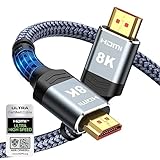
- Top Technology--8K@60HZ: This 8K Ultra-High Speed 2.1 HDMI Cable uses the most cutting-edge technology, which is compatible with 8K@60HZ,4K@240HZ and 4K@120HZ clearly displays every particle, and accurately processes every signal source.
- Upgrade Revolution: Highwings Ultra High Speed HDMI Cable 2.1 8K supports 48Gbps (6GB/s) which can will no longer be stuck or dropped frames when watching video. It is also backward compatible with HDMI 2.0b/2.0a/1.4/1.3/1.2/1.1 versions.
- For Game Enthusiasts: This 8K Ultra High Speed HDMI Cable 2.1 can achieve a super smooth picture of 4K@120HZ. Its latest game mode supports variable refresh rate, maximizes the value of the graphics card and CPU to obtain a smoother and more detailed picture.
- Reinforced high-quality materials: This 8K HDMI Cord uses Highwings' most popular classic style. The tail's anti-bending design has been upgraded to make it more durable. The military grade tensile nylon material also greatly extends its life.
- The ultimate perfectionist: Highwings every parts of the cable has been put through rigorous the performance tests in the laboratory. After we've combined every flawless part into a perfect 8K cable and it can be presented to you.
There is a similar Xbox One misconception. Some Xbox One models have both HDMI In and HDMI Out. The HDMI In port brings a television or another video source into the Xbox; it does not send the Xbox’s own picture to a laptop. The original Xbox One specifications document this arrangement. Xbox Series X and Series S use HDMI Out for their console video connection.
Relevant specifications and explanations:
- Lenovo: using a laptop as a monitor
- Lenovo: identifying HDMI input on laptops
- Xbox One specifications
- Xbox Series X|S hardware specifications
Method 1: Use Xbox Remote Play
For most laptop owners, Remote Play is the right answer. It streams the games installed on your own Xbox One or Xbox Series X|S to a supported browser on the laptop. The laptop is not receiving an HDMI signal; it is displaying an interactive video stream from the console.
Microsoft’s current route is the browser experience at xbox.com/remoteplay. Older guides may tell you to install the Windows Xbox app and press a Stream button. That workflow is outdated as the primary instruction: Microsoft said in its April 2025 Xbox update that Remote Play moved to the web, and Remote Play was removed as a direct-access option from the Xbox mobile app.
Remote Play requirements
Microsoft’s current Remote Play pages list these basic requirements:
The Tool Desk
Outbyte Driver Updater FREEFix the driver behind crashes, sound loss and screen glitchesFind Drivers →Outbyte PC Repair FREERepair Windows errors before they cause bigger problemsFix Now →- An Xbox One or Xbox Series X|S with Remote Play enabled.
- A Microsoft account with an Xbox profile—the same account associated with the console.
- An internet connection of at least 10 Mbps.
- A compatible controller. Microsoft recommends a Bluetooth-capable Xbox Wireless Controller.
- For the clearly documented Windows route, Windows 10 or Windows 11 version 22H2 or later and a supported web browser.
Remote Play itself does not list a subscription as a basic setup requirement, although Microsoft notes that individual games and online multiplayer can have their own Game Pass or account requirements. Check the requirements for the particular game you plan to play.
Microsoft’s current requirements and console list are available on the Xbox Remote Play page and the Xbox Remote Play overview.
Microsoft still lists Windows 10 compatibility, but Windows 10 support ended on October 14, 2025. In 2026, an updated, supported Windows 11 laptop is the better choice where available. Microsoft does not publish a complete public compatibility matrix promising every Mac, Chromebook, or Linux configuration. Those devices may work if the browser-based Xbox experience supports the browser and operating system, but Windows is the platform explicitly covered by the current requirements.
Set up Remote Play on the Xbox
- Turn on the Xbox.
- Press the Xbox button on the controller.
- Open Profile & system > Settings.
- Select Devices & connections > Remote features.
- Turn on Enable remote features.
- If the console offers Test remote play, run the test.
- Set the power option to a sleep or standby mode if you want Remote Play to wake the console remotely.
The wording can vary slightly with the Xbox generation, system update, or region. Microsoft’s consumer support instructions and development documentation use the Remote Features menu path above.
Rank #2

- IN THE BOX: HDMI cable (A Male to A Male) for connecting 2 HDMI-enabled devices; 6 feet long in Black
- DEVICE COMPATIBLE: Connects Blu-ray players, Fire TV, Apple TV, PS4, PS3, Xbox One, Xbox 360, and computers to TVs, displays, A/V receivers, and more
- SUPPORTS 4K VIDEO: Supports 4K video at 60 Hz, 2160p, 48-bit/px color depth, as well as bandwidth up to 18Gbps, Ethernet, 3D, and Audio Return Channel (ARC)
- EASY CONNECTION: Share an Internet connection among multiple devices (no need for a separate Ethernet cable)
- BACKWARDS COMPATIBLE: Works with earlier versions to allow for use with a wide range of HDMI-enabled devices
The Xbox cannot be completely shut down if you expect it to wake remotely. Microsoft’s Remote Play information refers to an Xbox One being turned on or in Instant-On mode. Newer Xbox software may show labels such as Sleep or Standby instead.
See Microsoft’s official Remote Play setup support page and its documentation for the Remote Features menu.
Start Remote Play on the laptop
- Open an up-to-date browser on the laptop. Edge, Chrome, or another modern supported browser is the sensible starting point, but Microsoft does not publish a definitive browser-version table for every configuration.
- Go to xbox.com/remoteplay.
- Sign in with the Microsoft account connected to the Xbox.
- Select the console shown on the page.
- Choose the Remote Play option.
- Wait for the Xbox dashboard or game stream to appear.
- Connect the controller to the laptop if the browser asks for one.
Once connected, Remote Play can show the Xbox dashboard, games, settings, friends list, and other console activity—not just the currently running game.
Connect the controller to the laptop
The controller usually needs to be connected to the laptop, not left connected to the Xbox in another room. You can use either of these methods:
Quick wins for a faster PC:
Scan for outdated or missing drivers - takes under a minuteDriver Scan →Repair Windows errors before they cause bigger problemsFix Now →- Bluetooth: In Windows, open Settings > Bluetooth & devices > Add device > Bluetooth, put the controller into pairing mode, and select it.
- USB: Connect the controller to the laptop with a compatible USB cable.
- Xbox Wireless Adapter for Windows: This can be useful when the controller or laptop setup does not use Bluetooth.
Microsoft lists Bluetooth connectivity for compatible Xbox Wireless Controller models on Windows 10/11 and compatibility with Xbox One and Xbox Series X|S. See the Xbox Wireless Controller specifications and Microsoft’s Bluetooth pairing instructions.
Not every original Xbox One controller has Bluetooth. If an older controller does not appear in the laptop’s Bluetooth list, use USB or a compatible wireless adapter instead of repeatedly trying to pair it.
Remote Play performance, latency, and network setup
Remote Play is a compressed network video stream, not a direct HDMI connection. Compared with playing directly on a TV or monitor, you should expect some combination of image compression, occasional resolution changes, and extra input delay. The severity depends on the network, Wi-Fi interference, browser, laptop, and distance between the console and the laptop.
Microsoft announced up to 1080p at 60 frames per second for PC Remote Play in 2021, but that announcement described the then-current Xbox app experience. The current browser-based Remote Play page does not provide a universal resolution or frame-rate guarantee. Do not assume that Remote Play delivers 4K/120Hz simply because an Xbox Series X can output high-resolution, high-refresh-rate video to a compatible display.
Recommended Free Tools
Rank #3

- Top Technology----8K@60HZ: This 8K Ultra High Speed HDMI Cable uses the most cutting-edge technology, is compatible with 8K@60HZ and 4K@120HZ, clearly displays every particle, and accurately processes every signal source
- Upgrade Revolution: Highwings Ultra High Speed HDMI Cable supports 48Gbps (6GB/s) which can will no longer be stuck or dropped frames when watching video. It is also backward compatible with HDMI 2.0b/2.0a/1.4/1.3/1.2/1.1 versions
- For Game Enthusiasts: This 8K Ultra High Speed HDMI Cable can achieve a super smooth picture of 4K@120HZ. Its latest game mode supports variable refresh rate, maximizes the value of the graphics card and CPU to obtain a smoother and more detailed picture
- Reinforced high-quality materials: This 8K HDMI Cord uses Highwings' most popular classic style. The tail's anti-bending design has been upgraded to make it more durable. The military grade tensile nylon material also greatly extends its life
- Clear Size Information: This HDMI cable has a total length of 4.99ft (151cm) and a middle cable length of 4.63ft (141cm). Please note that the cable is relatively short, making it ideal for devices that are placed close to each other, Our products are guaranteed for one year. If there are any problems within one year, we offer free returns or replacement. Whether you need setup advice or troubleshooting, our team responds within 13 hours!
Remote Play is generally more comfortable for turn-based games, RPGs, adventure games, and ordinary single-player play. Competitive shooters, fighting games, racing games, and rhythm games expose streaming delay much more clearly. These are practical trade-offs of a network video stream, not a Microsoft-published latency measurement.
Improve the connection
Microsoft lists 10 Mbps as the minimum internet requirement and identifies 5 GHz Wi-Fi as a suitable connection type. That number is a floor, not a promise of low latency or perfect image quality. For the most stable result:
- Use Ethernet for the Xbox if possible.
- Use Ethernet or 5 GHz Wi-Fi for the laptop.
- Avoid congested 2.4 GHz Wi-Fi when practical.
- Move the laptop closer to the wireless router if it is using Wi-Fi.
- Pause large downloads, cloud backups, game updates, and other video streams.
- Test Remote Play at home before trying it from a different network.
- If you play away from home, remember that both the home Xbox connection and the laptop’s current network affect the result.
Method 2: Use a USB HDMI capture card
A USB HDMI capture card is the practical wired alternative for a laptop without HDMI input. It receives the Xbox’s HDMI output, converts it into a USB video source, and lets software such as OBS display it on the laptop.
This is not the same as plugging the Xbox into the laptop’s HDMI port. The capture card performs the conversion that the laptop’s ordinary HDMI connector cannot.
What you need
- An Xbox One or Xbox Series X|S.
- A USB HDMI capture device.
- An HDMI cable from the Xbox to the capture device.
- A USB cable from the capture device to the laptop.
- Capture software such as OBS Studio.
- Optionally, a second HDMI cable and a TV or monitor for passthrough.
Connect the hardware
Xbox HDMI OUT
        ↓
Capture card HDMI IN
        ↓ USB
Laptop USB port
        ↓
OBS Studio or the capture card’s software
If the capture card has HDMI passthrough, the optional display connection is:
Capture card HDMI OUT
        ↓
TV or monitor
The Xbox goes into the capture card’s HDMI IN, not its HDMI OUT. The capture card then connects to the laptop over USB. A capture device’s requirements are model-specific. For example, Elgato’s Xbox Series X|S setup documentation gives a case where USB 3.2 Gen 2 is required for the full capture mode and USB 3.2 Gen 1 lowers the available capture resolution. A random USB port or inexpensive dongle may not support the resolution, frame rate, HDR, or bandwidth you expect.
Before buying, check the capture card’s specifications for:
- Maximum input and capture resolution.
- 30Hz versus 60Hz support.
- 4K, HDR, VRR, and 120Hz compatibility.
- USB version and bandwidth requirements.
- Operating-system support and drivers.
- Whether HDMI passthrough supports a different mode from the USB capture output.
Elgato’s Xbox Series X|S capture setup illustrates the standard wiring and why the USB specification matters.
Rank #4

- CTS Version: 2.1/2.1a/2.0b/2.0a/2.0/1.4/1.3/1.2/1.1. CTS 2.1 is the most recent update of the HDMI specification.
- Resolution & Deep Color: 10k@60Hz 12-bit, 8K@60Hz 12-bit,5k@120Hz 90Hz 12-bit, 4K@120Hz 144Hz 12-bit, 2k@240H 165Hz,1080p@240Hz, 720p, 480p.
- It supports the latest features: 1ms, low EMI, SBTM, 48Gbps Bandwidth, ALLM, VRR, QMS, QFT, Dynamic HDR, HDR10, CEC, HDCP 2.2 & 2.3, VESA DSC 1.2a.
- Digital Audio Video Format Support: The latest high-bitrate audio formats are supported including eARC, ARC, DTS Master, DTS:X, Dol-by TrueHD, Dol-by Vision, Dol-by Atmos and more.
- Wide Compatibility: Gaming PC, FreeSync, G-SYNC, All GeForce RTX 30 series, Soundbar, PS5 4, Xbox Series X, Xbox Series S, All Apple TV+, All OLED TV, 2021 Macbook Pro, laptop, Projector, Monitor, Fire TV, Roku TV, SHIELD TV.
Show the Xbox in OBS Studio
- Install and open OBS Studio.
- Create or select a scene.
- In the Sources panel, click +.
- Select Video Capture Device.
- Choose the capture card in the Device menu.
- Set the resolution and frame rate to a mode supported by the capture device.
- Confirm that the Xbox picture appears in the OBS preview.
- If there is no sound, configure the capture source’s audio output or monitoring settings.
- Maximize the OBS window and use its preview as the laptop display.
OBS identifies Video Capture Device as the source type for capture cards. On Windows, capture hardware generally needs to provide a DirectShow-compatible device. OBS’s Video Capture Sources documentation explains the source and audio-output options; its console-capture FAQ covers the broader capture workflow.
Capture-card latency and passthrough
Playing from the OBS preview is not automatically lag-free. Delay can come from the capture hardware, USB connection, drivers, software buffering, OBS settings, and the laptop’s performance. A cheap USB capture dongle may be limited to 1080p30, 1080p60, or lower, and its preview may not feel responsive enough for fast competitive games.
HDMI passthrough sends the signal from the capture card directly to a TV or monitor in real time, creating a more direct display path. It can be much more responsive than playing from the software preview, but it requires a second display—so it no longer solves a laptop-only situation. Passthrough quality and support for HDR, VRR, 4K, and 120Hz vary by model.
Why a capture-card preview may be black: HDCP
Capture cards cannot capture HDMI signals protected by HDCP. Xbox games will commonly display normally, but protected apps such as Netflix or Hulu can activate HDCP and produce a black screen or no video in the capture software. This is a content-protection limitation, not necessarily a defective capture card, and a capture card should not be treated as a way to record protected streaming services.
Free tools Windows power users keep installed
One-click scans. No signup required.
Elgato documents this limitation in its guide to HDCP-protected HDMI signals.
Which method should you choose?
| Method | Extra hardware | Uses your Xbox? | Latency | Best for | Internet needed? |
|---|---|---|---|---|---|
| Xbox Remote Play | Controller | Yes | Variable network-streaming delay | Most users, low cost, temporary setups | Yes |
| USB HDMI capture card | Capture card, HDMI cable, USB connection, software | Yes | Preview delay varies; passthrough can be more responsive | Recording, livestreaming, and a wired video workflow | Not necessarily for the local video path |
| Laptop with genuine HDMI input | HDMI cable | Yes | Depends on the laptop | Rare specialty laptops with documented HDMI input | No |
| Xbox Cloud Gaming | Controller and usually an eligible account or subscription | No; it uses Microsoft’s servers | Cloud-streaming delay | Playing Xbox games without using the local console | Yes |
Choose Remote Play when:
- You want the cheapest and easiest solution.
- You already have a working Xbox connected to the internet.
- You can accept some network latency and video compression.
- Your laptop is a supported Windows system.
- You do not need to record or livestream the video feed.
Choose a capture card when:
- You specifically want a physical HDMI-based setup.
- Remote Play is unreliable on your network.
- You want to record or livestream through OBS.
- You need the Xbox video feed as a source in other software.
- You understand that the laptop’s software preview can still add delay.
Use a dedicated monitor or TV when:
- You regularly play competitive shooters, fighting games, racing games, or rhythm games.
- You want the lowest and most predictable display latency.
- You need 4K, HDR, VRR, or 120Hz without capture-card limitations.
- You are building a permanent setup rather than solving a temporary lack of a display.
Check for HDMI input only when:
- The laptop is a specialized model or workstation.
- Its official documentation explicitly says HDMI input.
- The manufacturer confirms that the port can display an external HDMI source.
Remote Play troubleshooting
The Xbox does not appear on the Remote Play page
- Confirm that the laptop is signed in with the Microsoft account associated with the Xbox.
- On the console, revisit Settings > Devices & connections > Remote features.
- Confirm that Enable remote features is still turned on.
- Make sure the console is powered on or in its sleep/standby mode rather than fully shut down.
- Confirm that the Xbox is connected to the internet.
- Close and reopen the browser.
- Sign out of Xbox.com and sign in again.
- Try Remote Play from the same home network before testing from another location.
- Restart both the Xbox and the laptop.
- If the console remains missing, use Microsoft’s official Remote Play troubleshooting and setup support.
Remote Play connects, but the controller does not work
- Pair the controller with the laptop rather than leaving it connected only to the Xbox.
- Try a USB cable.
- Click the Remote Play browser window so it has focus.
- Remove and re-pair the controller under Windows Bluetooth settings.
- Update the controller firmware with the Xbox Accessories app where supported.
- If it is an older original Xbox One controller, use USB or a compatible wireless adapter because it may not support Bluetooth.
Microsoft’s controller information and Windows Bluetooth instructions cover compatibility and pairing.
The Remote Play stream is blurry or stutters
- Use Ethernet for the Xbox where possible.
- Use Ethernet or 5 GHz Wi-Fi for the laptop.
- Reduce other traffic on the network.
- Move the laptop closer to the router.
- Close downloads, cloud-sync applications, and unnecessary browser tabs.
- Test the laptop on another network to determine whether the issue follows the home network.
- Remember that Microsoft’s 10 Mbps figure is a minimum, not a guarantee of stable gameplay.
Capture-card troubleshooting
The capture-card preview is black
Check the following in order:
- The Xbox HDMI cable is connected to the capture card’s HDMI IN.
- The capture card is connected to the laptop’s USB port.
- OBS is using Video Capture Device, not Game Capture.
- The capture card is selected in the source’s Device menu.
- The USB port meets the capture card’s bandwidth requirements.
- The Xbox is not displaying a protected HDCP app.
- The capture device supports the Xbox’s current output resolution, refresh rate, HDR, or other active mode.
Use the OBS capture-source documentation, the manufacturer’s Xbox wiring instructions, and the manufacturer’s HDCP documentation when diagnosing a black screen.
The capture card shows video but no sound
- Check whether the capture card appears as an audio source in OBS.
- Open the capture source’s properties.
- Verify the selected audio output or monitoring mode.
- Check Windows’ selected playback device and volume mixer.
- If using HDMI passthrough, verify that the connected TV or monitor is not muted.
OBS documents the audio-output modes for Video Capture Device sources in its capture-source guide.
What’s actually slowing this PC down?
Pick the symptom - the matching free tool is one click away.
Best Value

- COMPACT DESIGN - The compact-designed portable Benfei HDMI to VGA adapter connects a computer, desktop, laptop, or other devices with HDMI port to a monitor, projector, HDTV, or other devices with VGA port; Tuck this lightweight gadget into your bag to do a business presentation with your laptop and projector, or extend your desktop screen to a monitor or TV;
- INCREDIBLE PERFORMANCE - The HDMI male to VGA Male cable supports resolutions up to 1920x1080@60Hz (1080p Full HD) including 720p, 1600x1200, 1280x1024 for high definition monitors or projectors; Gold plated HDMI connector resists corrosion and abrasion and improve the signal transmission performance; Molded strain relief increases cable durability
- 18 MONTH WARRANTY - Exclusive Benfei Unconditional 18-month Warranty ensures long-time satisfaction of your purchase; Friendly and easy-to-reach customer service to solve your problems timely
What about Xbox Cloud Gaming?
Xbox Cloud Gaming is a useful alternative, but it is not a way to display your particular Xbox on the laptop. Remote Play streams from the Xbox in your home or wherever that console is connected. Cloud Gaming runs a game on Microsoft’s cloud servers and streams that session to the laptop.
Cloud Gaming has separate game-availability, account, subscription, and regional requirements. Depending on the game and region, an eligible Game Pass plan may be required. It can make sense if you want to play Xbox titles on a laptop without using or even having access to the local console, but it does not provide access to the exact console state, installed games, settings, or local hardware.
Xbox announcements about up to 1440p cloud streaming apply to Xbox Cloud Gaming and eligible users or regions. They are not evidence that console-to-laptop Remote Play universally streams at 1440p. See Microsoft’s Cloud Gaming guide and its 2026 1440p Cloud Gaming announcement.
Frequently Asked Questions
Can I use an HDMI cable directly from my Xbox to my laptop?
Only if the exact laptop model has a genuine HDMI input, which is uncommon. Most laptop HDMI ports are output-only. Otherwise, use Xbox Remote Play or a USB HDMI capture card.
Do these 3 things before closing this tab:
1Scan for outdated or missing drivers - takes under a minute2Repair Windows errors before they cause bigger problems3Fix the driver behind crashes, sound loss and screen glitchesDoes the Xbox app still have the Stream button for Remote Play?
Microsoft’s current route is the browser at xbox.com/remoteplay. Older instructions centered on the Windows Xbox app or mobile app may no longer match the current Remote Play experience.
Is Xbox Cloud Gaming the same as Remote Play?
No. Remote Play streams games from your own Xbox console. Xbox Cloud Gaming uses Microsoft’s servers and does not display or control your particular console.
Can I use a USB-C-to-HDMI adapter as a laptop HDMI input?
Usually not. Most USB-C-to-HDMI adapters send video out from the laptop. To receive the Xbox signal, you need a laptop with documented video input or a USB capture device.
The Bottom Line
For most Xbox owners, use Remote Play: enable remote features on the console, open xbox.com/remoteplay in a supported browser, sign in, and connect the controller to the laptop. Use a USB HDMI capture card when you need a wired feed for OBS, recording, or livestreaming. For competitive games or the best 4K/HDR/VRR/120Hz experience, a dedicated monitor or TV remains the better display.
Outdated Drivers Are Slowing You Down
One free scan finds every outdated or missing driver and matches the right update for your exact hardware.Free scan · exact hardware matchPC Slower Than It Used to Be?
A free scan shows the junk files, broken settings and background clutter dragging Windows down - then fixes them in one click.Free scan · Windows 10 & 11Quick Recap
Product prices and availability are accurate as of the date/time indicated and are subject to change. Any price and availability information displayed on Amazon at the time of purchase will apply.




