What’s actually slowing this PC down?
Pick the symptom - the matching free tool is one click away.
Yes—recent desktop Core i3 processors can be good for budget gaming, especially with an entry-level or midrange graphics card. The exact model matters: an i3-12100F or i3-14100F is a very different proposition from an older dual-core i3. Your games, graphics card, resolution, refresh-rate target, and plans to stream or multitask matter just as much as the i3 label.
Which gaming setups suit an i3?
| Situation | Guidance |
|---|---|
| Budget 1080p gaming with an entry-level or midrange GPU | A recent four-core/eight-thread desktop i3 can be a sensible choice. |
| Esports or older games at mainstream refresh rates | Usually a good fit, though consistently high minimum frame rates demand more than a strong average FPS. |
| 1440p or 4K with a mainstream GPU | Often suitable when the GPU is the limiting component; CPU-heavy games and high refresh rates can still expose limits. |
| 240–360 Hz play, CPU-heavy games, or a high-end GPU | A Core i5 or Ryzen 5 with more cores is the safer choice. |
| Gaming while streaming, recording, or multitasking heavily | Prefer a six-core/twelve-thread CPU for more headroom. |
| An older dual-core i3 for a new gaming PC | Generally avoid it; assess the exact generation and specifications rather than relying on the i3 name. |
| An i3-F processor without a discrete graphics card | It cannot provide display output on its own; budget for a graphics card. |
This article focuses on desktop processors. Laptop Core i3 chips differ in power limits, cooling, graphics, memory configuration, and generation, so desktop specifications do not predict laptop gaming performance.
What “Core i3” means
Core i3 is a product tier, not a fixed performance level. Older desktop i3s may have only two cores and four threads; later models added cores, and recent parts such as the i3-12100F and i3-14100F have four performance cores and eight threads. Clock speeds, memory support, integrated graphics, and compatible motherboards also change by generation. Intel’s desktop processor comparison sheet illustrates how much those specifications vary.
Pay attention to the complete model name. The “F” suffix means the processor lacks integrated graphics—it does not mean faster. Standard models may have integrated graphics, but these are generally not intended for modern AAA gaming. K-series desktop chips, available in higher Core tiers, are unlocked for overclocking; the i3 models discussed here are locked processors.
Free tools Windows power users keep installed
One-click scans. No signup required.
#1 Best Overall

- 4 cores (4 P-cores + 0 E-cores) and 8 threads. Integrated Intel UHD Graphics 730 included.
- Performance two core microarchitecture, prioritizing and distributing workloads to optimize performance
- Up to 4.7 GHz unlocked. 12MB Cache
- Compatible with Intel 600-series (with potential BIOS update) and 700-series chipset-based motherboards
- PCIe 5.0 & 4.0 support. DDR4 and DDR5 Memory support. RM1 thermal solution included.
i3-12100F and i3-14100F compared
These are relevant budget desktop options, both using four performance cores and eight threads on the LGA1700 platform. Intel lists the following specifications:
| Specification | Core i3-12100F | Core i3-14100F |
|---|---|---|
| Generation | 12th | 14th |
| Cores and threads | 4 performance cores, 8 threads | 4 performance cores, 8 threads |
| Base and maximum turbo frequency | 3.3 GHz; up to 4.3 GHz | 3.5 GHz; up to 4.7 GHz |
| Cache | 12 MB Intel Smart Cache | 12 MB Intel Smart Cache |
| Processor base power / maximum turbo power | 58 W / 89 W | 58 W / 110 W |
| Socket | LGA1700 | LGA1700 |
| Memory support | DDR4-3200 or DDR5-4800, depending on motherboard | DDR4 or DDR5 on a compatible motherboard |
| Integrated graphics | None | None |
| Intel recommended customer price | $107–$117 | $109–$119 |
Intel’s recommended customer prices are not guaranteed retail prices. The 12100F specifications and listed price are on Intel’s product page; the 14100F figures are on Intel’s product page.
Do not assume the newer 14100F is worth a large premium. In Tom’s Hardware’s testing, it was about 3.8% faster than the 12100F with an RTX 5090, used to expose CPU differences, and about 2% faster with an RTX 4060, a more budget-oriented pairing. The result is specific to that review’s test setup and games, but it demonstrates how a GPU-limited system can make the CPU upgrade hard to notice. Tom’s Hardware’s budget CPU testing also found DDR5 improved gaming performance by roughly 5–8% across the tested titles; that does not mean DDR5 is automatically the better-value platform once motherboard and memory costs are included.
Choose the 14100F when its price is close to the 12100F’s and the platform cost makes sense. A discounted 12100F can be better value, particularly if you already own a compatible LGA1700 DDR4 motherboard. Compare the total cost of CPU, motherboard, and memory rather than the processor price alone.
Do these 3 things before closing this tab:
1Clear out junk files and repair common Windows errors2Fix the driver behind crashes, sound loss and screen glitches3Repair Windows errors before they cause bigger problemsRank #2

- Intel® Core® i3 3.30 GHz processor uses less power and the hyper-threading architecture delivers high performance for demanding applications at an affordable price
- 12 MB of L3 cache rapidly retrieves the most used data available to improve system performance
- Built-in Intel UHD Graphics 730 controller for improved graphics and visual quality. Supports up to 4 monitors.
How resolution and graphics-card choice affect performance
1080p
At 1080p, the graphics card may render frames quickly enough for the CPU to become the limit, especially at low graphics settings or high frame-rate targets. A modern i3 is generally a reasonable match for budget or midrange graphics cards and mainstream 60–144 Hz play. A high-end GPU can expose the four-core limit sooner, particularly in CPU-heavy games.
1440p and 4K
Higher resolutions generally put more work on the GPU, so an i3 can deliver results closer to those of a faster processor when the graphics card is already the constraint. That is not a guarantee: a 4K game targeting 60 FPS differs from a 1440p esports game targeting 240 FPS, and CPU-intensive scenes can still reduce performance.
Judge the target, not a “bottleneck” percentage
There is no universal CPU–GPU bottleneck percentage that answers whether a pairing is right. The result changes with the game engine, resolution, settings, target frame rate, memory, background software, and updates. Instead, ask whether the CPU prevents the frame rate and consistency you want in the games you actually play. A GPU bottleneck is not inherently bad: it often means the system’s limits are concentrated in the component most directly responsible for graphics quality.
Games and situations where an i3 is a good fit
- Esports and competitive games at mainstream refresh rates.
- Indie titles and older AAA games.
- GPU-heavy games where the graphics card, rather than the processor, is the main limit.
- Budget 1080p systems where spending more on a graphics card would improve the overall experience more than moving from one recent i3 to another.
Game categories are only a guide: patches, settings, and individual scenes can change CPU demands. Large multiplayer matches, simulation and management games, open worlds with many NPCs or streaming tasks, and demanding new releases may use more CPU resources. A high average frame rate does not guarantee smooth delivery in those moments.
The Tool Desk
Outbyte Driver Updater FREEFix the driver behind crashes, sound loss and screen glitchesFind Drivers →Outbyte PC Repair FREERepair Windows errors before they cause bigger problemsFix Now →Rank #3

- Intel Core i3-12100F Desktop Processor 4 (4P-0E) Cores Up to 4.3 GHz Turbo Frequency LGA1700 600 Series Chipset 58W Processor Base Power
Average FPS is not the whole experience
- Average FPS describes overall rendering throughput, but can hide slow sections.
- 1% lows are a rough guide to slower moments and potential stutter; they are not a complete measure of smoothness.
- Frame-time consistency describes how evenly frames arrive, which matters for perceived smoothness.
- CPU and GPU utilization can help identify which component is limiting performance, though readings depend on the game and monitoring method.
- Background work such as browsers, launchers, recording, antivirus scans, and updates can use CPU resources that a four-core processor has less room to spare.
Modern four-core/eight-thread i3s can produce strong averages in many games, but a six-core/twelve-thread processor generally leaves more room for background tasks and CPU-heavy scenes. Tom’s Hardware also reported severe stuttering in its Borderlands 4 testing with 8 GB graphics cards regardless of CPU choice. That is an example of a graphics-card memory limitation being mistaken for a processor problem, not evidence that every 8 GB card behaves the same in every game. The review’s test results apply to its specific hardware and methodology.
Advantages of choosing an i3
More budget for the graphics card
A lower-cost CPU can leave more of a fixed budget for the GPU, which usually has a direct effect on visual settings and GPU-limited frame rates. If moving to a more expensive processor means dropping to a weaker graphics card, the cheaper i3 may produce the better gaming build.
Strong gaming performance for the cost
Recent i3s have modern cores and high boost frequencies. In Tom’s Hardware’s comparison, both Intel i3s led the Ryzen 5 5500 in single-threaded performance, while the Ryzen’s additional cores helped in multithreaded workloads. Those are review findings for the tested parts and conditions, not a universal ranking of every game or Ryzen 5 model.
Manageable processor power
Intel lists 58 W processor base power and 89 W maximum turbo power for the 12100F, and 58 W base power and 110 W maximum turbo power for the 14100F. These are processor power specifications, not total system consumption: the GPU and other components add to the system’s draw. The figures are listed on the respective 12100F and 14100F pages.
Quick wins for a faster PC:
Clear out junk files and repair common Windows errorsFree Scan →Scan for outdated or missing drivers - takes under a minuteDriver Scan →Rank #4
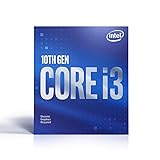
- Country Of Origin :China
- Package Dimensions :7.3Cm L X10.7Cm W X11.8Cm H
- Package Weight :9.9Ounces
- Product Type : Computer Processor
Trade-offs and limitations
Less headroom for demanding games and multitasking
Four cores and eight threads are sufficient for many gaming workloads, but offer less room than six-core/twelve-thread processors for demanding scenes, streaming, CPU-based encoding, recording, mods, and other applications running alongside a game. GPU hardware encoding can reduce the burden when available and suitable, but should not be assumed in every build.
A shorter comfort horizon
An i3 does not suddenly stop running games, but as games and background software become more demanding, the processor may be more likely to limit minimum frame rates, consistency, or multitasking. If you want to keep a new build for years without changing the CPU, a Core i5 or Ryzen 5 is generally the safer choice.
High-refresh targets ask more of the CPU
Producing a comfortable 60 FPS and sustaining 144, 240, or 360 FPS are different workloads. Competitive players should pay attention to minimums and frame-time consistency, not just a headline average. For consistently high frame rates, a six-core alternative offers more headroom.
Motherboard compatibility is more than the socket
Both processors use LGA1700, but a compatible socket alone does not confirm that a motherboard will boot the chip: older 600-series boards may need a BIOS update for later processors. Check the board maker’s CPU support list and BIOS requirements before buying. Also assess the board’s memory type, connectivity, power delivery, and cooling if you plan to upgrade later. A board that supports a CPU is not automatically a strong upgrade platform, and a future higher-tier processor is not guaranteed to be a worthwhile or compatible upgrade.
Best Value
- Intel UHD Graphics 630
- Compatible only with Motherboards based on Intel 300 Series Chipsets
- Cores: 4, Threads: 4
- 3.60 GHz Base Frequency / 6 MB Cache
- Intel Optane Memory Supported
Cooling depends on the whole build
The included cooler is generally adequate for a locked, low-power i3, but temperatures and noise depend on case airflow, ambient temperature, installation, and motherboard power settings. Tom’s Hardware used a 360 mm liquid cooler for comparative thermal testing and cautioned that stock-cooler temperatures would be higher; those test temperatures should not be treated as stock-cooler results. See the review methodology and qualifications.
i3 versus Core i5 or Ryzen 5
For a gaming-only budget build with a suitable GPU, a recent i3 can be the rational choice. A six-core/twelve-thread Core i5 or Ryzen 5 is a better fit when you want more CPU headroom, although exact value depends on the processor, motherboard, memory, and current local prices. Do not compare CPU prices in isolation: a seemingly cheaper chip may require a pricier motherboard or memory kit.
- Choose an i3 if your budget is tight, you target mainstream 1080p gaming, use a budget or midrange GPU, mostly play esports, older AAA, indie, or moderately demanding games, and are comfortable with the possibility of an earlier CPU upgrade.
- Choose a six-core alternative if you target high-refresh play, use a high-end GPU, play simulation, strategy, MMO, open-world, or large multiplayer games, stream or record, work with demanding applications, or want more longevity and minimum-FPS headroom.
How to plan a budget i3 gaming build
- Set the actual target. Decide which games, resolution, graphics settings, and refresh rate matter. This defines the performance you need more accurately than a generic compatibility calculator.
- Balance the GPU and CPU budget. For a budget or midrange GPU, a recent i3 may leave more money for graphics performance. Avoid pairing it with an expensive high-end GPU for 1080p high-refresh play unless benchmarks in your games support the choice.
- Choose memory and motherboard together. The processors support DDR4 and DDR5, but a motherboard is built for one type; the modules are not interchangeable. DDR4 can improve value, while DDR5 may offer modest gains in some titles. Spend on DDR5 only if the full platform cost still leaves an appropriate GPU budget. Aim for 16 GB as a practical minimum and consider 32 GB for newer games, mods, streaming, or multitasking.
- Verify firmware and upgrade needs. Check the motherboard’s CPU support list and whether a BIOS update is needed. If a later Core i5 upgrade is part of the plan, consider board power delivery, cooling, memory type, storage, USB, and Wi-Fi—not only socket fit.
- Budget for graphics with an F model. The 12100F and 14100F have no integrated graphics, so a discrete graphics card is required for display output. A non-F model’s integrated graphics may help with troubleshooting or temporary display use, but paying a large premium for it solely for gaming may not make sense.
- Size the rest of the system for the full load. Choose a power supply for the CPU, GPU, and other components together; CPU base and turbo power do not describe whole-system draw. Provide reasonable case airflow and install the cooler correctly to manage heat and noise.
For an existing i3 system, identify the exact CPU and monitor performance in the games that feel slow. If the GPU is already the limit, a graphics-card upgrade may help more. If the processor is saturated and frame delivery is inconsistent, a CPU and possibly motherboard upgrade is more relevant. Do not expect a CPU change to fix insufficient graphics memory or another GPU-side problem.
Quick Recap
Product prices and availability are accurate as of the date/time indicated and are subject to change. Any price and availability information displayed on Amazon at the time of purchase will apply.




