Free tools Windows power users keep installed
One-click scans. No signup required.
AMD’s Strix Halo platform—sold as the Ryzen AI Max+ 395 with integrated Radeon 8060S graphics—has been shown in AMD’s own testing to challenge, and sometimes outperform, a low-power GeForce RTX 4070 Laptop GPU at 1080p. AMD reported results from a 17-game High-settings comparison, including an individual-game gain of up to about 68%. A later AMD summary put the average advantage at 14%, while a third-party calculation of the earlier published figures estimated roughly 23%.
Those are not contradictory measurements of every RTX 4070 laptop. They are separate claims from different AMD presentations, using specific complete systems. The NVIDIA machine was a compact ASUS ROG Flow Z13 implementation with an approximately 65W RTX 4070 Laptop GPU. Higher-power RTX 4070 laptops can be substantially faster, so the evidence establishes a serious low-power challenge—not a universal AMD victory.
What “Strix Halo Ryzen AI 395” actually means
Strix Halo was AMD’s codename. The retail processor is the Ryzen AI Max+ 395; “Ryzen AI 395” is understandable shorthand but not the complete product name. Its integrated GPU is called Radeon 8060S Graphics.
| Specification | Ryzen AI Max+ 395 |
|---|---|
| CPU architecture | Zen 5 |
| CPU cores / threads | 16 / 32 |
| Base / boost clock | 3.0GHz / up to 5.1GHz |
| Default TDP | 55W |
| Configurable TDP | 45W–120W |
| Integrated GPU | Radeon 8060S, RDNA 3.5 |
| GPU compute units | 40 |
| GPU frequency | Up to 2.9GHz |
| Memory support | 256-bit LPDDR5X, up to 128GB |
| NPU | Up to 50 TOPS |
AMD’s full specifications are available on its Ryzen AI Max+ 395 product page.
#1 Best Overall

- Extreme All-in-One Performance: Powered by the AMD Ryzen AI Max+395 processor (Zen 5 architecture) and AMD Radeon 8060S Graphics (RDNA 3.5, 40 compute units), with a stable 120W TDP for smooth AAA gaming at high frame rates. Outperforms RTX 4070 Mobile and delivers up to 2.6x faster 3D rendering than Intel Core Extreme 9 288V.
- Breakthrough On-Device AI & Memory: Features up to 128GB LPDDR5X-8000 unified memory and up to 96GB dynamically allocated VRAM—seamlessly runs 70B+ parameter LLMs (like Llama 3) locally. The dedicated NPU (XDNA 2, 50 TOPS) provides 2.2x greater AI performance than RTX 4090 with 87% lower power consumption, ending VRAM limitations forever.
- Dual SSD Slots & Full-Featured I/O: Includes two PCIe 4.0 SSD slots—one M.2 2280 for the system and one external Mini SSD slot for AI models—enabling easy model swapping and cost-effective upgrades. Equipped with USB-C 4.0, HDMI 2.1 (4K 144Hz), TF 4.0 card slot, and more for maximum expandability.
- Vibrant 14-inch AMOLED Display & All-Day Battery: A stunning 14-inch AMOLED native landscape display delivers fluid gaming refresh rates and studio-grade color accuracy in a compact form factor. The large 83.5Wh battery supports extended gaming and productivity sessions, featuring bypass charging to preserve battery health.
- Advanced Cooling & Mobile Workstation Power: Optimized thermal design sustains high performance under load in a 14-inch chassis. Combines desktop-level capabilities—from rendering and simulation to local AI deployment—with true portability, making it the ultimate compact tool for creators, developers, and power users.
Why this integrated GPU can approach a discrete RTX 4070
Radeon 8060S is unusually large for an integrated laptop GPU, with 40 compute units and a high graphics clock. The processor and graphics engine also share a wide, 256-bit LPDDR5X memory interface. A system can be configured with up to 128GB of that memory, which is useful for workloads that need a large common pool for the CPU and GPU.
That design avoids a separate GPU package and its dedicated VRAM, helping manufacturers build compact systems. It does not make shared memory identical to GDDR6: latency, cache behavior, driver scheduling, and available bandwidth remain different. Graphics performance still depends on the laptop’s sustained package power, cooling, memory speed, firmware and the amount of system memory assigned to graphics.
ASUS lists up to 128GB of onboard LPDDR5X-8000 in selected 2025 ROG Flow Z13 configurations. That capacity is system memory, not 128GB of dedicated VRAM. See the ROG Flow Z13 specifications.
Rank #2

- THE ULTIMATE 2-IN-1 – Stay in the zone with a larger touchpad, up to 10 hrs of battery life, and a flexible 170° kickstand that adapts effortlessly to create, game and work on the go.
- POWER MEETS PORTABILITY – Equipped with a brand-new one stop shop chipset experience in the AMD Ryzen AI MAX+ 395 processor with 16 cores, up to 50 tops NPU power and RDNA 3.5 graphics in a 13-inch chassis, the Flow Z13 is designed for next generation portable power.
- GAME CHANGING AI ASSISTANT – Experience productivity boosts and improved power efficiency curtesy of ROG Intelligent Assistance with Copilot + PC powered by AMD Ryzen AI.
- SEAMLESS PERFORMANCE – The LPDDR5X 8000MHz quad-channel memory dynamically balances the integrated CPU and GPU. With 32GB of low-latency memory, it ensures smooth gaming.
- ROG NEBULA DISPLAY, BRILLANCE UNLEASHED – Experience brilliance with the 16:10 WQXGA 180 Hz/3ms PANTONE Validated touchscreen, covering DCI-P3 color space.
What AMD actually tested
The comparison was a platform test, not an isolated GPU benchmark. AMD’s published material used a Ryzen AI Max+ 395 system configured at 55W, with Radeon 8060S graphics, 32GB of memory and a 1TB SSD. The games were tested at 1920×1080 with the High preset on Windows 11; AMD’s later setup description specifies Virtualization-Based Security enabled.
The Tool Desk
Outbyte PC Repair FREERepair Windows errors before they cause bigger problemsFix Now →Outbyte Driver Updater FREEFix the driver behind crashes, sound loss and screen glitchesFind Drivers →The comparison machine was the previous-generation ASUS ROG Flow Z13 with an Intel Core i9-13900H and an RTX 4070 Laptop GPU. Reporting on AMD’s materials identifies that compact implementation as having an approximately 65W GPU power limit. The Flow Z13 itself is a 13.4-inch 2-in-1 with a 2560×1600, 180Hz display, so the headline 1080p result is below its native panel resolution.
| Element | AMD test platform | NVIDIA comparison platform |
|---|---|---|
| Processor | Ryzen AI Max+ 395 | Intel Core i9-13900H |
| Graphics | Radeon 8060S | GeForce RTX 4070 Laptop GPU |
| Chassis reference | ROG Flow Z13-class system | Previous-generation ROG Flow Z13 |
| GPU power information | 55W processor configuration | Approximately 65W GPU implementation |
| Memory / storage | 32GB / 1TB SSD | Configuration reported by AMD materials |
| Game settings | 1080p, High | 1080p, High |
AMD’s competitive guide is the primary reference for the test configuration: Ryzen AI Max series competitive guide. AMD’s later methodology summary appears in its official Ryzen AI Max performance blog.
Rank #3
- Extreme All-in-One Performance: Powered by the AMD Ryzen AI Max+395 processor (Zen 5 architecture) and AMD Radeon 8060S Graphics (RDNA 3.5, 40 compute units), with a stable 120W TDP for smooth AAA gaming at high frame rates. Outperforms RTX 4070 Mobile and delivers up to 2.6x faster 3D rendering than Intel Core Extreme 9 288V.
- Breakthrough On-Device AI & Memory: Features up to 128GB LPDDR5X-8000 unified memory and up to 96GB dynamically allocated VRAM—seamlessly runs 70B+ parameter LLMs (like Llama 3) locally. The dedicated NPU (XDNA 2, 50 TOPS) provides 2.2x greater AI performance than RTX 4090 with 87% lower power consumption, ending VRAM limitations forever.
- Dual SSD Slots & Full-Featured I/O: Includes two PCIe 4.0 SSD slots—one M.2 2280 for the system and one external Mini SSD slot for AI models—enabling easy model swapping and cost-effective upgrades. Equipped with USB-C 4.0, HDMI 2.1 (4K 144Hz), TF 4.0 card slot, and more for maximum expandability.
- Vibrant 14-inch AMOLED Display & All-Day Battery: A stunning 14-inch AMOLED native landscape display delivers fluid gaming refresh rates and studio-grade color accuracy in a compact form factor. The large 83.5Wh battery supports extended gaming and productivity sessions, featuring bypass charging to preserve battery health.
- Advanced Cooling & Mobile Workstation Power: Optimized thermal design sustains high performance under load in a 14-inch chassis. Combines desktop-level capabilities—from rendering and simulation to local AI deployment—with true portability, making it the ultimate compact tool for creators, developers, and power users.
What the performance numbers mean
| Claim | Reported result | How to read it |
|---|---|---|
| Largest individual-game result | Up to about 68% faster | AMD’s maximum in its selected game set, not an average |
| Estimated average from the earlier slide set | About 23% | Third-party calculation from AMD’s published figures, not independent testing |
| Later AMD aggregate | 14% average increase | A separate AMD presentation with its own test set or configuration |
| Resolution and preset | 1080p, High | Not an Ultra-setting or native-1600p claim |
Contemporary coverage of the original slide reports the maximum result and the power-limit caveat in Tom’s Hardware. The important distinction is between “up to 68%” in one result and an average across games. Neither figure should be presented as a universal Radeon 8060S lead.
Why this does not prove that every RTX 4070 laptop is slower
RTX 4070 Laptop GPUs have different power limits
NVIDIA’s mobile RTX 4070 is a family of configurations. A 65W version in a thin 2-in-1 has far less sustained power than a higher-wattage implementation in a thicker 15- or 16-inch gaming laptop. Comparing the GPU name without recording its power limit can therefore reverse the apparent ranking.
The CPUs and platforms are different
The Ryzen system has 16 Zen 5 cores and 32 threads; the comparison machine uses a Core i9-13900H. Game results measure the complete platform. CPU-limited scenes, asset streaming and background workloads can affect the result independently of graphics hardware.
Rank #4
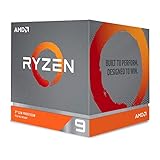
- The world's most advanced processor in the desktop PC gaming segment
- Can deliver Ultra-fast 100 plus FPS performance in the world's most popular games
- 12 Cores and 24 processing threads, bundled with the AMD Wraith Prism cooler with color controlled LED support
- 4.6 GHz max Boost, unlocked for overclocking, 70 MB of game Cache, DDR 3200 support. OS Support-Windows 10 - 64-Bit Edition, RHEL x86 64-Bit, Ubuntu x86 64-Bit. Operating System (OS) support will vary by manufacturer
Cooling and firmware matter
The Flow Z13 is a compact gaming tablet with limited thermal volume. A larger RTX laptop may hold higher clocks for longer, while an AMD laptop with a lower sustained package limit may fall behind its short-run result. Fan curves, BIOS settings and driver maturity also change performance.
Upscaling and generated frames must be separated
Native-rendered FPS, FSR or XeSS output, DLSS output and generated-frame FPS are different measurements. Reporting on AMD’s presentation noted uncertainty about which upscaling or frame-generation features were enabled in every test. Do not compare a native Radeon result with DLSS 3 frame-generation output as though they were the same workload. TechRadar’s coverage discusses those unanswered methodology questions.
Independent reader supportYour contribution helps us test, update, and keep practical guides available for everyone.What to expect beyond 1080p
The published claim is specifically a 1080p comparison. It does not establish equal performance at 2560×1600 or 1440p. Higher resolution increases the graphics workload; memory bandwidth, upscaling support and the game engine determine whether the gap widens or narrows. The Flow Z13’s 2560×1600, 180Hz panel makes this distinction practical: a buyer may use the machine at its native resolution rather than at AMD’s test resolution.
Recommended Free Tools
Best Value

- AMD Ryzen 9 9950X3D Gaming and Content Creation Processor
- Max. Boost Clock : Up to 5.7 GHz; Base Clock: 4.3 GHz
- Form Factor: Desktops , Boxed Processor
- Architecture: Zen 5; Former Codename: Granite Ridge AM5
A meaningful review should report:
- Native 1920×1080 and native 2560×1600 or 1440p results.
- FSR or XeSS where supported, and DLSS separately on RTX systems.
- Ray tracing both enabled and disabled.
- Average FPS alongside 1% lows and frame-time consistency.
- Sustained results after a long gaming session, not only a short run.
Radeon 8060S versus RTX 4070: which platform fits?
Reasons to favor Ryzen AI Max+ 395
- You want a compact laptop or gaming tablet with strong CPU and GPU performance in one package.
- A large unified-memory configuration helps creative applications or local AI workloads.
- The specific system has adequate cooling and a high sustained power limit.
- You do not depend on CUDA software or NVIDIA-specific creator tools.
Reasons to favor an RTX 4070 Laptop GPU
- Ray-tracing performance and broad DLSS support are priorities.
- You use CUDA applications, NVIDIA creator features or other CUDA-dependent software.
- The laptop provides a high-power RTX 4070 implementation with independent review data.
- You prefer dedicated VRAM behavior or a larger conventional chassis with more cooling headroom.
How to compare an actual laptop before buying
- Record the exact GPU power limit, not just “RTX 4070.”
- Check sustained CPU and GPU performance in independent gaming reviews.
- Verify memory capacity, speed and whether it is soldered; unified system memory is not dedicated VRAM.
- Match benchmarks to the display resolution and refresh rate you will use.
- Separate native, upscaled and generated-frame results.
- Check ray-tracing performance, noise, battery capacity, weight and thermal behavior.
- Compare SSD upgradeability, warranty and the current price in your country.
The 2025 ASUS ROG Flow Z13 is a useful example of the trade-off. ASUS lists Ryzen AI Max configurations, Radeon 8060S graphics, up to 128GB LPDDR5X and a 13.4-inch 2560×1600 180Hz display. Its U.S. launch prices were $2,099.99 to $2,799.99 depending on configuration, but those were 2025 launch prices rather than verified August 2026 street prices. See the official product page and ASUS’s launch announcement.
Verdict
AMD has demonstrated a credible low-power gaming challenge: in AMD’s selected 1080p High-settings tests, a Ryzen AI Max+ 395 system with Radeon 8060S graphics can match or beat the approximately 65W RTX 4070 Laptop GPU used in the comparison. The reported maximum of about 68%, the roughly 23% third-party calculation and AMD’s later 14% average are separate figures, not one universal score.
That result makes Strix Halo important for compact systems, but it does not show that every Ryzen AI Max+ 395 laptop beats every RTX 4070 laptop. For a purchase, compare the complete chassis, sustained power, cooling, display resolution, feature support and independent game data—not the processor or GPU label alone.
Quick Recap
Product prices and availability are accurate as of the date/time indicated and are subject to change. Any price and availability information displayed on Amazon at the time of purchase will apply.
What’s actually slowing this PC down?
Pick the symptom - the matching free tool is one click away.




