Verdict: The Radeon RX 6600 remains a sensible 1080p graphics card when bought at a genuinely low street price. Its 8GB of memory, modest 132W board power and high-refresh 1080p performance are compelling, but 1440p ultra settings, ray tracing and prices close to faster cards weaken the case.
What the Radeon RX 6600 is
AMD launched the Radeon RX 6600 on 13 October 2021 with a $329 suggested e-tail price (SEP). That launch figure is historical, not a current price; the card’s value now depends on live stock, condition and competing graphics-card prices.
| Specification | Radeon RX 6600 |
|---|---|
| Architecture | AMD RDNA 2 |
| Compute units | 28 |
| Memory | 8GB GDDR6 |
| Infinity Cache | 32MB |
| Typical board power | 132W |
| Power connector | One 8-pin connector |
| Recommended minimum PSU | 450W |
Partner cards can use different factory clocks, coolers and acoustic profiles. The launch review tested an XFX Radeon RX 6600 Speedster SWFT 210, so its temperatures and noise should not be treated as universal for every RX 6600.
1080p performance: the card’s proper target
The RX 6600 is designed for high-refresh 1080p gaming. AMD’s published 1080p maximum-setting examples list:
Do these 3 things before closing this tab:
1Scan for outdated or missing drivers - takes under a minute2Clear out junk files and repair common Windows errors3Fix the driver behind crashes, sound loss and screen glitches#1 Best Overall

- System Compatibility Note: 2-slot card, 269.2x131.8x40.3mm, single 8-pin power, recommended 550W PSU. Verify chassis clearance before purchase.
- Dedicated Support: Please contact us directly through Amazon for any product questions or assistance you may require.
- Next-Gen AMD RDNA 3 Architecture: Powered by RX 7600 GPU with 32 CUs and 2048 stream processors, delivering exceptional 1080p gaming with hardware ray tracing.
- Factory Overclocked for Maximum Performance: Boost clock up to 2695MHz and game clock of 2280MHz, providing the raw power for smooth high-framerate gaming.
- 8GB GDDR6 Memory on 128-Bit Bus: Equipped with 8GB of high-speed GDDR6 memory running at 18 Gbps, offering ample bandwidth for modern game textures.
| Game | Reported average frame rate |
|---|---|
| The Division 2 | 98 FPS |
| Doom Eternal | 138 FPS |
| Far Cry 6 | 102 FPS |
| Shadow of the Tomb Raider | 118 FPS |
| Wolfenstein: Youngblood | 173 FPS |
| Apex Legends | 153 FPS |
| Fortnite | 111 FPS |
| Valorant | 452 FPS |
These are AMD’s own examples from its 2021/current product material, not an independent, reproducible benchmark suite. Actual results vary with the game version, driver, processor, graphics preset and whether features such as ray tracing are enabled. They nevertheless show the intended use: a 1080p display running well above 60Hz in many games.
What 8GB means at 1080p
The 8GB GDDR6 framebuffer gives the RX 6600 useful room for modern 1080p texture settings. It does not make the GPU equivalent to a faster 8GB card: shader throughput, memory bandwidth, ray-tracing hardware and the game’s settings still determine performance. Avoid assuming that lowering resolution alone will solve a demanding title whose frame rate is limited by the GPU’s processing capacity.
Rank #2
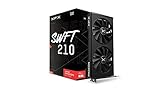
- Chipset: AMD RX 7600
- Memory: 8GB GDDR6
- XFX SWFT Dual Fan Cooling Solution
- Boost Clock: Up to 2655 MHz
Can it handle 1440p?
Yes, but 1440p requires more selective settings. Tom’s Hardware found 1440p ultra “wasn’t nearly as compelling,” with several tested games falling below 60 FPS. High or mixed medium/high presets are more realistic starting points than a blanket ultra setting.
In that launch-era testing, the RX 6600 was about 9% behind the GeForce RTX 3060 at 1440p. The result is a useful relative guide, not a guarantee for every game: the review’s measurements date from October 2021, and later drivers and game updates can change the gap.
Rank #3

- Chipset: AMD RX 7600
- Memory: 8GB GDDR6
- XFX SWFT Dual Fan Cooling Solution
- Boost Clock: Up to 2655 MHz
Choose the RX 6600 for 1440p when
- You are comfortable tuning individual settings instead of insisting on ultra.
- Your priority is roughly 60 FPS rather than maximum refresh-rate performance.
- The RX 6600 is substantially cheaper than faster alternatives.
Look elsewhere when
- You want consistently high-refresh 1440p performance at maximum settings.
- You expect to use demanding ray-traced effects at 1440p.
- A faster card is available for only a small additional cost.
RX 6600 versus RX 6600 XT and RTX 3060
| Comparison | RX 6600 | RX 6600 XT | RTX 3060 |
|---|---|---|---|
| Positioning | Lower-cost 1080p RDNA 2 option | Faster version of the same generation | Faster competing 1080p/1440p option in the cited review |
| VRAM | 8GB GDDR6 | Not stated in the supplied evidence | Not stated in the supplied evidence |
| Relative performance | Baseline | About 15% faster than RX 6600 in most cases, according to Tom’s Hardware | RX 6600 was about 9% slower at 1440p in Tom’s Hardware testing |
| Ray tracing | Weaker than RTX 3060 in the review comparison | Not established here | Stronger than RX 6600 in the review comparison |
| Power and acoustics | 132W typical board power; partner implementation varies | Not stated | Not stated |
The RX 6600 XT is the straightforward performance upgrade: Tom’s Hardware reported the RX 6600 was about 15% slower in most cases. The RTX 3060 is also faster in the cited 1440p comparison and has the stronger ray-tracing showing in that review. Whether either upgrade is worthwhile depends on the actual listing prices, not the original launch positioning.
Power, connectors and system requirements
AMD rates the RX 6600 at 132W typical board power and recommends a minimum 450W power supply. The card uses one 8-pin power connector. A PSU that meets the wattage recommendation but lacks the correct connector should not be adapted casually; use the power cables and configuration specified by the card maker.
Rank #4

- System Compatibility Note: 2.5‑slot card measuring 303 mm (L) x 131 mm (W) x 45 mm (H); requires a single 8‑pin power connector and a recommended 550W power supply. Please verify chassis clearance and power supply capacity before purchase.
- Dedicated Support: Please contact us directly through Amazon for any product questions or assistance you may require.
- AMD RDNA 3 Architecture with AI & Ray Tracing Acceleration: Powered by 32 RDNA 3 Compute Units featuring 3rd Gen Ray Tracing Accelerators and 2nd Gen AI Accelerators, delivering lifelike lighting, shadows, and superior machine learning performance for enhanced gaming and content creation.
- Powerful 1080p & 1440p Gaming Engine: Features a max boost clock of up to 2695 MHz, a game clock of 2280 MHz, and 2048 stream processors, ensuring outstanding frame rates in the latest titles.
- 8GB High‑Speed GDDR6 Memory: Equipped with 8GB of GDDR6 memory on a 128‑bit interface running at 18 Gbps, delivering up to 288 GB/s bandwidth for high‑resolution textures and demanding game workloads.
- Check that the case has room for the specific partner card.
- Confirm one available 8-pin PCIe power lead.
- Use a reliable 450W-or-better PSU, allowing additional headroom for the rest of the system.
- Install current graphics drivers and remove old drivers when changing vendors if troubleshooting begins.
Ray tracing, upscaling and image-quality trade-offs
Ray tracing is a relative weakness for the RX 6600. Tom’s Hardware’s comparison found weaker ray-tracing capability than the RTX 3060. That does not prevent ray-traced games from running, but it makes compromises more likely: lower ray-tracing presets, reduced resolution, or an upscaling mode may be needed to maintain smooth play.
The RX 6600’s strongest value case is conventional rasterized rendering at 1080p. Evaluate each game’s available upscaling and image-quality controls rather than assuming a single setting will produce the same result across titles.
The Tool Desk
Outbyte Driver Updater FREEFix the driver behind crashes, sound loss and screen glitchesFind Drivers →Outbyte PC Repair FREEClear out junk files and repair common Windows errorsFree Scan →Best Value

- Not compatible with all built-in computers or systems
- AMD Radeon RX 6600 GPU: Built on RDNA 2 architecture, delivering excellent 1080p gaming performance with high efficiency.
- 8GB GDDR6 Memory: Provides smooth gameplay and multitasking with fast data transfer rates.
- Challenger D Cooling: Features a dual-fan design for effective heat dissipation and quiet operation.
- PCIe 4.0 Support: Ensures high bandwidth for improved gaming and productivity performance.
What is a fair price?
There is no defensible current fair price from the launch data alone. AMD’s $329 SEP applies to the 13 October 2021 launch, while the review’s street-price conclusion was explicitly that value depended on “street prices and availability.” Before buying an AMD Radeon RX 6600 graphics card, compare:
- New versus used condition.
- Seller reputation, warranty and return terms.
- Current prices for the RX 6600 XT, RTX 3060 and newer competing cards.
- The exact partner model, cooler design, dimensions and included power requirements.
- Whether the listing is actually in stock, rather than a stale or back-ordered offer.
A low-priced RX 6600 makes sense when 1080p is your target and the savings over faster cards are meaningful. If its price approaches an RX 6600 XT or RTX 3060, the performance and ray-tracing trade-offs become difficult to justify.
Bottom line for buyers
Buy the RX 6600 for efficient, high-refresh 1080p gaming, 8GB of VRAM and a system that can comfortably meet a 450W PSU recommendation. Treat 1440p as a tuned-settings workload, and do not choose it primarily for ray tracing. The card is a good deal only when today’s listing price and availability preserve its role as the lower-cost option; its $329 launch SEP and October 2021 benchmark results are historical context, not a current market verdict.
Quick Recap
Product prices and availability are accurate as of the date/time indicated and are subject to change. Any price and availability information displayed on Amazon at the time of purchase will apply.




