Free tools Windows power users keep installed
One-click scans. No signup required.
Video games usually determine gunfire with one of two approaches: an immediate scene check called hitscan, or a simulated projectile that travels through the world and can collide over time. The distinction affects travel time, aiming, and how a shot interacts with moving targets. What you see—a tracer, muzzle flash, or impact effect—does not necessarily reveal which method the game uses.
How hitscan shots work
A basic hitscan shot is an invisible ray or line query. When the player fires, the game chooses an origin and direction, checks the scene, and uses the first eligible intersection as the shot result. The result can include the object hit, the distance, and the point in the world where the ray met it. Unity demonstrates this approach in its shooting with raycasting tutorial.
The query can be constrained. In Unity’s version 6000.5 Raycast API, parameters include the ray’s origin and direction, a maximum distance, and a layer mask. A layer mask can exclude objects that should not count for that shot; the maximum distance limits how far the query checks. The exact API and available options depend on the engine version used by a project.
Because the game resolves the query when the shot is fired, a basic hitscan weapon has no simulated time-of-flight. A straight ray also does not curve under gravity or wind by itself. A developer can add extra rules, but those are additions to the basic ray check.
#1 Best Overall

- Compatible with Windows and Android.
- 1000Hz Polling Rate (for 2.4G and wired connection)
- Hall Effect joysticks and Hall triggers. Wear-resistant metal joystick rings.
- Extra R4/L4 bumpers. Custom button mapping without using software. Turbo function.
- Refined bumpers and D-pad. Light but tactile.
How simulated projectiles work
A simulated projectile is an object whose position advances through the game world. Its speed and trajectory determine where it travels, and the game checks whether it collides with a target or another object. Unity’s Netcode for GameObjects 1.6.0 projectile overview describes projectiles in terms of travel speed and trajectory. In an Unreal Engine example, a collision component and hit callback handle a projectile’s collision.
That does not mean every game uses the same underlying simulation. A developer might use a physics body, custom movement code, or repeated collision queries along the projectile’s route. The shared idea is travel through the world before a hit is resolved, not one required implementation.
Rank #2
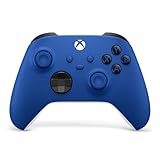
- MODERNIZED DESIGN — Experience the modernized design of the XBOX Wireless Controller with sculpted surfaces and updated geometry that enhances comfort and control during long gaming sessions.
- PRECISION PERFORMANCE — Stay on target with a hybrid D-pad and textured grips on triggers, bumpers, and back case for improved accuracy and handling.
- SHARE BUTTON: Seamlessly capture and share content such as screenshots, recordings, and more with the new Share button.
- VERSATILE CONNECTIVITY — Connect via USB-C for plug-and-play on console and PC, or quickly pair and switch between supported devices with XBOX Wireless and Bluetooth support.
- BUILT-IN AUDIO SUPPORT — Plug in compatible headsets using the 3.5mm audio jack for direct voice chat and immersive in-game sound.
What the difference changes during play
| Question | Basic hitscan | Simulated projectile |
|---|---|---|
| When is the hit resolved? | When the ray query runs at firing time; there is no simulated travel delay. | After the projectile travels far enough to reach or collide with something. |
| How does distance matter? | Distance can be limited by the query, but it does not create travel time in the basic model. | Travel time depends on the projectile’s speed and the distance it covers. |
| What about a moving target? | The game checks the scene state used for the query; the shot does not inherently spend time in flight. | The target may move while the projectile travels, so aiming ahead can matter. |
| Does the shot have a curved path? | Not in a plain straight-ray check. | The trajectory can be designed to include a curve, such as bullet drop. |
These are consequences of the basic models, not rules for every game. A game can add range falloff, custom trajectory logic, or other behavior to either approach.
Why visuals do not prove how a shot is calculated
A tracer can make a shot visible, but it may be a presentation effect rather than the object the game uses to determine a hit. The game can render a muzzle flash, tracer, or impact effect while resolving the shot with a ray query. Conversely, a visible moving object may be part of projectile simulation. Visual effects alone are not enough to establish a game’s hit-detection method.
Rank #3

- With broad game support, the Logitech Gamepad F310 works with old standbys to today's biggest titles, so it's easy to set up and use with your favorite games.
- Profiler software allows the gamepad to be programmed to perform keyboard and mouse commands for games without gamepad support.* * Requires software installation.
- A familiar control layout that doesn't require a learning curve to be able to use, with all the same buttons as on an Xbox 360.
- The unique floating D-pad rests on four switches-instead of a single pivot point-making it responsive to quick changes in direction.
- The six-foot cord lets you lean back and play a comfortable distance from your PC monitor.
How online games handle hit registration
In multiplayer, a player’s view and the server’s simulation may represent different moments or positions. That creates an agreement problem: should the game judge a shot against the world as the shooter saw it, or against a later server state?
One documented technique is lag compensation. Unity’s Netcode for Entities 1.2 lag-compensation documentation describes a server consulting a collision world from an earlier tick, corresponding to the client’s view. This is one approach, not a universal feature of online shooters. Network authority and hit-registration rules vary by game, so a player’s experience alone cannot establish that a particular title rewinds the world or identify its netcode design.
Quick Recap
Best Value

- Feel physically responsive feedback to your in-game actions through haptic feedback
- Experience varying levels of force and tension at your fingertips with adaptive triggers
- Chat online through the built-in microphone and connect a headset directly through the 3.5mm jack
- Switch voice capture on and off using the dedicated mute button
- Play on more devices using the USB Type-C cable or Bluetooth to connect easily to Windows PC and Mac computers, Android and iOS mobile phones as well as your PlayStation 5
Rank #4

- Compatible with Wide Range of Consoles: This controller works with consoles such as Switch 2, Switch, Switch Pro, Switch Lite, and Switch OLED. (Please note): The controller's “HOME” button cannot wake up the Switch 2 console and does not have the C button for voice chat functions. However, all other functions are fully usable, including: dual vibration, 6-axis gyroscope, screenshot function, Hall effect buttons, and turbo.
- Cool and Colorful Lighting Switch Controller Wireless: It features 7 colors of RGB lighting (Red - Orange - Yellow - Green - Cyan - Blue - Violet) and 4 light modes (Dazzle - Monochrome - Monochrome Breathe - Monochrome Breathe Cycle).
- Hall Effect Technology for Switch Pro Controller: Experience zero drift and unmatched accuracy with our Hall effect joystick switch. Adaptive trigger feedback with adjustable resistance levels lets you feel every action. With <0.1 ms response time and 256 levels of pressure sensitivity, enjoy instant trigger detection in FPS games. 3+ million clicks on the controller mean a long service life.
- Dual Motor Vibration, Turbo Function and 6 Axis Gyroscope: The switch 2 controller has two vibration motors with three intensity levels—off, low, and high—and provides exceptional haptic feedback to enhance the gaming experience. The controller also offers three adjustable turbo speeds (5-10-15 Hz), which are particularly suitable for first-person shooter games. In addition, it features a 6 axis gyroscope chip for precise motion control. The physical movements of the players are precisely matched to the actions of their game characters.
- Reliable After-Sales Support You Can Count On: Your satisfaction is our top priority. Should you experience any quality concerns with your gaming controller, simply reach out to us via our customer service email, and we’ll respond promptly. We stand behind our product with a hassle-free replacement policy—ensuring you’re back to gaming without worry, no questions asked.
Further reading for developers
- Unity Learn: shooting with raycasting for a basic ray-based weapon example.
- Unity 6000.5 Raycast API for query parameters and filtering.
- Unreal Engine: implementing projectiles for an example using collision and hit handling.
Product prices and availability are accurate as of the date/time indicated and are subject to change. Any price and availability information displayed on Amazon at the time of purchase will apply.



