What’s actually slowing this PC down?
Pick the symptom - the matching free tool is one click away.
OnLive is no longer available. The service ended on April 30, 2015, so this is a retrospective review. OnLive streamed games rendered on its servers to PCs, Macs, televisions, mobile devices and an optional MicroConsole. It made demanding games possible on weak hardware, but latency, compression, licensing and fragile ownership rights kept the service from becoming a dependable alternative to local gaming.
OnLive at a glance
| Category | Retrospective assessment |
|---|---|
| Public debut | Game Developers Conference, March 2009 |
| Living-room hardware | Approximately $100 MicroConsole, launched around late 2010 |
| Core idea | Games rendered remotely and delivered as interactive video |
| Best qualities | Low hardware requirements, instant access, trials and ambitious cross-device support |
| Biggest problems | Input delay, image artifacts, network sensitivity, licensing limits and non-durable access |
| Service end | April 30, 2015 |
| Overall verdict | Technically remarkable for its era, but commercially and practically unreliable |
OnLive was one of the earliest high-profile attempts to commercialize cloud gaming. Sony acquired selected OnLive technology and patents, reportedly including about 140 U.S. and international patents, but did not continue the consumer service in its existing form. TechCrunch reported the asset sale and closure.
How OnLive worked
OnLive was not remote access to a gaming PC that you owned. It was a centrally operated platform with its own servers, game licenses and account system.
- The game ran on an OnLive server.
- That server rendered each frame and compressed the resulting video and audio.
- The stream traveled to your computer, television, tablet or other supported device.
- Your controller, keyboard or mouse input traveled back to the server.
- The server processed that input and sent back the next frame.
That round trip added network latency, server processing, video encoding, transmission and decoding to every action. A local game could render directly on your hardware; OnLive had to make the entire interaction work across a connection.
The Tool Desk
Outbyte PC Repair FREERepair Windows errors before they cause bigger problemsFix Now →Outbyte Driver Updater FREEScan for outdated or missing drivers - takes under a minuteDriver Scan →#1 Best Overall

- The next-generation optical HERO sensor delivers incredible performance and up to 10x the power efficiency over previous generations, with 400 IPS precision and up to 12,000 DPI sensitivity
- Ultra-fast LIGHTSPEED wireless technology gives you a lag-free gaming experience, delivering incredible responsiveness and reliability with 1 ms report rate for competition-level performance
- G305 wireless mouse boasts an incredible 250 hours of continuous gameplay on just 1 AA battery; switch to Endurance mode via Logitech G HUB software and extend battery life up to 9 months
- Wireless does not have to mean heavy, G305 lightweight mouse provides high maneuverability coming in at only 3.4 oz thanks to efficient lightweight mechanical design and ultra-efficient battery usage
- The durable, compact design with built-in nano receiver storage makes G305 not just a great portable desktop mouse, but also a great laptop travel companion, use with a gaming laptop and play anywhere
Launch and hardware
OnLive demonstrated its plans at GDC in March 2009 and later sold the roughly $100 MicroConsole as a living-room client around late 2010. The MicroConsole was not a conventional console containing the games. It primarily connected a television and controller to OnLive’s servers. Ars Technica documented that launch history.
What playing OnLive was actually like
There was no single OnLive experience. Results depended on distance from a data center, connection stability, home-network traffic, Wi-Fi interference, packet loss and the type of game being played.
Best-case conditions
- A player was geographically close to an OnLive data center.
- The connection was stable, low-latency and uncongested, preferably over Ethernet or strong 5 GHz Wi-Fi.
- The game was turn-based, strategic or otherwise tolerant of small timing errors.
- The display made compression less obvious, such as a television viewed from across a room.
Worst-case conditions
- A long route to the nearest server increased round-trip delay.
- Busy household networks, wireless interference or ISP congestion introduced jitter and packet loss.
- Fast shooters, fighting games, rhythm games and precision platformers exposed control delay.
- Rapid motion, smoke, foliage, dark scenes and fine textures revealed blur, blockiness or banding.
Responsiveness
Some reviewers found OnLive surprisingly playable when conditions were favorable, while others noticed delay immediately. That apparent contradiction is the important result: latency was not a fixed property of the service. It changed with location, route, congestion and game genre. A small delay could be acceptable in a slower single-player game and deeply frustrating in a competitive or timing-sensitive one.
Picture quality
The image was a compressed video stream rather than a locally rendered frame. On a good connection it could look convincing, but movement and difficult scenes could produce softness, macroblocking, banding and lost detail. A higher average download speed did not by itself eliminate those problems; consistency and low jitter mattered too.
Convenience and social features
OnLive avoided large installations, patch downloads and a gaming-PC upgrade. Games could start quickly, and streamed trials were useful when digital storefronts and broadband were less mature. The service also let people watch others play and interact with streams, ideas that anticipated later spectator features.
Rank #2
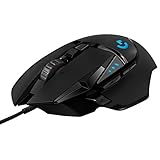
- HERO Gaming Sensor: Next generation HERO mouse sensor delivers precision tracking up to 25600 DPI with zero smoothing, filtering or acceleration
- 11 programmable buttons and dual mode hyper-fast scroll wheel: The Logitech wired gaming mouse gives you fully customizable control over your gameplay
- Adjustable weights: Match your playing style. Arrange up to five 3.6 g weights for a personalized weight and balance configuration
- LIGHTSYNC technology: Logitech G LIGHTSYNC technology provides fully customizable RGB lighting that can also synchronize with your gaming (requires Logitech Gaming Software)
- Mechanical Switch Button Tensioning: A metal spring tensioning system and metal pivot hinges are built into left and right computer gaming mouse buttons for a crisp, clean click feel with rapid click feedback
Plans, products and changing business models
“OnLive” described several products across different periods. A launch-era review cannot be applied unchanged to the later service.
| Product or plan | How it worked | Important qualification |
|---|---|---|
| OnLive Game Service | The main platform for streaming games to supported devices | Catalog and device support were limited by licenses and platform availability |
| PlayPass | Access to an individual game for a defined period or rental-style term | It was access to a hosted service, not a conventional local copy |
| PlayPack | A monthly library subscription, reported in the later period at roughly 250 older games | The included catalog and terms could change |
| CloudLift | A later hybrid model connecting selected streamed games with games owned through Steam | Only selected titles and arrangements qualified |
| OnLive Desktop | A separate streamed remote-desktop product | It was not the same product as the Game Service |
| SL Go | A streamed Second Life experience | It also ended with OnLive’s shutdown |
OnLive underwent major restructuring in 2012, after which subscriptions, individual access and the Steam-linked CloudLift model coexisted. This made the value proposition harder to understand than either a normal console purchase or a conventional PC storefront. TechCrunch’s account of the restructuring and later plans and Ars Technica’s shutdown report describe those changes.
OnLive’s strengths
Low hardware requirements
Because the server did the rendering, a modest PC, Mac or MicroConsole could display games that would otherwise require a gaming computer. This was especially attractive to laptop and Mac owners and to households avoiding a large hardware purchase.
Do these 3 things before closing this tab:
1Repair Windows errors before they cause bigger problems2Fix the driver behind crashes, sound loss and screen glitches3Clear out junk files and repair common Windows errorsFast access
There was no multi-gigabyte installation, local patch cycle or graphics-card upgrade. The convenience was real when the connection was stable.
Broad device ambition
OnLive pursued computers, televisions, tablets and other endpoints at a time when that kind of continuity was unusual. The same account could, in principle, make a game available in several rooms and form factors.
Rank #3

- Next-gen 12,000 DPI HERO optical sensor delivers unrivaled gaming performance, accuracy and power efficiency
- Advanced LIGHTSPEED wireless gaming mouse for super-fast 1 ms response time and faster than wired performance
- Ultra-long battery life gives you up to 250 hours of continuous gaming on a single AA battery
- Lightweight mechanical design and classic shape for maximum maneuverability, durability and comfort
- Compact, portable design with convenient built-in storage for included USB wireless receiver
Trials and spectatorship
Streaming made short trials practical, while viewing other players gave the service a social dimension beyond simply launching a game.
OnLive’s weaknesses
Latency was built into the design
Every input had to reach a remote machine and return as video. Slower genres could tolerate it; precise competitive play generally could not.
Quick wins for a faster PC:
Clear out junk files and repair common Windows errorsFree Scan →Scan for outdated or missing drivers - takes under a minuteDriver Scan →Compression replaced local image quality
Even when controls felt acceptable, the picture could look softer or less detailed than a local render, especially during high-motion scenes.
The internet was part of the console
A local game could remain playable during an outage or household congestion. OnLive could not. Server distance, ISP routing, Wi-Fi conditions and service load all affected play.
Licensing limited the catalog
Publishers had to authorize server-based delivery. Games could be unavailable in a region, removed from a plan or disappear when a license changed.
Rank #4

- ICONIC ERGONOMIC DESIGN WITH THUMB REST — PC gaming mouse favored by millions worldwide with a form factor that perfectly supports the hand while its buttons are optimally positioned for quick and easy access
- 11 PROGRAMMABLE BUTTONS — Assign macros and secondary functions across 11 programmable buttons to execute essential actions like push-to-talk, ping, and more
- HYPERSCROLL TILT WHEEL — Speed through content with a scroll wheel that free-spins until its stopped or switch to tactile mode for more precision and satisfying feedback that’s ideal for cycling through weapons or skills
- 11 RAZER CHROMA RGB LIGHTING ZONES — Customize each zone from over 16.8 million colors and countless lighting effects, all while it reacts dynamically with over 150 Chroma integrated games
- OPTICAL MOUSE SWITCHES GEN 2 — With zero unintended misclicks these switches provide crisp, responsive execution at a blistering 0.2ms actuation speed for up to 70 million clicks
Access was weaker than ownership
Older OnLive purchases depended on OnLive’s servers. When those servers shut down, the practical ability to play those games ended. Some later CloudLift arrangements were associated with Steam, but that did not make every PlayPass or PlayPack entitlement transferable.
Why OnLive failed
Latency alone does not explain the outcome. OnLive had to pay for powerful, geographically distributed servers while also negotiating publisher licenses and persuading customers to accept a new form of game access. Its monetization mixed rentals or individual access, subscriptions, hardware and later Steam-linked streaming. That complexity competed with established consoles and PC stores whose ownership expectations were easier to understand.
The service’s inconsistent performance made the business problem harder: an excellent connection could produce a striking demonstration, while an ordinary congested connection could make the same product feel broken. Financial and commercial pressure led to the 2012 restructuring. In 2015, Sony bought selected technology and patents, and OnLive announced that the Game Service, Desktop and SL Go would remain available only until April 30. TechCrunch reported the closure terms. A UK government cloud-gaming opinion now lists OnLive among services that ceased operation: Competition and Markets Authority opinion (PDF).
Independent reader supportYour contribution helps us test, update, and keep practical guides available for everyone.What happened to the MicroConsole and purchased games?
Can a MicroConsole still be used?
No. It depended on OnLive’s servers, so surviving hardware is a historical collectible rather than a working gateway to the original service. The Register covered the shutdown’s effect on the hardware.
Can old purchases be recovered?
Do not assume so. Games bought through older hosted plans were tied to OnLive and lost server access when the service ended. Some later CloudLift titles were handled through Steam, but the result depended on the specific game, plan, account and purchase date. No general transfer of OnLive purchases to Steam occurred.
PC Slower Than It Used to Be?
A free scan shows the junk files, broken settings and background clutter dragging Windows down - then fixes them in one click.Free scan · Windows 10 & 11Outdated Drivers Are Slowing You Down
One free scan finds every outdated or missing driver and matches the right update for your exact hardware.Free scan · exact hardware matchBest Value

- Pentakill, 5 DPI Levels - Geared with 5 redefinable DPI levels (default as: 500/1000/2000/3000/4000), easy to switch between different game needs. Dedicated demand of DPI options between 500-8000 is also available to be processed by software.
- Any Button is Reassignable - 11 programmable buttons are all editable with customizable tactical keybinds in whatever game or work you are engaging. 1 rapid fire + 2 side macro buttons offer you a better gaming and working experience.
- Comfort Grip with Details - The skin-friendly frosted coating is the main comfort grip of the mouse surface, which offers you the most enjoyable fingerprint-free tactility. The left side equipped with rubber texture strengthened the friction and made the mouse easier to control.
- 5 Decent Backlit Modes - Turn the backlit on and make some kills in your gaming battlefield. The hyped dynamic RGB backlit vibe will never let you down when decorating your gaming space, it would be better with other Redragon accessories with lights on.
- Fatigue Killer with Ergonomic Design - Solid frame with a streamlined and general claw-grip design offers a satisfying and comfortable gaming experience with less fatigue even though after hours of use.
OnLive compared with current cloud-gaming choices
Modern services benefit from better codecs, broadband, hardware and regional infrastructure, but they still depend on latency, bandwidth, licensing and provider continuity. Choose by access model rather than assuming any service is a direct OnLive replacement.
| Service category | Best for | How access works | Main trade-off |
|---|---|---|---|
| NVIDIA GeForce NOW | People who already own supported PC games | Connect supported Steam, Epic, Ubisoft and other storefront accounts | Not every owned game is supported; a subscription does not supply a universal catalog |
| Xbox Cloud Gaming through Game Pass | People wanting an included subscription library | Stream games available in a supported Game Pass plan, device and region | Catalog, features and access vary by plan and region |
| Amazon Luna | Readers willing to verify its current catalog and terms | Amazon’s hosted game service | 2026 changes affecting third-party purchases and subscriptions make ownership particularly important to check |
| Cloud PC services | Users needing a general-purpose remote Windows gaming machine | Rent a virtual PC, then install or connect supported launchers and games | More control and complexity; plans, locations, storage and acceptable-use rules vary |
NVIDIA GeForce NOW
For U.S. pricing listed by NVIDIA’s marketplace, the Free tier is ad-supported; Performance was $9.99 per month or $99.99 per year; Ultimate was $19.99 per month or $199.99 per year; and day passes were $3.99 for Performance and $7.99 for Ultimate. These prices and availability can change, so verify them at signup. Check current GeForce NOW plans. It is a poor fit if you do not own games in supported stores or need a fully included console-style catalog.
Xbox Cloud Gaming
Xbox says cloud gaming requires a supported Game Pass plan, device and region, and a compatible controller for most games. Its guidance lists a minimum 10 Mbps download speed, with some devices requiring 20 Mbps for best quality, and recommends 5 GHz Wi-Fi. See Microsoft’s cloud-gaming requirements and the current Game Pass Ultimate plan. Availability and catalog contents change over time.
Amazon Luna
Verify Luna’s current terms before subscribing. Reporting indicates changes in 2026 affecting third-party-store purchases and subscriptions, with affected titles losing streaming access after June 10, 2026. That makes it a poor choice for anyone specifically trying to avoid the entitlement risk OnLive demonstrated. Open Luna’s official entry point and check the terms for your region.
Cloud PCs
A full cloud PC differs from OnLive’s curated platform: you rent a remote Windows computer and may install launchers, mods and games yourself. It can offer more control, but it is usually more complicated and its price, hardware tier, location and storage limits must be checked for your region.
Final verdict
OnLive proved that high-end games could be streamed to inexpensive hardware, and under ideal network conditions it could feel astonishingly close to local play. It was not, however, a dependable replacement for a local console or PC. Its latency and video quality varied with the connection; its catalog and plans depended on publishers; and its hosted entitlements disappeared when the company closed. OnLive was ahead of its time technologically, but its reliability, economics and ownership model were not ready for a durable mass-market service.
Quick Recap
Product prices and availability are accurate as of the date/time indicated and are subject to change. Any price and availability information displayed on Amazon at the time of purchase will apply.




