Short answer: The Radeon RX 7600 is the most economical 1080p match, the GeForce RTX 4060 is the best choice for Nvidia features and low power, the RX 7600 XT 16GB adds memory headroom, the RX 7700 XT is the balanced 1440p option, and the RX 7800 XT is the strongest 1440p pairing in this shortlist. The right choice depends on your monitor, games, power supply, motherboard PCIe mode and current street price—not a single “bottleneck” percentage.
Best GPUs for a Ryzen 5 5600 at a glance
| GPU | Best target | VRAM | Reference board power | Best for | Main drawback |
|---|---|---|---|---|---|
| AMD Radeon RX 7600 | 1080p high settings | 8GB GDDR6 | 165W; AMD recommends 550W system PSU | Lowest-cost sensible upgrade | 8GB and PCIe 4.0 x8 |
| Nvidia GeForce RTX 4060 | 1080p with DLSS/ray tracing | 8GB | Verify board-partner model | Nvidia software, efficiency and encoding | 8GB; weaker value for pure raster performance when prices are close |
| AMD Radeon RX 7600 XT | 1080p ultra; entry 1440p | 16GB GDDR6 | 190W; AMD recommends 600W | Texture-heavy games and longer ownership | Value depends heavily on its premium over faster cards |
| AMD Radeon RX 7700 XT | 1440p high refresh | 12GB GDDR6 | 245W; AMD recommends 700W | Balanced rasterized 1440p gaming | 12GB and higher power demand |
| AMD Radeon RX 7800 XT | 1440p high/ultra; ultrawide | 16GB GDDR6 | 263W; AMD recommends 700W | Maximum 1440p headroom in this list | Excessive for 1080p/60Hz and needs a suitable PSU and case |
Specifications above are AMD reference figures where stated; partner cards can differ in clocks, dimensions, connectors, cooling and warranty. Check the exact listing before ordering. AMD platform specifications are available at AMD’s processor specifications, while independent performance context is available in Tom’s Hardware’s GPU hierarchy. Historical launch figures such as $299.99 for the RTX 4060 are not August 2026 retail prices.
Is the Ryzen 5 5600 still adequate for gaming?
Yes. The Ryzen 5 5600 remains a six-core, 12-thread AM4 processor with PCIe 4.0 support and a 65W default TDP. Its DDR4 platform makes a GPU-only upgrade attractive when the existing graphics card is the weak link.
CPU limits are scenario-dependent. At 1080p low settings and very high refresh rates, the processor is more likely to cap frame rates, especially in competitive shooters, large-scale strategy, simulations, MMOs and poorly optimized open-world games. At 1440p ultra or 4K, the GPU usually does more work per frame, so cards in the RX 7700 XT and RX 7800 XT class become easier to justify. The same PC can be CPU-limited at 1080p and GPU-limited at 1440p; no universal calculator percentage captures that.
Quick wins for a faster PC:
Fix the driver behind crashes, sound loss and screen glitchesFind Drivers →Repair Windows errors before they cause bigger problemsFix Now →Scan for outdated or missing drivers - takes under a minuteDriver Scan →#1 Best Overall
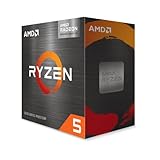
- Play some of the most popular games at 1080p with the fastest processor graphics in the world, no graphics card required
- 4.6 GHz Max Boost, unlocked for overclocking, 20 MB cache, DDR4-3200 support
- For the advanced Socket AM4 platform
Quick buying decisions
- Cheapest good 1080p option: RX 7600, if it is materially cheaper than 16GB or 1440p-class alternatives.
- Nvidia features and low power: RTX 4060 for DLSS, ray tracing, Broadcast, CUDA-dependent software or efficient small-form-factor builds.
- More memory on a budget: RX 7600 XT 16GB when its premium is modest.
- Best balanced 1440p value: RX 7700 XT, provided an RX 7800 XT is not only slightly more expensive.
- Highest 1440p tier here: RX 7800 XT for ultra settings, high refresh or ultrawide displays.
- Newer alternative: Check the RX 9060 XT 16GB and current Nvidia generations against live prices and independent tests before buying an older model.
1. AMD Radeon RX 7600: best economical 1080p pairing
Why choose it
The RX 7600 is aimed at mainstream 1080p gaming and is a proportionate match for a Ryzen 5 5600 targeting roughly 60–144 frames per second rather than extreme competitive refresh rates. AMD lists 8GB GDDR6, a PCIe 4.0 x8 interface, 165W board power and 550W recommended system power for its reference specification. The reference card uses an 8-pin connection, although partner designs should be checked individually. See AMD’s RX 7000 quick-reference specifications.
Limitations and compatibility
Eight gigabytes remains workable for ordinary 1080p play, but newer games using ultra textures or heavy ray tracing can require compromises. Because the card uses only eight PCIe lanes, a B450 board operating at PCIe 3.0 deserves testing rather than an assumption that performance is identical to PCIe 4.0. The card supports Radeon features such as FSR and HYPR-RX, but compare actual ray-tracing and upscaling results with Nvidia at the price you can buy.
Who should skip it
Skip it for a planned 1440p ultra build, a long texture-heavy ownership cycle, or a price close to a substantially faster 12GB or 16GB card.
2. Nvidia GeForce RTX 4060: best Nvidia 1080p pairing
Why choose it
Nvidia positions the RTX 4060 as a mainstream 1080p card with DLSS, hardware ray tracing and a low-power design. Those features, Nvidia Broadcast and CUDA-dependent applications can matter more than rasterized frames for some buyers. Nvidia’s positioning and feature details are documented in its RTX 4060 guide.
Trade-offs
The standard card has 8GB of VRAM. At 1440p, demanding textures or ray-traced settings may need adjustment, and an AMD card can be the better purchase when similarly priced and Nvidia software is not needed. At very high 1080p frame rates, the Ryzen 5 5600 can become the limit before the RTX 4060 does.
Who should skip it
Choose another card when a same-price AMD model delivers materially more raster performance or memory and you do not need DLSS, Nvidia encoding, Broadcast or CUDA.
3. AMD Radeon RX 7600 XT 16GB: best VRAM-conscious budget choice
What the extra memory does
The RX 7600 XT has 16GB GDDR6, a PCIe 4.0 x8 interface, 190W board power and AMD’s 600W reference PSU recommendation. Its principal advantage over the RX 7600 is the larger memory buffer, which can reduce texture-quality compromises in games that exceed an 8GB card’s practical capacity; it does not guarantee a proportional frame-rate increase. AMD lists FSR, HYPR-RX, Fluid Motion Frames, Anti-Lag and Radeon Super Resolution on the RX 7600 XT product page.
Rank #2

- The fastest cores in the world for PC gamers
- A fast and easy way to expand and accelerate the storage in a desktop PC with an AMD Ryzen processor
- For the best possible VR experiences, AMD offers select Ryzen VR-Ready Premium processors
- Unlocked for Overclocking: Yes
AMD’s VRAM guidance places the 7600 XT in a 1080p 16GB category and the 7800 XT in a 1440p/4K 16GB category. That is vendor positioning, not independent proof of every game’s performance.
Value and platform checks
Buy it when the premium over the RX 7600 is modest and memory longevity matters. If its price approaches an RX 7700 XT or RX 9060 XT 16GB, the faster alternative is generally more compelling. Its x8 link also makes PCIe 3.0 behavior on older AM4 boards worth checking.
4. AMD Radeon RX 7700 XT: best upper-mainstream 1440p match
Why it fits 1440p
The RX 7700 XT provides 12GB GDDR6, a full PCIe 4.0 x16 interface, 245W board power, a 192-bit memory bus and 432GB/s bandwidth; AMD’s reference guidance calls for a 700W PSU. It offers considerably more 1440p headroom than the 7600-class cards without moving to an unnecessarily large flagship for many Ryzen 5 5600 systems.
Trade-offs
Twelve gigabytes is a stronger 1440p baseline than 8GB but offers less capacity than 16GB cards. At 1080p and very high frame rates, CPU limits can prevent full utilization. Check whether an RX 7800 XT or newer equivalent is only marginally more expensive, and verify case airflow and the exact partner card’s dimensions.
Best use
This is the balanced pick for a 1440p owner who prioritizes conventional rasterized AAA performance over Nvidia-specific software and ray-tracing features.
What’s actually slowing this PC down?
Pick the symptom - the matching free tool is one click away.
5. AMD Radeon RX 7800 XT: best high-end 1440p pairing
Why it fits the platform
The RX 7800 XT has 16GB GDDR6, a 256-bit interface, PCIe 4.0 x16 support, 263W board power and 624GB/s bandwidth; AMD recommends a 700W system PSU. Its capacity and performance make it the strongest all-around 1440p recommendation in this five-card list, including high-refresh AAA, ultra settings and ultrawide displays.
At 1440p, the heavier GPU workload makes this pairing defensible even though a 1080p bottleneck calculator may show a CPU limitation. CPU-heavy games and competitive settings can still produce weaker minimums, and 4K remains primarily a GPU upgrade with possible processor limits. Pairing context is discussed at PC Bottleneck’s Ryzen 5 5600/7800 XT page, but treat calculators as heuristics rather than measurements.
Rank #3

- AMD's fastest 6 core processor for mainstream desktop, with 12 processing threads. System Memory Type: DDR4
- Can deliver elite 100+ FPS performance in the world's most popular games
- Bundled with the quiet, capable AMD Wraith Stealth cooler
- 4.6 GHz Max Boost, unlocked for overclocking, 35 MB of cache, DDR-3200 support
- For the advanced Socket AM4 platform, can support PCIe 4.0 on X570 and B550 motherboards
When not to buy it
It is poor value for a 1080p/60Hz monitor, a compact case without clearance, an aging or low-quality PSU, or a buyer who mainly wants Nvidia ray tracing, DLSS, Broadcast or CUDA.
Newer cards that can change the ranking
Radeon RX 9060 XT 16GB
The RX 9060 XT 16GB deserves a price-and-performance check before purchasing an older RX 7000 card. AMD’s sales material identifies 8GB and 16GB versions and Radeon features, but its tests use a Ryzen 7 9800X3D rather than a Ryzen 5 5600. It therefore cannot establish CPU-specific results; see AMD’s RX 9060 XT material.
Before replacing a recommendation, verify independent 1080p and 1440p results, U.S. street price, board power, PSU guidance, PCIe width and PCIe 3.0 behavior, ray tracing and upscaling. If the 16GB model costs close to an RX 7700 XT or RX 7800 XT, compare performance rather than buying by capacity alone.
Intel Arc B-series and newer Nvidia cards
Intel Arc B-series cards may offer attractive memory-per-dollar, but Resizable BAR, BIOS configuration, drivers and individual game behavior deserve current testing on the Ryzen 5 5600. Newer Nvidia generations can supersede the RTX 4060 if they offer better raster performance, ray tracing, upscaling, VRAM, efficiency and price. Current product families can be checked at Intel Arc and Nvidia GeForce graphics.
Motherboard, memory, power and case checklist
B450, B550 and X570
- The Ryzen 5 5600 supports PCIe 4.0, but the motherboard and BIOS determine the slot’s actual generation.
- Update BIOS only according to the board maker’s instructions and confirm the processor is supported.
- Enable Resizable BAR or AMD Smart Access Memory when the board, BIOS and GPU support it; treat it as a potential optimization, not a guarantee.
- Pay special attention to the RX 7600 and RX 7600 XT’s PCIe 4.0 x8 interface on PCIe 3.0 boards. Full x16 cards are less exposed to this particular link-width issue.
PSU selection
AMD’s reference guidance is 550W for RX 7600, 600W for RX 7600 XT and 700W for RX 7700 XT and RX 7800 XT. RTX 4060 requirements vary by board partner. These are whole-system recommendations, not isolated GPU draw. Verify the exact model’s connectors, transient guidance, PSU age, protections and reputation; a nominal wattage label alone is insufficient. Quality PSU ranges are available from Corsair, Seasonic and be quiet!.
RAM and physical fit
Use 32GB dual-channel DDR4 if modern games regularly exhaust a 16GB system; it improves consistency but does not substitute for a stronger GPU. Check maximum card length, slot thickness, radiator clearance, power-cable bend space and airflow for the exact partner model. Case ranges from Fractal Design, Corsair and NZXT illustrate why a generic GPU name is not a dimension specification.
Recommended Free Tools
Choose by monitor and game type
1080p, 60Hz
RX 7600 or RTX 4060 is usually sufficient. A 7800 XT makes little economic sense unless you plan a display upgrade or demand maximum settings and substantial headroom.
Rank #4

- Pure gaming performance with smooth 100+ FPS in the world's most popular games
- 6 Cores and 12 processing threads, based on AMD "Zen 5" architecture
- 5.4 GHz Max Boost, unlocked for overclocking, 38 MB cache, DDR5-5600 support
- For the state-of-the-art Socket AM5 platform, can support PCIe 5.0 on select motherboards
- Cooler not included
1080p, 144–240Hz
RX 7600, RTX 4060 or RX 7700 XT can fit, but CPU-heavy games may require an eventual processor upgrade. A stronger GPU is sensible when you will move to 1440p or use demanding visual settings.
1440p, 60–165Hz
RX 7700 XT is the balanced starting point; RX 7800 XT adds ultra-setting and longevity headroom. RX 7600-class cards are better treated as entry-level 1440p solutions with sensible settings.
Ultrawide 1440p and 4K
Favor RX 7800 XT-class performance or a newer equivalent, while remembering that CPU-heavy games can still limit minimum frame rates. At 4K, the workload is usually GPU-led, but the Ryzen 5 5600 is not guaranteed to deliver flagship-tier frame pacing in every title.
Free tools Windows power users keep installed
One-click scans. No signup required.
Should you upgrade the CPU first?
Upgrade the GPU first when the current card cannot meet your 1440p target. Consider an AM4 CPU upgrade such as a Ryzen 7 5700X3D-class part when a strong existing GPU is being held back at 1080p, particularly in simulation or competitive games, and when availability and price are sensible. A complete platform change is more rational for sustained high-refresh 1080p, CPU-heavy workloads or a future high-end GPU. Processor availability should be checked on AMD’s Ryzen pages.
Used-GPU option
Used RX 6800, RX 6800 XT, RTX 3070 and RTX 3080 cards can be attractive, but compare warranty, return policy, mining history, cooler condition, connector requirements, efficiency and VRAM. A cheap older card is not a bargain if its power cost, condition or lack of current features outweighs the purchase saving.
Final verdict
Best budget: RX 7600. Best Nvidia feature set: RTX 4060. Best VRAM-conscious budget choice: RX 7600 XT 16GB. Best balanced 1440p choice: RX 7700 XT. Best high-end 1440p choice: RX 7800 XT. Recheck live U.S. pricing and independent benchmarks on August 16, 2026—or the actual publication date—because the RX 9060 XT 16GB or a newer Nvidia equivalent may offer a better balance. “Best pairing” means the best balance for your resolution, games, PSU, case and upgrade plans, not the fastest card that can physically plug into an AM4 system.
Quick Recap
Product prices and availability are accurate as of the date/time indicated and are subject to change. Any price and availability information displayed on Amazon at the time of purchase will apply.
The Tool Desk
Outbyte Driver Updater FREEScan for outdated or missing drivers - takes under a minuteDriver Scan →Outbyte PC Repair FREEClear out junk files and repair common Windows errorsFree Scan →



