The Ryzen 9 9950X3D is the faster all-rounder. It consistently leads the Ryzen 9 9900X3D in multi-core applications and is generally faster in CPU-limited games, although the gaming gap can range from noticeable to effectively invisible depending on the title, resolution, graphics card, and test settings.
The Ryzen 9 9900X3D becomes sensible only at a substantial discount, or when its lower rated processor power and 12-core layout matter more than maximum performance. For a gaming-only PC, the eight-core Ryzen 7 9800X3D—or a newer or discounted gaming-focused X3D processor—can offer better value.
As an Amazon Associate I earn from qualifying purchases.
Ryzen 9 9950X3D vs. 9900X3D: the short verdict
AMD designed both processors as Zen 5 gaming-and-productivity chips with 3D V-Cache, but they are not equivalent versions of the same CPU. The Ryzen 9 9950X3D has 16 cores and 32 threads; the Ryzen 9 9900X3D has 12 cores and 24 threads. More importantly for games, the 9950X3D has eight cores on its cache-equipped chiplet, while the 9900X3D has six.
What’s actually slowing this PC down?
Pick the symptom - the matching free tool is one click away.
That difference explains the benchmark results better than the processors’ total cache figures do. In games that remain primarily on the cache-equipped CCD, the 9950X3D can use two additional high-cache cores. In rendering, encoding, compiling, simulation, compression, and heavy multitasking, it simply has four more physical cores and eight more threads.
#1 Best Overall

- AMD Ryzen 9 9950X3D Gaming and Content Creation Processor
- Max. Boost Clock : Up to 5.7 GHz; Base Clock: 4.3 GHz
- Form Factor: Desktops , Boxed Processor
- Architecture: Zen 5; Former Codename: Granite Ridge AM5
Independent testing from Tom’s Hardware, TechSpot, GamersNexus, and Puget Systems supports the same broad conclusion: the 9950X3D is the stronger conventional Zen 5 X3D choice, while the 9900X3D’s justification depends heavily on its selling price.
Specifications
| Specification | Ryzen 9 9950X3D | Ryzen 9 9900X3D |
|---|---|---|
| Architecture | Zen 5 | Zen 5 |
| Cores / threads | 16 / 32 | 12 / 24 |
| Base clock | 4.3 GHz | 4.4 GHz |
| Maximum boost | Up to 5.7 GHz | Up to 5.5 GHz |
| AMD-listed total cache | 144 MB | 140 MB |
| Typical processor power | 170 W | 120 W |
| Socket and memory | AM5, DDR5 | AM5, DDR5 |
| PCI Express | PCIe 5.0 | PCIe 5.0 |
| Integrated graphics | Radeon Graphics | Radeon Graphics |
| Launch MSRP | $699 | $599 |
| Launch date | March 12, 2025 | March 12, 2025 |
These specifications come from AMD’s Ryzen desktop processor listings and its official product pages for the 9950X3D and 9900X3D. AMD’s total-cache numbers include both L2 and L3 cache; they should not be described as 144 MB or 140 MB of L3 cache alone. Neither CPU includes a stock cooler.
Why the 9950X3D’s extra cores affect gaming
Both CPUs use two Zen 5 CCDs, with second-generation 3D V-Cache added to one CCD. AMD’s chipset software, Windows integration, and firmware are intended to steer games toward that cache-equipped CCD while allowing background or productivity work to use the other chiplet. PC Gamer’s explanation describes the practical role of this scheduling system.
The cache CCD is not the same size on both processors:
- The 9950X3D has eight cores on its cache-equipped CCD.
- The 9900X3D has six cores on its cache-equipped CCD.
- The 9950X3D also has four additional total cores for workloads that scale across both CCDs.
Consequently, saying that the 9900X3D is “almost a 9950X3D” because both use X3D cache misses the central architectural distinction. The 9900X3D still has 12 physical cores, but the six-core figure refers to the cache-equipped CCD used for game scheduling—not to the whole processor.
Gaming benchmark results
1080p: the biggest separation
At 1080p with a high-end graphics card, CPU differences are easiest to expose. Tom’s Hardware found the 9900X3D slower than the 9950X3D in its gaming suite and specifically linked the result to the smaller six-core cache CCD. The 9950X3D’s advantage is most relevant in games that are sensitive to CPU throughput, cache capacity, simulation work, or large numbers of active game-world objects.
Rank #2

- The best for creators meets the best for gamers, can deliver ultra-fast 100+ FPS performance in the world's most popular games
- 16 Cores and 32 processing threads, based on AMD "Zen 5" architecture
- 5.7 GHz Max Boost, unlocked for overclocking, 80 MB cache, DDR5-5600 support
- For the state-of-the-art Socket AM5 platform, can support PCIe 5.0 on select motherboards
- Cooler not included, liquid cooler recommended
Simulation and strategy games, massively multiplayer games, esports titles targeting very high refresh rates, and some open-world games are more likely to reveal a meaningful difference. Examples include Civilization-style strategy workloads, Anno, Microsoft Flight Simulator, Counter-Strike 2, Rainbow Six Siege, Cyberpunk 2077, Starfield, and games with demanding crowd or physics systems. Results remain game-specific: engine behavior, patches, GPU drivers, memory latency, and scheduling can change the ranking.
Frame rate averages are only part of the story. A processor can post a similar average while producing weaker 1% lows or less consistent frame times. For a high-refresh competitive display, those lows may matter more than a small difference in average FPS. No single review’s result should be treated as universal because the tested game list and configuration determine the geometric mean.
1440p: often close in a real gaming system
At 1440p, the graphics card carries more of the workload. With a flagship GPU, the 9950X3D can still lead in CPU-limited scenes, particularly in simulation, strategy, esports, and open-world titles. With a less powerful GPU or higher visual settings, however, the two processors can become difficult to distinguish during ordinary play.
This is why a 1080p review result should not be converted directly into a promised 1440p improvement. If the GPU is already limiting performance, upgrading from the 9900X3D to the 9950X3D may produce little visible benefit even though the CPU benchmark gap remains real.
4K: usually a GPU comparison
At 4K, most modern gaming systems are predominantly GPU-limited. The 9950X3D remains the more capable processor, but the 9900X3D will often deliver effectively indistinguishable gaming results when both are paired with the same graphics card and the game is rendering at the same GPU-limited settings.
Do these 3 things before closing this tab:
1Scan for outdated or missing drivers - takes under a minute2Clear out junk files and repair common Windows errors3Fix the driver behind crashes, sound loss and screen glitchesThere are exceptions. High-refresh 4K gaming, unusually CPU-heavy simulations, and settings that reduce the graphics workload can expose processor differences. For normal 4K gaming, the money may be better spent on a faster GPU, more storage, or a display upgrade.
Rank #3

- AMD Ryzen 9 9950X3D2 Dual Edition
What about the Ryzen 7 9800X3D?
The 9800X3D deserves inclusion in any gaming-focused comparison. An eight-core X3D processor can match or beat a higher-core-count chip in particular games because gaming performance does not automatically scale with total core count. A PC Guide summary noted a case where the 9800X3D led the 9950X3D in a 720p average, illustrating why broad suite results matter more than product positioning.
The practical rule is straightforward: choose the 9800X3D when gaming is overwhelmingly the workload and it is substantially cheaper. Choose the 9950X3D when the PC must also perform serious multi-core work. The 9900X3D sits between those options, but its smaller cache CCD makes it less compelling as a premium gaming purchase.
Productivity and content creation
The 9950X3D’s advantage is clearer outside games. Four extra cores and eight extra threads improve workloads that can use the entire processor:
- Rendering: Blender, Corona, and V-Ray generally benefit from the 9950X3D’s larger total compute resources.
- Encoding: HandBrake and similar CPU encoders favor the 16-core model when settings scale across many threads.
- Compression: 7-Zip compression and decompression can expose the 9900X3D’s reduced thread count.
- Compiling and simulation: code builds, scientific workloads, and other parallel tasks have more execution capacity on the 9950X3D.
- Multitasking: streaming, recording, browser workloads, asset processing, virtual machines, and creator applications are less likely to compete for the same limited cores.
In Puget Systems’ content-creation testing, the 9950X3D generally behaved similarly to the regular Ryzen 9 9950X and Intel Core Ultra 9 285K, while the 9900X3D more often resembled the regular Ryzen 9 9900X. That does not make the 9950X3D the fastest choice in every application, but it shows that its gaming cache does not require a large productivity sacrifice.
Tom’s Hardware likewise found the Core Ultra 9 285K ahead of the 9900X3D in multi-threaded productivity while the AMD chip retained a gaming advantage. The 9900X3D is therefore a hybrid CPU, not a universally superior workstation processor.
Single-core performance
Lightly threaded applications are likely to produce much closer results than all-core rendering or encoding. Clock behavior, application optimization, memory settings, and boost conditions can decide the winner. The 9950X3D’s higher maximum boost specification does not guarantee a fixed percentage advantage in every single-core test.
Rank #4

- AMD Ryzen 9 9950X3D Desktop Processor, 16-Core, 32-Thread, 5.7 GHz Max Boost, Unlocked for overclocking, L2+L3 144 MB cache, DDR5, Default TDP 170W. The world's fastest gaming processor, built on AMD Zen5 technology and Next Gen 3D V-Cache
- For the state-of-the-art Socket AM5 platform, can support PCIe 5.0 on select motherboards. OS Support: Windows 11/ 10-64-Bit Edition. Cooler & Thermal Solution (PIB) not included. AMD Radeon Graphics Integrated
- MSI MAG X870E Tomahawk WiFi Motherboard, ATX Form Factor, Supports Dual-Channel DDR5 up to 256GB, PCIe 5.0 Supports, 2x PCIe 5.0 x4 M.2 Slot, 2x PCIe 4.0 x4 M.2 Slot, 4x SATA 6GB/s, 2x USB 40Gbps Type C, Wi-Fi 7, Bluetooth 5.4, Windows 11 64-bit Support, Supports AMD Ryzen 9000/ 8000/ 7000 Series Desktop Processors
- Supports DDR5 Memory, Dual Channel DDR5 8400+ MT/s (OC);/ Ultra Performance: 14+2+1 Duet Rail Power System, dual 8-pin CPU power connectors, Core Boost, Memory Boost, 8-layer PCB made by 2oz thickened copper and server-grade level material;/ Frozr Guard: Extended Heatsink, MOSFET thermal pads rated for 7W/mK, additional choke thermal pads and EZ M.2 Shield Frozr II are built for high performance system and non-stop experience
- EZ DIY: EZ M.2 Shield Frozr II, EZ M.2 Clip II, EZ PCIe Release and EZ Antenna;/ Lightning Fast Game experience: PCIe 5.0 slot, Lightning Gen 5 x4 M.2;/ Ultra Connect: USB4 and 5G LAN with Wi-Fi 7 Solution - the latest solution for professional and multimedia use, delivering secure, stable, and high-speed networking and data transmission;/ Audio Boost 5: Reward your ears with studio-grade sound quality for the most immersive gaming experience
For a purchase decision, the more important distinction is workload scaling: if an application regularly uses more than 12 cores, the 9950X3D’s extra resources matter substantially; if it uses only a few threads, the difference may be small.
Outdated Drivers Are Slowing You Down
One free scan finds every outdated or missing driver and matches the right update for your exact hardware.Free scan · exact hardware matchPC Slower Than It Used to Be?
A free scan shows the junk files, broken settings and background clutter dragging Windows down - then fixes them in one click.Free scan · Windows 10 & 11Power, temperature, and cooling
The 9950X3D carries a 170 W typical processor-power rating, compared with 120 W for the 9900X3D. That gives the 9900X3D a potential cooling and power advantage in sustained workloads, but the rating alone does not prove better performance per watt. Efficiency must be calculated from measured performance and measured power under the same conditions.
A fair comparison uses the same motherboard power limits, BIOS settings, memory kit, cooler, thermal interface, fan curve, and ambient conditions. It should report CPU package power, complete-system wall power, peak temperature, noise, and performance per watt separately for gaming and all-core workloads. Different coolers or automatic motherboard settings can erase the validity of a power comparison.
Neither CPU includes a cooler. A quality tower air cooler or liquid cooler is required, especially for sustained 9950X3D rendering or encoding. Cooling capacity also depends on the case, fan curve, ambient temperature, motherboard behavior, and whether Precision Boost Overdrive or Curve Optimizer is enabled.
In one Tom’s Hardware test, PBO improved 9950X3D gaming performance by less than 1%. That is a result from that test configuration, not a universal promise. Stock results should remain separate from tuned results.
The Tool Desk
Outbyte PC Repair FREERepair Windows errors before they cause bigger problemsFix Now →Outbyte Driver Updater FREEFix the driver behind crashes, sound loss and screen glitchesFind Drivers →How to interpret benchmark reviews
Published scores from different outlets should not be averaged as though they came from one controlled test. Reviews can use different BIOS versions, Windows builds, memory timings, GPU drivers, game patches, graphics cards, and benchmark scenes.
Best Value
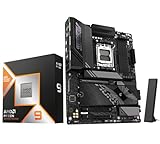
- AMD Ryzen 9 9950X3D Desktop Processor, 16-Core, 32-Thread, 5.7 GHz Max Boost, Unlocked for overclocking, L2+L3 144 MB cache, DDR5, Default TDP 170W. The world's fastest gaming processor, built on AMD Zen5 technology and Next Gen 3D V-Cache
- For the state-of-the-art Socket AM5 platform, can support PCIe 5.0 on select motherboards. OS Support: Windows 11/ 10-64-Bit Edition. Cooler & Thermal Solution (PIB) not included. AMD Radeon Graphics Integrated
- GIGABYTE X870E AORUS Elite Motherboard, AMD Socket AM5, ATX Form Factor, Dual channel memory DDR5 up to 256GB, PCIe 5.0 x16 Support, 3x PCIe 5.0 M.2 Slot, 1x PCIe 4.0 M.2 Slot, 4x SATA 6Gb/s connectors, 2x USB4 USB Type-C, Wi-Fi 7, BLUETOOTH 5.4, Windows 11 64-bit Support, Ready for AMD Ryzen 9000/ 8000/ 7000 Series Processors
- Digital twin 16+2+2 phases VRM solution;/ Dual Channel DDR5: 4*DIMMs with AMD EXPOMemory Module Support;/ WIFI EZ-Plug: Quick and easy design for Wi-Fi antenna installation;/ EZ-Latch Plus:PCIe and M.2 slots with Quick Release & Screwless Design;/ EZ-Latch Click:M.2 heatsinks with screwless design
- Sensor Panel Link:Onboard video port for hassle-free in-chassis panel setup;/ Friendly UI: Multi-Theme, AIO Fan Control, and Q-Flash Auto Scan in BIOS and SW; Ultra-Fast Storage:4*M.2 slots, including 3* PCIe 5.0 x4;/ Efficient Thermal:VRM Thermal Armor Advanced & M.2 Thermal Guard L;/ Reliable Audio:Realtek ALC1220 HD Audio & Audiophile Grade Capacitors
The most useful comparison has:
- Identical motherboard, BIOS, memory, GPU, storage, cooler, and operating-system image.
- Latest stable AMD chipset driver and motherboard BIOS available on the test date.
- Documented Windows Game Mode, hardware scheduling, Resizable BAR or Smart Access Memory, and power-plan settings.
- DDR5-6000 memory with known timings, preferably a validated low-latency EXPO kit.
- At least three benchmark runs, with the median reported.
- Average FPS, 1% lows, and frame-time data rather than average FPS alone.
- 1080p CPU-limited testing plus 1440p and 4K results that show when the GPU becomes the limit.
- Separate stock and tuned configurations.
AMD’s own published performance claims use particular systems, including DDR5-6000, Windows 11, X870E motherboards, and high-end Nvidia GPUs. They are useful as manufacturer claims, but should be labeled AMD internal testing, not presented as independent benchmark evidence. See AMD’s competitive product brief for configuration context.
Scheduling and troubleshooting
X3D processors depend partly on the platform correctly identifying the cache-equipped CCD and directing games appropriately. Software support has improved, but outdated firmware or drivers can affect results.
- Update the motherboard BIOS to a version that supports the processor and current AMD scheduling behavior.
- Install the latest stable AMD chipset driver.
- Bring Windows up to date and verify Game Mode is enabled for gaming tests.
- Confirm memory stability before benchmarking. DDR5-6000 EXPO is common for Ryzen testing, but an unstable EXPO profile can cause crashes and inconsistent frame times.
- Keep background processes consistent. Streaming, recording, browser tabs, antivirus scans, and asset compilation can alter scheduling.
- Do not mix PBO, Curve Optimizer, undervolting, or manual overclocking into stock comparisons.
Symptoms such as unexpectedly low gaming performance, unusual frame-time spikes, or results that vary widely between runs do not automatically indicate a defective CPU. Check BIOS, chipset drivers, Windows settings, memory stability, background load, and whether the game is GPU-limited first.
Recommended Free Tools
Platform and upgrade considerations
Both processors use AMD’s AM5 socket, DDR5 memory, and PCIe 5.0. A current AM5 board with suitable power delivery and BIOS support can host either CPU, but an older board may require a BIOS update before installation. Confirm support on the motherboard manufacturer’s CPU list; compatibility is not guaranteed merely because the socket is AM5.
The real platform cost includes the motherboard, DDR5 kit, cooler, storage, and—if the system is new—a graphics card and power supply. A $100 launch-MSRP difference can be outweighed by a motherboard bundle, memory promotion, BIOS requirement, or cooler purchase. Neither CPU’s launch MSRP should be mistaken for its current retail price.
The Ryzen 9 9950X3D2 Dual Edition launched in April 2026 as a separate, newer dual-cache product. It changes the high-end market context, but it must not be inserted into historical 9950X3D-versus-9900X3D benchmark results. Its price and performance should be evaluated independently in a current buying guide. See AMD’s announcement and PC Gamer’s coverage.
Value and buying decisions
Pricing checked August 16, 2026: the research available for this comparison confirms launch MSRPs of $699 for the 9950X3D and $599 for the 9900X3D, but does not provide a dependable live US retail snapshot. Treat those figures as historical launch prices, not current selling prices. Check the official AMD 9950X3D page and AMD 9900X3D page for current availability and pricing before buying.
Free tools Windows power users keep installed
One-click scans. No signup required.
Use three separate value tests:
- Gaming value: compare the price of each CPU with the same-suite gaming result, ideally using the geometric mean and 1% lows.
- Multi-core value: compare rendering, encoding, compression, or compilation performance per dollar.
- Platform value: include the motherboard, cooler, DDR5 memory, and any BIOS-related cost.
At launch, the $100 gap was too small to make the 9900X3D attractive for buyers seeking both top-end gaming and serious productivity. In 2026, that conclusion depends on actual street pricing. If the 9900X3D is only slightly cheaper, the 9950X3D is the rational upgrade. If the discount is substantial and the workload rarely uses more than 12 cores, the 9900X3D can be defensible.
Quick Recap
Which CPU should you buy?
- Gaming plus demanding workstation work: Ryzen 9 9950X3D. It combines excellent CPU-limited gaming capability with four more cores and eight more threads.
- Gaming plus streaming or occasional creator work: Usually the 9950X3D, unless the 9900X3D is materially cheaper or the work is light.
- Gaming only: Compare the Ryzen 7 9800X3D and current gaming-focused X3D alternatives first. The 9950X3D is justified when its extra productivity capability will be used.
- More than eight cores at lower power: Ryzen 9 9900X3D, but only at a clear discount and with realistic expectations about its smaller cache CCD.
- Productivity first: Compare the 9950X3D with the regular Ryzen 9 9950X. If the non-X3D model is substantially cheaper and games are GPU-limited, it may be the better purchase.
- Existing AM5 owner: Upgrade only if the current CPU limits a high-end GPU, a specific application, or a high-refresh gaming target. Confirm BIOS support and memory stability before ordering.
Product prices and availability are accurate as of the date/time indicated and are subject to change. Any price and availability information displayed on Amazon at the time of purchase will apply.




