Recommended Free Tools
An ancient cistern was a reservoir within a larger water system: channels, rainfall, springs, or aqueducts brought water in, and people drew or distributed it for households, palaces, baths, or irrigation. Their designs and histories differed by place. Alexandria’s medieval reservoirs, Istanbul’s Basilica Cistern, and Carthage’s reservoirs show three distinct ways storage was built into urban infrastructure.
What was an ancient cistern used for?
A cistern stored water until it was needed. Its role depended on the system around it: how water reached the reservoir, how it was kept clean enough for its intended use, and where it went afterward. A cistern might serve a building or neighborhood, or act as a storage and distribution point within a larger city network.
As an Amazon Associate I earn from qualifying purchases.
The examples below are case studies, not a complete catalogue. The word “ancient” also needs care: Alexandria’s featured reservoirs were built in the medieval period, while the Basilica Cistern dates to the sixth century and the Zaghouan–Carthage system to the Roman era.
Do these 3 things before closing this tab:
1Fix the driver behind crashes, sound loss and screen glitches2Repair Windows errors before they cause bigger problems3Scan for outdated or missing drivers - takes under a minuteHow did ancient cisterns collect and distribute water?
Alexandria: seasonal water stored beneath the city
According to the Centre d’Études Alexandrines (CEAlex), Alexandria’s cistern system received Nile floodwater in summer through a canal that began on the Canopic branch about 30 km east of the city; rainwater was also collected in winter. The canal and reservoirs made seasonal supplies available for later use.
#1 Best Overall

- 50-Gallon Capacity: Provides ample storage for harvested rainwater, ideal for watering gardens, lawns, and plants.
- Durable Construction: Made from UV-resistant polyethylene for long-lasting durability and protection from the elements. Made of 100% Recycled plastic.
- Overflow Valve: Built-in overflow valve for managing excess water and the option to connect multiple barrels for increased storage.
- Convenient Spigot: Easy-to-use plastic spigot for quick and efficient water retrieval.
- Low Maintenance: Easy to install and maintain, offering a simple, sustainable solution for homeowners.
CEAlex lists 144 underground reservoirs from documents and excavations, while noting that the exact medieval total is unknown. Around 20 survive today. A separate historical count, reported by CEAlex from Mahmoud Bey el-Falaki, recorded at least 700 cisterns beneath Alexandria in the mid-nineteenth century. These figures describe different periods and records; they should not be treated as a direct survival-rate calculation.
Istanbul: a reservoir serving palace buildings
The sixth-century Basilica Cistern stored water brought by waterways and rain for the Great Palace and nearby structures, according to the Atatürk Library of the Istanbul Metropolitan Municipality. It is an example of a large urban reservoir linked to major buildings rather than a stand-alone water source.
Carthage: reservoirs at the end of a long aqueduct
In present-day Tunisia, the Zaghouan–Carthage system conveyed spring water from Mount Zaghouan and, after a later connection, a spring near Jouggar. The pipeline network was about 132 km long, according to the Austrian Archaeological Institute. Its reservoirs, including La Maalga and Bordj Djedid, stored water for distribution within Carthage, including to the Antoninus Pius Baths.
How were ancient cisterns built?
Alexandria’s masonry reservoirs
CEAlex describes medieval Alexandrian cisterns with masonry walls and interior frameworks of intersecting columns and arches. The arches divided the space into bays that could be covered by masonry vaults. Builders reused architectural elements, including granite column shafts and marble capitals and bases. Hydraulic plaster coated walls, floors, and ceilings to make them watertight. Shafts allowed people to draw water and reach the reservoir for cleaning.
Rank #2
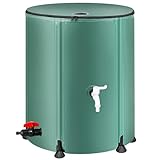
- 【Leak-Proof Design】Unlike typical rain barrels, our product features an integrated design with a straightforward screw-in faucet, eliminating the hassle of assembling multiple parts. This thoughtful construction guarantees a leak-proof system and simple installation
- 【Durable and Sturdy】Our collapsible rainwater collection system is made from premium three-layer PVC material, providing exceptional strength to endure even the toughest conditions. To enhance stability, the rain barrel includes circular footpads, effectively preventing any wobbling or tipping
- 【Easy to Store and Transport】 In contrast to bulky traditional wooden barrels, our rain barrel is foldable, making it easy to carry and store. Say goodbye to heavy, cumbersome containers and embrace convenience. Order our collapsible rain barrel today for effortless water conservation!
- 【Filtering Design】The top of our water storage container is equipped with a mesh design that prevents overflow and keeps leaves and debris out of your clean water. Rainwater collected through the faucet or overflow kit is clearer and can be reused for gardening, farm irrigation, car washing, and more—ideal for eco-conscious individuals
- 【Simple Installation and Exceptional Service】If you encounter any missing or damaged parts during installation, please contact us. We are dedicated to providing prompt replacements to ensure a worry-free experience for our customers
El-Nabih illustrates the scale and layout possible within this tradition. CEAlex gives its interior dimensions as 11.50 by 13 m, about 11 m below today’s ground level, and its operating capacity as 1,200 m³. Three levels of columns and arches gave it the nickname “the underground cathedral.” Excavations and structural analysis place its construction between the 11th and 13th centuries; a substantial restoration probably took place between the 16th and 19th centuries.
The Basilica Cistern’s column grid
The Basilica Cistern is arranged around 336 columns in 28 rows of 12, according to the Atatürk Library. Many columns were probably reused from older buildings. The library describes the structure as about 140 m long and 65 m wide, covering approximately 1,000 m²; it reports a capacity of 80,000 tons. These are the dimensions and capacity stated by that municipal source, not a standardized comparison with the cubic-metre figure for El-Nabih.
Carthage’s aqueduct and storage network
The Zaghouan–Carthage project combined long-distance conveyance with reservoirs and onward distribution. Its cisterns were therefore one part of an engineered network, not isolated tanks. The Austrian Archaeological Institute dates construction of the complex from the second century to the beginning of the third century CE.
Crashes, No Sound, or Screen Glitches?
Random freezes, missing sound and display glitches usually trace back to one bad driver. Find and replace yours safely.Free scan · under a minutePC Slower Than It Used to Be?
A free scan shows the junk files, broken settings and background clutter dragging Windows down - then fixes them in one click.Free scan · Windows 10 & 11How did these cisterns change over time?
Alexandria
CEAlex associates the decline of cistern use in Alexandria with epidemics and insanitary water. A modern water network was installed in the late 19th century. In 1911, the municipality formally prohibited drawing water from cisterns and encouraged their abandonment and filling. This account concerns Alexandria’s system; it does not establish that all ancient cistern water was unsafe.
Rank #3

- RELIABLE LONG-LASTING VERTICAL WATER STORAGE: The Elkhart Plastics 1500 Gallon Water Container is designed for a wide range of applications; Vertical tanks are versatile for bulk water, well water storage, rainwater collection, and fire suppression
- EASY TO USE: 2 16" Manway lids on the water tank give flexibility for top-down plumbing, filtrated catchment, and access; 1.5" fitting at highest point for optimized fill, 2" fittings at lowest point for maximum drainage; Air bleeds allow for max fill
- SAFE FOR DRINKING WATER: UV-resistant HDPE protects against the sun; Dark-colored tank will obstruct light from entering for pure, safe drinking water; Made from virgin polyethylene and compliant with FDA and NSF/ANSI 61 standards
- DURABLE WATER COLLECTION: Banded body and reinforced top make this tough water barrel sturdy and ready for a long service life; Built-in gallon indicators provide easy fill level identification; Rotomolded build is resistant to rust, chips, and cracks
- DELIVERY AND INSTALL: Tank is delivered via freight and may not fit in garage or through small gates; Recommended to sit on reinforced concrete block or pad for stability; Diameter: 72", Height: 94"
Istanbul
The Basilica Cistern later served Topkapı Palace’s needs. Petrus Gyllius rediscovered it in the mid-sixteenth century, and Ottoman rulers carried out repairs. It opened as a museum in 1987. A municipal heritage team resumed restoration in 2020 after work that began in 2016, having identified earthquake-related structural risk.
Carthage and Tunis
Sections of the Zaghouan–Carthage system were repeatedly destroyed and rebuilt from late antiquity onward; from the sixteenth century, parts were used as quarries. Restoration followed in the second half of the nineteenth century. The Austrian Archaeological Institute reports that the system was recommissioned in 1862 and still supplies Tunis, showing that infrastructure of ancient origin can remain in use after substantial repair and alteration.
Independent reader supportYour contribution helps us test, update, and keep practical guides available for everyone.What these examples show
| Example | Water source and route | Storage and construction | Use and later history |
|---|---|---|---|
| Alexandria | Nile floodwater conveyed by canal; winter rainfall also collected. | Underground masonry reservoirs with columns, arches, vaults, and hydraulic plaster. El-Nabih’s operating capacity is 1,200 m³, as reported by CEAlex. | Part of the medieval city’s water supply. Cistern use declined after a modern network arrived; the municipality prohibited drawing water in 1911. |
| Basilica Cistern, Istanbul | Waterways and rain, according to the Atatürk Library. | 336 columns in a 28-by-12 grid; reported capacity 80,000 tons. | Supplied the Great Palace and nearby buildings; later served Topkapı Palace and is now a museum. |
| Zaghouan–Carthage, Tunisia | Springs at Mount Zaghouan and near Jouggar, carried through a pipeline about 132 km long. | Network included the La Maalga and Bordj Djedid cisterns; a comparable capacity figure is not stated by the Austrian Archaeological Institute. | Reservoir water was distributed within Carthage, including to the Antoninus Pius Baths. The restored system was recommissioned in 1862 and still supplies Tunis. |
The comparison makes the central point: “cistern” names a storage function, not one fixed design. Local water sources, urban needs, building traditions, and later repairs shaped each system.
Quick Recap
Product prices and availability are accurate as of the date/time indicated and are subject to change. Any price and availability information displayed on Amazon at the time of purchase will apply.




