Buy the LG 24U411A-B if it is still $99.99 before tax. Its 24-inch-class 1080p IPS panel, 120Hz refresh rate, adaptive-sync support and established-brand support make it the safest all-round choice. Prices below are US observations from August 16, 2026; shipping, tax, cables and accessories are excluded.
Best gaming monitors under $100 at a glance
| Model | Observed price (US) | Panel and size | Resolution / refresh | Sync and inputs | Best for | Main drawback |
|---|---|---|---|---|---|---|
| LG 24U411A-B | $99.99 on LG US, Aug. 16, 2026 | 24-inch-class IPS | 1920×1080, 120Hz | FreeSync-related features; HDMI | Safest overall choice | Tilt-only stand; 1080p only |
| MSI PRO MP251 E2 | Under $100 in Best Buy sale/search signals; verify current price | 24-inch IPS | 1920×1080, 120Hz | Adaptive Sync; DisplayPort, HDMI | Cheaper alternative, speakers | Price, warranty and exact listing can change |
| ViewSonic VX2416 | Requires a sale; published US MSRP about $114.99 | 23.8-inch IPS | 1920×1080, 100Hz | FreeSync; HDMI, DisplayPort, 3.5mm audio | Brand confidence and mixed use | Usually over the strict budget |
| Viewedge 24-inch 144Hz | $89.99 listing observed | 24-inch VA | 1920×1080, 144Hz | HDMI, VGA | Maximum refresh-rate value | Limited evidence on support and motion quality |
Best overall: LG 24U411A-B
The LG 24U411A-B is the best default purchase while LG’s US price remains $99.99 before tax. It combines a 23.8/24-inch-class Full HD IPS panel with 120Hz, AMD FreeSync support, HDR10 signaling, up to 99% sRGB coverage, Dynamic Action Sync and Black Stabilizer.
That combination avoids the most common budget compromises: basic 60Hz operation, a very small 21.5-inch screen and an unknown manufacturer. IPS is a sensible fit for gaming, schoolwork and general desktop use because viewing angles and color consistency are usually more forgiving than on inexpensive VA panels.
The compromises are straightforward. Resolution is 1080p, the stand tilts but does not provide height adjustment, and the advertised “1ms Motion Blur Reduction” is a blur-reduction mode—not proof of a measured 1ms pixel response. LG confirms HDR10 compatibility, but the product page does not establish the brightness, contrast or local dimming needed for convincing HDR, so treat HDR as signal support rather than a reason to buy it.
Outdated Drivers Are Slowing You Down
One free scan finds every outdated or missing driver and matches the right update for your exact hardware.Free scan · exact hardware matchPC Slower Than It Used to Be?
A free scan shows the junk files, broken settings and background clutter dragging Windows down - then fixes them in one click.Free scan · Windows 10 & 11#1 Best Overall

- 【INTEGRATED SPEAKERS】Whether you're at work or in the midst of an intense gaming session, our built-in speakers provide rich and seamless audio, all while keeping your desk clutter-free.
- 【EASY ON THE EYES】 Protect your eyes and enhance your comfort with Blue-Light Shift technology. This feature reduces harmful blue light emissions from your screen, helping to alleviate eye strain during long hours of use and promoting healthier viewing habits.
- 【WIDEN YOUR PERSPECTIVE】Our sleek minimal bezel design ensures undivided attention. The nearly bezel-free display seamlessly connects in a dual monitor arrangement, delivering an unobstructed view that lets you focus on more at once, completely distraction-free.
Best cheaper alternative: MSI PRO MP251 E2
The MSI PRO MP251 E2 is worth choosing when its current price is materially below the LG’s. The listed specification includes a 24-inch Full HD IPS panel, 120Hz, Adaptive Sync, HDR-ready support, DisplayPort, HDMI and built-in speakers.
DisplayPort is useful for desktop PCs, and speakers can simplify a console or temporary setup. Confirm that the listing says MP251 E2, not a similar MSI model, and check the seller, return window, dead-pixel policy and warranty before ordering. Best Buy pricing and stock are promotional signals, not a permanent MSRP.
Best if discounted: ViewSonic VX2416
The ViewSonic VX2416 offers a 23.8-inch IPS panel, 100Hz, FreeSync, HDMI, DisplayPort, a headphone output and a published typical brightness of 250 cd/m². ViewSonic publishes 104% sRGB gamut coverage; that describes gamut size, not color accuracy or factory calibration.
Rank #2
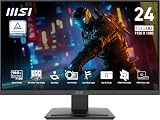
- MSI's 23.8-inch Full HD IPS gaming monitor (1920×1080) delivers a 1500:1 contrast ratio with wide 178°/178° viewing angles — producing deeper blacks, brighter highlights, and accurate colors from virtually any position for gaming and productivity.
- TÜV Rheinland certified Flicker Free and Low Blue Light — eliminating the ~200Hz screen flicker common on standard monitors and reducing harmful blue light exposure to minimize eye strain during extended gaming or work sessions.
- 144Hz high refresh rate delivers ultra-smooth motion and sharper tracking versus standard 60Hz or 75Hz monitors — keeping every frame fluid and responsive for fast-paced FPS, racing, and action games without screen tearing or stuttering.
- MSI's built-in Eye-Q Check provides a vision assessment tool to help optimize display settings for healthier long-term viewing — designed for professionals and students spending extended hours in front of a Full HD IPS screen.
- Tilt-adjustable stand (-5°~20°) for comfortable viewing at any desk setup, with VESA 100×100mm wall mount compatibility for monitor arms, brackets, and multi-monitor arrangements — reducing neck strain during long gaming or work sessions.
ViewSonic’s published US MSRP material places it around $114.99, so it belongs on a strict under-$100 list only when a verified sale brings the pre-tax item price below the limit. Its 100Hz refresh is adequate for everyday gaming, but it is slower than the LG’s 120Hz.
Best maximum-refresh-rate option: Viewedge 24-inch 144Hz
A Best Buy under-$100 listing showed a Viewedge 24-inch FHD 144Hz VA monitor at $89.99, with an advertised 1ms response, 100% sRGB, HDMI, VGA and wall-mount support. On paper, it delivers the highest refresh rate here for the least money.
This is a specification/value alternative, not the editorial winner. The available listing provides limited evidence about quality control, warranty service, stand stability and real response behavior. VA can provide stronger native contrast and darker blacks, but inexpensive VA panels may show dark-level smearing in fast games. Choose it only if 144Hz matters more than established-brand confidence and verified testing.
Rank #3
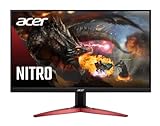
- 23.8" Full HD (1920 x 1080) Widescreen VA Monitor | AMD FreeSync Premium Technology
- Refresh Rate: 165Hz | Response Time: 1ms (VRB) | Pixel Pitch: 0.275mm | Color Saturation: NTSC 72%
- Zero-Frame Design | HDR Ready
- VESA mounting compliant (100 x 100mm) | Ergonomic Tilt: -5° to 15°
- Ports: 1 x Display Port 1.2 and 2 x HDMI 2.0 (HDMI Cable Included)
What $100 realistically buys in 2026
Expect a 21.5- to 24-inch display, 1920×1080 resolution, 100Hz to 144Hz operation, an IPS or VA panel, HDMI and often a basic tilt-only stand. Built-in speakers, DisplayPort and adaptive sync appear occasionally. Height adjustment, USB hubs, USB-C video, credible HDR performance and well-supported 1440p are uncommon at this price.
At 24 inches, 1080p remains a practical balance of sharpness and performance. It suits entry-level GPUs, older systems and esports games where higher frame rates matter. A 27-inch 1080p screen spreads the same pixels over more area and therefore looks less sharp at normal desk distance.
Free tools Windows power users keep installed
One-click scans. No signup required.
Panel, refresh-rate and response-time decisions
IPS versus VA
- IPS: generally wider viewing angles and more consistent color, making it the safer mixed-use choice. Blacks and contrast are often weaker, and IPS glow can occur.
- VA: usually higher native contrast and darker blacks, useful in a dim room. Low-cost models can have narrower viewing-angle consistency and visible dark smearing.
100Hz, 120Hz or 144Hz
All three are meaningful upgrades from 60Hz. Approximate frame intervals are 16.67ms at 60Hz, 10ms at 100Hz, 8.33ms at 120Hz and 6.94ms at 144Hz. The jump from 60Hz to 100/120Hz is easier to notice than 120Hz to 144Hz, so a well-supported 100Hz or 120Hz IPS monitor can be a better purchase than a poorly validated 144Hz model.
Rank #4
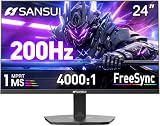
- SANSUI 24 Inch Gaming Monitor 200Hz/160Hz FHD 1080 FreeSync Technology for Game/Office
- Fast & Smooth - 200Hz/160Hz Refresh Rate, 1ms MPRT Response Time; FreeSync technology; CrossHair/Timer/RTS/FPS /RACING game assistants
- Vivid Image Colos - 110% sRGB Color Gamut, HDR, 300cd/m² Brightness, 4000:1 Contrast; Anti-flicker, Anti-Glare, Low Blue Light Eye Care Technology
- HDMI & DP Ports - Easily Connect Gaming or Work Devices, One HDMI Cable Included in the Package. (No Built-in Speakers)
- Trustful Warranty - SANSUI 24 inch 200Hz160Hz 1ms gaming monitor supports a money-back and free replacement warranty from order date within 30 days and lifetime technical support. Any questions please feel free to contact our after-sells support
What “1ms” does—and does not—tell you
GtG pixel response, MPRT blur-reduction response, input lag and refresh rate are different measurements. A retailer’s or manufacturer’s “1ms” claim may refer to an advertised mode, commonly MPRT or aggressive overdrive. Do not rank these monitors from that number alone.
Independent reader supportYour contribution helps us test, update, and keep practical guides available for everyone.Connections and console compatibility
HDMI is the minimum practical connection for consoles and most PCs. DisplayPort is valuable on desktop PCs and may be required for a monitor’s maximum refresh rate or adaptive-sync range. A headphone output can pass audio from HDMI or DisplayPort; built-in speakers, where included, are generally a convenience rather than a quality feature.
VGA is an older analog connection and is not a dependable route to modern high-refresh gaming. A laptop may need a USB-C, HDMI or HDMI-to-DisplayPort adapter, and the adapter, cable, GPU and monitor input must all support the desired mode.
Best Value

- 27-inch Full HD (1920x1080) 1500R curved gaming monitor with ultrafast 165Hz refresh rate designed for professional gamers and immersive gameplay
- ASUS Extreme Low Motion Blur (ELMB ) technology enables a 1ms response time (MPRT) together with Adaptive-sync, eliminating ghosting and tearing for sharp gaming visuals with high frame rates.
- FreeSync Premium technology to eliminate screen tearing and choppy frame rates
- Shadow Boost enhances image details in dark areas, brightening scenes without over-exposing bright areas
- Flexible connectivity options with HDMI (V2.0) and D-Sub
These 1080p HDMI monitors should generally connect to PlayStation, Xbox, Nintendo Switch and PCs, but the available refresh rate depends on the console model, game, HDMI path and settings. Do not assume 120Hz or console variable refresh rate without checking every part of that chain.
What to check before ordering
- Copy the exact model and suffix, such as 24U411A-B or MP251 E2.
- Verify the pre-tax price, shipping charge, seller and expected delivery date.
- Read the return window, dead-pixel policy and warranty terms; marketplace sellers may differ from the manufacturer.
- Confirm HDMI/DisplayPort availability, included cable specification and whether maximum refresh requires DisplayPort.
- Check VESA mounting and stand adjustment. A tilt-only stand may require a separate arm.
- Confirm that Adaptive Sync works over the input and GPU you intend to use.
- After delivery, test solid black, white, red, green and blue screens, backlight uniformity, every input, audio, adaptive sync and the advertised maximum refresh rate.
Set the advertised refresh rate after installation
Windows can default to 60Hz. Open Settings → System → Display → Advanced display → Choose a refresh rate. In NVIDIA Control Panel, use Change resolution and select the monitor under the PC resolution section, then choose the refresh rate. In AMD Software, verify the display mode and FreeSync status. Menus can change between software versions.
Start with the monitor’s normal adaptive-sync mode. Blur-reduction modes can conflict with variable refresh rate, and VRR may flicker at low frame rates or work only through a particular input.
When spending more is sensible
If you can exceed the ceiling by $10–$20, Dell’s E2426H was listed at $109.99 on Dell US with a 24-inch IPS panel, 120Hz, HDMI, DisplayPort and VGA. It is not an under-$100 recommendation, but the extra cost may buy greater brand and support confidence.
Raise the budget further if you need 1440p, USB-C video or docking, a height-adjustable stand, measured high-refresh motion performance or genuinely capable HDR. A refurbished or used monitor can offer more specifications for the money, but panel wear, dead pixels, warranty and return rights become larger risks.
Quick Recap
Product prices and availability are accurate as of the date/time indicated and are subject to change. Any price and availability information displayed on Amazon at the time of purchase will apply.



