
Recommended Free Tools
For an original PlayStation 2, use a properly shielded component (YPbPr) cable and, if your TV has no analog inputs, connect it to a dedicated scaler. The RetroTINK-5X Pro is the strongest all-around documented option: it accepts component and several other analog formats, applies motion-adaptive deinterlacing to 480i game video, and outputs HDMI-compatible 1080p. The simpler RetroTINK-2X Pro is a cheaper line doubler, while a generic PS2-to-HDMI dongle is the lowest-cost route with the greatest variation in image quality, lag and deinterlacing.
The short answer: which PS2 setup should you choose?
Your best connection depends on the display you already own.
As an Amazon Associate I earn from qualifying purchases.
- CRT or older flat panel with compatible analog inputs: connect the PS2 directly. A CRT preserves the original standard-definition scanline presentation.
- HDMI-only TV and the best documented picture: use a component cable with a RetroTINK-5X Pro. It accepts YPbPr, handles the PS2’s frequent 480i output with motion-adaptive deinterlacing, and scales to HDMI-compatible 1080p.
- HDMI-only TV and a lower-cost dedicated scaler: use a component cable with a RetroTINK-2X Pro. It line-doubles compatible signals with zero added latency, but it lacks the 5X’s advanced deinterlacing and is listed as a legacy product.
- Fastest and cheapest setup: use a generic PS2-to-HDMI adapter, commonly priced under $30. It is convenient, but quality, latency and handling of interlaced games vary substantially.
- You already own an enthusiast scaler: OSSC and GBS-C are legitimate alternatives. OSSC is known as a sharp line-doubling path, while GBS-C can be useful with interlaced PS2 content when motion-adaptive deinterlacing is available. The exact result depends on the unit, firmware and display.
Before buying anything, check the TV’s inputs and whether the games you play offer 480p. A scaler must accept the mode the console or game actually outputs; an adapter cannot create a progressive signal that the source never supplies.
What’s actually slowing this PC down?
Pick the symptom - the matching free tool is one click away.
Why the PS2 is difficult for modern TVs
The PlayStation 2 was designed for televisions that handled analog standard-definition signals directly. Many games output 480i, an interlaced format that modern flat panels must deinterlace before displaying. A television’s built-in deinterlacer may produce flicker, combing or visible jitter, and its analog inputs may be absent altogether.
#1 Best Overall

- WORKS WITH PS2 & PS1 — PHAT AND SLIM — Connect your PS2 (both original Phat and Slim models) or PS1 directly to any modern HDTV, monitor, or projector via HDMI. No drivers required. Just plug in and play your classic game library on your modern display within minutes.
- WHAT TO EXPECT FROM THE PICTURE — This adapter converts your PS2/PS1's analog AV signal to HDMI so it works on modern TVs. The PS2 hardware outputs a standard-definition signal (480p max) — the adapter upscales this to 720p for a cleaner look, but cannot go beyond the console's own limits. Great for retro gaming; not a 4K upgrade.
- 4:3 / 16:9 ASPECT RATIO SWITCH — One button to toggle between classic 4:3 and widescreen 16:9 display. Supports 480p and 720p resolution output. Low-latency signal processing for responsive, lag-free gameplay — ideal for action and rhythm games where timing matters.
- POWER REQUIRED — PLEASE READ BEFORE BUYING — This adapter requires an external DC 5V/1A USB power source to operate. A USB cable is included; a USB power adapter is NOT included. Use any standard phone charger or plug into your TV's USB port. No power = no signal output.
- IMPORTANT — PS2 AND PS1 ONLY — Works exclusively via the PS2/PS1 AV output port. Does NOT support PS3, PS4, or PS5. Does NOT work with HDMI capture cards, splitters, or passthrough devices — connect directly from console to TV. Not compatible with BlackMagic brand displays.
A scaler performs two separate jobs. First, it converts or deinterlaces the incoming analog signal into a progressive digital image. Second, it enlarges that image to a format the television accepts over HDMI. Those jobs should not be confused with adding detail: scaling can make a 480-line source fit a 1080p output, but it does not turn the original game into a native high-resolution render.
Interlaced handling is particularly important on PS2 because a simple bob deinterlacer alternates the two fields, making fine details appear to move or shimmer. Motion-adaptive processing analyzes movement and can keep static areas stable while treating moving areas differently. RetroTINK describes the 5X’s deinterlacer as custom-developed for 480i game content, with flicker-free output and no additional lag penalty according to its product description.
Connection options compared
| Path | Inputs and output | 480i handling | Latency information | Setup and cost | Best for |
|---|---|---|---|---|---|
| Direct to CRT or analog-input display | Composite or component, depending on the display | The display handles the original signal; a CRT keeps the native scanline presentation | Not stated for a particular display | No scaler purchase; requires a compatible analog input | Players who already have a working CRT or older flat panel |
| Generic PS2-to-HDMI adapter | PS2 analog output to HDMI | Varies by adapter; inexpensive models can leave interlaced games jittery | Varies by model; cheap units may add lag | Commonly under $30, according to GamesRadar+ in 2026 | Lowest cost and fewest boxes |
| Component plus RetroTINK-2X Pro | Component, S-Video or composite input; HDMI output | Line-doubles 240p, 480i, 288p and 576i; no 5X-style motion-adaptive deinterlacer | Manufacturer states zero added latency | $139.99 listed price in 2026; legacy product; requires at least 5V/1A power | Simple, low-latency HDMI conversion |
| Component plus RetroTINK-5X Pro | Component, RGB, SCART, S-Video and composite input; HDMI-compatible output up to 1080p | Motion-adaptive deinterlacing designed for 480i game content | About 0.25 frames in framelock mode, or 0.25–1.25 frames with triple buffering, according to the manufacturer | $325 listed price in 2026; requires a 5V/2A USB source | Best documented general-purpose setup for original PS2 hardware |
| PS2 HD15 Dongle plus compatible scaler | Passes YPbPr to HD15 RGB lines and carries stereo audio | Does not deinterlace or upscale; the downstream sink does that work | Does not alter timing | $19.99 listed price in 2026; requires a YPbPr-compatible sink with sync on Y/Green | Owners of a compatible HD15 scaler or display |
| OSSC | Depends on the unit and cable configuration; commonly used with component or RGB sources | Sharp line-doubling approach; exact interlaced behavior depends on configuration | Not stated here | Cost and availability depend on the specific unit | Enthusiasts who already own one and want tuning control |
| GBS-C | Depends on the build and installed inputs | Useful for PS2 interlaced content when motion-adaptive deinterlacing is configured | Not stated here | Cost and availability depend on the specific unit | Owners comfortable with a more configurable setup |
Prices are listed figures from 2026 and can change. Availability is especially relevant for the 2X Pro because it is identified as a legacy product.
Option 1: connect directly to a CRT or analog-input TV
When direct connection makes sense
A CRT with the correct composite or component sockets needs no HDMI conversion. The screen accepts the console’s analog timing as intended, and the visible scanline structure is part of the original presentation. An older flat panel with matching inputs can also work, although its internal processing may not look as natural as a CRT.
What you need
- A working PS2 and its matching AV connector.
- Composite cable for a yellow video input, or component cable for red, green and blue video inputs plus the red-and-white audio pair.
- A display that explicitly accepts that format. Component video is not interchangeable with composite video simply because both use RCA-style plugs.
Connection steps
- Turn off the PS2 and display.
- Connect the video plugs to the matching color-coded inputs. Connect the red and white audio plugs to the display or an audio receiver.
- Choose the corresponding input on the display.
- Power on the display and then the PS2. Keep the aspect ratio at 4:3 unless your particular display arrangement requires another setting.
This route is the least complicated, but it does not solve the practical problem of finding and maintaining a working CRT. It also leaves you with standard-definition output rather than an HDMI signal for a current television.
Option 2: use a generic PS2-to-HDMI adapter
Why people choose it
A dongle is a single small purchase and avoids a separate scaler, analog cable run and power supply. The cited 2026 buying guide places common models under $30, making this the lowest-cost path for an HDMI-only TV.
Rank #2

- 🎮HD LINK🎮Convert and upscale the analog RGB signals to digital HDMI signals for modern HDTVs/monitors/projectors, which makes the HD link cable compatible with classic PS1, PS One, Fat PS2, Slim PS2
- 🎮EASY TO USE🎮Plug and play with well-prepared cables. Detachable design, so high-end or extended HDMI cables can be used
- 🎮AWESOME IMAGE🎮Provide the best upscaled signal processing with great precision, colors, resolution and details at this price
- 🎮ASPECT RATIO SWITCH & LOW LATENCY🎮Support 4:3 and 16:9 with a toggle switch & unnoticeable lag when playing games
- 🎮ONE-YEAR WARRANTY🎮Offer the free replacement without asking and helpful customer service
What the price does not guarantee
“HDMI” describes the connector, not the quality of the conversion. Cheap adapters can soften the image, add processing delay or produce unstable-looking interlaced games. Their deinterlacing method, output resolution, audio behavior and compatibility with different televisions are not uniform. If a game looks jittery or the TV reports an unusual signal, the dongle may be the limiting component rather than the PS2.
When it is acceptable
- You want the fewest components and are willing to accept variable results.
- You mainly play titles whose output is already progressive and your particular adapter handles that mode correctly.
- You are testing whether the console works before investing in a dedicated scaler.
Use the television’s game mode if it has one, preserve 4:3 geometry, and do not assume the adapter has improved the underlying resolution merely because its output is labeled 720p or 1080p.
Option 3: component cable with the RetroTINK-2X Pro
What it does
The 2X Pro accepts component, S-Video and composite signals and line-doubles 240p, 480i, 288p and 576i to HDMI. The manufacturer states that this process adds zero latency. For a PS2, that makes it a straightforward upgrade over a generic dongle when you want predictable conversion without buying the larger 5X model.
Important limitation
Line doubling is not the same as the 5X’s motion-adaptive treatment of 480i. Interlaced games can therefore retain more of the limitations associated with a simpler deinterlacing path. The 2X Pro is also listed as a legacy product, so check current availability before designing a new setup around it.
Installation
- Connect a quality PS2 component cable to the console and the red, green and blue inputs on the 2X Pro. Connect the red and white audio plugs as directed by the scaler’s labeling.
- Connect the scaler’s HDMI output to an open TV input.
- Provide at least a 5V/1A power source as specified for the 2X Pro.
- Select the scaler’s HDMI input on the TV and set the TV to 4:3.
Option 4: component cable with the RetroTINK-5X Pro
Why it is the strongest all-around documented choice
The 5X accepts component, RGB, SCART, S-Video and composite, so it can serve more than one retro console without replacing the unit. For PS2 owners, its key feature is the motion-adaptive deinterlacer designed specifically around 480i game content. It outputs HDMI-compatible video up to 1080p, giving modern televisions a signal they generally accept more reliably than raw analog video.
PC Slower Than It Used to Be?
A free scan shows the junk files, broken settings and background clutter dragging Windows down - then fixes them in one click.Free scan · Windows 10 & 11Outdated Drivers Are Slowing You Down
One free scan finds every outdated or missing driver and matches the right update for your exact hardware.Free scan · exact hardware matchLatency and power
RetroTINK lists approximately 0.25 frames of latency in framelock mode and 0.25–1.25 frames with triple buffering. Those are manufacturer figures, not an independent laboratory measurement. The listed price is $325 in 2026, and the unit requires a 5V/2A USB power source.
Rank #3

- Avoid Black Screen – Easy Setup Required: Make sure to set your PS2 output to YPbPr/YCbCr (component mode) before using this HDMI converter. Search “How to set up PS2 to HDMI adapter” online to avoid black screen or “out of range” errors..
- Wide Compatibility – Works with HDTVs & Monitors: This PS2 to HDMI adapter supports all standard PS2 display modes (480i, 480p, 576i) and connects seamlessly to HDTVs, HDMI monitors, projectors, and more for a great gaming experience.
- High-Definition Video & Audio Output: Enjoy crystal-clear digital video and audio via HDMI with perfect sync. This converter only supports YPbPr/YCbCr signals (component), delivering lossless quality for your classic PS2 games. (Note: CVBS signals are not supported.)
- Designed for Original PS2 Consoles Only: Our converteronly compatible with PS2 console models (10000/ 30000/ 50000/ 70000 series). Not for PS2 90000 consoles. If your PS2 has been hardware- or software-modified, the PS2 HDMI adapter may not function correctly, potentially resulting in a black screen or loss of signal.
- Plug & Play with USB Power Supply: No drivers needed. Simply connect the converter between your PS2 and display, with no complex drivers required, this PS2 to HDMI converter ensures a straightforward installation for a seamless gaming experience.
Installation steps
- Run the PS2’s component cable from the console to the 5X’s YPbPr inputs. Use the matching red, green and blue video connectors and the associated stereo-audio connections.
- Connect the 5X’s HDMI output to the television.
- Connect a 5V/2A USB power source to the scaler before powering the PS2.
- Select the correct input on the 5X and the matching HDMI input on the TV.
- Set the display to 4:3. If the game supplies a progressive mode, confirm that the 5X and TV accept it before selecting that mode.
The 5X is not a magic high-resolution renderer. Its advantage is a cleaner, more stable conversion of the PS2’s existing signal, especially when the source is interlaced.
Option 5: the PS2 HD15 Dongle
What it is
The PS2 HD15 Dongle is a pass-through accessory, not an upscaler. RetroTINK lists it at $19.99 in 2026. It routes YPbPr to HD15 RGB lines and carries stereo audio without upscaling or changing the timing.
Compatibility requirements
- The PS2 or PS3 must be configured for YPbPr rather than RGB.
- The receiving display or scaler must accept YPbPr over the HD15 connection.
- The sink must support sync on Y/Green.
If any of those conditions is missing, the dongle is not a complete HDMI solution. It is useful when you already own a compatible scaler or display, but buying it alone will not convert a PS2 signal for an ordinary HDMI-only television.
OSSC and GBS-C: when alternatives make sense
OSSC
OSSC is a legitimate enthusiast route when you already have one or want a sharp line-doubling design with manual tuning. Its suitability depends on the exact input board, cable and television. Treat it as a configurable tool rather than a guaranteed plug-and-play PS2 answer, and verify that your chosen setup accepts the console’s 480i output.
GBS-C
GBS-C can be attractive for PS2 owners who care about interlaced material because motion-adaptive deinterlacing can reduce the jitter associated with simpler field handling. Builds and configurations vary, so cost, connectors, firmware and output behavior are not a single fixed specification. It is most sensible for someone comfortable checking compatibility and tuning options.
Choose the right cable before choosing the scaler
Component is the practical baseline
For original PS2 hardware, component (YPbPr) is the recommended quality baseline. Use a cable with proper shielding and the correct PS2 connector. A poor cable can introduce visible noise or make troubleshooting harder, while a scaler cannot recover detail or stability lost before the signal reaches it.
Rank #4
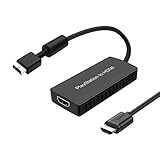
- PS2 Adapter: Convert PlayStation1/2/3 signal to HDMI signal (sony playstation game console connection to HDTV)
- No need to install drivers, portable, flexible, plug and play.
- PS2 to HDMI Converter: Support HDMI 16:9/ 4:3 output switch.
- NOTE: Compatible with PlayStation1/2/3 only.(Note: It's just a converter, you also can play PS1 games on PS2)
- RGB signal mode display. Video signal transfer only, can't improve the video quality.
Match the PS2’s output setting
The PS2 system menu distinguishes RGB and component output. A component cable connected while the console is set to RGB can produce a blank or unusable picture, and the reverse mismatch can do the same. Set the console’s output type to match the cable and the downstream device.
Composite is a fallback
Composite is widely compatible and works with the 5X and 2X Pro, but it combines the video information into one signal and is generally less clean than component. Use it when the cable or display options leave no better path; do not choose it merely because the plugs look familiar.
Complete setup procedure for an HDMI-only television
Step 1: inventory every input
- Look at the TV’s rear and side panels and write down whether it has HDMI, component, composite or another analog input.
- Check whether the television accepts 480p over the connection you intend to use.
- Confirm that the scaler’s output resolution is accepted. The 5X outputs up to HDMI-compatible 1080p; the 2X Pro outputs a line-doubled HDMI signal.
Step 2: select the signal path
Choose direct analog connection for a compatible CRT, a generic dongle for minimum cost, 2X Pro for simple dedicated line doubling, or 5X for broad input support and the strongest documented 480i processing.
Step 3: connect video and audio separately where required
Component uses three video channels plus separate stereo audio. Make sure the red audio plug is not confused with the red component-video plug; color coding is not always enough when a scaler places both near each other. Follow the labels on the scaler and cable.
Step 4: power the conversion device
The 5X needs a 5V/2A USB source. The 2X Pro needs at least 5V/1A. A passive cable or the PS2’s own power lead cannot substitute for the scaler’s required supply.
Do these 3 things before closing this tab:
1Clear out junk files and repair common Windows errors2Fix the driver behind crashes, sound loss and screen glitches3Repair Windows errors before they cause bigger problemsStep 5: set the console and display
- Set the PS2 output mode to match the cable: component for YPbPr, RGB for an RGB path.
- Select the scaler’s input and the television’s corresponding HDMI input.
- Choose 4:3 aspect ratio on the TV or scaler unless a particular game and display arrangement justify another mode.
- Enable the TV’s low-latency or game-oriented picture mode if available, then judge the result in an actual game rather than only at the console menu.
What to do if the picture is blank, unstable or wrong
Blank screen immediately after changing cables
The most common documented cause is an RGB/component setting mismatch. If the screen went blank after changing adapters or cables, navigate blindly to the PS2 system configuration menu and switch the output type to match the connected cable. If that does not restore the image, power down, reseat every plug and verify that the scaler is on the intended input.
Best Value

- Composite to HDMI Converter: Converts analog AV composite (Yellow, White, Red) input to HDMI 720P/1080P (60HZ) output, displayed on smart TV, Projector or HD Display, which bring back your old and cherish memories.
- Plug to Play: This HDMI Converter no extra drivers need, just plug and play,easy to use. Please hook up the USB Power Cable (included) to 5V power source during use. Note: The Video Converters only support converts AV to HDMI, can't converts HDMI to AV.
- Widely Used: This composite to hdmi adapter is widely applied to PS1, PS2, PS3, Xbox, N64, Wii, STB, VHS, VCR, DVD Players and other devices with standard composite AV input. Note: It can only be used when PS2 is set to RGB output.
- Wide Compatibility: This Video Audio Converter Adapter supports source formats of PAL, NTSC3.58, NTSC4.43, SECAM, PAL/M, PAL/N standard TV. Provide advanced signal processing with great precision, colors, resolutions, and details. Important Note: This converter can't improve video quality!
- Attention & Package: Please ensure to connect this av hdmi converter to power source to make it work. Package include: 1*AV to HDMI Adaptor, 1*USB Power Cable(adapter not included), 1*User Manual.
Picture appears but games shimmer or jitter
First determine whether the game is outputting 480i. A basic dongle or line-doubling path may not handle interlaced motion gracefully. Move to a scaler with motion-adaptive deinterlacing, such as the documented 5X approach, or use a GBS-C configuration designed for interlaced content. Do not assume a higher HDMI label fixes field-motion artifacts.
Image is soft
Check whether you are using composite or a low-quality generic adapter. Replace the adapter with a properly shielded component cable and a dedicated scaler. Also verify that the TV is not applying an additional overscan or sharpness mode that exaggerates softness or ringing.
No sound
Component video does not carry audio. Confirm that the red and white stereo plugs are connected to the scaler or an audio input that follows the selected HDMI path. With the HD15 Dongle, remember that audio is carried separately even though the video uses the HD15 connection.
Free tools Windows power users keep installed
One-click scans. No signup required.
TV reports “no signal” after selecting 480p
Not every game offers 480p, and not every scaler or television accepts every timing. Return to the game’s standard video mode, then verify compatibility before enabling progressive output again. A scaler can only pass or convert modes within its supported range.
Picture is stretched
Set the television and scaler to 4:3. Widescreen stretching changes the geometry of the original game and is not an improvement in resolution.
Scaler repeatedly resets
Check the required USB supply: at least 5V/2A for the 5X or 5V/1A for the 2X Pro. Connect the power source directly as specified, then reseat the HDMI cable and test another TV input.
How to decide based on budget and priorities
| Your priority | Recommended path | Trade-off |
|---|---|---|
| Spend as little as possible | Generic PS2-to-HDMI adapter, commonly under $30 | Unpredictable image quality, latency and interlaced handling |
| Use a CRT you already own | Direct composite or component connection | Standard-definition output and the inconvenience of aging hardware |
| Dedicated scaler at the lower listed price | Component plus RetroTINK-2X Pro, $139.99 listed in 2026 | Legacy availability and simpler deinterlacing than the 5X |
| Best documented general-purpose conversion | Component plus RetroTINK-5X Pro, $325 listed in 2026 | Higher cost and a separate 5V/2A power requirement |
| Reuse an existing compatible HD15 setup | PS2 HD15 Dongle, $19.99 listed in 2026 | Pass-through only; requires a YPbPr-compatible sink with sync on Y/Green |
| Customize an enthusiast system | OSSC or GBS-C | More configuration and no single guaranteed specification across builds |
These are listed prices and broad use cases, not a promise of current stock or universal television compatibility. Recheck availability and the exact input requirements before ordering.
Practical picture-quality checklist
- Prefer component/YPbPr over composite when the console, cable and scaler support it.
- Use a cable with proper shielding and a correctly fitted PS2 connector.
- Match the PS2’s RGB or component setting to the cable.
- Use motion-adaptive deinterlacing for 480i-heavy libraries when possible.
- Keep the output at 4:3 unless you have a deliberate reason to change it.
- Confirm 480p support for both the game and the scaler before selecting progressive mode.
- Supply the scaler with the specified voltage and current.
- Judge latency in a game, not from the HDMI label or the scaler’s output resolution alone.
Bottom line
For most original-PS2 owners with a modern HDMI television, the dependable path is a quality component cable into a dedicated scaler. The RetroTINK-5X Pro is the most capable documented choice because it combines broad analog-input support, motion-adaptive 480i deinterlacing and HDMI-compatible 1080p output. The RetroTINK-2X Pro is a simpler, lower-cost line doubler if its legacy availability and basic interlaced handling meet your needs. A generic HDMI dongle is reasonable only when low cost and minimal setup outweigh consistency. The PS2 HD15 Dongle belongs in a compatible existing scaler chain; by itself, it does not upscale or create an HDMI signal.
Quick Recap
Product prices and availability are accurate as of the date/time indicated and are subject to change. Any price and availability information displayed on Amazon at the time of purchase will apply.

