Yes. PSVR2 can display ordinary, non-VR PS5 games in Cinematic Mode on a large virtual flat screen inside the headset. It does not turn them into VR games: there is no VR world, head-tracked gameplay or automatic motion-control support. You’ll normally play with a DualSense controller, and the connected TV goes black while Cinematic Mode is active.
What Cinematic Mode does—and what it doesn’t
Cinematic Mode puts the PS5 interface, supported media apps and standard games on a virtual screen in front of you. It can make the image feel like a personal cinema display, but the game still runs as a conventional PS5 title. Its camera and controls behave as the game was designed to behave.
That is different from a native PS VR2 game, which is built to render a VR environment and may use headset tracking and PS VR2 controls. Sony describes Cinematic Mode and its virtual screen on its Cinematic Mode support page.
- Cinematic Mode: a standard 2D game or app displayed on a virtual screen.
- Native PS VR2 mode: a game designed to render and play in VR.
Sony lists 1920×1080 HDR content and 24Hz, 60Hz and 120Hz options for Cinematic Mode on its PS VR2 features page. Its video-output guide also describes the headset image as reaching up to 2K per eye. Those specifications describe display and output capabilities; they do not mean a standard game is rendered at native 2K per eye or that every game supplies 4K HDR. HDR and 120Hz depend on the game and console output settings.
#1 Best Overall
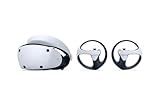
- PlayStation VR2 Sense technology: Eye tracking. Headset feedback. 3D Audio. Highly intuitive controls – Haptic Feedback, Adaptive Triggers and Finger Touch Detection
- Cutting-edge performance
- 4K HDR visuals
- 110º field of view
- Advanced graphical rendering
Which games and content work?
If a normal, non-VR game runs on your PS5, it can generally be displayed through Cinematic Mode, subject to the game running normally on the console and any title-specific requirements. Native PS VR2 games use VR mode instead. The distinctions matter for older content and consoles:
| Content | PSVR2 compatibility | How it appears |
|---|---|---|
| Normal PS5 game | Generally yes, if it runs on your PS5 | Flat virtual screen in Cinematic Mode |
| Native PS VR2 game | Yes, if the title supports PS VR2 | VR mode |
| Original PS VR game | No, PSVR2 cannot play PS VR content | Not playable as PS VR content on PSVR2 |
| PS4 console | No, PSVR2 is designed for PS5 | Not supported on a PS4 console |
Check a specific title’s platform and VR requirements rather than assuming that all PS4 games or original PS VR titles carry over. Sony’s compatibility guide covers console, game and controller compatibility.
PS5 menus and supported media apps can also appear on the virtual screen. Services such as Netflix are examples of PS5 media apps, but app availability and playback restrictions can vary by service, account, region and software version. Sony describes games and entertainment on the virtual screen in its feature overview.
How to start a normal PS5 game
- Turn on the PS5 and PSVR2. If the headset is not connected, plug its supplied USB-C cable into the PS5’s front USB-C port.
- Put on the headset and follow any on-screen setup prompts.
- From the PS5 home screen, select a non-PS VR2 game or a supported media app. It appears on the virtual screen; there is no separate command to convert the game to VR.
- Use the controller the game normally requires—usually the DualSense wireless controller.
Sony’s PS VR2 support hub covers the USB-C connection and setup.
Quick wins for a faster PC:
Clear out junk files and repair common Windows errorsFree Scan →Scan for outdated or missing drivers - takes under a minuteDriver Scan →Repair Windows errors before they cause bigger problemsFix Now →Controllers, screen controls and headset settings
Use the DualSense for ordinary games
Do not expect the two PS VR2 Sense controllers to replace the DualSense in a standard PS5 game. Use the controller the game normally supports, typically DualSense. For native PS VR2 games, controller support varies by title. Sony explains the distinction in its PS VR2 compatibility guide.
Resize and reposition the screen
To open PS VR2 Quick Settings, press the PS button and select the PS VR2 Quick Settings card. Screen size, brightness and headset vibration are among the available controls. To recenter or reposition the virtual screen, press and hold the Options button on the right Sense controller. You can also change screen size through Cinematic Mode settings. See Sony’s Cinematic Mode instructions.
Check the room without removing the headset
Use the headset’s Function button or Quick Settings to open See-Through View. It lets you check your surroundings; it does not change how the game plays. Keep the cable clear and the controller within easy reach.
Rank #2

- PlayStation VR2 Sense technology: Eye tracking. Headset feedback. 3D Audio. Highly intuitive controls – Haptic Feedback, Adaptive Triggers and Finger Touch Detection
- Cutting-edge performance
- 4K HDR visuals
- 110º field of view
- Advanced graphical rendering
Set HDR or 120Hz output
These are output options, not promises that a game supports HDR or runs at 120 frames per second. Game performance and image presentation remain title-dependent.
Free tools Windows power users keep installed
One-click scans. No signup required.
- For HDR: open Settings > Accessories > PlayStation VR2 > Cinematic mode, select Video Output for Cinematic Mode, then choose HDR output.
- If 120Hz is unavailable: open Settings > Screen and Video and change 120 Hz Output from Automatic to Off. Then go to Settings > Accessories > PlayStation VR2 > Cinematic mode, select Video Output for Cinematic Mode and set 120 Hz output.
Those paths and the workaround are documented in Sony’s PS VR2 video and audio output guide.
Audio in Cinematic Mode
You can use PSVR2 audio for private listening. Cinematic Mode’s Lock Audio Position setting can keep the audio position fixed relative to the direction you are facing. PS5 3D Audio for Headphones is a separate feature that depends on compatible headphones and game support; it does not make flat gameplay into VR. Sony documents the audio controls in its Cinematic Mode guide and video and audio output guide.
What happens to the TV and multiplayer?
In Cinematic Mode, the connected TV screen turns black and the social screen is disabled, according to Sony’s video-output guidance. The headset gives you a private view, but spectators may not be able to follow the game on the TV. That can make local multiplayer or shared viewing inconvenient.
Online multiplayer works according to the game’s usual PS5 requirements, including its network, account and any applicable subscription rules. For local play, another player may need a separate controller, and whether the game remains practical depends on its mode and the lack of a visible TV image. Check the individual game rather than assuming a single multiplayer or subscription rule applies to all titles.
What’s actually slowing this PC down?
Pick the symptom - the matching free tool is one click away.
The black TV output does not mean all capture features are disabled: Sony says screenshots, gameplay video capture and the Create menu remain available. See its PS VR2 features page.
Independent reader supportYour contribution helps us test, update, and keep practical guides available for everyone.Do you need a VR play area?
Room-scale boundaries are not used for Cinematic Mode, so the 2m × 2m (6 ft 7 in × 6 ft 7 in) space Sony specifies for room-scale VR is not a requirement for playing a standard game on the virtual screen. That dimension applies to room-scale games and apps, as described in the compatibility guide.
For a controller-based game, playing seated is a practical choice. Keep the headset cable clear, leave the controller close by and use See-Through View when you need to check the room.
Is Cinematic Mode better than a TV?
It depends on what you want from the session. The headset can provide a personal, large-feeling screen when the TV is occupied or unavailable, and lets you listen privately. It is not automatically a better display: fit, lenses, brightness, text size and personal comfort affect the experience, and image quality cannot be ranked universally against a television from specifications alone.
Recommended Free Tools
- Consider Cinematic Mode for solo play, a private screen or a room without a convenient display.
- Prefer a TV or monitor if you want spectators to see the game, are playing local multiplayer, need to see the room easily, or find headset weight, heat or small text uncomfortable.
Even a non-VR game can feel uncomfortable for some people when viewed through a headset. Take breaks if you experience nausea, disorientation or other discomfort; Sony’s PS VR2 safety information warns about these symptoms and says the headset is not for children under 12.
What to try if something is wrong
The game does not appear
- Check that the headset is connected to the PS5 and that the title is a standard PS5 game or supported media app, not original PS VR content.
- Restart the PS5 and headset, and check for system software updates.
- If there is still no image, use Sony’s PS VR2 support hub for troubleshooting guidance.
The screen is off-center
Press and hold the Options button on the right Sense controller to reset its position, as described in Sony’s Cinematic Mode guide.
120Hz is unavailable
Follow the console and Cinematic Mode settings sequence above: set Settings > Screen and Video > 120 Hz Output to Off, then enable 120Hz under Cinematic Mode’s video output settings. This selects an output mode; it does not guarantee a game renders at 120 frames per second. Sony’s full steps are in its video-output guide.
Audio seems detached from the screen
Check Lock Audio Position in Cinematic Mode settings. If your setup and game support it, you can also review Settings > Sound > 3D Audio for Headphones.
Windows Errors? Fix Them Before They Spread
Repair common Windows errors and clear accumulated junk for a smoother, more stable PC - no reinstall needed.Free scan · no reinstallCrashes, No Sound, or Screen Glitches?
Random freezes, missing sound and display glitches usually trace back to one bad driver. Find and replace yours safely.Free scan · under a minuteQuick Recap
Product prices and availability are accurate as of the date/time indicated and are subject to change. Any price and availability information displayed on Amazon at the time of purchase will apply.



