
For current PlayStation 5 and Xbox Series X|S consoles, storage is the practical upgrade; RAM is not. Console RAM is integrated and fixed at manufacture, so players cannot add memory later. A larger or faster compatible SSD can keep more games installed and preserve the high-speed data streaming modern games expect, but it does not generally raise frame rates. FPS is primarily limited by the console’s fixed CPU, GPU and memory design, plus the game’s own performance modes.
Choose a console with the memory and graphics capability you need, then expand storage when capacity, transfer time or loading convenience becomes the problem. The correct expansion depends on the platform: PS5 accepts a compatible internal M.2 SSD up to 8TB, while Xbox Series X|S uses Storage Expansion Cards for internal-SSD-class performance.
As an Amazon Associate I earn from qualifying purchases.
RAM and storage solve different problems
RAM and storage are both measured in gigabytes, but they are not interchangeable. Their locations in the data path, speed characteristics and upgrade options are different.
What’s actually slowing this PC down?
Pick the symptom - the matching free tool is one click away.
RAM is the console’s active workspace
Random-access memory holds the data the operating system, game code, graphics workloads and current scene need immediately. Its capacity determines how much information can remain readily available; its bandwidth determines how quickly that information can be moved between the processor, graphics hardware and memory.
#1 Best Overall

- FASTEST, MOST POWERFUL XBOX — Experience next-generation performance with 12 teraflops of processing power, delivering smoother gameplay, richer worlds, and faster responsiveness than any previous XBOX.
- TRUE 4K GAMING UP TO 120 FPS — Enjoy breathtaking visuals with true 4K resolution, HDR, and frame rates up to 120 FPS, plus hardware-accelerated ray tracing for a heightened level of realism.
- 1TB CUSTOM SSD AND XBOX VELOCITY ARCHITECTURE — Reduce load times dramatically with the custom 1TB NVMe SSD and XBOX Velocity Architecture, enabling lightning-fast performance and seamless world streaming.
- QUICK RESUME — Seamlessly switch between multiple games and resume exactly where you left off. No more waiting through title screens and loading bars.
- FOUR GENERATIONS OF GAMES — Play thousands of games from XBOX Series X|S, XBOX One, XBOX 360, and Original XBOX, with many titles enhanced for better visuals and performance on XBOX Series X.
Modern consoles use a shared, high-bandwidth memory pool rather than a user-replaceable desktop-style DIMM. The game and system software divide that pool according to the console’s hardware design. Microsoft lists Xbox Series X with 16GB of GDDR6 memory on a 320-bit bus, split into 10GB at 560GB/s and 6GB at 336GB/s (Microsoft Xbox specification, 2026). That page does not describe a consumer RAM-upgrade path. Treat these figures as a purchase-time specification, not an accessory option.
Storage is the permanent library and data source
Storage retains the operating system, installed games, updates and saves when the console is turned off. During play, the console reads assets from storage through its I/O system and places the data needed at that moment into RAM. More storage capacity therefore means more room for installations; it does not create additional working memory.
An SSD can supply data much faster than a hard disk, which matters for installation, copying and the asset-streaming designs used by current-generation games. The benefit is preserving the intended data path and reducing waits, not adding rendering units. Official sources in this comparison do not publish a universal number of seconds or a fixed percentage by which every game’s loading time improves, so any such promise would be misleading.
Free tools Windows power users keep installed
One-click scans. No signup required.
Will an SSD increase FPS on PS5 or Xbox?
Not as a general rule. Frame rate is the number of rendered frames per second. A game’s FPS ceiling and dips are normally governed by its CPU simulation workload, GPU rendering workload, fixed memory bandwidth and the developer’s selected quality or performance mode. Replacing a drive does not change those components.
Storage can still affect how a game feels. Faster sustained reads may shorten a loading screen, reduce the time needed to move between areas, and support the rapid asset streaming the game was designed around. Those are responsiveness and convenience improvements, not extra GPU or CPU performance. A title that already runs at 30 or 60 FPS will not automatically become a higher-FPS title because it is installed on a larger SSD.
Rank #2

- Officially licensed M.2 SSD for PlayStation 5 consoles[4] so you can easily install and play with no concern of compatibility. [4]For PlayStation 5 system software compatibility, please visit the official WD_BLACK site.
- With capacities ranging from 1TB to 4TB[1], your PS5 console has the additional space to store up to 200 games[3] (8TB model) [1]1GB = 1 billion bytes and 1TB = one trillion bytes. Actual user capacity may be less depending on operating environment. [3] Number of games based on a 36GB average per game. The number of games will vary based on file size, formatting, other programs, and factors.
- Experience uninterrupted gameplay with a brand-new, optimized heatsink designed especially for the PS5 console for an easy, worry-free installation into the M.2 slot.
- Play directly from the drive and eliminate the need to transfer or delete games from your console with tested and approved storage for your PS5 console[4].
- Push the envelope of PCIe Gen 4 technology with read speeds up to 7,300MB/s[2], giving you seamless gameplay and incredibly short load times. [2]1 MB/s = 1 million bytes per second. Based on internal testing; performance may vary depending upon host device, usage conditions, drive capacity, and other factors.
There are two common sources of confusion:
- Loading versus frame rate: a shorter wait before gameplay is not a higher frame rate once gameplay starts.
- Storage versus memory: a 2TB drive adds 2TB of persistent capacity; it does not turn into additional RAM when the console runs out of working memory.
If a game stutters, first check its available performance modes, patches, thermal state and the console’s hardware limits. An expansion drive is the wrong tool for changing a developer’s FPS target.
What each upgrade can and cannot change
| Question | Fixed console RAM | Compatible internal or approved SSD expansion | External USB storage |
|---|---|---|---|
| Can it raise the console’s maximum FPS? | No user upgrade path on mainstream PS5 or Xbox Series X|S | No universal FPS increase; CPU, GPU and fixed memory remain unchanged | No; it is a capacity and transfer solution |
| Can it hold more installed games? | No | Yes | Yes |
| Can it reduce waits or copying? | RAM is not a library-storage upgrade | Often, when the drive meets the platform’s required interface and performance | Depends on the drive and connection; current-generation titles may need to be moved before play |
| Can current-generation games run directly from it? | Not applicable | Yes, subject to the platform’s compatibility rules | Platform-specific; USB drives are commonly used for storage or archiving rather than internal-SSD-class play |
| What must be checked before purchase? | Choose the memory tier when buying the console | Console model, firmware, interface, capacity limit and heatsink dimensions | USB specification, capacity, transfer behavior and the game’s platform requirements |
PlayStation 5: the useful upgrade path
Internal M.2 SSD expansion
Sony Interactive Entertainment says PS5 owners can install a compatible internal M.2 SSD and expand capacity by up to 8TB (Sony Interactive Entertainment, 2026). This is the relevant route when the goal is to keep more PS5 games immediately playable without repeatedly downloading or transferring them.
Do these 3 things before closing this tab:
1Repair Windows errors before they cause bigger problems2Fix the driver behind crashes, sound loss and screen glitches3Clear out junk files and repair common Windows errorsCompatibility is more than a capacity number. Before buying, compare the drive with Sony’s current requirements for the exact console model and firmware. Confirm the supported interface and read-performance class, the maximum permitted capacity, and the physical heatsink dimensions. A drive that fits the slot but lacks the required performance or cooling may not be accepted or may not deliver the intended behavior.
One documented example is the WD_BLACK SN850P NVMe SSD for PS5. Western Digital describes it as officially licensed, with read/write performance above Sony’s minimum requirements and a heatsink shaped for PS5 airflow. Licensing is not a substitute for checking the current console requirements: verify the model, firmware and installation clearances at the time of purchase.
External USB storage
PS5 also supports external USB drives for storing PS5 and PS4 content. This is useful when the priority is library management, backup-like keeping of installations, or moving a large game out of the internal space without deleting it permanently.
Rank #3

- Efficient Performance: M.2 SSD 1TB adopts PCIe Gen4 x4 technology and is compatible with NVMe1.4 protocol, With speeds reaching 4800MB/s, the PCIE 4.0 1TB NVMe SSD is perfectly compatible with the PS5, ensuring swift game launches for an immersive gaming experience
- Ample Storage Expansion: The S690Q M.2 SSD offers storage capacities ranging from 500GB to 4TB, eliminating concerns about game storage. Effortlessly expand your gaming storage and indulge in a plethora of gaming delights
- Fast Heat Dissipation: The heat dissipation sticker ensures NVMe 1TB SSD operates at low temperatures during prolonged and intensive usage, providing a reliable memory expansion for your PS5
- Wide Compatibility: The Internal SSD 1TB not only provides optimal storage expansion for PS5, but also can be used on various platforms including desktops and laptops. Excellent compatibility provides a versatile solution, providing strong support for various scenarios, ensuring work efficiency and gaming experience
- 5-Year Service: Our 1TB NVMe SSD come with a 5 years after-sales service and lifetime technical support. If you have any questions, please contact us and we will sincerely and professionally solve the problem for you
The distinction is playability. Sony’s rules determine which content can run directly from a USB drive. When a PS5 title requires the internal path, move it back to the console’s internal storage or a compatible internal M.2 SSD before playing. An external drive can therefore save a download and provide inexpensive capacity, but it is not a guaranteed substitute for the internal expansion slot.
Quick wins for a faster PC:
Clear out junk files and repair common Windows errorsFree Scan →Scan for outdated or missing drivers - takes under a minuteDriver Scan →Repair Windows errors before they cause bigger problemsFix Now →PS5 installation checklist
- Identify the console and software state. Record the PS5 model and install the latest available system software so the expansion requirements shown by Sony match your machine.
- Check the M.2 specification. Verify interface, sequential-read requirement, maximum capacity and the allowed heatsink height and width. Do not rely on a generic “NVMe” label alone.
- Prepare the physical installation. Shut down the console completely, disconnect power and follow Sony’s current cover and slot-access procedure. Keep the heatsink and mounting screw seated as specified; forcing a thick cooler can damage the bay or cover.
- Format when prompted. After startup, use the PS5’s storage settings to format the new M.2 drive. Formatting erases the drive, so copy off any existing data first.
- Set the installation destination. In storage settings, choose whether new games and applications go to the internal drive or the M.2 expansion. Use the move/copy command to manage existing titles.
- Test before filling the drive. Install or move one game, launch it and confirm that the console reports the expected storage location and no temperature or read errors.
Xbox Series X|S: expansion cards preserve the internal path
Internal SSD and I/O specifications
Microsoft lists Xbox Series X with a custom NVMe SSD delivering 2.4GB/s raw I/O throughput and 4.8GB/s compressed throughput using the console’s hardware decompression block (Microsoft Xbox specification, 2026). These figures describe the platform’s data path, not a promise that every game will load in a particular number of seconds.
Storage Expansion Cards
For Xbox Series X|S, Microsoft’s Storage Expansion Cards are designed to match the internal storage performance. Jason Ronald, Xbox Partner Director of Program Management, wrote in Xbox Wire in 2020 that the card was designed to deliver “the exact same consistent, sustained performance as your internal SSD,” allowing the same gameplay experience regardless of where the game resides.
That makes an approved expansion card the direct capacity upgrade for Series-optimized games. It adds room while retaining the performance characteristics those games expect. It still does not add RAM, CPU cores or GPU units, so it should not be sold as an FPS upgrade.
External USB drives on Xbox
An external USB 3.1 hard disk is useful for capacity, moving installations and archiving a library. It is not equivalent to the dedicated expansion card. Series-optimized games may need to be transferred to the internal SSD or an approved Storage Expansion Card before they can run; the console will indicate when a title has that requirement.
Outdated Drivers Are Slowing You Down
One free scan finds every outdated or missing driver and matches the right update for your exact hardware.Free scan · exact hardware matchPC Slower Than It Used to Be?
A free scan shows the junk files, broken settings and background clutter dragging Windows down - then fixes them in one click.Free scan · Windows 10 & 11Rank #4

- BEST VALUE IN GAMING — Experience next-gen speed and performance in the smallest XBOX ever. The XBOX Series S delivers powerful all-digital gameplay in a sleek, compact design.
- UP TO 120 FPS GAMEPLAY — Enjoy smooth, responsive gaming with frame rates up to 120 FPS, powered by XBOX Velocity Architecture, a custom NVMe SSD, and DirectX Raytracing for a heightened level of realism.
- 1TB CUSTOM SSD AND XBOX VELOCITY ARCHITECTURE — Reduce load times dramatically with the custom 1TB NVMe SSD and XBOX Velocity Architecture, enabling lightning-fast performance and seamless world streaming.
- QUICK RESUME — Seamlessly switch between multiple games and resume exactly where you left off. No more waiting through title screens and loading bars.
- FOUR GENERATIONS OF DIGITAL GAMES — Play thousands of digital games from XBOX Series X|S, XBOX One, XBOX 360, and Original XBOX with backward compatibility. Many titles are enhanced for better visuals and performance. Smart Delivery ensures you always get the best version for your console.
USB storage remains valuable if download bandwidth is limited or you rotate through a large collection. Keep less frequently played titles there, then move them to internal-SSD-class storage when needed. This approach trades transfer time for lower-cost capacity rather than attempting to change frame rate.
Xbox installation checklist
- Classify the game. Check whether the title is optimized for Xbox Series X|S or is an older backward-compatible release. The storage location rules can differ.
- Choose the storage class. Select a Storage Expansion Card when you need internal-SSD-class performance for Series-optimized games; choose USB 3.1 storage when archiving and moving games is acceptable.
- Connect with the console powered down if the accessory instructions require it. Seat the expansion card fully in the dedicated port, or connect the USB drive directly rather than through an unpowered hub.
- Let Xbox detect and format the drive. Follow the on-screen storage prompt. Formatting removes existing contents, so copy anything important elsewhere first.
- Set defaults and move titles. In Settings > System > Storage devices, choose the default installation location and use Move or copy to place games on the appropriate drive.
- Confirm launch behavior. Start a moved game. If Xbox reports that the title must be on internal storage or an expansion card, transfer it before troubleshooting anything else.
Which upgrade should you choose?
Choose storage when capacity is the problem
Expand storage if you routinely delete games to make room, wait for large downloads to repeat, or keep a library on a slower archive drive. Capacity is the measurable benefit: more installations and fewer management sessions. Match the drive to the platform rather than buying by advertised terabytes alone.
Do not buy storage to fix an FPS complaint
If a game is locked to 30 FPS, offers a 60-FPS performance mode, or dips during heavy scenes, a larger drive will not alter that design. Check the game’s graphics-mode selector, patch notes, display settings and whether the console is overheating. If the hardware itself is the limit, only a different console model or a developer update can change the result.
Use an archive drive when transfers are acceptable
An external USB drive is a sensible secondary tier when price or capacity matters more than instant playability. It lets you retain installations without redownloading them. Budget time for transfers, and keep the titles you play most often on the internal drive or the platform-approved high-speed expansion.
Buy the console for its fixed memory tier
Because RAM is integrated, compare console models before purchase if a specification or memory-related capability matters to you. There is no normal later step that turns a lower memory configuration into a higher one. Storage can be expanded; the console’s RAM capacity and bandwidth cannot.
Best Value
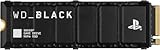
- Officially licensed M.2 SSD for PlayStation 5 consoles[4] so you can easily install and play with no concern of compatibility. [4]For PlayStation 5 system software compatibility, please visit the official WD_BLACK site.
- With capacities ranging from 1TB to 8TB[1], your PS5 console has the additional space to store up to 200 games[3] (8TB model) [1]1GB = 1 billion bytes and 1TB = one trillion bytes. Actual user capacity may be less depending on operating environment. [3] Number of games based on a 36GB average per game. The number of games will vary based on file size, formatting, other programs, and factors.
- Experience uninterrupted gameplay with a brand-new, optimized heatsink designed especially for the PS5 console for an easy, worry-free installation into the M.2 slot.
- Play directly from the drive and eliminate the need to transfer or delete games from your console with tested and approved storage for your PS5 console[4].
- Push the envelope of PCIe Gen 4 technology with read speeds up to 7,300MB/s[2], giving you seamless gameplay and incredibly short load times. [2]1 MB/s = 1 million bytes per second. Based on internal testing; performance may vary depending upon host device, usage conditions, drive capacity, and other factors.
Compatibility and buying checks
- Platform: Confirm that the accessory is intended for PS5, Xbox Series X|S, or the specific console generation you own.
- Interface: Match Sony’s M.2 requirements or Microsoft’s approved expansion-card format. A physically similar connector is not proof of compatibility.
- Firmware: Check the current console software and the manufacturer’s compatibility notes. Requirements can be enforced by system software.
- Capacity ceiling: PS5’s documented internal M.2 expansion limit is up to 8TB. Do not assume a larger module will be recognized.
- Sustained performance: Look for the required sustained read behavior, not only a peak burst number on the box.
- Cooling and clearance: For PS5, verify heatsink height, width and airflow clearance. Thermal throttling can undermine a drive that otherwise meets the interface specification.
- Data safety: Formatting a new or reused drive erases its contents. Move or back up anything needed before accepting the console’s format prompt.
- Playability rules: Determine whether the games you care about can launch from external USB storage or must reside on internal-SSD-class storage.
Troubleshooting common misconceptions and failures
“The new SSD did not increase FPS.”
That is the expected result. Check that the article of purchase was solving capacity or loading rather than a frame-rate limit. Select the game’s performance mode if one exists and compare FPS only under the same display and game settings.
“The console sees the drive but will not launch a game.”
On PS5, move a PS5 game from external USB storage to internal storage or the compatible M.2 drive if Sony’s rules require it. On Xbox, move a Series-optimized game from USB storage to the internal SSD or Storage Expansion Card. Recheck that the drive is formatted by the console and that the title is fully updated.
“The M.2 drive is rejected or reports a problem.”
Power down and verify the exact PS5 model, system software, interface, capacity and heatsink dimensions against Sony’s current requirements. A generic NVMe designation does not establish compliance. Reseat the module only after disconnecting power and following the installation procedure.
Recommended Free Tools
“Transfers are unexpectedly slow.”
Check whether the source is an external hard disk, whether the USB connection is the required specification, and whether another process is using the drive. Moving between archive storage and internal-SSD-class storage is inherently different from launching a game already on the approved high-speed path.
“There is less free space than the label suggests.”
Console formatting and system-reserved space reduce the user-visible figure. Compare the available capacity shown in the console’s storage menu rather than the unformatted decimal capacity printed on the drive.
Quick Recap
A practical decision sequence
- Name the symptom. Is it too few installed games, long transfers, loading waits, stutter, or low FPS?
- Separate capacity from performance. Capacity and transfers point toward storage; an FPS limit points toward the game’s settings and fixed console hardware.
- Select the platform-approved tier. For PS5 gameplay expansion, evaluate a compatible internal M.2 SSD; for Xbox Series-optimized gameplay, evaluate a Storage Expansion Card.
- Reserve USB storage for its strengths. Use it for PS5 library storage under Sony’s playability rules or for Xbox archiving and transfers when direct play is not required.
- Verify before installing. Check model, firmware, interface, capacity, cooling and formatting requirements, then test one game before migrating the entire library.
Key takeaways
- Console RAM is fixed at purchase; mainstream PS5 and Xbox Series X|S systems do not offer a normal user RAM upgrade.
- More storage primarily means more installed games and fewer downloads or deletions.
- An SSD can preserve the fast I/O path and reduce waits, but no official evidence here supports a universal loading-time figure or FPS increase.
- PS5 supports a compatible internal M.2 SSD expansion up to 8TB, while external USB storage has separate storage and playability rules.
- Xbox Series X|S Storage Expansion Cards are designed to match internal SSD performance; USB 3.1 drives are primarily capacity and archive solutions for Series-optimized titles.
- Buy the console for its fixed RAM and graphics capability, then buy storage that matches how you actually play.
Product prices and availability are accurate as of the date/time indicated and are subject to change. Any price and availability information displayed on Amazon at the time of purchase will apply.

