
Not automatically. An expensive digital audio player (DAP) can sound audibly better when its analogue output stage, headphone amplifier, output impedance, or noise performance fixes a real problem in your headphones. If an inexpensive source is already transparent with your setup, paying more for a luxury model usually buys power, storage, software, battery life, balanced connections, controls, and build quality rather than a reliably audible improvement.
The useful question is not “How much did the player cost?” but “What limitation in my current chain will this player solve?”
As an Amazon Associate I earn from qualifying purchases.
What a digital audio player actually does
A DAP stores or streams digital music, converts that data to an analogue waveform, and sends the result either to headphones or to another audio component. Every device that plays digital audio—including a phone, laptop, game console, streamer, or portable player—already contains a digital-to-analogue converter (DAC). The presence of a more expensive DAC chip is therefore not, by itself, evidence of better sound.
What’s actually slowing this PC down?
Pick the symptom - the matching free tool is one click away.
The audible result comes from the whole analogue path:
#1 Best Overall

- Large Capacity: This mp3 player is designed specifically for music enthusiasts. It has 64GB storage space, which can easily hold thousands of songs, and supports TF card expansion up to 128GB, so you don't need to change songs frequently or worry about insufficient storage space. (TF card is sold separately)
- The latest version of bluetooth : mp3 player Equipped with the latest version of Bluetooth 5.3 MP3 player, which has better compatibility, signal stability, lower power consumption, longer connection distance, and stronger anti-interference ability. (Note: Bluetooth function only supports Bluetooth headset and Bluetooth speaker connection)
- Easy to operate buttons: This reproductor mp3 has several intuitive buttons. Short press “One-Key Sound” can open the music mode, support breakpoint replay function, continue to play from the last exit position; independent volume key can be up and down toggle the precise adjustment of the volume; Short press “Lock Key” can lock the screen, simple and convenient.
- High quality speakers:MP3 player Equipped with high-quality speakers that deliver clear, undistorted sound. No need to wear headphones, you can enjoy music, listen to books or play recording files directly through the speakers. Whether you're relaxing at home, traveling outdoors or sharing music with friends, the speakers will meet your listening needs.
- Upgraded design: MP3 player Length 4.25 inches (10.85 cm), width 1.95 inches (4.96 cm), thickness 0.37 inches (0.95 cm), weight 80.7 grams, equipped with a 2.4-inch color screen to enhance the visual experience and ease of operation; metal alloy shell both durability and comfortable feel, fashionable appearance to adapt to the sports, commuting, travel and other scenarios, carry no burden.
- DAC: Converts digital samples into an analogue signal.
- Analogue output stage: Filters, buffers, and sets the line or headphone output level after conversion.
- Headphone amplifier: Supplies the voltage and current demanded by the connected headphones or in-ear monitors (IEMs).
A player can use an excellent DAC and still be a poor match if its amplifier cannot reach the required level, its output impedance changes the headphone’s frequency response, or its noise floor produces hiss. Conversely, a well-designed, inexpensive DAC and amplifier can be effectively transparent in a normal listening chain.
When a more expensive player can sound better
Headphones that need more voltage or current
Some full-size headphones need substantial voltage to reach realistic peaks; low-impedance or inefficient models may demand considerable current. If your player clips, sounds compressed at loud passages, or requires the volume control near its limit, a more powerful output stage can produce an audible improvement. Compare power and voltage at your headphones’ actual impedance, not a headline wattage measured into an easier load.
Balanced connectors such as 4.4 mm often provide a higher-power output, but the connector itself does not guarantee better fidelity. A balanced output is useful when the circuit behind it delivers more clean voltage or current, or when it fits your cable and system. A 3.5 mm output from a well-designed amplifier can outperform a poorly implemented balanced stage.
Sensitive IEMs and output noise
Very sensitive IEMs can reveal hiss that is inaudible with over-ear headphones. A player with a lower noise floor, sensible gain settings, and a clean output can make quiet passages genuinely cleaner. This is a system-match issue: the same player may be silent with one headphone and noisy with another.
Output impedance and frequency-response interaction
Headphones and multi-driver IEMs do not all present a constant electrical load. A high output impedance can interact with that changing load and alter frequency response, sometimes enough to hear. When comparing players, check output impedance and prefer a value appropriate for your headphones rather than assuming that a larger, heavier player is safer.
Rank #2
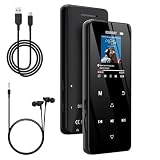
- 🏃【MP3 Player with Bluetooth 5.3 & Wireless Connectivity】 Equipped with Bluetooth 5.3 technology, this MP3 player provides a stable connection to your Bluetooth headphones or speakers. Designed for an active lifestyle, it allows you to enjoy a wire-free experience during workouts, running, or cycling sessions, helping you stay active without the restriction of cables.
- 💾【32GB Internal Memory & 128GB Expandable Slot】 Carry your entire music library with ease. This device features 32GB of built-in storage, enough to store thousands of your favorite songs or audiobooks. For additional space, the integrated MicroSD slot supports expansion up to 128GB (TF card not included), providing ample room for extensive playlists, motivational podcasts, and educational materials.
- 🎵【HiFi Sound Quality & Built-in Speaker】 Enjoy clear audio with support for multiple high-fidelity formats, including FLAC, APE, and WAV. This MP3 player delivers a refined listening experience for all your favorite tracks. For added flexibility, the integrated HD speaker allows you to listen to music or audiobooks without headphones, making it an ideal choice for relaxing at home or sharing stories with family.
- 🛡️【Sturdy Metal Shell & Compact Pocket-Size Design】 Designed for portability and long-term use. Crafted from a zinc alloy, the metal housing provides a solid feel and enhanced durability for an active lifestyle. Its slim profile fits easily into pockets or gym bags, making it a reliable lightweight companion for travel, hiking, or your daily commute.
- 🎁【Complete Gift Set & All-in-One Value】 Looking for a practical gift? This comprehensive set includes 1×MP3 player, 1×Type-C charging cable, 1×User manual, and 1×Wired earphones. It is a thoughtful and functional gift choice for children, students, or music enthusiasts, providing everything needed to start enjoying music right out of the box.
Cleaner operation at demanding levels
Measurements of noise and distortion matter most when they cross the audibility threshold in your chain. An amplifier that remains linear at the level your headphones require can sound more controlled than one that is already clipping or adding distortion. The relevant question is performance at your listening level and load, not the device’s best result under an unrelated test condition.
Why the DAC chip name is a weak buying signal
Manufacturers often advertise a particular converter family, high sample-rate support, or multiple DAC chips. Those specifications describe capability, not guaranteed audible superiority. Implementation around the chip—clocking, power regulation, analogue filtering, output buffering, and volume control—determines much of the measured result.
Free tools Windows power users keep installed
One-click scans. No signup required.
High-resolution formats can be useful for compatibility, but support for 32-bit/768 kHz or DSD512 does not prove that a player sounds better with ordinary lossless music. A player that handles your files reliably and converts them without audible errors is already doing the essential job.
What measurements can—and cannot—tell you
Evaluate a DAP as a system. Useful measurements include frequency response, channel balance, noise, distortion and SINAD, jitter, maximum output level, output impedance, and amplifier power into the impedance of your headphones. One impressive SINAD number cannot rank every player for every listener.
Audio Science Review’s published tables illustrate the non-monotonic relationship between price and measured performance:
Rank #3

- [Hi-Res Sound with ESS DAC] Built with the ESS ES9018K2M DAC, the H2 delivers clear, detailed sound for serious music listening. It supports DSD128, FLAC, WAV, APE, ALAC and other high-resolution formats, with 107dB SNR and low distortion for a richer experience than standard phone audio.
- [Bluetooth 5.2 Transmitter & Receiver] Enjoy flexible wireless listening with Bluetooth 5.2. The H2 can send music to Bluetooth headphones or work as a receiver for phone audio, with aptX support for cleaner wireless playback. Ideal for commuting, travel, office listening and home audio use.
- [64GB Card Included, Supports up to 512GB] The H2 comes with a 64GB microSD card, so you can start loading your music right away. It supports microSD cards up to 512GB and can read up to about 14,999 songs, making it suitable for large local music collections.
- [USB DAC, Line Out & Headphone Out] Use the H2 as more than a portable MP3 player. Connect it to your computer as a USB DAC, plug in wired headphones through the 3.5mm headphone jack, or use the dedicated line out with car AUX, powered speakers or home audio systems.
- [Zinc Alloy Body with Physical Controls] The solid zinc alloy chassis gives the H2 a premium, durable feel, while the physical buttons and scroll wheel make music control simple without relying on a touchscreen. Up to 10 hours of playback supports daily listening at home, work or on the go.
| Device | Listed price | SINAD | Table and entry date |
|---|---|---|---|
| Musetec Audio MH-DA005 | $3,299 | 96 dB | Audio Science Review measurement table, 2022 review entry |
| SMSL R100 | $289 | 90 dB | Audio Science Review measurement table, 2026 review entry |
| Fosi ZD3 multifunction DAC | $180 | 117 dB | Audio Science Review all-electronics table, 2024 review entry |
| Eversolo DMP-A8 digital source | $1,980 | 120 dB | Audio Science Review all-electronics table, 2024 review entry |
These are device-specific results measured under each review’s conditions, not a universal price rule. They show why cost cannot substitute for checking the measurements that matter to your headphones and listening level. A player with slightly lower SINAD may still be the better choice if it supplies the required voltage, has less hiss with your IEMs, or offers the software and outputs you actually need.
How to establish whether you can hear a difference
Descriptive listening—“warmer,” “wider,” or “more detailed”—can communicate a preference, but it does not establish that two outputs are measurably or audibly different. A controlled ABX comparison tests whether you can identify A versus B when you do not know which is playing. It cannot determine which presentation you prefer; an ABX result answers detectability, not “better.”
- Use the same recording and headphones. Pick familiar tracks with quiet passages, vocals, bass transients, and dense peaks.
- Level-match precisely. Even a small loudness difference can make one output seem more detailed or dynamic. Match at the headphone output, not only at a digital volume setting.
- Remove sighted cues. Hide the player’s identity and keep gain, filters, and playback software equivalent.
- Switch quickly and repeat. Short, randomized trials reduce memory errors. Record each identification rather than relying on confidence.
- Change one variable at a time. If you change headphones, cables, gain, and player together, you cannot identify the cause.
If your results hover around chance, treat the players as audibly equivalent in that chain and choose on features, ergonomics, and price. If you can repeatedly identify one, inspect measurements and system matching before attributing the result to the DAC chip alone.
Where diminishing returns usually begin
Diminishing returns start after the chain is quiet, linear, powerful enough, and electrically compatible with your headphones. Spending beyond that point may still be worthwhile, but the benefit shifts from sound quality to ownership: more storage, longer battery life, a better screen and controls, faster software, a stronger chassis, or a warranty and repair network.
There is no universal dollar threshold. A cheap player can be a poor value if it hisses with your IEMs or cannot drive your headphones; an expensive player can be a poor value if its extra power and features go unused. Compare the cost of solving the specific limitation with a less expensive transparent source.
Rank #4

- A Brand-New Processor That Surpasses Competing Products — Qualcomm Snapdragon 680 Built on a 6nm process, it delivers superior performance and enhanced power efficiency. With 4GB+64GB storage and Android 13, it ensures smooth and seamless operation for all major music apps.
- Patented Desktop Mode with 950mW High Power Output: When Desktop Mode is activated, the M21 operates entirely on external power, with the built-in battery neither charging nor discharging—effectively extending battery lifespan.
- Quad CS43198 Matrix DACs, Fully Balanced 2-Stage Amplification: Featuring a 4-channel, 8-path fully differential output design, it unleashes its full potential with exceptional dynamic range and high noise immunity. The headphone amp adopts a 2-stage circuit design—the first stage handles voltage amplification while the second stage boosts current—ensuring pristine sound quality and rich detail.
- Versatile Ports, High-Performance Output: Supports dual 3.5mm + 4.4mm headphone/LO outputs, equipped with independent line amplification circuits. Also supports SPDIF and USB Audio output, with SPDIF performance rivaling professional digital transports—reducing jitter by 70%.
Compare two players by these practical axes
| Question | What to check | Why it matters |
|---|---|---|
| Can it drive my headphones? | Clean voltage and current, power at the actual impedance, gain options | Prevents clipping, compression, and excessive volume settings |
| Will it stay quiet? | Noise specification, measured hiss reports, low-gain mode | Sensitive IEMs expose output noise |
| Is the output electrically suitable? | Output impedance, 3.5 mm and 4.4 mm behavior, line-out level | Avoids frequency-response interaction and connection surprises |
| Does it fit my library? | Local-file formats, streaming apps, codec support, firmware updates, microSD capacity | Prevents software limitations from outweighing audio hardware |
| Will I carry it? | Battery endurance, weight, heat, screen, buttons, pocketability | A theoretically excellent player is useless if it stays at home |
| What happens if it fails? | Warranty length, repairability, update history, regional support | Protects the value of a costly portable device |
When an external DAC or headphone amplifier is the better upgrade
If your current player is quiet and powerful enough, replacing the entire DAP may solve no audible problem. An external DAC/headphone amplifier is more targeted when you need extra drive, a lower-noise output, a desktop connection, or a line-level feed for powered speakers. Conversely, a DAP is the better fit when you need an all-in-one portable library, streaming apps, battery operation, and storage expansion.
Check whether your existing phone, computer, or console can operate as a digital transport or USB source. If it can, adding an amplifier may address the actual bottleneck without paying for a second screen, battery, and operating system. Make sure the external unit accepts the connection your source provides and that its gain is appropriate for your headphones.
Feature-rich players: the FiiO M27 as an example
TechRadar describes the FiiO M27 as using twin ESS Sabre DACs, supporting up to 32-bit/768 kHz and DSD512, and working as a USB DAC, digital transport, and streaming player. Those capabilities make it a useful example of what premium pricing can fund: high output power, multiple operating modes, and a broader feature set.
They do not prove that the M27 must sound better than every cheaper player. Before buying, verify its current price, firmware, streaming compatibility, battery behavior, and retailer availability in your region. The same checklist applies to any premium DAP: confirm that its particular outputs and software solve a problem you actually have.
Recommended Free Tools
A step-by-step buying decision
- Identify the limitation. Write down the symptom: audible hiss, insufficient loudness, clipping, missing storage, poor battery life, unavailable streaming, or an inconvenient interface.
- Record your headphone load. Note impedance, sensitivity, connector, and whether the manufacturer recommends a particular power range.
- Set a minimum specification. Choose the needed output power or voltage, acceptable output impedance, and noise performance before looking at luxury features.
- Check independent measurements. Look for results at the relevant output and load, including maximum clean level, not just DAC-chip branding or a single SINAD figure.
- Separate sound from convenience. Price the storage, battery, screen, controls, balanced connection, software, and support independently from audible performance.
- Audition under controlled conditions. Level-match and repeat an ABX-style comparison if you can; otherwise, treat sighted impressions as preferences.
- Buy only the excess you will use. If the cheaper player meets your technical minimum and offers the required software, spend more only for a clearly valued ownership benefit.
Common mistakes and how to avoid them
- Buying by chip count: Two DAC chips do not automatically double quality. Inspect the complete output stage and measurements.
- Confusing balanced with superior: Balanced is a connection and circuit topology; it is beneficial only when it provides a useful, clean output for your system.
- Ignoring gain and volume range: A powerful amplifier can be awkward with sensitive IEMs if its lowest gain is still too loud or noisy.
- Comparing at different loudness: Louder commonly sounds better. Match levels before judging detail or bass.
- Treating one test number as a verdict: SINAD does not reveal output impedance, power delivery, battery life, software quality, or ergonomics.
- Assuming high-resolution support improves every file: Format compatibility is useful; it is not proof of audible improvement.
Bottom line
An expensive DAP sounds better only when its implementation fixes an audible weakness in your system or provides a feature you genuinely need. Once a less expensive player is transparent, quiet, powerful enough, and compatible with your headphones, additional spending is primarily a choice about convenience, durability, and capability—not guaranteed sound quality.
Quick Recap
Product prices and availability are accurate as of the date/time indicated and are subject to change. Any price and availability information displayed on Amazon at the time of purchase will apply.

