
A greatsword is a broad modern term for a very large sword intended for two-handed use. It does not describe one standardized historical weapon. The word can refer to medieval two-handed swords, the Renaissance German Zweihänder or Bidenhänder, ceremonial weapons, and—especially in video games and tabletop RPGs—a fictional heavy weapon built around the idea of reach and power.
Historical greatswords were genuinely large, but they were not universally oversized iron slabs. Their dimensions, blade shapes, handling characteristics, and purposes varied considerably. Some were practical specialist battlefield weapons; others were ceremonial, processional, or judicial swords. Understanding that distinction makes it easier to separate the museum evidence from fantasy conventions.
As an Amazon Associate I earn from qualifying purchases.
What is a greatsword?
In historical writing, greatsword works best as a descriptive umbrella rather than a precise, universal classification. Museums and collections more often use terms such as two-handed sword, two-hander, battle sword, bearing sword, Zweihänder, Bihänder, or Bidenhänder.
The German terms emphasize the weapon’s defining handling method: two hands on a long grip. The English word, by contrast, can group together several large sword forms from different periods. A sixteenth-century German Zweihänder and an earlier English two-handed sword may both be called greatswords in casual conversation, but they are not automatically the same weapon.
#1 Best Overall

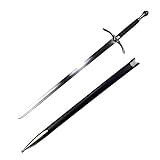
- Authentic Medieval Sword Design - This renaissance sword is a two-hand medieval sword, adding a real touch to your collection. It's a great addition for any enthusiast interested in medieval swords, and other larping weapons.
- High-Quality Material - This stainless steel sword is designed for longevity. It’s not just a sword prop but a well-crafted piece among fake swords. It’s a perfect blend of durability and elegance.
- Intricately Designed - This sword with sheath features intricate design elements like a faux leather-wrapped handle, and a pommel for a touch of mythical elegance.
- Scabbard Included - This sword replica comes with a scabbard for secure storage, making it an ideal sword display. Whether you're into toy swords, or looking for renaissance costume accessories, this piece is an excellent choice.
- Perfect Collector's Gift - Equally suited for display, gifting, cosplay, or larp weapons, this sword sheath makes for a fantastic medieval sword prop.
A useful working definition is: a greatsword is a very large, generally double-edged sword designed primarily for two-handed use, encompassing historical weapons whose roles ranged from specialist combat arm to ceremonial or display object.
Greatsword, longsword, and Zweihänder
- Longsword: a broad category of primarily two-handed swords with many forms and a long historical life. Not every longsword is large enough to be called a greatsword.
- Greatsword: a flexible English label for especially large two-handed swords.
- Zweihänder or Bidenhänder: a particularly large German Renaissance two-handed sword, strongly associated with specialist infantry and Landsknecht formations.
- Executioner’s sword: a separate judicial weapon designed for beheading, not an ordinary battlefield greatsword.
The categories overlap in popular usage, but treating them as interchangeable creates misleading claims about date, construction, and purpose.
How greatswords developed
Two-handed swords existed before the famous sixteenth-century Zweihänder. The Metropolitan Museum of Art records an English or Western European example dated approximately 1400–1450. It is a comparatively light weapon for its size, with a double-edged blade, an acute point, and a flattened diamond-shaped cross-section with a medial ridge. Its geometry supported both cutting and thrusting, including fighting in the context of increasingly sophisticated plate armor. The Met’s catalogue record is a useful reminder that early two-handed swords were not necessarily crude or impossibly heavy.
The larger and more recognizable Zweihänder emerged later. The Styrian Armoury notes that two-handed swords appeared as early as the thirteenth century, while the Zweihänder developed a distinct design during the second half of the sixteenth century. Its familiar features included a very long blade, a long handle, a straight crossguard, and a pear-shaped pommel. The Armoury’s overview of two-handed swords also identifies “two-hander,” “Bidenhänder,” and “both-hander” as related names.
The Landsknechte and the battlefield role
The popular image of a greatsword is closely tied to the German Landsknechte, professional or semi-professional mercenary infantry who were especially prominent during the late fifteenth and sixteenth centuries. Some German and Swiss formations used exceptionally large two-handed swords as specialist weapons, but the weapon was never the standard arm of every Landsknecht.
Most infantry formations depended on combinations of pikes, shorter swords, firearms, and sidearms. Greatsword specialists had demanding assignments: protecting flags, occupying forward positions, and trying to disrupt or break opposing pike formations. The Styrian Armoury describes these soldiers as specially selected, physically strong, trained for the role, and better paid than ordinary troops.
The weapon’s reach could matter in an open formation. A long blade and two-handed grip offered leverage and gave a trained user more options for controlling space than a shorter sidearm. But that advantage came with obvious limitations. A very large sword was difficult to use in crowded, confined mêlée, and it required room, strength, and practice. It was not a universal answer to armor, pikes, or every battlefield problem.
What’s actually slowing this PC down?
Pick the symptom - the matching free tool is one click away.
Rank #2
- Knight Collections One Handed Medieval Swords Non-Battle Ready
- 41.25" overall length with scabbard
- Carbon steel blade with 8" handle. Metal guard and pommel
- Faux Leather wrapped wood scabbard, Dull Blade
- Good For Collections, Gift, Cosplay and LARP
What a historical greatsword looked like
There was no single standard length or weight. Surviving examples differ according to period, region, construction, and intended function.
A British Museum catalogue records a probably German two-handed sword from around 1500 measuring 1,495 millimeters overall, with a 1,060-millimeter blade and a recorded weight of 1,725 grams. The museum also cautions that the object may be a nineteenth-century imitation rather than an original late-medieval weapon, so the entry should not be treated as unquestionable evidence for every sword of the period. Even so, its measurements illustrate why the common fantasy assumption that every greatsword weighed dozens of kilograms is implausible.
A much larger German example at the Cleveland Museum of Art, dated 1550–1600, measures 191.5 centimeters overall. Its blade is 144.8 centimeters long and its grip is 40.7 centimeters. The museum identifies it as a weapon originally used by specialist infantry. Its scale is impressive, but the catalogue does not provide a displayed weight, so its dimensions should not be converted into a made-up “typical” mass. See the Cleveland Museum’s catalogue entry.
Blade shape and the ricasso
Some large two-handed swords had long, tapering, pointed blades suited to both cutting and thrusting. Others emphasized cutting and had different proportions. A ricasso—the unsharpened section of blade immediately above the guard—could provide extra control and allow additional hand positions. Some large swords also had parrying hooks or branches around the ricasso, giving the user more ways to manipulate the weapon at close range.
Do these 3 things before closing this tab:
1Clear out junk files and repair common Windows errors2Scan for outdated or missing drivers - takes under a minute3Repair Windows errors before they cause bigger problemsThese features were not universal. A greatsword in a game may have a consistent silhouette, but historical examples cannot be reduced to one fixed combination of ricasso, hooks, guard, pommel, and blade profile.
Flamberge and waved blades
The flamberge, or flamboyant sword, is recognized by its undulating or flame-shaped blade. It is one of the most visually memorable greatsword designs and has had a major influence on fantasy art, games, and film.
However, a waved edge should not automatically be described as a mechanism for sawing through armor, catching enemy blades, or generating extraordinary cutting power. The Styrian Armoury states that the undulating edge on the late examples it discusses had no special cutting function and served primarily as decoration. The Kunsthistorisches Museum likewise identifies a German Zweihänder dated approximately 1570–1590 as a large cutting weapon with a wavy blade while noting that such weapons increasingly became ornamental and parade weapons during the sixteenth century. The museum’s object record shows why appearance and practical battlefield function should be discussed separately.
Rank #3

- Authentic Medieval Design: 41-inch handmade medieval sword with rustic finish, inspired by historical weapons and traditional knight sword styles. Perfect swords for adults, collectors, and sword display.
- High Carbon Steel Sword Blade: Forged from durable high carbon steel sword for strength, sharpness, and long-lasting use. An ideal real sword option for enthusiasts.
- Full Tang Construction: Solid one-piece metal sword design with sturdy cross guard and round pommel for balance and durability – crafted for swords for men and historical collectors.
- Leather Wrapped Handle: Comfortable grip with genuine leather wrapping, perfect for cosplay sword, light reenactment, or real swords for adults sharp collectors’ displays.
- Collector’s Piece: Ideal real swords for men, medieval enthusiasts, and metal swords for adults seeking a great sword centerpiece. Note: This szco sword is sold without a scabbard or sword with sheath.
Were greatswords too heavy to use?
Large does not mean unusable. A combat sword had to be controllable, mechanically coherent, and suitable for the person carrying it. The museum evidence does not support a single “normal” weight, but it does undermine the idea that historical greatswords were universally gigantic.
Crashes, No Sound, or Screen Glitches?
Random freezes, missing sound and display glitches usually trace back to one bad driver. Find and replace yours safely.Free scan · under a minutePC Slower Than It Used to Be?
A free scan shows the junk files, broken settings and background clutter dragging Windows down - then fixes them in one click.Free scan · Windows 10 & 11The British Museum example weighs 1.725 kilograms despite being nearly 1.5 meters long. Other examples were longer or built for different purposes. A sword made for combat had different requirements from a ceremonial bearing sword, a parade weapon, or a modern fantasy replica designed mainly to look dramatic.
When judging a greatsword, separate three categories:
- Combat weapons: built around control, durability, and a plausible fighting role.
- Ceremonial or processional swords: potentially larger, more ornate, or less practical because display mattered more than battlefield handling.
- Modern fantasy replicas: designed according to visual impact, collecting preferences, or a fictional setting rather than historical performance.
That distinction is particularly important when a game’s “greatsword” is a blade as tall as its wielder. The visual language communicates power and reach; it is not a museum measurement.
Greatsword versus executioner’s sword
An executioner’s sword is a related but separate two-handed form. The Deutschlandmuseum describes its medieval executioner’s sword as a judicial tool rather than a combat weapon. It has a broad, flat blade and a rounded tip, features suited to an ambidextrous beheading stroke rather than battlefield thrusting. Read the Deutschlandmuseum’s explanation.
Recommended Free Tools
Calling every large, blunt-tipped sword a greatsword—or using an executioner’s sword as evidence for battlefield greatswords—blurs two different occupational functions. The legal context, blade design, and intended movement were not the same.
Why the greatsword became ceremonial
By the late sixteenth and seventeenth centuries, exceptionally large swords increasingly moved away from ordinary battlefield use. The Cleveland Museum says that by the late seventeenth century such enormous swords had largely taken on ceremonial or bodyguard functions. The Kunsthistorisches Museum similarly emphasizes the increasingly ornamental and parade-oriented character of some late Zweihänder.
Rank #4

- AUTHENTIC DESIGN: Beautifully crafted medieval mini short sword featuring ornate cast metal furnishings and decorative brass knight pommel for historical authenticity
- BLADE SPECIFICATIONS: 7.5-inch stainless steel blade with detailed engravings, providing both durability and aesthetic appeal
- COMPACT SIZE: 14-inch overall length makes this sword perfect for display or collection purposes while maintaining authentic medieval styling
- INCLUDED SCABBARD: Comes with a matching wood scabbard for proper storage and elegant presentation
- CRAFTSMANSHIP: Intricately detailed handle with cast metal components showcasing medieval-inspired artistic elements and designs
This change helps explain why surviving examples may look exaggerated, ornate, or impractical. Not every spectacular sword in a collection is a record of an ordinary soldier’s combat equipment. Some were symbols of office, rank, ceremony, or institutional identity.
What “greatsword” means in video games and tabletop RPGs
In games, greatsword is usually a rules or equipment label rather than a carefully defined historical category. It commonly signals a weapon with high damage, a two-handed requirement, slow attacks, large reach, or a strength-focused playstyle. A game can therefore call a huge fictional blade a greatsword without claiming that it reproduces a particular Zweihänder.
Dungeons & Dragons demonstrates the difference clearly. The current D&D Beyond equipment entry lists the greatsword as a martial melee weapon costing 50 gp, weighing 6 lb, and dealing 2d6 slashing damage. It has the Heavy and Two-Handed properties, and the current rules presentation also lists the Graze weapon mastery property. These are game mechanics, not historical measurements or a claim about how a real Renaissance sword performed. Check the current D&D Beyond entry for the rules version and presentation relevant to your table.
Video games often go further by giving greatswords special animations, stagger effects, armor penetration, charged attacks, or enormous fantasy proportions. Those choices are useful for class identity and combat balance. They should not be read as evidence that historical users swung swords through plate armor or wielded them like oversized clubs.
Buying, collecting, or training with a greatsword
Modern products sold as greatswords fall into several distinct groups:
- Decorative wall-hangers: intended for display and not for impact, cutting, or sparring.
- Historical replicas: reproductions for collecting, display, reenactment, or study. Construction and accuracy vary widely.
- Blunt reenactment swords: non-sharp weapons for controlled historical activities; they are not automatically suitable for free fencing.
- HEMA trainers or feders: purpose-built training swords designed around supervised historical fencing, with specialized flexibility, tips, and protective requirements.
- Foam, polypropylene, or wooden trainers: useful for introductory drills or lower-risk instruction, but not necessarily historically accurate.
If your goal is display, a greatsword replica can be a relevant search starting point, but verify whether a listing is decorative, blunt, sharp, or fantasy-styled before buying. Do not assume that a product described as “battle ready” is suitable for sparring, cutting, or unsupervised use. Check construction details, dimensions, seller information, return terms, local laws, and secure storage requirements.
Free tools Windows power users keep installed
One-click scans. No signup required.
If your goal is practice, start with a club rather than a shopping cart. A HEMA longsword trainer may be an adjacent training path, but an ordinary longsword feder is not necessarily a historically accurate greatsword. HEMA clubs and competitions can have different equipment rules, and a trainer must be matched with appropriate protective equipment, instruction, and supervised drills. Guidance for new practitioners is available in this HEMA equipment overview.
For a large decorative sword, plan the display before purchasing. A sword display stand or properly rated rack can be more appropriate than improvising with a wall hook. The mounting surface, fasteners, sword weight, access by children or pets, and local regulations all matter. A display mount is not a substitute for a training scabbard or safe handling procedure.
Independent reader supportYour contribution helps us test, update, and keep practical guides available for everyone.How to read a greatsword in a game or fantasy setting
When a game labels a weapon “greatsword,” ask what the label is doing:
Best Value

- Historical Knight Sword Design: Inspired by the legendary Earl of Huntington, this medieval sword reflects nobility and timeless craftsmanship—ideal for collectors of swords for men and swords for adults.
- High-Quality Stainless Steel Blade: Features a 22.5" mirror-polished steel sword blade for brilliant shine and authenticity, styled like a real sword but made as a decorative sword for sword display.
- Detailed Pewter Finish Handle: Intricately crafted pewter-finish handle and guard provide antique character, making it a centerpiece great sword replica for fans of metal swords for adults.
- Matching Scabbard Included: Comes with a coordinating black and pewter sword with sheath/scabbard, completing the knightly look and ensuring safe storage or wall mounting.
- Perfect for Collectors and Cosplay: A standout cosplay sword for Renaissance fairs, theatrical use, or medieval reenactments—fits seamlessly in collections of real swords for adults, real swords for men, and swords real enthusiasts.
- Is it a historical reference? Look for terms such as Zweihänder, Landsknecht, Renaissance, or two-hander.
- Is it a class identity? The weapon may simply communicate a slow, powerful, two-handed playstyle.
- Is the design ceremonial or fantastical? Excessive length, glowing edges, impossible balance, and magical effects place it firmly in fictional territory.
- Does the game distinguish weapon types? A longsword, greatsword, executioner’s sword, and flamberge may be separate gameplay categories even when their historical boundaries overlap.
This approach lets you enjoy the fantasy without repeating myths as history. A fictional greatsword can be dramatically oversized; a historical greatsword needs to be assessed through its surviving construction, date, and role.
Frequently Asked Questions
Is a greatsword the same as a Zweihänder?
Not exactly. Greatsword is a broad modern English term for very large two-handed swords. Zweihänder or Bidenhänder usually refers more specifically to a large German Renaissance form associated with specialist infantry and Landsknecht formations.
How heavy was a historical greatsword?
There was no universal weight. One British Museum example from around 1500 is recorded at 1,725 grams, despite measuring nearly 1.5 meters overall. Other swords differ, and ceremonial pieces may not represent practical combat weapons.
Could a greatsword cut through plate armor?
That is too broad a claim. Some two-handed swords supported both thrusting and cutting in an armor-focused fighting environment, but greatswords were not a uniform class and should not be described as universally cutting through plate.
What is a flamberge?
A flamberge is a sword with a waved or flame-shaped blade. The shape is strongly associated with large two-handed swords, but the cited museum evidence does not support claims that the waves reliably sawed through armor or opposing blades; on some late examples they were primarily decorative.
Quick wins for a faster PC:
Clear out junk files and repair common Windows errorsFree Scan →Scan for outdated or missing drivers - takes under a minuteDriver Scan →Can I use a decorative greatsword replica for HEMA?
No assumption is safe. Wall-hangers and display replicas are not automatically suitable for impact or sparring. Use equipment approved by your club, follow its protective-gear requirements, and train under qualified supervision.
The Bottom Line
The historical greatsword was not one fixed weapon but a family of very large two-handed swords. Earlier two-handed swords could be refined, pointed, and versatile; the later German Zweihänder became a specialist weapon associated with some Landsknecht formations before many oversized examples shifted toward ceremonial use. Games simplify all of this into a powerful two-handed weapon class, which is perfectly useful for gameplay—as long as fantasy statistics and silhouettes are not mistaken for historical evidence.
Quick Recap
Product prices and availability are accurate as of the date/time indicated and are subject to change. Any price and availability information displayed on Amazon at the time of purchase will apply.

