For Hyperia City, start by choosing your format: the prerelease Sealed rules are specific, while a constructed deck needs a format and legality check before you can settle on a list. In either case, build around a plan you can execute without ink drops, then treat each drop as a one-time resource to spend when it makes a meaningful difference. Ravensburger’s prerelease guide points to Coco’s music-and-singing theme as a promising direction, but Hyperia City is not generally available until October 23, 2026, so no constructed list or archetype can yet be called proven.
What kind of Hyperia City deck are you building?
This is an early deckbuilding guide for two different situations: prerelease Sealed and constructed play. They do not use the same deckbuilding assumptions. In particular, the official prerelease rules specify a 40-card Sealed deck made from six booster packs, with all six inks available and no four-glimmer-per-deck restriction. Those instructions do not establish a constructed deck size or a constructed card list.


As an Amazon Associate I earn from qualifying purchases.
Hyperia City prerelease events are scheduled to begin October 16, 2026; general availability is scheduled for October 23, 2026. Those dates matter for how confidently you can evaluate a deck: before release, an idea can be a sensible starting hypothesis, but it cannot be supported as a post-release tournament recommendation. Ravensburger introduced the set as the first to bring Disney and Pixar’s Coco glimmers into Lorcana, alongside the new ink-drop mechanic.
What’s actually slowing this PC down?
Pick the symptom - the matching free tool is one click away.
- At a prerelease: follow the six-pack, 40-card Sealed framework and make decisions from the cards you actually open.
- For constructed: decide which constructed format you intend to play, then verify its current deckbuilding rules and Hyperia City card legality before choosing a list.
Do not carry the Sealed rules into constructed by assumption. A deck built from a limited pool and a deck assembled for a constructed format answer different questions: Sealed asks how to make the strongest functioning deck from what you opened; constructed asks which legal cards best support a chosen plan.
#1 Best Overall

- A TEAM OF CHARACTERS: Each of the two prebuilt decks is filled with special versions of Disney friends called "glimmers" that are ready to join you on your adventure. With Disney Lorcana Gateway, you’ll learn both how to play them and ways they can work together.
- GET READY TO CHALLENGE: As with any Disney adventure, you’re bound to run into a few obstacles, whether it's a villain, a rival, or some friendly competition. Clear your path to victory by sending your glimmers to challenge these adversaries. The guides in the box show you how and help you sharpen this skill for an even faster win.
- YOUR QUEST TO WIN: Every round is a race for a magical story star. The more “lore” you collect, the closer you get to that prize. We’ll show you how to make the most of every quest with the help of your glimmers.
- UNLOCK MORE CARDS AS YOU GO: As you progress, you’ll unlock different gates letting you add more card types to your hand. You’ll discover songs, items, and Floodborn glimmers as well as how these help you along your quest.
If you are still deciding what to play, ask yourself what you can actually access and what kind of games you want. A prerelease gives you a fixed six-pack pool and the official Sealed constraints. Constructed lets you select cards, but it requires you to settle on a format and check legality. Pack Rush is another distinct play option in the prerelease materials; its specifications are not a shortcut for building either a Sealed or constructed deck.
Choose a plan before choosing individual cards
A deck is easier to build and adjust when its cards work toward the same outcome. One reasonable first direction for Hyperia City is a music- or singing-oriented plan using Coco glimmers. Ravensburger’s prerelease guide specifically says, “As you might expect, the various glimmers inspired by Disney and Pixar’s Coco are interested in music and singing,” and recommends making use of their tuneful and harmonizing abilities.
That is a set-theme pointer, not evidence that a particular Coco list, ink combination, or card package is the strongest. Treat it as a hypothesis to explore: as you inspect your pool or possible constructed choices, ask whether the cards reinforce the musical plan and whether the deck still functions when you do not draw the cards that best express it.
Before adding a card, be able to say what job it performs. It might help establish characters, advance the music plan, provide a useful ink-drop interaction, or help the deck pursue lore. If a card does none of those things—or only works when another specific card and an ink drop are both available—it needs a stronger justification than theme alone.
Turn a theme into a testable plan
A theme becomes useful when it helps you make choices. Write a one-sentence description of what the deck is trying to do, then check each candidate card against it. “Use Coco glimmers and music interactions” is a direction to investigate; it is not yet a full game plan. The next question is whether your available cards make the direction coherent and whether the deck has useful plays when a key musical card is missing.
Separate a card’s flavor connection from its mechanical contribution. A card can fit Coco thematically but still be a poor fit for a particular build if it does not help the plan you selected. Likewise, an ink-drop interaction is not automatically valuable just because the new mechanic is central to the set’s announcement. Ask what that card accomplishes, what it asks you to spend, and whether it remains useful when the setup does not appear.
Keep the plan functional without a special draw
Ink drops are one-time-use resources, not a permanent increase to the amount of ink available. A deck that depends on generating one before its ordinary plays are useful risks being awkward when the relevant card is absent or its drop has already been spent. Evaluate each card both with and without its ideal setup: is it still a reasonable play on its own, and what does the deck do if the setup does not arrive?
This is a practical consistency check, not a claim about a tested Hyperia City list. The set is at prerelease stage, and the published information does not establish a quantified drop-generation rate or a proven constructed package.
Understand what an ink drop changes
Ravensburger describes ink drops as a new, one-time-use ink resource. They can pay for cards or empower card effects, and they can be spent on the turn they are created. That makes each drop a timing decision: using it now may change the board immediately, while keeping it available may enable a more consequential play later.
Lead Game Designer Lukas Litzsinger said in Ravensburger’s September 22, 2026 announcement: “Ink drops can completely change the tempo of a game.” The useful deckbuilding question is not simply whether a card mentions a drop. Ask what the drop lets you do that you could not otherwise do at that moment.
Compare the three main uses
| Use | What it can accomplish | Question to ask |
|---|---|---|
| Spend early for board presence | Ravensburger’s prerelease guide suggests using a drop early to establish character glimmers. | Will an earlier character materially improve your position now, or is the resource better saved? |
| Save for a high-cost card | The guide also suggests holding resources to deploy a high-cost card ahead of schedule. | Is that card important enough to justify waiting, and can you afford to delay the earlier benefit? |
| Use a card-specific payoff | Some card effects improve when a drop is removed to play them; Intense Research is an official example. | Does the improved effect change the quality of the play enough to make spending the drop worthwhile? |
These are alternatives, not a universal sequence. The right choice depends on the board, the cards in hand, and what a drop enables at that specific point. When assessing a drop-generating card, write down three things: what it costs to create the drop, which useful plays or effects it enables, and whether the card remains worthwhile when you cannot use a drop.
Do these 3 things before closing this tab:
1Repair Windows errors before they cause bigger problems2Fix the driver behind crashes, sound loss and screen glitches3Clear out junk files and repair common Windows errorsUse a simple decision check on your turn
When a drop is available, compare the immediate and delayed options rather than spending it automatically. First, identify what it enables this turn: an earlier character, a more powerful version of an effect, or a high-cost card ahead of schedule. Next, consider what you give up by using it now. Finally, decide whether the board or your hand makes one option meaningfully better than the others. The official guidance supports both early board development and saving for a high-cost play, so the choice is situational rather than a fixed rule.
Keep track of whether generating a drop changes a real decision. If the resource sits unused, or if the cards that benefit from it do not show up together, that is useful evidence for your own next adjustment. It does not establish a universal drop-generation rate or prove that an entire package is reliable; that needs testing with the deck and format you are actually playing.
Use Intense Research as a concrete payoff example
The official card gallery lists Intense Research as a Sapphire action costing 2, inkable, and Rare. Its text is: “Look at the top 2 cards of your deck, then put one into your hand and the rest on the bottom of your deck in any order. If you removed an ink drop to play this action, look at the top 5 cards of your deck instead.” The gallery lists it as legal in Core Constructed and Infinity.
Rank #3

- WELCOME TO THE ILLUMINARY: Designed to introduce Disney Lorcana through exciting new gameplay mechanics, this starter set teaches core rules and strategy using curated decks built for an approachable, balanced learning experience.
- START YOUR JOURNEY: If you are new to Disney Lorcana, 2-player starters sets are the place to begin. The 2 included decks are built to give you and a friend a well-balanced and fun gameplay experience right out of the box.
- DIFFERENT PLAY STYLES: The Amber-Emerald deck is for those who love cards that “play nice” together allowing for more card draw. But if a player prefers something more daring and heroic, the Amethyst-Ruby deck is made to help save the day.
- BUILT FOR CASUAL AND FAMILY PLAY: Structured for smooth, out-of-the-box gameplay, the two decks offer a balanced a balanced experience for first-time players exploring the game.
- COMPONENTS INCLUDE: A 2-player starter set includes 2 decks containing 60 cards (including 2 foil cards in each), 13 damage tokens, 2 lore trackers, and 1 rulebook.
The example shows a direct card-specific use for a drop: the action examines more cards if you removed one to play it. That does not establish that Intense Research belongs in every Sapphire deck, that its improved effect is always worth the resource, or that it is a proven competitive inclusion. In a deck you are considering, compare the ordinary effect with the enhanced one and decide whether the better selection supports your actual game plan.
To assess it, consider both modes separately. Without removing a drop, it looks at two cards and lets you keep one; with a drop removed to play it, it looks at five instead. Ask whether that improvement matters to the deck’s priorities and whether spending the drop on the action is better than using it to establish a character or accelerate a high-cost card. Its cost, inkable status, rarity, and listed legality are useful card facts, but they are not a performance report.
Also check the official Hyperia City release notes when interpreting individual card interactions. The notes include set-specific clarifications and corrections, so a detailed combo explanation should follow the current official text and rulings rather than an early spoiler wording.
Build a prerelease Sealed deck from six packs
Ravensburger’s prerelease guide sets out the relevant Sealed framework: open six booster packs and build a 40-card deck. In this format, all six inks are permitted, and the four-glimmer-per-deck restriction does not apply. This is the supported format-specific starting point; it is not a constructed deck recipe.
- Open the six packs and sort the cards. Group them by ink and mark cards that support a shared plan, especially any Coco glimmers or cards that interact with ink drops.
- Identify the strongest coherent direction in your pool. The Coco music theme is a useful lens, but do not force it if the cards you opened do not support it. Prefer a plan that your available cards can actually carry out.
- Separate enablers from payoffs. Note which cards create ink drops, which cards can spend or benefit from them, and which useful cards do not need the mechanic at all.
- Check the deck’s ordinary turns. Consider whether you can make useful plays without drawing an enabler or saving a drop. A Sealed deck should not rely on a perfect sequence that your pool may not provide.
- Build to the required 40 cards. Apply the official Sealed rules rather than importing a constructed list or presumed constructed deck size.
- Review the result against its plan. For every card that looks conditional, ask what it does when its preferred setup is missing. Replace cards that leave the deck with too many hands that cannot support its central plan.
All-six-ink availability gives Sealed deckbuilders permission to use cards from any ink; it does not mean that using every ink automatically makes a better deck. As a practical construction judgment, weigh the benefits of including a useful off-plan card against whether it makes the rest of the deck less coherent. The guide’s ink allowance is a rule, not a recommendation to use all six colors.
Free tools Windows power users keep installed
One-click scans. No signup required.
For a useful final pass, look at the 40 cards as a whole rather than just asking whether each individual card is attractive. Can you describe the plan in a sentence? Are there cards whose value depends on an ink drop, and do you have a way to use those cards when the drop is available? Are you including something only because it is in a favored ink or matches Coco’s theme? These questions do not create new Sealed rules; they help you apply the official pool-and-deck framework to the cards you opened.
Approach constructed as a legality-first theorycraft
Before general release, a full card-by-card constructed list would overstate what is known. No post-release tournament record can yet establish a best-performing ink combination, a proven 60-card list, or reliable matchup guidance. The official Intense Research gallery entry confirms that card’s listed Core Constructed and Infinity legality; it does not establish the legality of every Hyperia City card in every format.
Rank #4
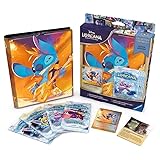
- KICK-START YOUR GAMEPLAY AND COLLECTING JOURNEY: If you’re new to Disney Lorcana TCG, this set is ideal for you. Containing plenty of treasures, it will give you a sample of the magic and mayhem when playing this exciting trading card game.
- CHARACTER-FILLED PORTFOLIO: Stitch – Rock Star is ready to keep 80 of your cards secure and protected within the included portfolio.
- CARDS GALORE: With the 4 Winterspell booster packs, you’ll add 48 cards to your collection. Who knows what characters, items, actions, songs, and locations await you.
- A GREAT GIFT FOR FANS: Perfect for Disney lovers, collectors, and new players alike, this starter set brings Stitch’s playful energy to every game. A fun, gift‑ready pick for anyone who enjoys Disney and Lorcana.
- Name the format. Decide which constructed format you are building for rather than treating constructed as one universal ruleset.
- Check current legality and deckbuilding rules. Use the official card information and relevant format rules, including any applicable deck size and card-copy limits. Do not infer those details from the Sealed guide.
- Write a one-sentence game plan. For example, you might explore whether Coco music and singing interactions give the deck a coherent route to its objective. Keep this as a testable idea, not a claim of dominance.
- Map drops to specific jobs. List your drop-generating cards alongside the cards that use or improve them. If a payoff has no reliable way to receive a drop, question whether it merits a slot.
- Test the deck’s baseline turns. Review whether it can function when no drop appears or when spending one would be less valuable than saving it. Do not make the whole plan depend on temporary resources being available on cue.
- Label an untested list honestly. Before results exist, describe a constructed build as a theorycraft or starting point and state the basis for its choices. Do not present it as a tournament-proven list.
The relevant evidence at this stage supports the mechanic, a theme-level Coco direction, and isolated card text—not a complete optimized list. A responsible early guide can give you a way to evaluate cards without pretending that missing event results already exist.
When you do put together a constructed starting point, make its assumptions visible to yourself: which format you intend to play, which cards support the main plan, which ones generate drops, and which ones ask you to spend them. That inventory makes it easier to see whether the list has a connected engine or simply contains several interesting cards with no dependable link between them. Do not substitute a guessed card count, ink combination, or matchup claim for the format rules and actual results.
The Tool Desk
Outbyte Driver Updater FREEFix the driver behind crashes, sound loss and screen glitchesFind Drivers →Outbyte PC Repair FREEClear out junk files and repair common Windows errorsFree Scan →Adjust the deck after games
After each game, record a specific problem rather than changing cards because a loss felt bad. A short log makes it easier to tell whether a card is genuinely mismatched or whether one game simply produced an unusual draw.
- Opening hand: Which cards were difficult to use early, and which useful plays did you lack?
- Cards stranded in hand: Did a card depend on a drop, another card, or a board state that did not appear?
- Drop timing: When you spent a drop, did it change the turn meaningfully? Would saving it have enabled a more important play?
- Plan execution: Did the deck pursue its chosen strategy, or did its cards pull in unrelated directions?
- Lore opportunities: Did you have practical ways to pursue lore while carrying out the plan?
Change one or a small number of cards at a time, then play again and note what changed. This is a way to learn from your own games, not published playtest data or proof of a broader matchup result. Avoid announcing performance conclusions unless you have documented games sufficient to support them.
For ink-drop lines, record the opportunity cost as well as the payoff. Note whether you spent a drop early to establish a character, saved it to bring a high-cost card forward, or removed it to improve a card effect. Then ask whether that decision changed the turn in the way you wanted. A play log helps distinguish “I drew this card once and it felt good” from a repeatable observation, without pretending that a few games establish a format-wide conclusion.
Keep nearby rules and product details in context
Ravensburger’s prerelease materials also describe Pack Rush: it uses two boosters, a 24-card deck, and 15 lore to win. Those are Pack Rush specifications, not the six-pack, 40-card Sealed framework, and neither format should be confused with constructed deckbuilding.
Quick wins for a faster PC:
Repair Windows errors before they cause bigger problemsFix Now →Fix the driver behind crashes, sound loss and screen glitchesFind Drivers →Clear out junk files and repair common Windows errorsFree Scan →Boosters are randomized, so they make sense for opening a pool or enjoying pack openings, but they cannot guarantee the specific cards in a constructed idea. If you already know the exact cards you want, singles are the more direct acquisition route. Availability and retail stock vary by location and date.
Ravensburger’s Hyperia City prerelease guide is dated October 8, 2026, and its set announcement is dated September 22, 2026. Check those official materials, the current card gallery, and the set’s release notes for the most relevant rules and card details as the set becomes available. A release date or a card-gallery entry is not evidence of tournament results; wait for actual event data before treating any early build as established.
Frequently Asked Questions
What is the best Disney Lorcana Hyperia City deck?
No best-performing constructed list can be established before general release on October 23, 2026, and the available official guidance does not provide a tested decklist. Treat a Coco music-and-singing build or an ink-drop package as a starting hypothesis, then check legality and evaluate it through games.
How many cards and packs do I need for Hyperia City prerelease Sealed?
Ravensburger’s prerelease guide specifies six booster packs to build a 40-card Sealed deck. All six inks are permitted, and the four-glimmer-per-deck restriction does not apply in that Sealed framework.
PC Slower Than It Used to Be?
A free scan shows the junk files, broken settings and background clutter dragging Windows down - then fixes them in one click.Free scan · Windows 10 & 11Outdated Drivers Are Slowing You Down
One free scan finds every outdated or missing driver and matches the right update for your exact hardware.Free scan · exact hardware matchCan I use an ink drop on the turn I create it?
Yes. Ravensburger describes ink drops as one-time-use resources that can be spent on the turn they are created. They can pay for cards or empower card effects, so decide whether the immediate play or saving the resource is more valuable.
Should I spend an ink drop early or save it?
It depends on the board and your hand. Ravensburger’s prerelease guide suggests spending early to establish characters or saving a drop to play a high-cost card ahead of schedule. Some card effects also improve when a drop is removed, as with Intense Research.
Is Coco music a proven Hyperia City archetype?
No. Ravensburger highlights Coco glimmers’ interest in music and singing and recommends using tuneful and harmonizing abilities, making that a supported theme to explore. It is not evidence that a particular list or ink combination is dominant.
Is Intense Research legal in every Lorcana format?
The official card gallery lists Intense Research as a Sapphire action costing 2, inkable and Rare, with Core Constructed and Infinity legality. Check the current official card information and format rules rather than assuming that its listed legality applies to every format.
Recommended Free Tools
Are Pack Rush deck rules the same as Sealed rules?
No. Ravensburger’s materials specify Pack Rush as two boosters, a 24-card deck, and 15 lore to win. Prerelease Sealed uses six boosters to build a 40-card deck. These are distinct formats, separate from constructed.
Should I buy boosters or singles for a constructed deck?
Boosters are randomized and useful for opening a pool, but they do not guarantee specific cards. If you know which cards you want for a constructed idea, singles are the more direct route; check current local availability and prices.
The Bottom Line
For a Hyperia City deck, settle the format first: prerelease Sealed means six packs and 40 cards under Ravensburger’s guide, while constructed requires a separate format and legality check. Explore Coco’s music theme and ink-drop interactions as hypotheses, not proven archetypes. Spend each one-time drop when it changes the turn meaningfully, then tune the deck using notes from actual games.
Quick Recap
Product prices and availability are accurate as of the date/time indicated and are subject to change. Any price and availability information displayed on Amazon at the time of purchase will apply.




