Recommended Free Tools
The easiest way to use Shadow PC on a Steam Deck is to open it in a supported Chromium-based browser, then add that browser to Steam as a non-Steam game. You can launch it from Gaming Mode and use Steam Input to map the Deck’s built-in controls.
This method does not install Windows or Shadow games on the Deck. Shadow runs the Windows PC remotely, while the Deck receives a video stream and sends back your input.
What you need
- An active, activated Shadow PC account.
- An updated Steam Deck running SteamOS.
- A current Chromium-based browser, preferably Google Chrome or another browser supported by Shadow’s browser client.
- Your Shadow login details and access to your authentication email or method.
- A stable internet connection.
A keyboard and mouse are strongly recommended for the first login and Windows setup. A USB-C dock, wired Ethernet connection, Bluetooth controller, or external gamepad is optional.
Shadow lists 15 Mb/s download, 5 Mb/s upload, and around 30 ms or less latency as basic targets. It also cites up to 40 Mb/s for 4K streaming. These are requirements and recommendations from Shadow, not guarantees of smooth gameplay. Packet loss, jitter, Wi-Fi congestion, and the distance to Shadow’s data center matter too. See Shadow’s connection troubleshooting guide before assuming that a fast speed-test result is enough.
The Tool Desk
Outbyte PC Repair FREEClear out junk files and repair common Windows errorsFree Scan →Outbyte Driver Updater FREEFix the driver behind crashes, sound loss and screen glitchesFind Drivers →#1 Best Overall

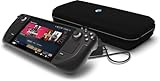
- 1TB NVMe SSD
- 1280 x 800 HDR OLED display with premium anti-glare etched glass, 7.4" Diagonal display size up to 90Hz refresh rate
- Wi-Fi 6E
- 50Whr battery; 3-12 hours of gameplay (content-dependent)
- Carrying case with removable liner
1. Switch the Steam Deck to Desktop Mode
- Press the Steam button.
- Choose Power.
- Select Switch to Desktop.
- Connect a keyboard and mouse if you have them.
SteamOS labels can change slightly between releases, but Desktop Mode is the correct environment for installing the browser and creating the Steam shortcut.
2. Install a Chromium-based browser
- Open Discover from the Desktop Mode taskbar or application menu.
- Search for Google Chrome or another supported Chromium-based browser.
- Install it and launch it once.
- Complete any first-run prompts.
Shadow’s browser client requires an up-to-date browser with H.264 support. Microsoft Edge can be useful, but Microsoft’s own Steam Deck instructions state that its Edge Flatpak is community-maintained and that Microsoft does not actively maintain or officially support Edge on SteamOS. Treat browser packages as version-dependent rather than assuming every build is first-party supported.
3. Start Shadow PC in the browser
- Open the browser and visit pc.shadow.tech.
- Sign in to your Shadow account.
- Choose the option to start Shadow PC.
- Allow required browser permissions, such as microphone or clipboard access, if you need those features.
- Wait for the remote Windows desktop to appear.
- Use the browser’s fullscreen control for a cleaner handheld experience.
Shadow’s browser client normally starts windowed and supports resolutions up to 2K at 60 Hz. Shadow also notes that some resolutions and aspect ratios can have issues, with support generally aimed at 16:9 and 16:10 displays.
Inside the remote Windows PC, install the launcher you need—such as Steam, Epic Games Store, or Battle.net—then install your game there. The game files, Windows installation, launchers, saves, and mods live on Shadow’s remote machine, not on the Steam Deck.
Crashes, No Sound, or Screen Glitches?
Random freezes, missing sound and display glitches usually trace back to one bad driver. Find and replace yours safely.Free scan · under a minuteWindows Errors? Fix Them Before They Spread
Repair common Windows errors and clear accumulated junk for a smoother, more stable PC - no reinstall needed.Free scan · no reinstallShadow is a full remote Windows PC rather than a fixed game catalogue, but that does not mean every game works. Kernel-level anti-cheat, DRM, unsupported launchers, unusual input systems, or virtual-machine detection can prevent a game from starting. Check Shadow’s compatibility and anti-cheat support resources for exceptions.
Rank #2

- International (UK) Version
- 7.4” diagonal, HDR OLED, 1280 x 800 x RGB, up to 90Hz Refresh rate, High performance touch, <0.1 ms Response time, 1,000 nits peak brightness (HDR), 600 nits (SDR)
- SteamOS 3.0 (Arch-based)
- 512GB NVMe SSD, 16GB LPDDR5 on-board RAM (5500 MT/s quad 32-bit channels), microSD UHS-I supports SD, SDXC and SDHC
- 6 nm AMD APU, CPU: Zen 2 4c/8t, 2.4-3.5GHz (up to 448 GFlops FP32
4. Add Shadow to Steam for Gaming Mode
Add the browser—not Shadow as a native Steam Deck game—to Steam as a non-Steam game.
- While still in Desktop Mode, open the Steam desktop client.
- Open Games in the top menu.
- Select Add a Non-Steam Game to My Library.
- Select the browser if it appears in the list.
- If it does not appear, choose Browse and locate the browser executable or Flatpak launcher.
- Add it to your library.
- Rename the shortcut to Shadow PC.
- Optionally add artwork and configure its controller layout.
Executable locations vary between Chrome, Edge, SteamOS versions, and Flatpak packaging. Do not rely on a path copied from an older guide. Steam’s Browse button, or a browser desktop shortcut from the application menu, is safer than hard-coding an unverified location.
For a cleaner launch, edit the shortcut so it opens https://pc.shadow.tech directly. Chrome and Edge use different app-mode or fullscreen options, and those flags can change between packages. Do not add --no-sandbox as a routine fix because it weakens browser security. First test the normal browser shortcut.
Launch the new shortcut once in Desktop Mode. Confirm that the correct browser opens, the login remains available, and Shadow starts. Then return to Gaming Mode and open Shadow PC from your library.
5. Configure the Steam Deck controls
The built-in controls may need Steam Input mapping before the remote Windows game recognizes them as a gamepad. Browser controller support does not automatically prove that every Deck control—especially trackpads, gyro, or rear buttons—will reach the game correctly.
- Open the Shadow PC shortcut’s controller settings in Steam.
- Choose a gamepad-oriented Steam Input layout.
- Map the sticks, buttons, triggers, and D-pad to an Xbox-style controller layout.
- For mouse-heavy games, map a trackpad or stick to mouse movement and use rear buttons for clicks or keyboard modifiers.
- Start the target game and test controls there, not only at the remote Windows desktop.
Steam Input can translate the Deck’s controls for the browser shortcut, but behavior varies with the browser, SteamOS version, game, and streaming session. If the controls remain unreliable, connect a physical Xbox or PlayStation controller before starting Shadow. Shadow documents support for many wired and Bluetooth Xbox, PlayStation, Nintendo, and third-party controllers.
For a controller, pair Bluetooth devices or connect wired devices before launching the Shadow session. If Shadow does not detect the controller, keep it connected and restart the session or application. Shadow’s controller guide covers the supported connection methods.
6. Tune image quality, latency, and bandwidth
Start with automatic bitrate detection. If you use a custom bitrate, keep it below the connection’s reliable capacity. Shadow documents a maximum bitrate of 70 Mb/s, but a lower setting can produce a more stable stream on congested Wi-Fi.
- Prefer 5 GHz Wi-Fi over a crowded 2.4 GHz network.
- Use Ethernet through a USB-C dock when diagnosing connection problems.
- Stop local downloads, uploads, and video streams.
- Begin around 1280×800 or 1280×720 for the Deck’s display.
- Use 60 fps only when the connection is stable; try 30 fps when it is not.
- Lower the bitrate before increasing it to chase a sharper image.
- Disable a VPN while troubleshooting. VPNs can add latency or interfere with connectivity.
These resolution and frame-rate suggestions are practical starting points for a handheld, not Shadow-mandated settings. If audio begins stuttering, reduce audio quality as well. Shadow’s bitrate guide and experience guide explain the available controls.
Common problems and fixes
| Problem | What to try first |
|---|---|
| Shadow will not load | Update the browser, try a private window, disable extensions, allow site permissions, and test the other supported Chromium browser. Try another network if public or workplace Wi-Fi may be restricted. |
| Login works in Desktop Mode but not Gaming Mode | Log in once in Desktop Mode, add the exact browser application to Steam, launch the shortcut once on the desktop, and avoid clearing its cookies. The login flow may open an external browser window. |
| Deck controls do nothing | Change the shortcut to a gamepad Steam Input layout, start Shadow after the controller is connected, restart the session, and test a physical controller. |
| The image is blurry | Check available bandwidth, reduce bitrate or resolution, stop background traffic, and test 5 GHz Wi-Fi or Ethernet. |
| The stream stutters or freezes | Check packet loss and jitter, move closer to the router, use Ethernet, disable a VPN, lower frame rate, and test another network. A fast connection can still perform badly when packet loss is present. |
| A controller is missing | Pair or connect it before starting Shadow, then restart the session while it remains connected. |
| A racing wheel, flight stick, webcam, or other USB device is missing | Confirm that SteamOS sees the device, try a USB 3 port or dock, and investigate ShadowUSB. Ordinary gamepads usually do not need USB forwarding. |
Should you install Shadow’s Linux client?
For most Steam Deck owners, no—not as the first step. Shadow’s official Linux installation instructions provide .deb packages and commands for Debian- and Ubuntu-based distributions, including:
Rank #4

- Valve is entering the gaming console marketplace with the new Steam Deck, a console geared towards PC gamers. The Steam Deck can be docked to a monitor, and used as a PC, or docked to a TV.
- Players can play a huge variety of games at any time with the comfort of a console and the freedom of a PC. Not anti-glare screen.
- Like the name suggests, the Steam Deck will include upgraded 1TB storage, and will include a carrying case. A micro SD slot will also enable expanded storage.
- Valve partnered with AMD to create a specialized APU optimized for handheld gaming, and Valve says the chip will deliver performance to run AAA gaming titles.
- The Steam Deck is outfitted with a 7-inch touchscreen, and two trackpads under the control sticks that allow gamers to operate games never designed outside of mouse and keyboard capabilities.
sudo apt install ./shadow-prod.debSteamOS is Arch-based, so those Debian/Ubuntu instructions are not directly applicable. Do not blindly install the .deb package or run apt commands on SteamOS. A native client may be possible when Shadow provides a current SteamOS-compatible build, but its compatibility and installation method are version-dependent.
Do these 3 things before closing this tab:
1Clear out junk files and repair common Windows errors2Fix the driver behind crashes, sound loss and screen glitches3Repair Windows errors before they cause bigger problemsThe native Linux application can offer more complete controls through Shadow’s Quick Menu, including controller, USB, audio, display, and network options. On Linux, Shadow documents the Quick Menu shortcut as Alt + Super + O. That shortcut should not be assumed to work in the browser client, which has different interface and shortcut support.
ShadowUSB can forward specialist hardware such as racing wheels, flight sticks, microphones, and webcams, but Shadow’s Linux documentation is aimed at AppImage or Debian packages and may not translate cleanly to SteamOS. Use Steam Input, Bluetooth, or a wired controller for normal Deck gaming, and reserve ShadowUSB for peripherals that genuinely require USB forwarding.
Browser versus native client
| Consideration | Browser method | Native Linux client |
|---|---|---|
| Setup | Simple and reversible | More technical and version-dependent |
| Gaming Mode | Add the browser as a non-Steam game | Add the compatible application as a non-Steam game |
| SteamOS risk | Minimal system modification | May be affected by package or SteamOS changes |
| Features | More limited | More complete when supported |
| USB forwarding | Not available for all devices | Possible with ShadowUSB, setup-dependent |
| Best for | Most Steam Deck owners | Advanced Linux users with a specific need |
Shadow says the browser client does not include several application features, including H.265, color enhancement, dual-screen support, and ShadowUSB. It also describes browser access as being in early development, so the installed application remains preferable when a supported build is available and browser limitations affect your use.
Is Shadow PC a good fit for Steam Deck?
Shadow makes the most sense when you need Windows-only games or software, want to install mods, use several PC launchers, or need a complete remote Windows desktop rather than a fixed cloud-gaming catalogue. It can also run demanding software on remote hardware that the Deck cannot handle locally, but remote GPU capability does not eliminate streaming latency, compression, network problems, or service availability.
A local Steam Deck installation is better for offline play, the lowest possible input latency, and games that already run well through SteamOS and Proton. GeForce NOW is a better fit if you want a supported cloud-game catalogue and do not need a complete Windows desktop. Xbox Cloud Gaming is similarly catalogue-based and is not a substitute for installing arbitrary Windows launchers or applications. If you already own a capable gaming PC, Steam Remote Play or another personal-PC streaming tool may avoid a separate cloud-PC subscription, although the home PC must be available and reachable.
Before subscribing, check Shadow’s current regional signup page for availability, activation timing, plan hardware, storage, usage limits, billing terms, and live pricing. Offers are region- and date-specific, so older promotional prices should not be treated as current checkout prices.
Quick Recap
Product prices and availability are accurate as of the date/time indicated and are subject to change. Any price and availability information displayed on Amazon at the time of purchase will apply.




