
For a gaming-first PC, choose the Ryzen 7 9800X3D. TechSpot measured it at 195 frames per second versus 123 fps for Intel’s Core Ultra 9 285K in A Plague Tale: Requiem, and found a 24% advantage in Shadow of the Tomb Raider. Those are configuration-specific results, not a promise for every game. For a machine that also renders, compiles, encodes or performs other heavily threaded work, the 16-core/32-thread Ryzen 9 9950X3D is the stronger AMD compromise. The Core Ultra 9 285K remains a sensible productivity-oriented alternative when Intel software requirements or a substantially cheaper complete platform change the calculation.
The short answer
There is no single winner for every workload. The right CPU depends on whether your priority is maximum gaming frame rate, sustained multithreaded throughput, or the cost and requirements of the complete platform.
As an Amazon Associate I earn from qualifying purchases.
| CPU | Published specifications | Best fit |
|---|---|---|
| AMD Ryzen 7 9800X3D | 8 cores, 16 threads, up to 5.2 GHz, 104 MB cache and 120 W; AMD describes it as a Zen 5 processor. | High-refresh gaming where the graphics card is often waiting on the CPU. |
| AMD Ryzen 9 9950X3D | 16 cores and 32 threads, with AMD’s 3D V-Cache positioning in its 2025 product materials. | Gaming combined with rendering, compiling, encoding or other sustained multithreaded work. |
| Intel Core Ultra 9 285K | Up to 5.70 GHz boost and a TSMC N3B process, according to Intel’s current specification page. | Productivity-first systems, Intel-specific software requirements, or a complete bundle that is materially cheaper. |
CPU-only pricing should not decide the purchase by itself. Motherboard, DDR5 memory, cooling, firmware support and the upgrade path all affect the final system cost.
Why X3D processors can lead in games
“X3D” identifies AMD processors that use the company’s 3D V-Cache approach. The practical reason to care is that games can respond strongly to cache capacity and latency, especially when the processor is limiting frame production rather than the graphics card. A large cache can keep more frequently used game data close to the cores, but the size of the benefit varies by engine, scene, settings and the rest of the test system.
#1 Best Overall

- Game and create with Windows 11 Home – Unlock your potential with Windows 11 Home, designed for gaming, multitasking, and productivity. With an intuitive interface and advanced features, it’s built to keep you ahead of the competition.
- Unleash next-gen power with AMD Ryzen 7 9800X3D processor – Powered by the AMD Ryzen 7 9800X3D processor, the GM700 delivers seamless multitasking and blazing-fast performance. Game, stream, edit, and create with confidence, knowing it's built for the most demanding workloads.
- Elevate your visuals with AMD Radeon RX 9070 XT PRIME OC GPU – Experience immersive gaming and smooth creative workflows with the next-gen AMD Radeon RX 9070 XT PRIME OC GPU. Advanced features like enhanced ray tracing and AV1 encoding deliver stunning visuals and incredible performance.
- Enjoy seamless multitasking with 32GB DDR5 RAM – Equipped with 32GB DDR5 memory, the GM700 effortlessly tackles intense workloads, gaming, streaming, and content creation without breaking a sweat.
- Lightning-fast load times with 2TB of PCIe Gen 4.0 SSD storage – Witness near-instant load times for games and applications, ensuring you spend more time playing and creating, and less time waiting. With ample space for your growing library of games, multimedia files, and work projects, this advanced storage solution keeps everything you need at your fingertips.
That is why a result from one title should be treated as evidence for that title, not as a universal multiplier. A game with a graphics-card bottleneck may show little difference between CPUs. A simulation, strategy game or high-refresh competitive title that stresses the processor can show a much larger gap.
AMD’s launch statement called the Ryzen 7 9800X3D “the ultimate solution for the PC gaming market, with eight high-performance ‘Zen 5’ processor cores and 16 processing threads ready to make quick work of gaming and productivity tasks.” That is AMD corporate marketing, not an independent test conclusion. Independent results are more useful when they publish the game, resolution, graphics card, memory settings, firmware, operating system and frame-time data alongside the average frame rate.
What the published gaming results actually show
| Game and metric | Observed result | How to interpret it |
|---|---|---|
| A Plague Tale: Requiem average frame rate | Ryzen 7 9800X3D: 195 fps; Core Ultra 9 285K: 123 fps | TechSpot comparison result; the advantage belongs to this game and its published test configuration. |
| Shadow of the Tomb Raider | Ryzen 7 9800X3D was 24% faster | TechSpot comparison result; do not apply the percentage automatically to other games. |
The A Plague Tale numbers are a substantial lead for the 9800X3D in that test. They are most relevant if you play similar CPU-limited workloads at a high refresh rate. They tell you less if your target is 4K with a graphics card that determines nearly all of the frame time.
Look beyond the headline average. The 1% low shows how the slowest one percent of sampled frames behave and is often a better guide to hitching and uneven motion. A CPU that posts a high average but poor lows can feel less consistent. Compare both processors at a resolution and quality level that exposes a CPU limit, then repeat at your intended resolution to see whether the difference survives in your own build.
Independent reviews and AMD’s own testing can use different GPUs, memory speeds, BIOS versions, operating systems and game settings. Two apparently conflicting charts may both be correct for their respective configurations. Keep the complete test configuration beside every benchmark before drawing a buying conclusion.
Rank #2

- Raphael AM5 6-Core Desktop Processor
- 6MB L2, 96MB L3 Cache, 6 Cores, 12 Threads
- AMD A620, B650, B650E, B840, B850, X670, X670E, X870, X870E Chipsets
- 128GB DDR5-5200 Memory Supported
- Heatsink Not Included
Ryzen 7 9800X3D: the focused gaming choice
The Ryzen 7 9800X3D has 8 cores and 16 threads, boosts up to 5.2 GHz, carries 104 MB of cache and is specified at 120 W. AMD identifies it as a Zen 5 processor. That combination targets the part of the market where game performance and frame-time consistency matter more than maximum workstation throughput.
When it makes sense
- You are building primarily for gaming, especially at high refresh rates.
- Your games are known to be CPU-limited at the settings you use.
- You want a straightforward eight-core gaming build and do not routinely run long, heavily threaded jobs.
- The 9800X3D and the required platform fit your complete budget after adding the motherboard, DDR5 memory and cooler.
Where its limits appear
Eight cores and 16 threads are not equivalent to the 9950X3D’s 16 cores and 32 threads for workloads that scale across many threads for minutes or hours. If your day includes frequent 3D rendering, large software builds, video encoding or similar sustained work, the larger Ryzen 9 is the more appropriate AMD starting point. A game-first buyer should not pay for cores that sit idle, but a creator should not choose on gaming averages alone.
Ryzen 9 9950X3D: the mixed-use compromise
AMD’s 2025 product materials list 16 cores and 32 threads for the Ryzen 9 9950X3D and retain the company’s 3D V-Cache positioning. That core and thread count gives it a much wider productivity envelope than the 9800X3D while keeping the X3D design aimed at strong gaming performance.
Who should choose it
- Streamers or creators who game and also render, encode or edit on the same machine.
- Developers who compile large projects while keeping other applications responsive.
- Users who want one system for high-end gaming and sustained multithreaded workloads instead of maintaining separate PCs.
- Buyers who value fewer compromises more than the lowest possible CPU or platform price.
No head-to-head benchmark table for the 9950X3D and Core Ultra 9 285K was published in the available evidence. It would therefore be misleading to assign the 9950X3D a specific percentage lead in either games or applications from the available evidence. Its 16-core/32-thread specification explains why it is the better X3D compromise for heavy productivity, but application results still depend on the software and test setup.
What to verify before purchase
Confirm that the motherboard firmware supports the processor, that the cooler is appropriate for the sustained workload, and that your memory kit is on the board maker’s compatibility list. Check the complete platform price rather than assuming a premium CPU automatically produces the cheapest or fastest system.
Rank #3

- AMD Ryzen 7 9800X3D Desktop Processor, 8-Core, 16-Thread, 5.2 GHz Max Boost, Unlocked for overclocking, 104MB L2 + L3 Cache, DDR5 Support, 120W TDP. The world's fastest gaming processor, built on AMD Zen5 technology and Next Gen 3D V-Cache
- AMD Socket AM5 Platform: Supports PCIe 5.0 on Select Motherboards; Integrated AMD Radeon Graphics Included; Cooler Not Included; Liquid Cooling Recommended; Supports Windows 10 and Windows 11 64-Bit Editions
- GIGABYTE B850 Gaming X Motherboard: ATX Form Factor, Dual-Channel DDR5 Support up to 256GB, PCIe 5.0 x16 Support, 3 M.2 Slots, 4 SATA 6Gb/s Ports, 1 USB 3.2 Gen 2x2 Type-C Port, Wi-Fi 6E, Bluetooth 5.3, and Windows 10/11 64-Bit Compatibility
- AMD Socket AM5: Supports AMD Ryzen 9000, 8000, and 7000 Series Processors; X3D Turbo Mode for Enhanced Gaming Performance; DDR5 Memory Overclocking up to 8200MT/s; Digital 6+2+2 Phase VRM Solution
- Dual Channel DDR5: 4 DIMM Slots with AMD EXPO Memory Module Support; WIFI EZ-Plug : Quick and easy design for Wi-Fi antenna installation; PCIe EZ-Latch Plus: PCIe slots with Quick Release Design; Friendly UI: Multi-Theme, AIO Fan Control, and Q-Flash Auto Scan in BIOS and SW
Core Ultra 9 285K: when Intel remains the right answer
Intel’s current specification page lists up to a 5.70 GHz boost for the Core Ultra 9 285K and identifies TSMC N3B process technology. Those specifications make it a credible high-end alternative for productivity-oriented buyers, but a boost-clock number is not a substitute for application testing. Workloads respond to architecture, thread scheduling, memory behavior, software optimization and sustained power limits as well as peak frequency.
What’s actually slowing this PC down?
Pick the symptom - the matching free tool is one click away.
Choose it when the platform or software dictates the decision
- Your primary applications have an Intel-specific requirement or a proven Intel preference.
- A complete 285K motherboard, DDR5 memory and cooling bundle costs substantially less than the AMD alternatives.
- You spend more time in productivity software than in CPU-limited games.
- Your target applications show a measured advantage for the 285K in independent tests using settings close to your own.
The 285K can still be a rational purchase even if an X3D chip wins selected gaming charts. A lower total platform price can fund a faster graphics card, more memory or better storage, changes that may have a larger effect on the finished system than a CPU-to-CPU frame-rate difference.
Gaming versus productivity: match the processor to the workload
High-refresh gaming
At 1080p or other CPU-sensitive settings with a fast graphics card, the 9800X3D is the focused choice from the tested options. The TechSpot results show why: 195 fps versus 123 fps in A Plague Tale: Requiem and a 24% lead in Shadow of the Tomb Raider. Before treating those numbers as decisive, check independent results for the games you actually play and inspect 1% lows as well as averages.
4K gaming
At 4K, the graphics card more often determines the frame rate. The CPU still affects minimums, simulation-heavy scenes and background tasks, but the visible gap can narrow. Spend the difference on the graphics subsystem if your benchmarks show a GPU limit; do not buy an X3D part solely because a chart was made at a CPU-limited resolution.
Rendering, compiling and encoding
These workloads commonly reward more available threads and sustained throughput. The 9950X3D’s 16 cores and 32 threads make it the AMD choice when this work is important alongside gaming. The 9800X3D can handle productivity tasks—AMD explicitly markets it that way—but its eight-core layout is a different trade-off from a 16-core processor. The 285K deserves consideration when your applications favor Intel or its complete platform is meaningfully cheaper.
Do these 3 things before closing this tab:
1Repair Windows errors before they cause bigger problems2Scan for outdated or missing drivers - takes under a minute3Clear out junk files and repair common Windows errorsRank #4

- AMD Ryzen 7 7800X3D Desktop Processor, 8-Core, 16-Thread, 5 GHz Max Boost, Unlocked for overclocking, L2+L3 104 MB cache, DDR5, Default TDP 120W. The world's fastest gaming processor, built on AMD Zen5 technology and Next Gen 3D V-Cache
- AMD Socket AM5 Platform: Supports PCIe 5.0 on Select Motherboards; Integrated AMD Radeon Graphics Included; Cooler Not Included; Liquid Cooling Recommended; Supports Windows 10 and Windows 11 64-Bit Editions
- GIGABYTE B850 Gaming X Motherboard: ATX Form Factor, Dual-Channel DDR5 Support up to 256GB, PCIe 5.0 x16 Support, 3 M.2 Slots, 4 SATA 6Gb/s Ports, 1 USB 3.2 Gen 2x2 Type-C Port, Wi-Fi 6E, Bluetooth 5.3, and Windows 10/11 64-Bit Compatibility
- AMD Socket AM5: Supports AMD Ryzen 9000, 8000, and 7000 Series Processors; X3D Turbo Mode for Enhanced Gaming Performance; DDR5 Memory Overclocking up to 8200MT/s; Digital 6+2+2 Phase VRM Solution
- Dual Channel DDR5: 4 DIMM Slots with AMD EXPO Memory Module Support; WIFI EZ-Plug : Quick and easy design for Wi-Fi antenna installation; PCIe EZ-Latch Plus: PCIe slots with Quick Release Design; Friendly UI: Multi-Theme, AIO Fan Control, and Q-Flash Auto Scan in BIOS and SW
Light office and everyday use
For web, office, communication and ordinary multitasking, all three are far beyond the minimum needed for a responsive system. Gaming priorities, application-specific tests, noise targets and total platform cost should decide the purchase rather than a small difference in peak specifications.
How to compare the CPUs correctly
- List the real workloads. Write down the games, creative applications, compilers and encoders you use, plus how many hours each workload runs continuously.
- Identify the bottleneck. Monitor whether the graphics card or CPU is limiting the frame rate at your intended resolution and quality settings.
- Collect comparable gaming data. Prefer tests with the same graphics card, memory configuration, operating system, BIOS generation and game version. Record average fps and 1% lows.
- Use application-specific productivity results. A rendering score does not predict compile time, and an encoding result does not predict every editing workflow. Choose tests that resemble your software and project sizes.
- Price the whole platform. Add the processor, motherboard, DDR5 memory, cooler and any required firmware or accessory costs. Compare complete bundles, not CPU listings alone.
- Check power and noise goals. Verify the cooler’s sustained-load capability and decide whether lower fan noise matters more than a small performance lead.
- Confirm the upgrade path. Check the board’s supported processors, firmware history and memory support before ordering. An apparently inexpensive CPU can become costly if the board must be replaced immediately.
Platform cost, cooling and noise
The processor price is only one line in a build. A fair comparison includes the motherboard, DDR5 memory, cooler and the possibility of a firmware update. If one CPU requires a more expensive board or cooling solution, its apparent value can disappear even when the sticker price looks attractive.
The 9800X3D is specified at 120 W, but that figure does not describe every real-world temperature or fan-speed outcome. Sustained workloads, cooler design, case airflow, ambient temperature and motherboard power behavior all matter. The 9950X3D and 285K should be evaluated with the same discipline: use the manufacturer’s current guidance and independent sustained-load measurements for the exact board and cooler you plan to buy.
Noise is part of performance for a desktop used for hours. Compare test graphs made under similar ambient conditions, and distinguish short benchmark bursts from long renders or encodes. A cooler that handles a brief boost may become noticeably louder during a prolonged workload.
Common buying mistakes and how to avoid them
Applying one game’s percentage to every title
The 24% Shadow of the Tomb Raider result and the 195-versus-123-fps A Plague Tale result are useful evidence, not universal conversion factors. Look for several games and retain their test conditions.
Best Value
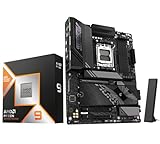
- AMD Ryzen 9 9950X3D Desktop Processor, 16-Core, 32-Thread, 5.7 GHz Max Boost, Unlocked for overclocking, L2+L3 144 MB cache, DDR5, Default TDP 170W. The world's fastest gaming processor, built on AMD Zen5 technology and Next Gen 3D V-Cache
- For the state-of-the-art Socket AM5 platform, can support PCIe 5.0 on select motherboards. OS Support: Windows 11/ 10-64-Bit Edition. Cooler & Thermal Solution (PIB) not included. AMD Radeon Graphics Integrated
- ASUS TUF Gaming X870E-PLUS Motherboard, ATX Form Factor, Socket AM5, Dual Channel Memory DDR5 up to 256GB, PCIe 5.0 Support, 1x PCIe 5.0 x4 M.2 Slot, 3x PCIe 3.0 x4 M.2,Slot, 4x SATA 6Gb/s ports, Wi-Fi 7, Bluetooth v5.4, 2 x Type-C USB4 (40Gbps) ports, Windows 11 Support, Ready for AMD Ryzen 9000 & 8000 & 7000 Series Desktop Processors
- Ready for Advanced AI PC: Designed for the future of AI computing, with the power and connectivity needed for demanding AI applications;/ Enhanced Power Solution: 16+2+1 80A power stages, 8-layer PCB, 8+8 pin ProCool power connectors, alloy chokes and durable capacitors for stable power delivery;/ Intelligent Control: ASUS-exclusive AI Overclocking, AI Cooling II, AI Networking II, and AEMP to simplify setup and improve performance
- Latest M.2 Support: Two onboard PCIe 5.0 M.2 slots and two PCIe 4.0 M.2 slots;/ Ultrafast Connectivity: Wi-Fi 7, PCIe 5.0 x16 slot, Realtek 2.5Gb Ethernet, rear two USB4 (40Gbps) Type-C ports, front USB 20Gbps Type-C connector with up to 30W PD Fast-charge;/ Comprehensive Cooling: Enlarged VRM heatsink, M.2 heatsink, PCH heatsink, hybrid fan headers and Fan Xpert 4 with AI Cooling II
Comparing average fps without 1% lows
Average frame rate can hide stutter or uneven delivery. Require frame-time lows when smoothness matters, particularly for competitive or simulation games.
Using boost clocks as a productivity verdict
The 285K’s up-to-5.70 GHz figure is a maximum boost specification, not a guaranteed all-core workload speed. Sustained application tests are the relevant evidence for rendering, compiling and encoding.
Ignoring the graphics-card bottleneck
If the GPU is already at full utilization, changing CPUs may produce little visible improvement. Test at the resolution and settings you actually intend to use.
Quick wins for a faster PC:
Clear out junk files and repair common Windows errorsFree Scan →Fix the driver behind crashes, sound loss and screen glitchesFind Drivers →Buying on CPU price alone
Include the motherboard, DDR5 memory, cooling and upgrade considerations. A discounted bundle can make the 285K the better value, while a gaming-focused system may justify the 9800X3D’s cost through higher CPU-limited frame rates.
Assuming every board is ready
Check processor support and firmware before installation. A board that needs an update may require a compatible older CPU or a flashback feature; verify the manufacturer’s documented procedure rather than discovering this after the build is assembled.
Decision guide
| Your priority | Best starting point | Reason |
|---|---|---|
| Mostly high-refresh gaming | Ryzen 7 9800X3D | It is the focused X3D gaming option, with independent results showing large leads in the cited games. |
| Gaming plus rendering, compiling or encoding | Ryzen 9 9950X3D | Its 16 cores and 32 threads provide the broadest AMD productivity headroom while retaining X3D positioning. |
| Productivity-first use or Intel-specific software | Core Ultra 9 285K | Its current specification lists up to 5.70 GHz boost and TSMC N3B process technology; application tests and platform price decide value. |
| Uncertain workload mix | Benchmark your actual applications, then compare complete platforms | No single gaming chart or boost-clock figure can predict a mixed system accurately. |
Bottom line
AMD’s Ryzen 7 9800X3D is the clearest choice when gaming performance is the main objective, especially in CPU-limited, high-refresh scenarios. The Ryzen 9 9950X3D is the more convincing all-rounder for buyers who will genuinely use 16 cores and 32 threads in rendering, compiling, encoding or similar work. Intel’s Core Ultra 9 285K remains competitive when productivity software, Intel platform requirements or a substantially lower complete-build price outweigh the X3D gaming advantage. Recheck current street prices, board compatibility, firmware and independent tests for your games and applications immediately before buying.
Quick Recap
Product prices and availability are accurate as of the date/time indicated and are subject to change. Any price and availability information displayed on Amazon at the time of purchase will apply.
Recommended Free Tools

