The Tool Desk
Outbyte Driver Updater FREEFix the driver behind crashes, sound loss and screen glitchesFind Drivers →Outbyte PC Repair FREERepair Windows errors before they cause bigger problemsFix Now →Verdict: The LG UltraGear 27GX790A-B proves that 480Hz OLED is more than a specification-sheet gimmick. In fast games such as Rocket League and Overwatch 2, the extra refresh headroom can make tracking and camera movement feel smoother and more immediate. But it remains a specialist luxury, not the sensible choice for most gamers.
At roughly $1,000, the 27-inch 1440p WOLED monitor makes sense mainly for serious competitive PC players with hardware capable of sustaining very high frame rates. Most gamers will get better value from a 240Hz OLED, a 4K OLED, or a cheaper display. The case is harder to make now that LG sells the newer 27GX790B-B, with QHD 540Hz and HD 720Hz modes.
As an Amazon Associate I earn from qualifying purchases.
What is the LG 27GX790A-B?
The LG UltraGear 27GX790A-B is a 27-inch WOLED gaming monitor announced in November 2024. It combines a 2,560 × 1,440 QHD resolution with a maximum 480Hz refresh rate and LG’s claimed 0.03ms gray-to-gray response time. It also includes DisplayPort 2.1, two HDMI 2.1 ports, NVIDIA G-SYNC compatibility and AMD FreeSync Premium Pro.
LG’s response-time number is a panel specification, not total system input latency. Your game, CPU, GPU, frame pacing and peripherals still determine how quickly an action reaches the screen.
#1 Best Overall

- LG UltraGear OLED Goes Glossy - Experience ultra-smooth, tear-free gameplay with up to 240Hz refresh rate and 0.03ms response time on a glossy, bright 27” QHD OLED display. React instantly, spot every detail, and outpace your opponents in every frame with outrageous speed and clarity.
- Next-Level OLED Brightness, for Next-Level Play - The brilliant OLED display brings every scene to life with jaw-dropping color and intensity. Delivering a standard 275 nits of brightness and peaking at 1300 nits, your games shine with vivid clarity—keeping dark corners detailed, explosions dazzling, and the action always visible no matter the environment.
- VESA DisplayHDR True Black 400 - An OLED display with VESA DisplayHDR True Black 400 and a 1.5M:1 contrast ratio deliver deep blacks and dazzling highlights, so you catch every hidden detail in dark scenes and every spark in the bright ones. With up to 98.5% DCI-P3 color, your worlds burst with vibrant intensity—making every game feel more alive.
- Three UL Certifications. One Clear Advantage for Eye Comfort. - This UltraGear OLED display is three times UL-certified—for Anti-Glare, Flicker-Free, and Low Blue Light. Combined with a glossy finish, the display helps reduce distractions, keep your view crisp, and maintain visual comfort—so you can stay focused and perform at your best, even during extended gaming sessions.
- 27” OLED Brilliance with up to 240Hz of Game-Changing Speed - Experience ultra-smooth, tear-free gameplay with up to 240Hz refresh rate on a glossy, bright 27” QHD OLED display.
The monitor has OLED’s near-black pixels, high contrast and wide-gamut color. Engadget reported 98.5% DCI-P3 coverage in its review context and praised the display’s dark scenes, color and bright highlights. As with other OLEDs, however, small bright highlights should not be confused with sustained full-screen HDR brightness.
There are no built-in speakers, but the monitor provides USB connectivity and a headphone output. It supports height, tilt and angle adjustments. Check the current regional product page or manual for the precise stand range before buying, since specifications and model suffixes can vary by market.
LG’s U.S. listing showed the 27GX790A-B at $999.99 when checked in August 2026. Prices, stock and promotions change, so treat that as a time-specific reference rather than a permanent street price. See the official LG product page.
What does 480Hz actually change?
At 480Hz, the monitor can refresh every approximately 2.08 milliseconds. At 240Hz, that interval is approximately 4.17ms; at 144Hz, it is approximately 6.94ms.
The improvement from 240Hz to 480Hz is real, but smaller than the jump from 60Hz to 240Hz. A 480Hz panel does not make a game run at 480 frames per second. The PC must render those frames, and the game must deliver them with consistent frame pacing.
Rank #2

- 32" 4K UHD Glossy OLED Display - Experience ultra-sharp visuals and lifelike color on a stunning 32-inch 4K UHD (3840 x 2160) glossy OLED display. Every detail pops with depth and vibrancy, bringing your favorite games and content to life.
- Bright OLED Gaming - This UltraGear features Micro Lens Array+ technology. So with a typical brightness of 275 nits, this monitor is brighter than previous UltraGear OLED gaming displays and has improved viewing angles.
- VESA DisplayHDR True Black 400 & 1.5M:1 Contrast Ratio - VESA DisplayHDR True Black 400 certified with upt to DCI-P3 98.5% color gamut means this monitor meets industry standards for brightness as well as deep, rich black color expression. With a 1.5M:1 contrast ration, the benefit for gaming impeccable color and image detail in dark scenes for a stunning visual experience.
- 32" UHD OLED Brilliance with 165Hz of Game-Changing Speed - Experience ultra-smooth, tear-free gameplay with up to 165Hz on a bright 32” Glossy UHD OLED display. React instantly, spot every detail, and outpace your opponents in every frame with outrageous speed and clarity.
- Leave Lag Behind with 0.03ms Response Time - Enjoy smoother scenes with less lag or ghosting thanks to LG UltraGear OLED's nearly instantaneous 0.03ms (GtG) response time.
| Refresh rate | Frame interval | Best suited to |
|---|---|---|
| 144Hz | 6.94ms | General gaming and affordable high-refresh setups |
| 240Hz | 4.17ms | Most competitive PC gamers |
| 480Hz | 2.08ms | High-end esports systems and players sensitive to motion clarity |
That distinction matters. If your system usually produces 80–200fps, you will not receive the full benefit of a 480Hz panel. Even if the monitor is set to 480Hz, much of its potential is unused. Average FPS is not enough either: poor 1% lows and uneven frame times can make a high-refresh display feel inconsistent.
Does 480Hz feel noticeably better?
Engadget’s May 2025 review, which scored the monitor 90/100, found that 480Hz could feel meaningfully smoother and more responsive in games including Rocket League and Overwatch 2. The reviewer described the benefit as something felt through tracking stability and responsiveness rather than an immediately dramatic visual leap.
Outdated Drivers Are Slowing You Down
One free scan finds every outdated or missing driver and matches the right update for your exact hardware.Free scan · exact hardware matchPC Slower Than It Used to Be?
A free scan shows the junk files, broken settings and background clutter dragging Windows down - then fixes them in one click.Free scan · Windows 10 & 11That is the right way to understand this monitor. The difference is most apparent when you are:
- Following a fast target through rapid camera movement.
- Making repeated direction changes in an arena shooter or sports game.
- Playing at a consistently high frame rate.
- Comparing 480Hz directly with 240Hz using the same settings and input equipment.
Competitive shooters, arena shooters and Rocket League are better demonstrations than cinematic single-player games. In a slower game running at 90fps, the 480Hz specification contributes little. Even in esports titles, it may improve perceived smoothness and timing without guaranteeing better aim or a higher rank.
Engadget reached 480fps at 1440p using an NVIDIA RTX 5090 and AMD Ryzen 9 9950X3D. Its review also noted that older hardware could exceed 300fps in some games, particularly at 1080p. Those are useful demonstrations of the panel’s ceiling, not a universal hardware requirement or performance guarantee.
Rank #3
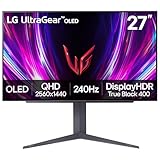
- 240Hz Refresh Rate - Gear up for smooth gameplay with an ultra-fast 240Hz OLED display. The faster speed lets you respond quickly to opponents and stay a step ahead of the competition. Plus, enjoy smoother scenes with less lag or ghosting thanks to LG UltraGear OLED's nearly instantaneous 0.03ms (GtG) response time.
- VESA DisplayHDR True Black 400 & 1.5M:1 contrast ratio - VESA DisplayHDR True Black 400 certified means this monitor meets industry standards for brightness as well as deep, rich black color expression. With a 1.5M:1 contrast ration, the benefit for gaming impeccable color and image detail in dark scenes for a stunning visual experience.
- NVIDIA G-SYNC Compatible and AMD FreeSync Premium Pro - Officially validated by NVIDIA as G-SYNC Compatible and equipped with AMD FreeSync Premium Pro means this UltraGear provides smooth, fast action that reduces screen tearing and stutter. Never miss a frame of the action as you clinch your victories.
- Anti-Glare / Low Reflection OLED - Play with less distractions thanks to an anti-glare screen that minimizes light reflections and lets you concentrate on winning.
- 2 Year UltraGear OLED Warranty - Game with peace of mind. This UltraGear OLED gaming monitor is protected by a two year limited warranty covering internal and functional parts and labor, including OLED Display Panel. See Warranty Information on this page for all warranty details.
OLED may be the bigger upgrade
For many buyers, the 27GX790A-B’s OLED characteristics matter more than its 480Hz ceiling.
What’s actually slowing this PC down?
Pick the symptom - the matching free tool is one click away.
- Contrast: OLED pixels can switch off for near-black scenes, producing far deeper blacks than conventional LCDs.
- Motion response: Very fast pixel response helps reduce visible smearing and ghosting.
- Color and highlights: Saturated color and small bright highlights can make games look more impactful.
- Resolution: QHD at 27 inches is a practical compromise between sharpness and the high frame rates required for competitive play.
The trade-off is OLED’s vulnerability to image retention and burn-in after prolonged static use. Static taskbars, browser elements, desktop windows and HUD-heavy games deserve more caution than varied full-screen gaming. Use automatic sleep and a screen saver, avoid leaving static images displayed unnecessarily, and allow the monitor’s pixel-care routines to run. Check LG’s current support documentation and the warranty terms for your country rather than assuming identical coverage everywhere.
OLED text rendering can also look different from an LCD, depending on the panel’s subpixel structure and your viewing distance. If the monitor will spend as much time displaying documents and browser windows as games, compare it with an LCD or another OLED in person where possible.
Hardware and setup requirements
To target 1440p at 480Hz, you need more than the monitor itself:
- Use a capable GPU output. LG says achieving up to 480Hz requires a graphics card supporting DisplayPort 2.1. Connect the cable to the dedicated graphics card, not the motherboard video output.
- Use an appropriate DisplayPort 2.1 cable. Verify that both the GPU and cable support the desired bandwidth and that the monitor is using the correct input mode.
- Pair it with a strong CPU. At very high frame rates, esports games can become CPU-limited even when the GPU has headroom.
- Select 480Hz in the operating system. In Windows, open Settings, choose System, then Display, Advanced display, and select the highest available refresh rate.
- Measure real performance. Use a frame-time or FPS overlay and check 1% lows, not only the headline average.
- Configure adaptive sync deliberately. Test G-SYNC or FreeSync with an in-game frame cap. The best cap depends on the game, driver and synchronization setup.
- Use HDR selectively. Enable it for games with good HDR implementations rather than assuming Windows-wide HDR is best for every desktop application.
If 480Hz is missing, check the GPU output, cable, monitor input mode, Windows refresh-rate menu and graphics-driver configuration. If the system cannot maintain at least the high hundreds of frames per second in the games you actually play, lower competitive-game settings or resolution only after deciding whether that trade-off is worthwhile.
Do these 3 things before closing this tab:
1Fix the driver behind crashes, sound loss and screen glitches2Repair Windows errors before they cause bigger problems3Scan for outdated or missing drivers - takes under a minuteRank #4

- Blazing Speed. Brilliant Color. Total Control. - Dominate the game with a 27" QHD IPS display built for speed, clarity, and precision. Enjoy ultra-smooth action with 300Hz/1ms (GtG), vibrant HDR visuals, and tear-free gameplay—plus pro-level adjustments and versatile ports for your perfect setup.
- 27" QHD IPS Clarity - Enjoy crisp, detailed visuals with QHD (2560x1440) IPS resolution on a vibrant 27" IPS display. Wide viewing angles keep colors vivid from any position, so every scene stays crisp and vibrant.
- Vivid Color and HDR Brilliance - Immerse yourself in lifelike visuals with up to 95% DCI-P3 color gamut and VESA DisplayHDR 400. Enjoy rich hues, bright highlights, and deep dark shadows that make every game more vibrant and every scene more cinematic.
- 300Hz Refresh Rate for the Win - React faster and play smoother with a blistering 300Hz refresh rate—perfect for high-speed competitive gaming where every millisecond counts. Experience fluid motion and razor-sharp clarity, even in the most intense action.
- 1ms (GtG): Astounding Gaming Speed - Play with a near-instantaneous 1ms response time, which minimizes ghosting for gaming visuals that are sharp, clear and buttery smooth.
480Hz OLED versus 240Hz OLED
| Priority | Better fit | Why |
|---|---|---|
| Maximum competitive performance | 480Hz OLED | Lower frame interval and more motion headroom when the PC can exploit it |
| Best value for most PC gamers | 240Hz OLED | Much easier to drive and commonly far cheaper |
| 4K single-player gaming | 4K OLED | Higher detail matters more than extreme refresh in cinematic games |
| Console gaming | 120/144Hz HDMI 2.1 display | Consoles generally cannot use 480Hz modes |
| Latest LG high-refresh technology | 27GX790B-B | Newer QHD 540Hz and HD 720Hz modes |
| Mixed work and gaming | Careful OLED comparison or LCD | Static desktop use and text behavior may matter more than refresh rate |
A good 240Hz OLED often delivers the more balanced experience: excellent motion response, OLED contrast, easier GPU demands and a lower purchase price. Choose the 27GX790A-B when you specifically value the last increment of competitive responsiveness and can sustain it, not simply because 480Hz sounds future-proof.
Why the 2026 buying context matters
The 27GX790A-B is no longer LG’s fastest 27-inch OLED option. LG’s current U.S. product page lists the 27GX790B-B, which offers QHD at 540Hz or HD at 720Hz and a claimed 0.02ms response time.
That does not automatically make the older model bad. It changes the price test. Buy the 27GX790A-B only when it is meaningfully cheaper than the newer monitor or when its availability and features better suit you. At similar prices, the newer model deserves first consideration. Also remember that its HD 720Hz mode is a specialized option, not a replacement for QHD image quality.
Other alternatives include LG’s 240Hz-oriented 27GX704A-B, LG’s newer 27GX700A-B with multiple operating modes, and the 27G850A-B, a Nano IPS Black display offering 4K 240Hz or Full HD 480Hz. These are not identical substitutes: LCD models will not provide OLED’s black levels or pixel response, while 4K OLEDs prioritize detail over extreme frame rates.
Free tools Windows power users keep installed
One-click scans. No signup required.
Who should buy the LG 27GX790A-B?
Serious esports competitor: Yes, conditionally
Buy it if your main games can regularly run around 360–480fps at 1440p, you play competitively, and the price is competitive with newer 540Hz alternatives. You may feel the extra smoothness and responsiveness, but it will not compensate for weak frame pacing, poor peripherals or inadequate practice.
Best Value

- Next-Level Gaming with 4K UHD & Nano IPS Black - Unleash next-gen gaming with the UltraGear's irst Nano IPS Black monitor. Play in razor-sharp 4K UHD at 240Hz or switch to blistering 480Hz in Full HD. With 1ms GtG response and DisplayPort 2.1, every frame is pure speed, precision, and power.
- 4K UHD: Nano IPS Black and HDR 600 Deliver Phenomenal Visuals - Dive into 4K UHD with Nano IPS Black and HDR600 for visuals that captivate. With up to 99% DCI-P3 color and deeper blacks, every scene comes alive with stunning clarity and contrast—elevating your gaming to new levels of excitement.
- Dual Mode: UHD at 240Hz or Full HD at 480Hz - Dual Mode lets you take full control. Enjoy graphically stunning story-driven adventures in UHD at up to 240Hz, immersing yourself in stunning visuals and rich detail. Or switch to Full HD at an electrifying 480Hz for ultra-responsive gameplay in FPS, MOBA, or racing titles. With a simple hotkey, you decide: resolution for beauty or speed for the win.
- 1ms (GtG): Astounding Gaming Speed - Play with a near-instantaneous 1ms response time, which minimizes ghosting for gaming visuals that are sharp, clear and buttery smooth.
- Serious Connectivity for Serious Gamers - DisplayPort 2.1 delivers ultra-fast data speeds for flawless high refresh rate gameplay. Enjoy sharper visuals with higher resolution support, virtually zero lag, and instant responsiveness, giving you the edge to dominate. The monitor also has two HDMI 2.1 ports and USB 3.2 Gen1 (1 upstream / 2 downstream)
Enthusiast with flagship hardware: Probably
A high-end CPU and GPU make the monitor’s capability easier to exploit. It is a compelling luxury if you specifically want 27-inch QHD OLED and do not prioritize 4K. Compare its current price with the 27GX790B-B before purchasing.
Mainstream PC gamer: Usually no
If your games normally run between 60 and 200fps, a 240Hz OLED or less expensive high-refresh display is the more rational choice. Put the savings toward a GPU, CPU or games where they will have a broader effect.
Console gamer: No
The two HDMI 2.1 ports are useful for compatible PlayStation 5 and Xbox Series X|S features, but console gaming does not normally use the 480Hz capability. A 120/144Hz HDMI 2.1 monitor, a 4K display or a larger screen is likely better value. Verify resolution, VRR and HDR support for the specific console rather than judging compatibility from the HDMI 2.1 label alone.
Recommended Free Tools
Productivity-heavy user: Think carefully
OLED contrast and gaming performance are attractive, but static desktop content and text rendering deserve attention. If most of your day involves documents, spreadsheets or browser windows, an LCD may be a more comfortable and lower-maintenance choice.
OLED-curious buyer on a budget: No
Do not pay for 480Hz merely to obtain OLED. A 240Hz OLED usually gives you the more important OLED benefits at a lower price.
Final verdict
The LG 27GX790A-B is a technically impressive monitor and Engadget was right to find genuine value in its 480Hz feel. The benefit is real in the right games, with the right player and the right PC. But the performance gain over 240Hz is incremental, the hardware requirements are demanding, and LG’s newer 27GX790B-B makes the older model harder to recommend at full price.
Buy the 27GX790A-B for high-frame-rate competitive gaming when it is substantially discounted. For everyone else, a 240Hz OLED, a 4K OLED or a better-priced current-generation display is the smarter purchase.
Quick Recap
Product prices and availability are accurate as of the date/time indicated and are subject to change. Any price and availability information displayed on Amazon at the time of purchase will apply.




