To make an iron golem yourself, arrange four iron blocks in a T shape and place a carved pumpkin on top. For renewable iron, build an edition-specific village farm: Java and Bedrock use different village and spawning rules, and a reliable Bedrock farm must control its village center, satisfy villager and bed requirements, provide valid spawn surfaces, and move each golem to collection.
Godlike.Host offers hosted Minecraft Java servers with its own game panel, SFTP access and free DDoS protection, if you would rather not host it yourself.
What an iron golem does
An iron golem is a powerful village defender. It attacks threats near villagers and can also be created by the player. Official Minecraft material describes golems as defenders that cannot drown, take fall damage or be knocked back. A golem may offer a poppy to a villager, making it one of the game’s most recognizable village interactions.
As an Amazon Associate I earn from qualifying purchases.
Quick wins for a faster PC:
Clear out junk files and repair common Windows errorsFree Scan →Scan for outdated or missing drivers - takes under a minuteDriver Scan →Microsoft’s Bedrock entity reference lists 100 health, a width of 1.4 blocks, a height of 2.9 blocks and attack damage ranging from 7 to 21 in its documented behavior format. The fall-damage immunity is also recorded there. Those values describe the Bedrock entity reference; do not assume every Java behavior or combat detail is identical without checking the rules for that edition.
How to make an iron golem by hand
- Collect four iron blocks. Each block is made from nine iron ingots, so the construction consumes 36 ingots.
- Place three iron blocks in a horizontal row.
- Place the fourth iron block in the middle of that row, forming a T.
- Put a carved pumpkin on top of the upright block. The pumpkin is the final piece that activates the structure; an uncarved pumpkin is not the specified ingredient.
Build the shape in an area where the resulting golem has room to stand. Once the carved pumpkin is placed, the structure becomes an iron golem rather than a permanent arrangement of blocks.
#1 Best Overall
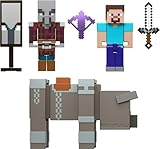
- Minecraft fans can join Steve on a quest to save the Village from attack with this Village Raid action figures and accessories set!
- The collectible pack includes 3 Minecraft action figures and 3 accessories to recreate the action in real life for play or display!
- Steve, a Raid Captain and a Ravager are included in 3-inch scale with movable joints for action moves and posability!
- Storm into the story with accessories that include an iron sword, enchanted crossbow and ominous banner!
- The collectible Minecraft set makes a fun, themed toy for video-game players and fans ages 6 years old and up!
Where iron golems appear naturally
Villages are the most common place to encounter an iron golem without building one. They can also appear at Pillager Outposts. If you free a golem held at an outpost, it can help attack the pillagers in that area.
A naturally encountered golem is useful as immediate protection, but it is not the same as a controlled iron farm. A farm needs a repeatable village setup, a known spawn area and a way to move golems to a safe holding or killing chamber.
The Tool Desk
Outbyte Driver Updater FREEFix the driver behind crashes, sound loss and screen glitchesFind Drivers →Outbyte PC Repair FREEClear out junk files and repair common Windows errorsFree Scan →How an iron farm turns village behavior into resources
An iron farm is a player-built village arranged so the game can spawn iron golems repeatedly. Water channels push spawned golems away from the spawn platform into a holding or killing area. A hopper then feeds iron and poppies into a collection chest. Some designs use lava in the killing chamber; others hold the golem for manual handling. The essential chain is village conditions, controlled spawn surfaces, transport and collection.
Rank #2

- Interactive Gaming Experience: Enhance your augmented reality gameplay with Minecraft Earth boost mini figure that keeps the fun going
- Authentic Video Game Characters: Based on characters from the famous video game with game-authentic features and Minecraft's signature 8-bit style
- In-Game Enhancement Features: Each boost mini figure offers a unique in-game boost such as attack power, defense power or resurrection to enhance your Minecraft Earth experience
- NFC Technology Integration: Features an NFC chip inside that you scan with a mobile device to unleash the boost for your character in the game
- Compact Collectible Size: Measures 1 inch in height, making it easy to display, collect, and trade with other members of the Minecraft community
The farm only works when the edition’s village rules are satisfied. A design copied from the other edition can fail even when the blocks appear correctly placed.
Java and Bedrock farms are not interchangeable
Choose your edition before placing the first bed. The exact trigger rules, village-center behavior and spawn checks differ, so a Java tutorial is not a safe substitute for a Bedrock tutorial or vice versa.
| Farm element | Java Edition | Bedrock Edition |
|---|---|---|
| Villager trigger | Uses Java-specific village and golem rules; the material here does not establish a single universal villager threshold. | Requires at least 10 villagers, with the bed and work-access conditions listed below. |
| Beds | Requirements depend on the Java design being followed. | At least 20 beds, and every villager must be linked to a bed. |
| Workstations | Requirements depend on the Java design being followed. | At least 75% of villagers must have worked at their workstations the previous day. |
| Village center | Center behavior is edition-specific; use a Java layout built for that behavior. | The center can shift when villagers link or unlink from beds, bells or other points of interest, so its position must be controlled. |
| Spawn volume | Use the spawn dimensions required by the Java design. | Spawn attempts use a 17×13×17 volume around the village center. |
| Simulation distance | The supplied requirements do not establish a Java simulation-distance threshold. | The village must remain inside the player’s simulation-distance volume. |
| Transport | Water, a holding or killing chamber and item collection are common design elements. | Water management, a holding or killing chamber, lava where used, a hopper and a chest are common components. |
| Typical failures | Use the failure checks for the specific Java design rather than applying Bedrock thresholds. | Wrong villager count, broken bed links, insufficient previous-day work, a shifted center, blocked spawn volume, simulation-distance issues or a surviving golem outside the chamber. |
Bedrock Edition requirements, one by one
Bedrock farms have several conditions that must be true together. Meeting only the villager count is not enough.
Rank #3

- Capture the excitement and adventurous play of Minecraft
- Each 3.25-inch scale Minecraft action figure comes with accessories to re-create favorite in-game moments
- The character figures are posable with movable joints for even more ways to play
- The designs of the figures and accessories stay true to the unique, pixelated world of Minecraft
- Makes a great toy for video-game players and fans ages 6 years old and up, who will want them all (Each sold separately, subject to availability.)
- Population: The village needs at least 10 villagers and at least 20 beds.
- Bed links: Every villager must be linked to a bed. A broken link can change the village’s effective state.
- Work activity: At least 75% of villagers must have worked at their workstations on the previous day. This is a previous-day condition, not merely a workstation placed beside a villager at the moment you inspect the farm.
- Simulation distance: The village must be inside the player’s simulation-distance volume. If you travel far enough for the village to leave that volume, spawning can stop.
- Spawnable space: The village must have a valid location in the 17×13×17 volume around its center.
- Existing-golem limit: There must be fewer than one naturally generated or spawned golem per 10 villagers. A golem stuck somewhere outside the collection chamber can therefore suppress further production.
Control the village center before building the platform
The village center determines where Bedrock checks for a golem. It is not necessarily the visual middle of your platform. The center can move when villagers link or unlink from beds, bells or other points of interest.
Bells deserve particular caution. The tutorial guidance notes that bells can create pathfinding failures and unlinking, making a compact bed-and-villager module easier to stabilize than a layout with unnecessary bells. Keep the farm isolated from nearby beds, workstations, bells and other villagers that could merge with the village or change its center.
After establishing the bed and villager module, verify that the intended villagers are still linked and that the center has not moved before you finalize spawn platforms. Farm layouts commonly cluster the beds and extend the spawn platform eight blocks horizontally from the relevant bed pillows and six blocks above or below the center. Treat those distances as part of the design’s center-control geometry, not as a universal replacement for checking the actual center.
Rank #4

- Each Minecraft Legends figure is designed in 3.25-inch scale and comes with its own attack feature.
- Fans can trigger the figure's attack move and battle enemies with easy activation for dramatic play.
- Players will love fidgeting with the attack feature as they contemplate their next difficult in-game move!
- The action figures have movable joints, so Minecraft fans can pose them for action and storytelling play!
- Character design and personality details stay true to the unique, pixelated world of Minecraft Legends -- perfect for collecting!
Understand the Bedrock spawn volume
Bedrock makes a random spawn attempt at a coordinate within a 17×13×17 volume around the village center. A candidate location needs a solid block beneath the golem and enough open space for its body. If the random coordinate lands in a wall, on an invalid floor or in a space too small for the entity, that attempt produces nothing.
PC Slower Than It Used to Be?
A free scan shows the junk files, broken settings and background clutter dragging Windows down - then fixes them in one click.Free scan · Windows 10 & 11Outdated Drivers Are Slowing You Down
One free scan finds every outdated or missing driver and matches the right update for your exact hardware.Free scan · exact hardware matchWhen all village conditions are met, the documented attempt rate is a 1/700 chance during each game tick. That averages one attempt every 35 seconds. This is an attempt interval, not a promise that a golem appears every 35 seconds: the selected coordinate still has to be spawnable, and successful output is lower when many sampled positions are invalid.
Cover the entire effective volume with intended spawn surfaces where the design calls for them. At the same time, block or light other valid surfaces so a golem cannot appear on a roof, ledge, cave floor or nearby natural platform and remain outside the water path.
Best Value

- Epic Minecraft lineup in your hands; features 12 fan-favorite characters including Steve, Alex, and Snow Golem
- Die-cast durability meets blocky style; each figure crafted in solid metal with pixel-perfect detailing for display or play
- Sized for collectors and kids alike; 1.65-inch scale fits easily on shelves, desks, or in toy worlds of their own
- Ready for creative adventures; includes animals, mobs, and heroes like Glow Squid, Yellow Llama, and Wild Axolotl
- Jada Toys – official Minecraft partner; trusted for authentic die-cast figures from the world’s biggest brands
Build an iron farm in a controlled sequence
- Confirm the edition. Select a design written for Java or Bedrock and keep its measurements together. Do not mix Bedrock bed counts with a Java layout.
- Choose an isolated site. Separate the farm from other beds, workstations, bells and villagers. Nearby points of interest can alter the village center or merge another villager into the setup.
- Create the villager and bed module first. Place the required beds and workstations, bring in the villagers, and check that links and work access are functioning. On Bedrock, wait for the previous-day work requirement to be satisfied before judging production.
- Locate and stabilize the center. Check the intended bed arrangement and remove unnecessary points of interest. If links change, re-check the center before extending the spawn platform.
- Build the spawn surfaces. Cover the design’s required horizontal and vertical range around the center with solid floors and sufficient air space above them. Remove, block or light unwanted spawnable surfaces outside the pad.
- Add transport. Lay water channels that carry golems from the platform to a predictable holding or killing chamber. Ensure the current cannot leave a golem stranded on a corner or behind a wall.
- Add the collection system. Use the chosen killing method, including lava where the design calls for it, then place a hopper below the drop point and a chest at the hopper’s output. Test that items move into the chest rather than accumulating on a ledge.
- Keep the farm active. Build and operate it inside simulation distance on Bedrock. Inspect the area for stray golems, hostile-mob access, broken links and center movement before measuring rates.
Transport, killing and collection choices
Water channels
Water is the usual transport layer because it moves a golem without requiring the player to fight it. Shape channels so every part of the spawn platform drains toward the same exit. A single dry corner can leave a golem outside the cap area and stop later spawning.
Holding chamber
A holding chamber lets you keep a golem alive for protection or finish it manually. It must still be close enough to the farm’s intended flow that golems do not accumulate on the spawn pad or around the villager module.
Killing chamber and hopper
A controlled killing chamber, often using lava in the design described by the tutorial, turns the drops into an automated output. Put the hopper directly where items land and connect it to a chest that you can inspect. Check the hopper orientation and the chest’s capacity during the first test cycle.
Why an iron farm stops working
No golems appear
- Verify that the design matches your edition.
- On Bedrock, count at least 10 villagers and 20 beds, confirm every villager is linked to a bed, and confirm that at least 75% worked at their workstations the previous day.
- Keep the village inside simulation distance.
- Inspect the 17×13×17 Bedrock spawn volume for missing floors, blocked headroom or other obstructions.
- Look for an existing golem elsewhere in the farm area; the per-villager limit can suppress another spawn.
Golems spawn outside the farm
- Search roofs, ledges, caves and ground-level platforms near the village.
- Remove or block valid spawn surfaces outside the intended pad.
- Re-check the village center. A bed, bell, workstation or villager link can shift the effective spawn area away from the platform you built.
The farm works briefly, then stops
- Search for a surviving golem stuck in a water corner, on a roof or below the platform. The existing-golem limit can prevent further attempts from becoming new golems.
- Check whether a villager lost a bed link or workstation access after the initial test.
- On Bedrock, remember that the 75% work condition concerns the previous day; fixing a workstation may not restore output immediately.
Bedrock output is inconsistent
- Confirm that the village remains within simulation distance while you wait.
- Verify all bed links again after any block or villager movement.
- Make more of the spawn volume valid rather than assuming every random attempt will land on your platform. The 1/700 per-tick figure describes attempts, while invalid coordinates reduce successful output.
Villagers or golems die unexpectedly
- Secure the enclosure and light areas where hostile mobs could enter.
- Check for gaps above the villager module, exposed walkways and openings around the collection chamber.
- Keep the water route and killing area separate from the beds so villagers cannot wander into danger.
Using a golem as village protection
A hand-built or naturally found golem can defend villagers without needing a farm. Its immunity to drowning, fall damage and knockback makes it resilient around uneven terrain and water, but it can still be exposed to hostile mobs or become trapped. Secure the village perimeter and give the defender clear paths instead of relying on the golem’s durability alone.
At a Pillager Outpost, freeing an imprisoned golem gives the nearby attack a powerful ally. That situation is separate from automated farming: the outpost golem protects the area, while a farm is designed to move repeated spawns into a collection system.
Recommended Free Tools
Quick reference: iron golem facts
| Fact | Value or rule |
|---|---|
| Manual recipe | Four iron blocks in a T shape plus one carved pumpkin |
| Bedrock village population | At least 10 villagers |
| Bedrock beds | At least 20, with every villager linked to a bed |
| Bedrock work requirement | At least 75% worked at workstations the previous day |
| Bedrock spawn volume | 17×13×17 around the village center |
| Bedrock attempt rate | 1/700 per game tick, averaging one attempt every 35 seconds when conditions are met |
| Bedrock golem limit | Fewer than one naturally generated or spawned golem per 10 villagers |
| Documented health | 100 |
| Documented dimensions | 1.4 blocks wide and 2.9 blocks high |
| Documented attack damage | 7 to 21 |
Bottom line
Build a golem instantly with four iron blocks and a carved pumpkin. For automation, treat the farm as a village-engineering problem: isolate the villagers, stabilize the village center, satisfy the rules for your edition, make the whole spawn volume usable, and move every golem into a controlled collection path. On Bedrock especially, bed links, previous-day work, simulation distance and stray golems determine whether the farm runs continuously or appears to fail.
Quick Recap
Product prices and availability are accurate as of the date/time indicated and are subject to change. Any price and availability information displayed on Amazon at the time of purchase will apply.




