The PowerColor Radeon RX 5700 XT Red Devil was one of the best custom RX 5700 XT cards because it made AMD’s Navi GPU quieter and better behaved—not because it delivered dramatically higher frame rates. Its triple-fan cooler, OC and Silent BIOS modes, custom power design, backplate, and RGB lighting made it a premium implementation of the 2019 RX 5700 XT. Today it is a discontinued used-market card, so condition, price, case clearance, power supply quality, and newer alternatives matter more than its original launch ranking.
Verdict: The PowerColor Radeon RX 5700 XT Red Devil was one of the best custom versions of AMD’s 2019 RX 5700 XT—not because its factory overclock transformed frame rates, but because its large triple-fan cooler made Navi substantially quieter and more flexible than the reference blower card. It offered an OC BIOS for maximum stock performance, a Silent BIOS for lower power and noise, a sturdy custom PCB, configurable RGB lighting, and a backplate. Its main drawbacks were equally practical: the card is very large, the Silent BIOS can allow high junction temperatures, and its original premium price only made sense when compared with 2019-era alternatives.
As an Amazon Associate I earn from qualifying purchases.
Today, this is a discontinued GPU and primarily a used-market purchase. The historic review remains favorable, but a current buying decision must weigh the individual card’s condition, price, warranty, power supply, case clearance, and the advantages of newer graphics cards.
Free tools Windows power users keep installed
One-click scans. No signup required.
What the Red Devil actually is
The PowerColor RX 5700 XT Red Devil is a premium partner design built around AMD’s first-generation RDNA GPU. AMD launched the reference Radeon RX 5700 XT in July 2019 at a $399 U.S. suggested price. Its Navi GPU used a 7 nm process, 40 compute units, 2,560 stream processors, 8 GB of GDDR6 memory, and a 256-bit memory interface. AMD specified up to a 1,905 MHz boost clock and up to 9.75 TFLOPS.
#1 Best Overall
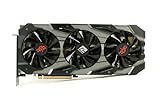
- Item Package Dimension: 15.8661417161L X 9.055118101W X 4.8031496014H Inches
- Item Package Weight - 4.0344593946 Pounds
- Item Package Quantity - 1
- Product Type - Video Card
PowerColor’s reviewed model was the AXRX 5700 XT 8GBD6-3DHE/OC. It retained the same fundamental GPU and memory configuration, but added a much larger cooler, a custom power design, a factory-overclocked BIOS, a lower-power Silent BIOS, RGB lighting, and a metal backplate. PowerColor published a 1,770 MHz base clock, up to a 1,905 MHz game clock, and up to a 2,010 MHz boost clock.
That distinction matters. The Red Devil was a better implementation of the RX 5700 XT rather than a faster class of GPU. Its appeal was refinement: lower noise, better thermal capacity, stronger physical construction, and more control over how the card behaved.
Specifications and design
| Specification | PowerColor RX 5700 XT Red Devil |
|---|---|
| GPU architecture | AMD first-generation RDNA, 7 nm |
| Compute units / stream processors | 40 / 2,560 |
| Memory | 8 GB GDDR6 at 14.0 Gbps |
| Memory interface | 256-bit |
| Published base clock | 1,770 MHz |
| Published game clock | Up to 1,905 MHz |
| Published boost clock | Up to 2,010 MHz |
| Outputs | 1 HDMI, 3 DisplayPort |
| Interface | PCIe 4.0 |
| Dimensions | 300 mm × 132 mm × 53 mm |
| Power recommendation | 700 W system power supply |
| BIOS options | OC and Silent, selected by a physical switch |
The 300 mm length and 53 mm thickness are not minor specifications. PowerColor called the card a 2.5-slot model, but builders should treat it as a triple-slot-class GPU. The cooler can block access to neighboring PCIe slots and may interfere with a front-mounted radiator, drive cage, or other obstruction near the front of the case. Measure from the rear expansion brackets to the first obstruction inside the chassis; do not rely only on a case’s general “GPU support” number.
Recommended Free Tools
The Red Devil’s appearance was more restrained than earlier cards in the family. Its black and gunmetal shroud used small red accents, a backplate, and three RGB lighting zones. KitGuru described the construction as solid, although the shroud itself included plastic sections and the glossy fan finish looked less premium than the metal elements. The output area was also illuminated, according to bit-tech, and the physical dual-BIOS switch was placed on the card’s edge.
Cooling and noise: the reason to buy this model
The reference RX 5700 XT’s blower cooler was the card’s most obvious weakness. The Red Devil addressed it with a thick heatsink and three fans, giving the GPU considerably more cooling capacity and allowing it to operate at lower acoustic levels.
In KitGuru’s test setup, the OC BIOS ran 9°C cooler and more than 10 dB quieter than the reference RX 5700 XT. That is a meaningful improvement, not a specification-sheet victory: the Red Devil delivered similar underlying GPU performance without the reference card’s aggressive blower noise. KitGuru also found it operating at a much higher rated clock than the reference design.
Rank #2
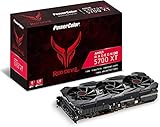
- Radeon RX 5700 XT
- RDNA architecture
- 7 nanometer technology
- Radeon image sharpening
- AMD FidelityFX Dual BIOS
GamersNexus reached a compatible but more nuanced conclusion. Its noise-normalized testing indicated that the cooler itself was strong, while the automatic fan behavior—particularly with the Silent BIOS—did not always pursue the lowest possible junction temperature. In its Silent-BIOS workload, GamersNexus recorded approximately 94°C junction temperature and 76°C edge temperature. With the OC BIOS, it measured roughly 1,340–1,350 rpm in gaming-oriented testing.
What’s actually slowing this PC down?
Pick the symptom - the matching free tool is one click away.
Those figures should not be treated as contradictory scores. The two laboratories used different test benches, drivers, workloads, fan behavior, and reporting conventions. GPU temperature, edge temperature, and junction temperature are also different measurements. The defensible conclusion is that the Red Devil had excellent thermal capacity and was among the quietest RX 5700 XT partner cards, but its quiet automatic profile could accept a warmer junction temperature under sustained load.
OC BIOS versus Silent BIOS
The card shipped with the OC BIOS selected by default. KitGuru measured its power target at 220 W. The physical switch also enabled a Silent BIOS with a measured 180 W power target.
| Mode | What it prioritizes | Trade-off |
|---|---|---|
| OC BIOS | Highest stock performance and clock headroom | Higher power draw and potentially more fan activity |
| Silent BIOS | Lower power target, lower fan speed, quieter operation | Lower clocks; a quiet fan curve can produce a higher junction temperature |
KitGuru recorded approximately 950 rpm and a 74°C GPU temperature on the Silent BIOS, describing the result as effectively inaudible in its environment. It also found that the card’s clock fell below reference levels in that mode. GamersNexus’s results show why buyers should not interpret “Silent” as “coolest”: reducing fan speed can make the card quieter while allowing the junction to run hotter.
The dual-BIOS switch is useful for everyday tuning and adds some redundancy for enthusiasts. It does not make every failed BIOS flash recoverable, so it should not be treated as a guarantee against firmware damage.
Quick wins for a faster PC:
Scan for outdated or missing drivers - takes under a minuteDriver Scan →Clear out junk files and repair common Windows errorsFree Scan →Fix the driver behind crashes, sound loss and screen glitchesFind Drivers →Gaming performance
The factory overclock was real, but its effect on frame rate was modest. KitGuru measured approximately 3% higher average performance than the reference RX 5700 XT with the OC BIOS. Its manually overclocked sample averaged about 8% above reference across its selected titles.
Rank #3

- Item Package Dimension -16.0L X 9.0W X 5.0H Inches
- Item Package Weight - 4.0 Pounds
- Item Package Quantity - 1
- Product Type - Video Card
GamersNexus found an average difference of roughly 2–2.2% versus the reference card in its comparison context. It also emphasized that partner-card frequency differences were small enough for software tuning to largely equalize them. In one 3DMark workload, the Red Devil’s OC-BIOS average frequency was around 1,950 MHz, but a higher observed frequency should not be confused with a proportionally higher frame rate.
In practical terms, the Red Devil plays the same games at broadly the same settings as any other well-configured RX 5700 XT. Its extra money bought a better operating experience rather than a new performance tier. KitGuru placed the card roughly around Nvidia’s RTX 2070 Super in its comparison set, though the exact result varied by game, driver, and card configuration.
Power, outputs, and system requirements
PowerColor recommended a 700 W system power supply. That is a system-level recommendation, not a statement that every computer containing the card will consume 700 W. Actual requirements depend on the processor, overclocking, storage, cooling, PSU quality, and the rest of the build. A reliable unit with the required GPU power connectors matters more than choosing a low-quality supply solely because its label says 700 W.
The rear I/O provides one HDMI output and three DisplayPort outputs. That arrangement suits a multi-monitor gaming or productivity setup, but users should check their monitor inputs before buying. If the screens use DisplayPort, a correctly specified DisplayPort cable may be needed; the card’s output count does not guarantee that an existing cable or adapter will support every desired resolution and refresh rate.
Fitment checklist for a new build
- Check length: allow for the full 300 mm card length, including any clearance needed for power cables.
- Check thickness: the 53 mm body is effectively triple-slot-class and can cover adjacent expansion slots.
- Check front clearance: verify that the card will not meet a front radiator, fan, drive cage, or structural brace.
- Check airflow: leave usable intake airflow below and in front of the GPU rather than placing it immediately against a solid obstruction.
- Check support: because of the large cooler, a GPU support bracket or graphics-card anti-sag bracket can be sensible in a vertical tower.
- Check the PSU: use a quality unit appropriate for the entire system and confirm connector availability.
Launch value and competing RX 5700 XT cards
At review time, KitGuru reported a $439 U.S. MSRP—$40 above the $399 reference-card price, or approximately $39 depending on how the figures were rounded. It considered the premium worthwhile for U.S. buyers because the Red Devil was substantially quieter and better cooled. The reported U.K. price was £449, where the regional value was judged less attractive.
GamersNexus compared the Red Devil mainly with Sapphire’s Nitro+ and MSI’s Gaming X variants. It regarded the Red Devil and Nitro+ as broadly similar, giving Sapphire a slight overall performance advantage in its assessment while praising the Red Devil’s PCB and cooler. Less expensive options such as Gigabyte’s Gaming OC were more compelling when the lowest purchase price mattered most.
Rank #4

- Power Connector: Two 8-pin PCI Express Power Connector
- Minimum System Power: 750W
- Internal Card Length: 340mm
- Card Dimensions: 340*132*69mm
- Display Connectors: 1 x HDMI 2.1b , 3 x DisplayPort 2.1a
That historical pricing should remain historical. The card is now from a discontinued generation, so the old $439-versus-$399 premium cannot be reused as a current recommendation. A used Red Devil may be worthwhile if it is priced appropriately and passes inspection, but newer GPUs may offer better efficiency, driver longevity, media features, or ray-tracing support at a similar total cost.
Outdated Drivers Are Slowing You Down
One free scan finds every outdated or missing driver and matches the right update for your exact hardware.Free scan · exact hardware matchWindows Errors? Fix Them Before They Spread
Repair common Windows errors and clear accumulated junk for a smoother, more stable PC - no reinstall needed.Free scan · no reinstallUsed-buying advice
For a later buyer, the exact condition of the individual card matters more than the Red Devil’s original review score. Before paying, ask about:
- fan bearing noise, grinding, rattling, or fans that fail to start;
- heavy dust buildup, corrosion, bent fins, damaged connectors, and missing screws;
- previous mining use or prolonged operation in a hot, dusty environment;
- artifacts, driver crashes, black screens, or instability under a sustained 3D workload;
- the physical BIOS-switch position and whether both OC and Silent modes function;
- remaining warranty, proof of purchase, return rights, and seller reputation;
- the card’s exact dimensions and compatibility with the buyer’s case and power supply.
Do not diagnose a suspected hardware fault by changing drivers alone. A clean driver installation, known-good power connections, temperature monitoring, memory testing, and testing in another compatible system can help separate software, power, thermal, and hardware problems. Driver-management software may assist with troubleshooting, but it cannot repair failing VRAM, worn fan bearings, damaged power circuitry, or a physically defective GPU.
Independent reader supportYour contribution helps us test, update, and keep practical guides available for everyone.PowerColor RX 5700 XT Red Devil: pros and cons
Advantages
- Excellent triple-fan cooling capacity.
- Much quieter than the reference blower design in comparative testing.
- Useful OC and Silent BIOS modes.
- Solid custom power delivery and backplate.
- 8 GB of GDDR6 and three DisplayPort outputs.
- Neutral black-and-gunmetal styling with configurable RGB.
Disadvantages
- Very large 300 mm × 132 mm × 53 mm chassis.
- Can block neighboring expansion slots.
- Factory overclock adds only about 2–3% in the cited comparisons.
- Silent BIOS sacrifices clock speed and may allow a higher junction temperature.
- PowerColor’s 700 W system recommendation raises build requirements.
- As an older used GPU, condition, warranty, current driver support, and modern feature requirements need careful consideration.
Should you buy the Red Devil?
In 2019: yes, if you wanted RX 5700 XT performance without the reference card’s blower noise. The premium was buying a cooler, quieter, more substantial card—not dramatically more frames per second.
On the used market: consider it only after comparing the complete deal with newer alternatives. A clean, stable card with good fan bearings, adequate case clearance, a trustworthy PSU, and a meaningful price advantage can still be attractive. A similarly priced newer card may be preferable if efficiency, current feature support, warranty coverage, or lower-risk ownership matters more than the Red Devil’s cooler.
The PowerColor Radeon RX 5700 XT Red Devil earned its reputation by fixing the reference RX 5700 XT’s biggest practical weakness. It remains an excellent example of a premium partner card: quiet, cool, well-built, and configurable. Its age means the purchase decision has shifted from “which RX 5700 XT should I buy?” to “is this particular used card, at this particular price, better than the alternatives available today?”
Best Value
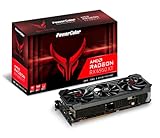
- Video Memory: 16GB GDDR6.Microsoft Windows 10 Support :Comprehensive OS supports the latest Windows10 functionality and Driver support. Memory Interface: 256-bit. Bus Standard :PCIE 4.0x16.Extension Power Connector : Three 8-pin PCI Express Power connectors.DirectX Support : 12. Stream Processor : 5120 Units.
- Stream Processor: 5120
- Game Clock: 2226 MHz (OC) / 2116 MHz (Silent)
- Boost Clock: 2435 MHz (OC) / 2324 MHz (Silent)
- Memory Clock: 18.0 Gbps
Frequently Asked Questions
Which Red Devil BIOS should I use?
The OC BIOS is the better default for maximum stock performance. The Silent BIOS lowers the power target and fan speed, but it also reduces clock speed and can produce a higher junction temperature because its fan curve prioritizes quiet operation.
Is the PowerColor RX 5700 XT Red Devil still worth buying used?
Yes, but only if the price and condition make sense. Check the fans, temperatures, stability, BIOS switch, case clearance, PSU quality, warranty, and how the card compares with newer GPUs available at the same price.
How large is the RX 5700 XT Red Devil?
It is 300 mm long, 132 mm tall, and 53 mm thick. Although PowerColor describes it as a 2.5-slot card, builders should treat it as triple-slot-class and check neighboring-slot and front-radiator clearance.
Do these 3 things before closing this tab:
1Clear out junk files and repair common Windows errors2Fix the driver behind crashes, sound loss and screen glitches3Repair Windows errors before they cause bigger problemsHow many monitors can the Red Devil connect?
The card has one HDMI output and three DisplayPort outputs. A multi-monitor setup may therefore require DisplayPort cables or suitable adapters, depending on the monitors.
The Bottom Line
Bottom line: The Red Devil was a premium, quiet RX 5700 XT rather than a substantially faster one. Its cooler, dual BIOS, build quality, and acoustic behavior justified the launch premium, but today its value depends on used-card condition, price, fitment, PSU quality, and the benefits offered by newer GPUs.
Quick Recap
Product prices and availability are accurate as of the date/time indicated and are subject to change. Any price and availability information displayed on Amazon at the time of purchase will apply.




