The GeForce RTX 4080 Super is the better all-round GPU. It is much faster for ray tracing, more power-efficient, and generally the safer choice for DLSS, AI, CUDA, and creator software. The Radeon RX 7900 XTX is the better value purchase when it is at least 15–20% cheaper and your priority is conventional rasterized gaming with 24GB of VRAM.
That price qualification matters in 2026. Both are older high-end GPUs, and remaining-stock prices can be distorted. Compare the exact card’s condition, warranty, and price with newer options such as the RTX 5080 and RX 9070 XT before buying.
As an Amazon Associate I earn from qualifying purchases.
RTX 4080 Super vs RX 7900 XTX at a glance
| Feature | RTX 4080 Super | RX 7900 XTX |
|---|---|---|
| Architecture | Ada Lovelace | RDNA 3 |
| Launch date | January 2024 | December 2022 |
| Launch MSRP | $999 | $999 |
| VRAM | 16GB GDDR6X | 24GB GDDR6 |
| Reference-rated board power | 320W TGP | About 350W TBP |
| Upscaling | DLSS | FSR |
| Display support | DisplayPort 1.4a-class and HDMI 2.1a-class outputs on reference designs | DisplayPort 2.1 UHBR13.5 and HDMI 2.1a |
| Best suited to | Ray tracing, DLSS, AI, creators, efficiency | Rasterized gaming, VRAM-heavy games, lower prices |
Specifications vary between board partners. Check the exact manufacturer model for clock speeds, dimensions, connectors, cooler, ports, and power limits. See the Nvidia RTX 4080 family specifications and AMD’s RX 7900 XTX specifications.
Free tools Windows power users keep installed
One-click scans. No signup required.
Gaming performance: close in rasterization, decisive in ray tracing
Rasterized gaming
In conventional rasterized games, the two GPUs are effectively tied. The RX 7900 XTX can hold a small lead at 1440p and 4K in some test suites, while the RTX 4080 Super wins in other games. The difference is usually smaller than the price gap between individual models.
#1 Best Overall

- Powered by NVIDIA DLSS3, ultra-efficient Ada Lovelace arch, and full ray tracing
- 4th Generation Tensor Cores: Up to 4x performance with DLSS 3 vs. brute-force rendering
- 3rd Generation RT Cores: Up to 2x ray tracing performance
- OC mode: 2640 MHz (OC mode)/ 2610 MHz (Default mode)
- Axial-tech fans scaled up for 23% more airflow
Results depend on the game engine, CPU, drivers, resolution, and settings. Tom’s Hardware found AMD-favoring results in games such as Far Cry 6 and Watch Dogs Legion, while some CPU-sensitive and strategy workloads favored Nvidia. Treat an aggregate average as a guide, not a guarantee for every title. At 1080p, CPU limits can hide much of the difference.
For 1440p/60Hz gaming, both cards are usually excessive. They make more sense for 1440p ultrawide or high-refresh displays, demanding settings, and 4K gaming.
Ray tracing and path tracing
The RTX 4080 Super is the clear winner once ray tracing is enabled. In Tom’s Hardware’s direct comparison, it was approximately 28–36% faster in ray-traced testing, with much larger advantages in exceptionally demanding path-traced scenarios.
Recommended Free Tools
The gap matters most at 4K, where ray tracing places greater pressure on the GPU. If you regularly play ray-traced or path-traced games, the Nvidia card’s performance advantage is more important than the small rasterization differences.
Source: Tom’s Hardware’s RTX 4080 Super vs RX 7900 XTX comparison.
DLSS, FSR, and frame generation
The RTX 4080 Super supports Nvidia’s DLSS ecosystem, while the RX 7900 XTX uses AMD’s FSR features. Neither feature is universal: support, image quality, preset behavior, and frame-generation artifacts vary by game and implementation.
Rank #2

- Powered by NVIDIA DLSS 3, ultra-efficient Ada Lovelace arch, and full ray tracing
- 4th Generation Tensor Cores: Up to 4X performance with DLSS 3 vs. brute-force rendering
- 3rd Generation RT Cores: Up to 2X ray tracing performance
- WINDFORCE Cooling system
- Metal backplate
DLSS has historically been available in more games and often delivers stronger fine-detail reconstruction and temporal stability in supported titles. FSR is widely available and can be a good solution, but its quality depends heavily on the game and version used. Do not treat “DLSS versus FSR” as a permanent universal verdict; check the games you actually play.
What’s actually slowing this PC down?
Pick the symptom - the matching free tool is one click away.
Frame generation should also be assessed separately from native rendering. It can increase perceived smoothness, but it does not remove the underlying input latency and can produce artifacts in some scenes.
VRAM: 24GB versus 16GB
The RX 7900 XTX has a substantial capacity advantage: 24GB versus 16GB. That is useful for heavily modded games, high-resolution texture packs, some 4K workloads, large creative assets, and local AI models that fit into video memory.
However, 24GB does not automatically make the Radeon faster or more future-proof. A workload can be limited by software support, ray-tracing performance, compute speed, or memory capacity. Sixteen gigabytes is not universally insufficient, while 24GB is not a guarantee of a longer useful life.
Choose the RX 7900 XTX for its VRAM when your specific games or applications regularly approach 16GB. Do not choose it solely because a larger number sounds safer if you depend on Nvidia’s software ecosystem.
Quick wins for a faster PC:
Fix the driver behind crashes, sound loss and screen glitchesFind Drivers →Clear out junk files and repair common Windows errorsFree Scan →Scan for outdated or missing drivers - takes under a minuteDriver Scan →AI, creation, streaming, and software
The RTX 4080 Super is the default choice for AI and creator workloads. CUDA, Tensor cores, Nvidia-specific acceleration, and broad application support make it easier to use with many AI frameworks, renderers, and creative applications. Nvidia also publishes RTX 4080 Super advantages in selected Stable Diffusion XL and Stable Video Diffusion workloads; those are first-party demonstrations rather than neutral benchmark results.
Rank #3

- Chipset: GeForce RTX 4080 Super
- Boost Clock / Memory: 2625 MHz / 23 Gbps
- Video Memory: 16GB GDDR6X
- Memory Interface: 256-bit
- Output: DisplayPort x 2 (v1.4a) / HDMI x 2 (2.1a)
The Radeon can still be the better choice when an application supports AMD’s software stack well and the job is constrained primarily by VRAM capacity. Verify support for the exact application, API, plug-in, and version before buying.
Both cards support AV1 decoding and encoding, but the exact streaming workflow and application support should be checked. For a creator who wants the least software experimentation, Nvidia is the safer recommendation.
Power, cooling, and compatibility
The RTX 4080 Super is more efficient in the cited direct testing. Tom’s Hardware measured approximately 92W less average power at 1440p and 65W less at 4K, although results vary with the game, frame rate, BIOS, undervolting, and board design. Lower power can mean less heat, lower fan noise, and easier case cooling.
The RX 7900 XTX’s reference-rated power is about 350W; some specifications and reviews describe approximately 355W. AMD recommends an 800W-or-greater power supply for its reference card. The exact board partner model may require more.
For either card, verify:
- PSU wattage, quality, and available PCIe power connectors;
- the RTX 4080 Super adapter or native connector and its seating;
- card length, thickness, slot spacing, and side-panel clearance;
- front-fan or radiator interference;
- monitor inputs, cables, and the card’s exact port layout.
The RX 7900 XTX has the stronger display specification on paper, with DisplayPort 2.1 UHBR13.5. That can benefit certain high-resolution, high-refresh monitors, but the complete monitor-and-cable chain must support the required mode.
Price matters more than the launch MSRP
Both cards launched at about $999, but that is historical context rather than a 2026 buying guide. Price trackers checked in August 2026 showed highly inconsistent listings: one reported an RTX 4080 Super at $1,468.73 and an RX 7900 XTX at $929.99, while another reported RX 7900 XTX deals beginning around $830. These figures may mix different retailers, models, conditions, and stock situations, so they are not a like-for-like live price comparison.
Rank #4
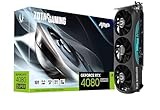
- Powered by NVIDIA DLSS 3, ultra-efficient Ada Lovelace arch, and full ray tracing
- 16GB GDDR6X, 256-bit, 23 Gbps, PCIE 4.0; Boost Clock 2610 MHz
- IceStorm 2.0 Advanced Cooling, SPECTRA RGB Lighting, 3x 90mm fans, FREEZE Fan Stop, Active Fan Control, Metal Backplate, Bundled GPU Support Stand
- 8K Ready, 4 Display Ready, HDCP 2.3, VR Ready
- 3 x DisplayPort 1.4a, 1 x HDMI 2.1a, DirectX 12 Ultimate, Vulkan RT API, Vulkan 1.3, OpenGL 4.6
Use this rule instead:
- Similar prices: buy the RTX 4080 Super for its ray tracing, DLSS, software, and efficiency advantages.
- RX 7900 XTX at least 15–20% cheaper: buy the Radeon for rasterized 1440p/4K gaming and 24GB VRAM.
- RTX 4080 Super more than 10–15% above the Radeon: require a clear reason, such as ray tracing, CUDA, AI, or a materially better warranty.
- Either card priced near a newer alternative: compare the RTX 5080 and RX 9070 XT first.
Do not compare a new Nvidia card with a used Radeon, or a premium factory-overclocked model with a basic model, without adjusting for warranty, cooling, condition, and return rights.
Buying used in 2026
A used card can make the RX 7900 XTX particularly attractive, but the discount must compensate for risk. Check for remaining transferable warranty, proof of purchase, a return period, mining history, fan or bearing noise, coil whine, hotspot temperatures, crashes, artifacting, VRAM errors, BIOS modification, liquid damage, and a missing adapter.
Prefer a retailer or seller with a meaningful return policy. A used RTX 4080 Super with no warranty should not command a large premium over a better-supported Radeon or a newer GPU.
Which GPU should you buy?
- Best overall: RTX 4080 Super.
- Best ray-tracing GPU: RTX 4080 Super.
- Best raster value: RX 7900 XTX, if substantially cheaper.
- Best VRAM capacity: RX 7900 XTX.
- Best for AI, CUDA, and creator software: RTX 4080 Super.
- Best for efficiency and thermally constrained systems: RTX 4080 Super.
- Best for DisplayPort 2.1 setups: RX 7900 XTX, provided the exact card has the required output.
- Best used purchase: whichever has the better combination of price, condition, warranty, and return protection.
Final verdict
Buy the RTX 4080 Super if the price is close, you use ray tracing, or you need DLSS, CUDA, AI, or creator-software support. Buy the RX 7900 XTX when it is meaningfully cheaper and your priority is rasterized gaming, 24GB of VRAM, or DisplayPort 2.1.
In 2026, neither is an automatic new purchase. Compare the exact listing against the RTX 5080 and RX 9070 XT, and account for condition, warranty, power requirements, and your actual games before committing.
Quick Recap
Product prices and availability are accurate as of the date/time indicated and are subject to change. Any price and availability information displayed on Amazon at the time of purchase will apply.




