
Quick wins for a faster PC:
Repair Windows errors before they cause bigger problemsFix Now →Fix the driver behind crashes, sound loss and screen glitchesFind Drivers →Yes, this is a real and clever hardware project—but it is not a simple firmware trick or a universal controller adapter. Bringus Studios repurposed a Bluetooth-enabled Stadia Controller into a battery-powered wireless bridge for a compatible wired USB gamepad. The build keeps the Stadia board and battery, removes most of the original controls, electrically neutralizes the removed analog sticks, and places the remaining electronics in a new enclosure.
The signal path is essentially:
wired USB gamepad → Stadia USB port → Tandem Mode → Bluetooth Low Energy → host deviceIt is best understood as a niche maker project for people with a spare Stadia Controller—not as a plug-and-play replacement for a commercial adapter.
As an Amazon Associate I earn from qualifying purchases.
What the finished device does
The modified Stadia Controller does not become a new type of Xbox or PlayStation controller. Instead, it acts as the wireless Bluetooth endpoint seen by the computer, phone, or other host. The attached wired gamepad supplies the actual button and axis inputs.
Google’s Tandem Mode merges the inputs from the secondary USB controller with those of the primary Stadia Controller. As a result, the host generally sees one Stadia-style Bluetooth gamepad rather than two independent controllers. The project therefore turns a compatible wired controller into a wireless one by reusing behavior that already existed in Stadia hardware.
#1 Best Overall
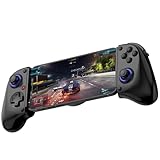
- Bluetooth Mobile Game Controller for Nintendo Switch 2 & iOS & Android & Tablets, Wireless Gamepad Grip with Hall Effect Trigger Joystick, Ergonomic Phone Controller for iPhone, iPad Pro, Samsung
- TURBO FUNCTION This MFi wireless controller has a turbo function, you can adjust the turbo button according to your needs and achieve one-click bursts, programming buttons are designed on the behind of the stretched gamepad, support macro programming, customise personalised game. making it easier for you to win in FPS games, and it is a good helper for you to play games.
- Hall effect joystick and linear trigger: mobile controller is with hall effect joystick, high precision, stable performance, faster response speed and long service life. Linear trigger has such high fluidity and response speed that gives you a competitive advantage in any game.
- ERGONOMIC DESIGN: Game accessory controllers are ergonomically designed to ensure flawless control and execution. The shape of the gamepad fits naturally in the hand, so you can better immerse yourself in the fun even during prolonged use. 360° rotating joystick analog sticks and trigger buttons ensure precise accuracy and comfort as well as increased sensitivity so you can better control your gaming remote control.
- Supports controllers up to 11 inch: Scalable design supports most tablets such as 11 inch iPad Pro (M5), 11 inch iPad Air (M3), iPad (A16), iPad mini (A17 Pro), 11 inch iPad Pro (M4), 11 inch iPad Pro 4/3/2/1, for Samsung, Lenovo, Amazon, Huawei tablets etc. (Not compatible with the 12.9-inch iPad Pro and 13-inch iPad Air)
Google documents Tandem Mode and its limitations in its Stadia Controller Bluetooth support guide.
The Stadia feature that makes the hack possible
Tandem Mode was originally intended as a “friend mode.” Two people could share the inputs of one gamepad, with both controllers’ actions registered as input from the primary Stadia Controller. It was not designed as a general-purpose USB-to-Bluetooth converter.
That distinction explains both the project’s usefulness and its limits:
The Tool Desk
Outbyte Driver Updater FREEFix the driver behind crashes, sound loss and screen glitchesFind Drivers →Outbyte PC Repair FREEClear out junk files and repair common Windows errorsFree Scan →- It can transmit input from one compatible wired controller wirelessly.
- It does not create two independent Bluetooth controllers.
- Only one secondary controller is supported.
- Google says USB hubs and splitters cannot be used to add multiple secondary controllers.
- The Stadia Controller must be connected wirelessly to the host; Tandem Mode does not work when the primary controller is connected to the host by USB.
The modified build is therefore a compact implementation of an existing Stadia feature, not a replacement firmware platform.
How Bringus Studios modified the controller
Coverage from Hackaday and Android Authority describes a substantial physical conversion:
- The Stadia Controller is opened and its original external gamepad hardware is removed.
- The main board, battery, power circuitry, and the control needed to switch the electronics on are retained.
- The original sticks, buttons, and unnecessary housing components are removed.
- The removed analog sticks are electrically neutralized, reportedly with resistors, so the board does not interpret their absence as constant joystick movement.
- A USB connection is provided for the secondary wired controller.
- The remaining electronics are installed in a new enclosure, including a 3D-printed case in the featured build.
The analog-stick modification is especially important. Simply desoldering the sticks can leave their axis inputs at invalid or floating values, producing unwanted movement. The reporting confirms that resistor modifications are used to establish neutral readings, but the accessible articles do not provide a complete schematic, verified resistor values, or every solder point. Those details should come from the creator’s original build material, including the Bringus Studios video, rather than being guessed.
The enclosure design referenced in the coverage is available through Printables. It should be treated as a community design, not a commercial product or guarantee of electrical safety.
PC Slower Than It Used to Be?
A free scan shows the junk files, broken settings and background clutter dragging Windows down - then fixes them in one click.Free scan · Windows 10 & 11Outdated Drivers Are Slowing You Down
One free scan finds every outdated or missing driver and matches the right update for your exact hardware.Free scan · exact hardware matchRank #2

- Versatile compatibility: supports Xbox Series X/S, Xbox One X/S consoles and PC Win10 and above (including the game platform Steam).
- Precise control: features Hall joysticks and Hall triggers for a comfortable feeling, long service life and improved game accuracy.
- Plug and Play Convenience: Wired USB connection (removable) for easy setup and instant play without the need for additional drivers.
- Customizable experience: Includes 2 custom backbuttons that allow users to eliminate false triggers and improve their gaming experience.
- Impressive gameplay: Provides a pulsating vibration trigger and an asymmetric vibration grip motor for intense tactile feedback.
What you need to build one
A prospective builder should expect to need:
- A Stadia Controller that has already been converted to Bluetooth mode.
- The Stadia main board and battery.
- A compatible wired USB gamepad.
- A USB data cable or suitable USB-C adapter.
- A soldering iron and fine soldering tools.
- Replacement resistors or equivalent circuitry for neutralizing the removed analog inputs.
- Tools for opening, cutting, and reshaping the enclosure; the reported build involves rotary-tool work.
- A replacement enclosure, mounting hardware, insulation, and cable strain relief.
Battery condition deserves particular attention. Do not reuse a swollen, punctured, damaged, unusually hot, or otherwise suspect lithium-ion battery. The available project coverage does not establish the battery’s health testing, charging-current validation, thermal behavior, protection-board condition, or mounting method. A finished case should prevent the battery and PCB from moving or contacting conductive material.
Which controllers are compatible?
The project should not be described as supporting every USB gamepad. It relies on the controller families recognized by Stadia’s Tandem Mode implementation. Google’s documented list includes:
- Stadia Controller
- Xbox Adaptive Controller
- Xbox Series X/S controllers
- Xbox One and Xbox One Elite controllers
- Wired Xbox 360 controllers
- Xbox 360 wireless adapters
- PlayStation DualSense
- PlayStation DualShock 4 and DualShock 3
- Nintendo Switch Pro Controller
- Valve Steam Controller and Steam Controller wireless adapter
That list is a starting point, not a guarantee for every revision or configuration. Compatibility can depend on USB HID behavior, firmware, power consumption, enumeration timing, adapters, hubs, and whether a controller requires proprietary drivers or authentication. The creator reportedly tested several controllers and experimented with USB hubs, but the available coverage does not establish a complete compatibility matrix.
A controller that works when connected directly to a computer may still fail through Tandem Mode. Conversely, basic button and axis input may work while motion controls, touchpads, advanced rumble, or special buttons do not.
Free tools Windows power users keep installed
One-click scans. No signup required.
Which devices can receive the Bluetooth signal?
Stadia Bluetooth mode uses Bluetooth Low Energy. Google’s documented testing focused on:
- Windows 10 and Windows 11 with Steam
- macOS 13 with Steam
- ChromeOS
- Android
Support outside those environments is not assured. In particular, do not assume that every smart TV, game console, or specialized device will accept the controller. A target system may require Bluetooth Classic HID rather than BLE, reject the Stadia controller’s identity, or expect a platform-specific controller protocol.
Console use is especially uncertain. The modified unit is not an Xbox or PlayStation protocol emulator, and it should not be presented as a solution for Nintendo hardware without separate, platform-specific testing or another compatible adapter.
Rank #3
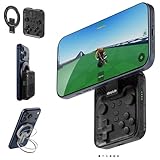
- Why Choose the abxylute M4 Snap-On Phone Controller? Designed exclusively for short quick retro gaming, like Game Boy, NES, SNES and etc. Trusted by 6000+ backers on a tech-focused crowdfunding platform. Pocket-sized play, perfect for your rest time. This compact clip-on controller is compatible with iOS and Android, features a Turbo function—crafted for short bursts of play vertically, horizontally or in detached mode, and ideal for packing in your pocket.
- 【Easy Setup – Power On & Play Instantly!】We recommend attaching the magnetic stickers to a phone case for all phones, rather than using a bare phone. ✅ For Apple MagSafe Models: Snap the magnetic ring onto your MagSafe phone case, power on, and start gaming! ✅ For Non‑MagSafe Models: First attach the included magnetic sticker to your phone case, then snap the magnetic ring onto it. Power on and game right away!
- 【Wide Compatibility – Android & iPhone】Compatible for Android devices, iPhones, and card-size phones (Android devices and iPhone 11/SE and earlier models; iPhone 12/13/14/15/16/17 with MagSafe). Works with all mainstream phones for smooth gaming. Fits iPhone Pro/Pro Max models but may feel top-heavy. Not compatible with foldable phones.
- 【Compact Yet No Loss of Fun】Featuring HID, PS and NS modes, it seamlessly connects to gaming devices via Bluetooth.⚫ HID Mode: Local Games for Android⚫ PS Mode: CODM & PS Remote Play for Android & iOS⚫ NS Mode: All kinds of Emulators
- 【Born for Retro Emulators on Mobile】Designed for retro gaming fans, the M4 Controller works smoothly with top emulators such as Delta, RetroArch and PPSSPP on both iOS and Android.It supports classic games for platforms including Game Boy, NES, SNES,3DS, FC, SFC, SS, N64, GBA, GBC, NDS, and more.
Pairing the modified Stadia electronics
For a Stadia Controller already in Bluetooth mode, Google’s documented pairing sequence is:
- Turn the controller off.
- Hold the Stadia button until the status light pulses orange.
- If pairing mode does not start, hold the Stadia and Y buttons together for two seconds.
- Open Bluetooth settings on the receiving device.
- Select the device whose name contains “Stadia.”
- A solid white status light indicates a successful connection.
A custom enclosure may make the power button, pairing buttons, or status light difficult to reach. The enclosure must preserve a practical way to power and pair the board before it is permanently closed.
What the adapter does not do
This project should not be treated as a universal Bluetooth translator. It does not automatically add wireless capability to every USB device, and it does not preserve every feature of the connected controller.
Potential limitations include:
- No independent multiplayer-controller identities.
- No guarantee of gyro or motion input.
- No guarantee of touchpad, adaptive-trigger, headset-audio, macro-button, or special-function support.
- Variable rumble or haptic support.
- No wired-headphone support through the Stadia Controller in Bluetooth mode, according to Google.
- No controlled latency measurements from the cited coverage.
- No guarantee of compatibility with proprietary wireless protocols.
Google also notes that haptics vary by receiving system. The available sources do not provide controlled latency testing, so claims that this build is low-latency, latency-free, or faster than commercial hardware would be unsupported.
Independent reader supportYour contribution helps us test, update, and keep practical guides available for everyone.Common failure points
False joystick movement
If the analog sticks are removed without electrically setting their axes to neutral, the controller may report constant movement. This is why the resistor modification is a critical part of the conversion. The correct values and placement should be taken from the creator’s documented build, not inferred from a photograph.
Recommended Free Tools
Bluetooth pairing failure
Check that the board was actually converted to Bluetooth mode, has power, and is entering pairing mode. The host must support BLE and the modified enclosure must leave the relevant controls accessible. Restarting both devices and repeating the pairing sequence may help, but an unsupported host cannot be fixed through pairing alone.
USB enumeration failure
The secondary controller may fail if it is unsupported, connected with a charge-only cable, drawing more power than the Stadia board can provide, or dependent on a proprietary driver or wireless adapter. Hubs may also change enumeration behavior, and Google does not support hubs or splitters for adding multiple secondary controllers.
Rank #4

- Officially licensed by Xbox. Bluetooth connection. Supports Xbox Cloud Gaming.
- Officially supported by Apple. Compatible with Apple and Android devices. Stretchable design fits most phones (100–170mm in length).
- Hall Effect Joysticks and Triggers - Upgraded. Robust and long-lasting. Offering higher precision and sensitivity.
- Tactile bumpers and D-pad, 2 Pro back paddle buttons, Xbox button, and wear-resistant metal joystick rings for more ways to play.
- Support 8BitDo Ultimate Software V2 on mobile.
Lost controller features
The modified board is no longer a conventional handheld Stadia gamepad. The build also gives up the original controller’s physical controls and may lose functions such as Stadia Wi-Fi behavior, Assistant and Capture features, wired headphone support in Bluetooth mode, and controller-specific haptics.
Battery and enclosure problems
A poorly mounted battery can be damaged by vibration, sharp edges, heat, or case pressure. Inspect the cell before use, isolate exposed contacts, provide strain relief, and stop using the device if the battery becomes hot, swollen, or damaged. The cited reporting does not amount to a complete electrical safety validation of every reproduction.
Do these 3 things before closing this tab:
1Scan for outdated or missing drivers - takes under a minute2Clear out junk files and repair common Windows errors3Fix the driver behind crashes, sound loss and screen glitchesDIY conversion versus simpler alternatives
| Option | Best for | Main drawback |
|---|---|---|
| Unmodified Stadia Controller | Using a spare Stadia pad over BLE | Does not make an arbitrary wired controller wireless |
| Normal Tandem Mode | Quick experimentation with a second supported controller | Leaves an external cable and merges inputs into one controller |
| DIY Stadia conversion | Makers, retro-gaming projects, and e-waste reuse | Destructive, time-consuming, and dependent on limited documentation |
| Commercial adapter | Reliability, convenience, or platform-specific support | Costs money and may not support the exact controller or host |
A product such as the 8BitDo USB Wireless Adapter 2 is designed for a different direction in many setups: connecting supported Bluetooth controllers to a USB host. The MAYFLASH Magic-NS 2 is more relevant to some console-oriented controller compatibility scenarios. Neither should automatically be assumed to accept any wired USB controller and transmit it over Bluetooth.
A generic Bluetooth USB dongle is not an equivalent replacement. It gives a computer Bluetooth capability; it does not automatically act as a USB-host bridge that reads a wired gamepad and emits controller input wirelessly.
2026 availability warning
Bluetooth conversion is a prerequisite for the wireless version of this project. Google’s support page describes a historical conversion process and gives December 31, 2024 as its deadline. In 2026, that documentation should not be read as proof that Google’s official web tool is still available.
Secondary reporting says the official conversion site is no longer available, while community-hosted replacement tools may exist. Those tools are not the same as Google-supported software. Verify their provenance and understand the firmware, security, and device-bricking risks before using any unofficial service. A Stadia Controller that was never converted may still work over USB, but it cannot provide this wireless adapter function without Bluetooth-capable firmware.
Google’s conversion also permanently disables the controller’s proprietary Stadia Wi-Fi functionality and cannot be reversed. Anyone considering this project should use a spare unit rather than the only Stadia Controller they own.
Should you build it?
Build it if you already have a spare Stadia Controller, enjoy soldering and enclosure work, and have a wired controller whose unusual shape or features make the experiment worthwhile. It is also an appealing e-waste-reduction project because it reuses a battery-powered board and an overlooked Stadia feature.
Do not build it if you need a plug-and-play adapter, reliable console support, full DualSense or Xbox feature parity, verified latency, or a fully documented and electrically validated schematic. For those priorities, a commercial adapter—or simply buying a wireless controller—will usually be the more sensible path.
Quick Recap
Product prices and availability are accurate as of the date/time indicated and are subject to change. Any price and availability information displayed on Amazon at the time of purchase will apply.

