
For PC streaming, use the included Steam Frame Wireless Adapter as the headset’s primary link. Valve describes it as a dedicated 6GHz connection between the gaming PC and headset, with best results when the adapter has clear line of sight to the playspace and is about 20 feet away or less. Ethernet is still worthwhile between the gaming PC and your router: it removes the PC’s Wi-Fi hop and can reduce contention, but it does not make the headset wired. The headset-to-PC stream remains wireless.
The short answer
The adapter and Ethernet solve different problems. The included adapter is designed for the low-latency PC-to-headset path. A wired PC-to-router connection stabilizes only the host side of the network. In a good room, using both gives you the intended arrangement: the PC uses Ethernet to reach the router, while the headset uses the dedicated 6GHz adapter link.
As an Amazon Associate I earn from qualifying purchases.
Steam Frame also has built-in Wi-Fi 7 for ordinary network access and can stream over a home Wi-Fi network. That route can work, but Steamworks describes it as more exposed to congestion and therefore generally less reliable than the direct adapter connection. If your priority is PC VR streaming, start with the included adapter rather than treating it as an optional convenience.
What the three connection options actually are
Included Wireless Adapter
The adapter creates a dedicated 6GHz link directly between the host PC and Steam Frame. This is separate from the normal traffic carried by your household Wi-Fi. Because the stream has its own radio path, downloads, phones, televisions and other clients are less likely to compete with the headset for the same access point airtime.
#1 Best Overall
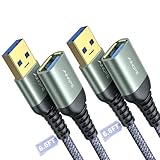
- REINFORCED SR CABLE JOINT:AINOPE USB 3.0 extension cable with test of 400,000+ bend, the special SR design makes the cable joints more sturdy. The flexible and wear-resistant armor nylon braided material offers stronger protection. The Included sticky buckles helps to shorten the length and keeps the USB 3.0 extension cable in an organized manner, no tangling worries and effectively prolong the service life.
- UPGRADED CONNECTOR:This USB extension cable with all-metal shell and aluminum alloy connector, provides you fancy texture with good hand-feeling, and ensure the extreme durability. Also constructed with multiple layers of shielding to minimize interference, corrosion-resistant , effectively prolong the cable service life.
- USB3.0 FAST CHARGING & DATA SYNCING:Charging and data transmission two in one, Our USB 3.0 extension cable is 10X faster than USB2.0 cable, also, this USB 3.0 extension cable backwards compatible with USB 2.0 and USB 1.1 standard devices
- UNIVERSAL COMPATIBILITY:You can using this cable to extends your usb connection to your computer, as well as a variety of USB peripherals such as Hubs, Printers, Card Readers, Bluetooth Adapters, USB Flash Drives, Scanners, Hard Drives, Mouse, Keyboard without any hysteresis or loss of data.
- WORRY-FREE SERVICE: If you have any questions about our product, please feel free to contact with our reliable customer service, we will reply you within 24 hours. Package: USB 3.0 Extension Cable Cable*2
The adapter is still a wireless connection. You do not connect a cable to the headset, and the headset remains free to move around the playspace. Its performance depends on radio conditions, distance, obstructions and the position of the adapter’s USB connection.
Home Wi-Fi
Steamworks says Steam Frame can stream over home Wi-Fi using its built-in wireless networking. This may be useful when the adapter cannot be placed conveniently or when you are testing whether a problem is specific to the dedicated link. The trade-off is that the stream shares the home network with other traffic and with the behavior of your router and access point.
A strong internet connection does not automatically make this path good. PC streaming is sensitive to local packet delivery and timing, not just the speed of your broadband plan. A fast connection to the internet can still coexist with congestion or interference inside the room.
Recommended Free Tools
Wired host-network setup
When people ask whether Steam Frame can be run “wired,” they usually mean connecting the gaming PC to the router with Ethernet. That removes the PC-to-router Wi-Fi segment. It does not create a wired headset connection: the final link to Steam Frame is still the dedicated wireless adapter or home Wi-Fi.
Steam support recommends testing a direct wired connection when wireless interference causes intermittent failures, and its network guidance treats Ethernet as the best baseline when the streaming client supports it. For Steam Frame, interpret that advice as wiring the host PC while leaving the adapter in place for the headset.
Rank #2

- 10FT PERFECT LENGTH: With the perfect 10ft length, you can play the game freely ,or lie on the sofa to use your devices for video while you are charging.What's more,you can also extend your surveillance camera (please make sure the camera interface is USB A port). Perfect Length for your easy life-use.
- REINFORCED SR CABLE JOINT:AINOPE USB 3.0 extension cable with test of 20,000+ bend, the special SR design makes the cable joints more sturdy. The flexible and wear-resistant armor nylon braided material offers stronger protection. The Included sticky buckles helps to shorten the length and keeps the USB 3.0 extension cable in an organized manner, no tangling worries and effectively prolong the service life.
- UPGRADED CONNECTOR:This USB extension cable with all-metal shell and aluminum alloy connector, provides you fancy texture with good hand-feeling, and ensure the extreme durability. Also constructed with multiple layers of shielding to minimize interference, corrosion-resistant and gold-plated connectors for optimal signal clarity, effectively prolong the cable service life.
- USB3.0 FAST CHARGING & DATA SYNCING:Charging and data transmission two in one, the charging speed is up to 2A, and the data transmission speed is 10X faster than USB2.0 cable, also, this USB 3.0 extension cable backwards compatible with USB 2.0 and USB 1.1 standard devices.
- WORRY-FREE SERVICE: If you have any questions about our product, please feel free to contact with our reliable customer service, we will reply you within 24 hours. Package: USB 3.0 Extension Cable*1
Latency: what improves it and what cannot be promised
There is no authoritative, universal millisecond comparison between the Steam Frame adapter and Ethernet in the available Valve material. A single number would be misleading because latency changes with radio interference, distance, walls, USB placement, router load, host-PC performance, encoding settings and the selected stream mode. Anecdotal millisecond figures from another room, router or firmware version are not a general result.
The adapter’s latency advantage is architectural
The dedicated adapter can take the PC-to-headset stream over a direct 6GHz path instead of sending it through an ordinary home Wi-Fi network that is also serving other devices. Fewer shared network hops and less competition can reduce queuing and variation in delivery. That is a mechanism-level advantage, not a guaranteed numerical difference.
What’s actually slowing this PC down?
Pick the symptom - the matching free tool is one click away.
“Lower latency” should therefore be read as “fewer opportunities for contention on the streaming path.” If your home Wi-Fi is already quiet and the adapter is obstructed or positioned poorly, the theoretical advantage may be offset by local radio conditions. Conversely, a carefully placed adapter can remain consistent even when the rest of the household network is busy.
What Ethernet changes
Ethernet can remove variability between the PC and router. This matters most when the computer’s Wi-Fi adapter competes with other clients, has a weak signal, or is separated from the access point by walls. It does not remove the wireless segment between the adapter and headset, so it cannot eliminate radio-induced delay at the playspace.
Using Ethernet and the dedicated adapter addresses both sides independently: the host has a predictable route to the network, and the headset has a separate direct radio link. If you can install only one improvement, use the included adapter first for the intended streaming path; add Ethernet when the PC’s own Wi-Fi is a source of contention or instability.
Rank #3

- High-Performance USB 3 Extension Cable: Extend the connection between your computer or Windows tablet and USB 3.0 and USB 2.0 peripherals, including VR headsets, hard drives, USB hubs, mice, keyboards, flash drives, printers, and more.
- Upgrade to SuperSpeed USB 3.0: Future-proof your data transfer speeds with SuperSpeed USB 3.0 extension cable, while maintaining backwards compatibility with your existing USB 2.0 devices using this USB extension cord.
- SuperSpeed Data Transfer Rate: Enjoy data transfer speeds up to 5 Gbps, 10x faster than USB 2.0, with this USB male to female extension cable. Perfect for VR headsets like the Oculus Rift, HTC VIVE, PlayStation VR, Valve Index, and Microsoft HoloLens.
- Durable and Easy-to-Use Design: This premium USB extender cable is built with molded strain relief connectors for added durability, and grip treads for easy plugging and unplugging. Connect this USB charger extension cord to a USB charging cable to fast charge your smartphone or tablet, such as the iPhone.
- Superior Construction for Optimal Performance: Featuring gold-plated connectors, bare copper conductors, and foil & braid shielding, this USB A extension cable ensures error-free data transmission and enhanced performance.
Range and placement
Use 20 feet as a performance target, not a hard limit
Valve recommends clear line of sight and a distance of approximately 20 feet or less between the adapter and the playspace. This is guidance for best performance, not a stated cutoff at which the connection must stop working. A shorter unobstructed path can outperform a longer path through a wall, floor or metal obstruction.
Distance should be measured from the adapter to the area where you actually play, not merely to the room’s doorway. If you move around, place the adapter so the most demanding part of the playspace remains within the recommended area.
Why line of sight matters
Walls, floors, metal objects, nearby wireless networks and electronic equipment can weaken or disturb wireless signals. A desktop tower under a desk, a metal shelving unit or a display positioned between the adapter and headset can create a worse path than the same distance in open air.
Placement also affects the adapter’s exposure to the PC itself. A USB 3.0 extension cable can let you move the adapter away from the computer chassis and closer to the playspace. The cable is a positioning aid; it is not evidence of a lower latency by itself.
Practical placement checklist
- Put the adapter on the side of the PC facing the playspace when possible.
- Keep the adapter elevated and visible rather than behind the tower or inside a cabinet.
- Maintain clear line of sight to the main play area.
- Stay approximately within 20 feet for the best-performance target.
- Use a USB 3.0 extension cable if the computer’s position forces a poor angle or location.
- Move competing electronics or large metal objects out of the direct path where practical.
Reliability and what happens during interference
Dual-link fallback
Valve engineer Jeremy Leinbaugh described a fallback design in which two active links can cover for one another if interference or range affects one of them. His explanation was: “If something happens to one of those links, the other one will immediately pick up and cover the gap.” That behavior is intended to mask short disruptions rather than make the system immune to every radio problem.
PC Slower Than It Used to Be?
A free scan shows the junk files, broken settings and background clutter dragging Windows down - then fixes them in one click.Free scan · Windows 10 & 11Outdated Drivers Are Slowing You Down
One free scan finds every outdated or missing driver and matches the right update for your exact hardware.Free scan · exact hardware matchRank #4

- USB3.0 Fast Charging & Data Transfer: Support phone charging and data transfer sync, charging speed up to 2A and transfer speed up to 5Gbps, 10 times faster than USB2.0.
- USB Extension Cable: Capable of extending up to 3.3ft, effectively solving the problem of short cables that add extra length to your device.
- Upgraded USB End: Adopting gold-plated connector and metal housing, multi-layer shielding to minimize interference and extend cable life.
- Durable Design: The tangle-free nylon braiding adds extra durability, able to withstand over 20,000+ bends, protecting your device from frequent plugging and unplugging.
- Compatibility: Extend USB connection to computers and various USB peripherals such as gamepads, printers, webcams, keyboards, mice, USB flash drives, hard drives, Playstation, Xbox, hubs, scanners, cameras, without any lag or data loss.
Valve also states that an extended dropout still fails the stream and returns you to the default environment. The fallback can bridge a brief disturbance; it is not an unlimited buffer for a blocked or out-of-range signal.
Independent observation
A PC Gamer reviewer reported that the included adapter was the best way to play, saw no connection issues at home or in a busy office, and described the headset as selecting between the dedicated link and local Wi-Fi for low packet loss and robustness. That is one reviewer’s experience, not a controlled benchmark. Your result can differ with room layout, interference, router behavior and PC placement.
Adapter versus Ethernet at a glance
| Axis | Included wireless adapter | Wired host-network setup |
|---|---|---|
| Headset freedom | Full movement with no headset cable | Still wireless at the headset; Ethernet only connects the PC to the router |
| Latency mechanism | Direct dedicated 6GHz PC link, with cooperation from the headset’s Wi-Fi system | Removes PC-to-router Wi-Fi variability; the headset leg remains wireless |
| Range | Best with clear line of sight and approximately 20 feet or less to the playspace | Ethernet cable length determines PC-to-router placement; the wireless headset range still applies |
| Reliability | Dual-link fallback can cover a short disruption; an extended dropout still ends streaming | More stable host-to-router segment, but headset-side radio conditions remain relevant |
| Setup | Pair the included adapter, use a USB 3.0 port and position it well | Add Ethernet from the PC to the router while keeping the adapter for headset streaming |
How to set up the intended PC-streaming path
- Connect the included adapter to the gaming PC. Use a USB 3.0 port. If the computer’s chassis or desk placement blocks the playspace, use a USB 3.0 extension cable to relocate the adapter.
- Place the adapter near the playspace. Aim for clear line of sight and approximately 20 feet or less to the area where you will play. Do not leave it behind the tower if that puts the PC between the adapter and headset.
- Pair the adapter with Steam Frame. Follow the headset’s pairing flow for the included adapter, then confirm that the dedicated link is available before starting a demanding stream.
- Run a normal session before changing anything else. Test from the position where you usually play. A connection that works beside the PC may behave differently at the far edge of the playspace.
- Add Ethernet if the PC uses Wi-Fi. Connect the gaming PC to the router with Ethernet, leave the headset adapter in place, and repeat the same test. This isolates host-side Wi-Fi variability without sacrificing headset freedom.
When Ethernet is worth adding
Ethernet is most useful when the gaming PC has a weak or busy Wi-Fi connection to the router. Symptoms can include intermittent stream failures that disappear when the PC is moved closer to the access point, performance that changes when other household devices become active, or a stable headset radio link paired with an unstable host network.
It is less likely to solve a problem that occurs only when you walk behind a wall, leave the recommended area or place your body and equipment between the adapter and headset. Those are headset-side radio conditions, and a cable from PC to router cannot bypass them.
The Tool Desk
Outbyte Driver Updater FREEScan for outdated or missing drivers - takes under a minuteDriver Scan →Outbyte PC Repair FREERepair Windows errors before they cause bigger problemsFix Now →Use a wired host test as an isolation step even if you do not intend to keep the cable permanently. If the problem disappears on Ethernet, the PC’s Wi-Fi segment was involved. If it remains, investigate adapter placement, range and local interference instead.
Best Value

- 10ft Long Extension Cable: This long 10ft USB extension cable is long enough for daily life and office work. With this USB 3.0 extension cable, you will no longer squeeze yourself in an uncomfortable position because of your short cables, you can lie on the sofa and sit wherever you'd like. No need to bend down under the desk or behind the TV to plug some USB peripherals anymore!
- 5Gbps High-speed Transfer: With data transfer rate up to 5 Gbps, this USB 3.0 extension cable is 10x faster than USB 2.0 (480 Mbps), backs up your huge files in seconds and ensures fast charging&data syncing. It is also backward compatible with USB 2.0, 1.1, 1.0 standard devices.
- Reinforced & More Durable: Engineered with nickel plated connectors, nylon braided jacket, reinforced joint and aluminum alloy case, the USB extension cable provides stable transmission with the clear optimal signal. The solid and durable two-shade braided nylon material provides stronger protection and flexible performance than others and avoids any potential breakage.
- Long-Lasting Performance Design: The USB extension cable is perfect for protecting the USB sockets of your devices from frequent plugging and unplugging. Moreover, with more than 10,000 bend tests, this advanced USB extender cable is more reliable and bend free, specially designed for a longer lifespan.
- Universal Compatibility: The USB extension cord is widely compatible with both USB 3.0 and USB 2.0 peripherals including Playstation, Xbox, keyboard, mouse, printer, scanner, camera, USB flash drive, card reader, hard drive and more devices.
Troubleshooting stutter, dropouts and failed connections
Intermittent failures on home Wi-Fi
- Connect the gaming PC directly to the router with Ethernet and retest.
- Keep the Steam Frame adapter active; do not mistake the Ethernet test for a wired headset mode.
- If the failure stops, the PC-to-router Wi-Fi path was a likely contributor. If it continues, focus on the adapter’s location and the headset’s radio path.
Stutter when the house network is busy
The dedicated adapter is intended to reduce competition from ordinary home Wi-Fi traffic. Check that the headset is actually using the adapter path, then move the adapter into clear view of the playspace. If the PC itself is on Wi-Fi, add Ethernet and compare the same scene and position. A busy network can affect either the host segment or the headset segment, so change one variable at a time.
Dropouts near a wall or at the edge of the room
Return the adapter to the recommended geometry: clear line of sight and approximately 20 feet or less. Use an extension cable to move it toward the playspace rather than stretching the headset’s operating area farther from the adapter. Treat the 20-foot figure as a best-performance recommendation, but expect walls, floors and metal to reduce practical range before distance alone does.
The connection fails despite Ethernet
Ethernet only stabilizes the PC-to-router segment. Confirm that the adapter is still paired and positioned well, then look for obstructions, competing wireless equipment and a playspace outside the recommended area. The headset radio remains the relevant link for these symptoms.
A brief interruption becomes a full exit
The dual-link fallback is designed to cover short disruptions. A longer loss of both usable paths still ends the stream and returns Steam Frame to its default environment. Repositioning the adapter and shortening the path are more appropriate fixes than expecting Ethernet to prevent a headset-side dropout.
Choosing a setup for your room
| Your situation | Best starting arrangement | Reason |
|---|---|---|
| PC and playspace are in the same open room | Included adapter, placed in clear view near the playspace | Matches Valve’s intended direct-link arrangement and keeps the headset untethered |
| PC is on unreliable Wi-Fi but the playspace has a good adapter path | Ethernet from PC to router plus the included adapter | Removes host-side Wi-Fi variability while preserving the dedicated headset link |
| Several walls or a floor separate the PC and playspace | Try relocating the adapter with USB 3.0 extension; test Ethernet separately | Placement addresses the radio path; Ethernet cannot make the headset segment wired |
| Home Wi-Fi is crowded | Use the included adapter; add Ethernet if the PC is also on Wi-Fi | Keeps the stream off ordinary Wi-Fi where possible and reduces host-side contention |
| Only occasional short interruptions occur | Improve line of sight and adapter placement before replacing the network | Valve’s fallback may cover brief disturbances, while placement addresses their cause |
What not to claim from a connection test
- A wired PC does not mean Steam Frame itself is wired.
- A single millisecond reading is not a universal adapter-versus-Ethernet result.
- A 20-foot recommendation is not a guaranteed maximum range.
- A USB 3.0 extension cable improves placement options; it does not inherently lower latency.
- One successful session, including an independent reviewer’s session, does not guarantee the same outcome in every room or network.
Bottom line
Use the included Steam Frame Wireless Adapter for PC streaming, position it with clear line of sight and aim for approximately 20 feet or less to the playspace. Add Ethernet from the gaming PC to the router when you want to remove the PC’s Wi-Fi variability or test whether host-side congestion is responsible for failures. The headset remains wireless either way. Valve’s dual-link fallback can hide brief interruptions, but no connection arrangement eliminates the effects of severe interference, obstructed placement or an extended dropout.
Quick Recap
Product prices and availability are accurate as of the date/time indicated and are subject to change. Any price and availability information displayed on Amazon at the time of purchase will apply.

