Quick wins for a faster PC:
Clear out junk files and repair common Windows errorsFree Scan →Fix the driver behind crashes, sound loss and screen glitchesFind Drivers →1080p remains a sensible gaming resolution in 2026 when you value affordable hardware, high frame rates, and high-refresh gaming more than maximum image sharpness. Its 1,920×1,080 image requires far less rendering work than 1440p or 4K, making it a practical fit for competitive games, older PCs, laptops, handhelds, and budget-focused setups.
It is not universally better. A 1440p display is often sharper for a 27-inch desktop monitor, while 4K is preferable when detail and pixel density matter most. The right choice depends on your hardware, games, screen size, viewing distance, and target frame rate.
What does 1080p mean?
1080p is a display resolution of 1,920 pixels wide by 1,080 pixels high. It has a 16:9 aspect ratio and contains 2,073,600 pixels. You may also see it called Full HD or FHD. The “p” refers to progressive scanning, although modern gaming discussions generally use 1080p simply as shorthand for the resolution.
A native 1080p monitor has a 1,920×1,080 pixel panel, so a game rendered at 1080p maps directly to the screen. That avoids the softness that can occur when a 1080p signal is stretched across a higher-resolution panel.
#1 Best Overall

- 【INTEGRATED SPEAKERS】Whether you're at work or in the midst of an intense gaming session, our built-in speakers provide rich and seamless audio, all while keeping your desk clutter-free.
- 【EASY ON THE EYES】 Protect your eyes and enhance your comfort with Blue-Light Shift technology. This feature reduces harmful blue light emissions from your screen, helping to alleviate eye strain during long hours of use and promoting healthier viewing habits.
- 【WIDEN YOUR PERSPECTIVE】Our sleek minimal bezel design ensures undivided attention. The nearly bezel-free display seamlessly connects in a dual monitor arrangement, delivering an unobstructed view that lets you focus on more at once, completely distraction-free.
The biggest advantage: high frame rates are easier to reach
Rendering fewer pixels generally reduces the GPU’s workload. The basic comparison is:
| Resolution | Pixel dimensions | Total pixels | Relative pixel count |
|---|---|---|---|
| 1080p | 1,920×1,080 | 2,073,600 | 1× |
| 1440p | 2,560×1,440 | 3,686,400 | About 1.78× 1080p |
| 4K UHD | 3,840×2,160 | 8,294,400 | 4× 1080p |
That difference is why 1080p can deliver higher frame rates on less expensive graphics hardware. Intel explains that lowering resolution can reduce the performance cost of reaching higher refresh rates, while AMD documents 1080p as a 1,920×1,080 display mode and details the scaling options available on compatible systems (Intel; AMD).
Pixel count is not the same as guaranteed performance. Moving from 1440p to 1080p will not necessarily produce 1.78 times the frame rate, and moving from 4K to 1080p will not necessarily quadruple it. CPU performance, game-engine limits, ray tracing, memory, asset streaming, drivers, and optimization also affect frame rate.
When lowering resolution does not help much
If a game is CPU-limited, reducing the number of pixels may barely change performance. Simulation, artificial intelligence, draw calls, background processes, frame caps, V-Sync, thermal throttling, or engine limits can all become the bottleneck. A lightweight esports game may already run beyond your monitor’s refresh rate at 1080p, leaving the CPU or engine—not the GPU—as the limiting factor.
1080p is well suited to high-refresh competitive gaming
A 60 Hz display updates 60 times per second. A 120 Hz display updates 120 times per second, while 144 Hz, 165 Hz, 240 Hz, and 360 Hz displays can show progressively more frequent updates when the system supplies enough frames. Microsoft notes that the maximum usable refresh rate depends on the graphics hardware, display, and selected resolution (Microsoft).
Because 1080p is relatively light to render, it can make it easier to sustain the frame rates needed to use a high-refresh monitor. That can make motion appear smoother and reduce frame-time problems, particularly in competitive shooters, battle royale games, MOBAs, and other fast-paced titles.
For competitive players, a stable frame rate is often more useful than a higher peak frame rate interrupted by severe drops. A 24-inch 1080p monitor is also a common practical pairing: the complete image fits comfortably within a compact field of view at a normal desktop distance.
However, 1080p does not automatically reduce input latency or improve aim. Latency depends on the game engine, CPU and GPU workload, frame queue, display processing, synchronization settings, refresh rate, and peripherals. Lower resolution can help a system produce higher frame rates and shorter frame times, which may contribute to responsiveness when the rest of the setup is configured appropriately.
Rank #2
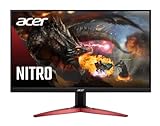
- 23.8" Full HD (1920 x 1080) Widescreen VA Monitor | AMD FreeSync Premium Technology
- Refresh Rate: 165Hz | Response Time: 1ms (VRB) | Pixel Pitch: 0.275mm | Color Saturation: NTSC 72%
- Zero-Frame Design | HDR Ready
- VESA mounting compliant (100 x 100mm) | Ergonomic Tilt: -5° to 15°
- Ports: 1 x Display Port 1.2 and 2 x HDMI 2.0 (HDMI Cable Included)
Lower hardware and upgrade costs
A 1080p monitor generally places fewer demands on the graphics card than a comparable high-refresh 1440p or 4K display. That allows a buyer to allocate more of a fixed budget to refresh rate, adaptive sync, motion quality, storage, memory, or other components instead of paying for a higher-resolution GPU.
There is no universal “minimum GPU for 1080p.” The appropriate hardware depends on the game, quality preset, ray-tracing settings, target frame rate, VRAM, and software version. A card that is comfortable at 1080p in an older competitive title may struggle with a new ray-traced game at maximum settings.
1080p can also extend the useful life of an older PC. Lowering resolution and adjusting settings may preserve playable performance without requiring a complete system upgrade. The same principle applies to laptops and handhelds, where limited cooling, battery capacity, and GPU power make every rendered pixel more expensive.
Good fit for older, lightweight, and streamed games
1080p is often sufficient for:
- Competitive shooters and esports titles
- MOBAs and strategy games
- Older PC games
- Indie games
- Emulated games
- Low-power PCs, laptops, and handhelds
It can also be a sensible output resolution for cloud gaming. NVIDIA’s GeForce NOW documentation lists 1,920×1,080 streaming configurations and describes higher-refresh arrangements for compatible hardware, displays, and memberships (NVIDIA GeForce NOW setup requirements). Availability, plan features, network requirements, and regional support vary, so check the current service documentation for your country.
Cloud gaming introduces a separate limitation: network latency, connection stability, bandwidth, and data caps can matter as much as local rendering performance. A 1080p stream cannot eliminate delay caused by a poor connection.
More choice among high-refresh monitors
1080p is widely paired with 120 Hz, 144 Hz, 165 Hz, 240 Hz, and even 360 Hz monitors. Intel’s gaming-monitor guidance uses 1,920×1,080 at 360 Hz as an example configuration, showing that Full HD remains relevant for very high-refresh gaming (Intel’s monitor guide).
Do not choose a monitor based only on its headline refresh rate. Confirm:
- Its native resolution
- The maximum refresh rate at the intended HDMI, DisplayPort, or USB-C input
- Whether the included or required cable supports that mode
- Adaptive-sync compatibility
- Measured motion performance rather than only an advertised “1 ms” response time
- Whether the desired refresh rate works specifically at 1,920×1,080
A 240 Hz monitor cannot make a game run at 240 frames per second. The game and hardware must produce enough frames to use the display’s capacity.
What’s actually slowing this PC down?
Pick the symptom - the matching free tool is one click away.
Rank #3
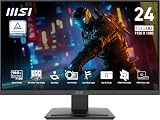
- MSI's 23.8-inch Full HD IPS gaming monitor (1920×1080) delivers a 1500:1 contrast ratio with wide 178°/178° viewing angles — producing deeper blacks, brighter highlights, and accurate colors from virtually any position for gaming and productivity.
- TÜV Rheinland certified Flicker Free and Low Blue Light — eliminating the ~200Hz screen flicker common on standard monitors and reducing harmful blue light exposure to minimize eye strain during extended gaming or work sessions.
- 144Hz high refresh rate delivers ultra-smooth motion and sharper tracking versus standard 60Hz or 75Hz monitors — keeping every frame fluid and responsive for fast-paced FPS, racing, and action games without screen tearing or stuttering.
- MSI's built-in Eye-Q Check provides a vision assessment tool to help optimize display settings for healthier long-term viewing — designed for professionals and students spending extended hours in front of a Full HD IPS screen.
- Tilt-adjustable stand (-5°~20°) for comfortable viewing at any desk setup, with VESA 100×100mm wall mount compatibility for monitor arms, brackets, and multi-monitor arrangements — reducing neck strain during long gaming or work sessions.
The disadvantages of 1080p
Lower sharpness and pixel density
1080p has fewer pixels than 1440p or 4K, so fine details, distant objects, interface elements, and text are less sharp. The difference is especially noticeable as screen size increases or as you sit closer to the display.
| Screen size | 1080p suitability | Qualification |
|---|---|---|
| 21.5–24 inches | Usually strong | A practical desktop size for high-refresh gaming |
| 25–27 inches | Mixed | Viewing distance and eyesight become more important |
| 32 inches or larger | Usually weaker | Lower pixel density is easier to notice up close |
| Television viewing distance | Highly variable | Distance can make 1080p acceptable on a larger screen |
These are practical guidelines, not hard limits. Anti-aliasing, game art style, eyesight, viewing distance, and display scaling all affect how 1080p looks.
Less desktop workspace
For general productivity, 1440p or 4K provides more room for windows, sharper text, and more usable detail. If your monitor must serve equally as a gaming screen and a work display, the performance advantage of 1080p may not outweigh its reduced workspace.
Softness on a non-native panel
Running 1080p on a 1440p or 4K monitor requires scaling. The monitor or graphics card must convert the 1,920×1,080 image to the panel’s native grid, and the result may look softer than native 1080p. NVIDIA provides aspect-ratio, full-screen, no-scaling, and integer-scaling modes; AMD provides options including preserve aspect ratio, full panel, and center (NVIDIA scaling documentation; AMD GPU scaling documentation).
Free tools Windows power users keep installed
One-click scans. No signup required.
Integer scaling can preserve sharp pixel edges in some content, but it is not a universal solution for modern 3D games. If you intend to stay at 1080p, a native 1080p panel is usually the clearest and simplest option.
1080p versus 1440p versus 4K
| Resolution | Main strength | Performance demand | Typical fit |
|---|---|---|---|
| 1080p | Affordable high frame rates | Lowest of the three | 24-inch monitors, competitive gaming, budget PCs |
| 1440p | Strong balance of sharpness and performance | About 1.78× the pixels of 1080p | 27-inch desktop gaming and mixed game libraries |
| 4K UHD | Maximum detail and pixel density | Four times the pixels of 1080p | Large displays, productivity, and image-quality-focused systems |
Choose 1440p if you use a 27-inch-or-larger desktop monitor, want sharper text and game detail, and can sustain your target frame rate. Choose 4K if image quality is the priority and you accept higher monitor and graphics-hardware requirements, possibly with upscaling or performance modes in demanding games. Intel also identifies 4K as having four times the pixels of 1080p (Intel).
Independent reader supportYour contribution helps us test, update, and keep practical guides available for everyone.How to get the most from a 1080p setup
Use the panel’s native resolution
On Windows, open Settings → System → Display, select the correct display, and set Display resolution to 1,920×1,080. In the game, select 1,920×1,080 and choose fullscreen or borderless mode according to your preference.
Select the intended refresh rate
Open Settings → System → Display → Advanced display and select the desired refresh rate. NVIDIA users can also open NVIDIA Control Panel → Display → Change resolution and choose the refresh rate there (NVIDIA instructions).
Rank #4

- High-Performance Display: 24.5-inch Full HD (1920x1080) Fast IPS gaming monitor with overclock to 310Hz refresh rate designed for professional gamers and immersive gameplay
- Ultra-Fast Response Time: ASUS Fast IPS technology enables a 0.3ms (GTG) response time(min.) for sharp gaming visuals with high frame rates
- Adaptive Sync Technology: FreeSync Premium and G-Sync compatible delivers a seamless, tear-free gaming experience
- Advanced Motion Blur Reduction: ASUS Extreme Low Motion Blur Sync (ELMB SYNC) technology enables ELMB together with variable refresh rate, eliminating ghosting and tearing for sharp gaming visuals with high frame rates
- Convenient Monitor Control: DisplayWidget Center enables easy OSD access and monitor settings adjustments with a mouse
If a 144 Hz or 240 Hz option is missing, check the monitor specification for that input, try the appropriate HDMI or DisplayPort connection, verify the cable, update the GPU driver, and check the game’s own refresh-rate setting. In a multi-monitor setup, high-bandwidth modes can affect available scaling behavior (NVIDIA’s multi-monitor scaling guidance).
Configure adaptive sync and frame limits
Enable adaptive sync when both the GPU and monitor support it, then use a frame limit appropriate for the display and game. The exact best setting depends on the synchronization technology and your goals, but avoiding severe frame-rate swings is generally more useful than chasing an unstable peak.
Check render scale and upscaling
These terms describe different situations:
- Native 1080p: The game renders at 1,920×1,080.
- Upscaled to 1080p: The game renders internally below 1080p, then reconstructs or stretches the image to a 1080p output.
- 1080p output on a higher-resolution monitor: The monitor or GPU scales the signal to the panel’s native resolution.
- Supersampling: The game renders above 1080p and downsamples to 1080p, improving some image-quality aspects at a performance cost.
Before judging image quality, set the game’s render scale to 100%. Upscaling quality varies with the technique, implementation, motion handling, sharpening, and game support. AMD describes FidelityFX Super Resolution as a spatial or temporal technology that requires integration in supported games; it is not automatically available everywhere or identical to native rendering (AMD reference guide).
Troubleshooting common problems
1080p looks blurry
- Confirm the monitor’s native resolution.
- Use native 1,920×1,080 on a 1080p panel.
- On a higher-resolution panel, compare monitor scaling with GPU scaling.
- Try preserve-aspect-ratio scaling instead of full-panel stretching.
- Set the game’s render scale to 100% before testing an upscaler.
- Reduce excessive sharpening, blur, or aggressive temporal settings.
- Test exclusive fullscreen if borderless mode behaves differently.
- Check for an unsuitable signal mode, including chroma subsampling.
Frame rate does not improve after lowering resolution
Check whether the game is CPU-limited or engine-limited. Also check frame caps, V-Sync, adaptive-sync settings, background processes, drivers, temperatures, and power limits. Resolution mainly reduces pixel-processing work; it does not remove simulation, AI, draw-call, or asset-streaming limits.
Recommended Free Tools
Console considerations
Console support is model- and game-specific. Before choosing a 1080p high-refresh display, verify whether your console supports 1080p at 120 Hz, whether the particular game offers a 120 Hz or performance mode, whether the monitor accepts the signal through the selected HDMI input, and whether variable refresh rate works on both devices.
Also consider your library. A console owner who mainly plays cinematic games may prefer a 1440p or 4K display, while someone prioritizing competitive play may value a 1080p high-refresh setup. Check the exact console model, game mode, HDMI requirements, and current firmware rather than relying on blanket claims about all consoles.
Who should choose 1080p?
- Competitive gamers: Choose it if you can sustain high frame rates and want to spend more of the display budget on refresh rate and motion performance.
- Budget PC owners: Choose it when a lower hardware requirement matters more than maximum sharpness.
- Older-GPU owners: Use it as a way to extend a system’s useful life, while adjusting demanding settings such as ray tracing when necessary.
- 24-inch desktop users: A native 1080p panel is often a practical match for normal viewing distances.
- Laptop and handheld users: Consider it when the device’s power and cooling limits make higher resolutions costly.
- Cloud gamers: Consider it when the service, membership, network, and display support Full HD reliably.
Prefer 1440p when you want one monitor for sharp desktop work and a broad mix of games, especially at 27 inches or larger. Prefer 4K when detail, media, and pixel density matter more than maximum frame rate and your hardware can support the intended settings.
Quick Recap
1080p gaming buyer checklist
- Is 1,920×1,080 the monitor’s native resolution?
- Can your games sustain the frame rate needed for the intended refresh rate?
- Are you CPU-limited rather than GPU-limited?
- Does the monitor support the target refresh rate on the input and cable you will use?
- Does it support adaptive sync?
- Are independent motion-performance measurements available?
- Will you also use the display for text-heavy productivity?
- Is the screen size appropriate for your viewing distance?
- For a console, does the exact model and game support the required resolution and refresh rate?
- For cloud gaming, are latency, bandwidth, data caps, and regional availability acceptable?
Product prices and availability are accurate as of the date/time indicated and are subject to change. Any price and availability information displayed on Amazon at the time of purchase will apply.