The best PS5 SSD for most buyers in 2026 is the WD_BLACK SN850P for PS5. It is officially licensed, described by its manufacturer as certified and tested for PS5 consoles, and includes a heatsink designed for the PS5 expansion slot. A 2TB drive is the safest capacity recommendation for most players.
The Samsung 990 PRO with Heatsink is the premium alternative, the Crucial T500 with heatsink is the value option when discounted, and the Seagate FireCuda 530R with Heatsink is a credible gaming-focused alternative. The key is not simply buying the fastest-looking NVMe drive: it must be PCIe Gen4 x4 NVMe, M Key, within Sony’s capacity and size limits, and properly cooled.
Quick verdict
For most PS5 owners, the WD_BLACK SN850P for PS5 is the safest buy: it is officially licensed, described by its manufacturer as certified and tested for PS5 consoles, and includes a heatsink designed for the console’s M.2 slot. Choose 2TB as the sensible default, 1TB for a smaller expansion, 4TB for a large library, or the 8TB model if you want the maximum officially supported capacity.
The Samsung 990 PRO with Heatsink is a strong premium alternative, while the Crucial T500 with heatsink becomes the value choice when its live price is clearly lower than comparable 2TB drives. The Seagate FireCuda 530R with Heatsink is another legitimate Gen4 option for buyers who prefer Seagate. None of these drives is automatically faster in PS5 games simply because its PC specification exceeds 7,000MB/s; Sony’s published recommendation is at least 5,500MB/s sequential read, along with the correct interface and effective cooling.
Recommended Free Tools
As an Amazon Associate I earn from qualifying purchases.
Prices, stock, capacity bundles, warranty terms, and retailer offers change frequently. Check the exact listing before buying, especially for the 4TB and 8TB versions.
The best PS5 SSDs at a glance
| Pick | Drive | Why it stands out | Best for |
|---|---|---|---|
| Best overall | WD_BLACK SN850P NVMe SSD for PS5 consoles | Officially licensed, PS5-tested or certified by the manufacturer, and supplied with a purpose-designed heatsink | Most buyers who want the lowest installation risk |
| Best premium alternative | Samsung 990 PRO with Heatsink | High-end PCIe 4.0 x4 NVMe performance, integrated heatsink, and a five-year limited warranty | Buyers who want a premium, broadly capable SSD |
| Best value when discounted | Crucial T500 with heatsink | PS5-focused product guidance and a heatsink-equipped version that can be excellent value at the right price | Shoppers comparing discounted 2TB drives |
| Best Seagate alternative | Seagate FireCuda 530R with Heatsink | Gaming-focused Gen4 drive line with official FireCuda PS5 installation guidance | Buyers who prefer Seagate or find a strong deal |
| Best maximum capacity | WD_BLACK SN850P 8TB | One of the clearest ways to reach Sony’s current 8TB expansion limit with a licensed PS5 product | Large digital libraries and slow internet connections |
What makes an SSD compatible with a PS5?
A PS5-compatible expansion drive is not simply any M.2 SSD. Sony’s current guidance specifies a particular interface, capacity range, physical size, speed target, and cooling arrangement. A drive can fit the slot physically and still be unsuitable if it is SATA, PCIe Gen3, too thick once its heatsink is installed, or missing effective heat dissipation.
#1 Best Overall

- Unleash Upgraded power - Employing PCIe Gen4x4 High Speed Interface, SIX X7400 nvme m.2 ssd confer it UP to 7350MB/s read speeds. With faster transfer speeds and high-performance bandwidth and throughput.
- Work and Play - Whether you pursue science or culture, X7400 m.2 ssd 1TB accentuates ferocious performance for heavy computing and immersive gameplay. Get up to 40% fast performance for heavy-duty applications in data analytics, content creation, gaming and more.
- Match ur Next-level M.2 SSD - Compatibility ready for laptop, desktop or PS5 storage expansion, X7400 internal 1TB ssd is easy to install to extend lifecycle and storage. Speed up your bootups, file transfers, and game loads for tech-savvy users or hardcore gamer.
- Purpose Built - SIX X7400 m.2 nvme ssd ps5 is built for achieving immersive gameplay, experiencing uninterrupted gameplay and incredibly short load times. Breathe in. Focus. Breathe out, X7400 lightning-fast loading are ready for your final boss.
- 5 Years Limited Warranty & What u Get - Your X7400 nvme m.2 ssd is safeguarded for 5 years by SIX Limited Warranty Service. To improve your installation experience, X7400 provide all you need for installation(such as screw, screwdrivers, heatsink and so on).
| Requirement | Sony’s current guidance | What to check on the product listing |
|---|---|---|
| Drive type | PCIe Gen4 x4 M.2 NVMe SSD | The listing must say PCIe 4.0 x4, Gen4 x4, or an equivalent NVMe specification |
| Key/interface | M Key | Do not confuse an M.2 form factor with the required M Key NVMe interface |
| Capacity | 250GB through 8TB | Stay within the range; usable space will be lower after formatting and system overhead |
| Supported lengths | 2230, 2242, 2260, 2280, and 22110 | Confirm the complete drive-and-heatsink assembly matches one of these supported sizes |
| Maximum width | 25mm including the heat-dissipation mechanism | Measure the widest point of the SSD, heatsink, thermal pad, and any attached components |
| Maximum thickness | 11.25mm including the heat-dissipation mechanism | Check both the top and bottom clearance; a thick double-sided heatsink can be a problem |
| Sequential read speed | Sony recommends at least 5,500MB/s | Use this as a buying filter, not as a promise of identical performance to the internal SSD |
| Cooling | Effective heat dissipation is required | Buy an integrated-heatsink model or add a PS5-compatible heatsink that keeps the complete assembly within the limits |
M.2 SATA drives are not supported. Neither are PCIe Gen3 drives if you are trying to meet Sony’s current recommended specification. The terms “M.2” and “NVMe” are not interchangeable with “SATA”: M.2 describes a physical format, while NVMe and SATA describe different storage interfaces.
Officially licensed versus specification-compliant
Sony’s dimensions and interface rules identify drives that meet the published requirements, but Sony does not certify every third-party SSD that happens to comply with them. An officially licensed or explicitly PS5-tested product reduces uncertainty about fit, cooling, and console use. That does not mean it will load every game faster than every other compliant Gen4 drive.
For that reason, this guide treats the SN850P differently from a generic “7,000MB/s” SSD. The SN850P’s licensing and PS5-oriented heatsink are useful evidence about installation compatibility. The Samsung, Crucial, and Seagate alternatives are still valid choices when their exact configurations meet Sony’s requirements, but you must verify the listing rather than assume every version in a product family is identical.
Best overall: WD_BLACK SN850P NVMe SSD for PS5 consoles
The WD_BLACK SN850P for PS5 is the easiest recommendation for buyers who want a straightforward expansion upgrade. The manufacturer describes it as officially licensed and certified and tested for PS5 consoles, and the included heatsink is designed around the PS5 M.2 slot. That combination lowers the chance of buying a technically fast drive with an unsuitable cooler.
The SN850P is available in 1TB, 2TB, 4TB, and 8TB capacities. WD lists up to 7,300MB/s sequential read and 6,600MB/s sequential write for the 2TB and 4TB models. The 8TB version is especially notable because it reaches Sony’s current maximum expansion capacity without requiring a separate drive-and-heatsink pairing.
What’s actually slowing this PC down?
Pick the symptom - the matching free tool is one click away.
Choose it if: you value the clearest PS5 compatibility story, want an integrated heatsink, or do not want to compare several third-party cooler measurements.
Trade-off: official licensing does not guarantee universally faster game loading than a less expensive compliant Gen4 SSD. If another drive has the same required interface, adequate cooling, and at least Sony’s recommended read speed at a substantially lower price, the SN850P is not automatically the better-performing console drive.
Best premium alternative: Samsung 990 PRO with Heatsink
The Samsung 990 PRO with Heatsink is a high-performance PCIe 4.0 x4 NVMe 2.0 M.2 2280 drive that Samsung identifies as PS5-compatible. Samsung lists sequential speeds of up to 7,450MB/s read and 6,900MB/s write, plus a five-year limited warranty. The 2TB listing measures approximately 80mm long, 24.3mm wide, and 8.2mm thick with its integrated heatsink, keeping that configuration within Sony’s 25mm width and 11.25mm thickness limits.
It is a good premium choice when you also want a capable Gen4 SSD for other compatible hardware, or when the Samsung model is competitively priced. Its PC-rated sequential speed is comfortably above Sony’s 5,500MB/s recommendation.
Quick wins for a faster PC:
Clear out junk files and repair common Windows errorsFree Scan →Scan for outdated or missing drivers - takes under a minuteDriver Scan →Repair Windows errors before they cause bigger problemsFix Now →Rank #2

- Officially licensed M.2 SSD for PlayStation 5 consoles[4] so you can easily install and play with no concern of compatibility. [4]For PlayStation 5 system software compatibility, please visit the official WD_BLACK site.
- With capacities ranging from 1TB to 4TB[1], your PS5 console has the additional space to store up to 200 games[3] (8TB model) [1]1GB = 1 billion bytes and 1TB = one trillion bytes. Actual user capacity may be less depending on operating environment. [3] Number of games based on a 36GB average per game. The number of games will vary based on file size, formatting, other programs, and factors.
- Experience uninterrupted gameplay with a brand-new, optimized heatsink designed especially for the PS5 console for an easy, worry-free installation into the M.2 slot.
- Play directly from the drive and eliminate the need to transfer or delete games from your console with tested and approved storage for your PS5 console[4].
- Push the envelope of PCIe Gen 4 technology with read speeds up to 7,300MB/s[2], giving you seamless gameplay and incredibly short load times. [2]1 MB/s = 1 million bytes per second. Based on internal testing; performance may vary depending upon host device, usage conditions, drive capacity, and other factors.
Choose it if: you prefer Samsung’s product ecosystem, want a high-end 2TB or larger Gen4 drive, or find the heatsink model at a price close to other premium options.
Trade-off: the extra PC-rated throughput does not establish a proportional improvement in PS5 loading times. The console, game engine, file layout, and workload all affect real-world results. Buy the 990 PRO for its overall quality and configuration, not on the assumption that 7,450MB/s will make games load dramatically faster than a compliant 5,500MB/s-class drive.
Best value when discounted: Crucial T500 with heatsink
The Crucial T500 with heatsink is the value pick only when its live price makes sense against competing 2TB models. Crucial positions the heatsink-equipped version for platforms including PlayStation 5 and provides a PS5 installation guide, which makes it a more appropriate recommendation than a bare T500 paired with an unverified cooler.
Crucial’s support documentation also includes firmware release notes mentioning improved performance in a Sony PlayStation 5 format test. That is useful product-support evidence, but it is not independent testing and does not prove that the T500 beats every other compatible SSD. Do not choose it solely because of that note; check the exact model, heatsink dimensions, capacity, and current price.
Choose it if: you find the heatsink version meaningfully cheaper than the SN850P and Samsung alternatives while it still meets Sony’s interface, speed, capacity, and size requirements.
Trade-off: the value case depends on the current sale. A product advertised as a “deal” can become poor value when a similar 2TB drive is discounted more heavily or when a bare-drive bundle requires an additional heatsink.
Best endurance-oriented alternative: Seagate FireCuda 530R with Heatsink
The Seagate FireCuda 530R with heatsink is a legitimate gaming-focused Gen4 alternative. Seagate maintains a FireCuda 530R product line with a preinstalled heatsink and provides official PS5 installation guidance for the FireCuda family.
This is the sensible Seagate choice for buyers who prefer that brand or find the exact heatsink-equipped configuration at a good price. However, verify the specific capacity, physical dimensions, stock status, and current warranty wording before ordering. Product configurations and retailer inventory can change, and the name of a drive family alone does not confirm that every listing has the same heatsink or measurements.
Choose it if: you want a gaming-oriented Seagate SSD with a preinstalled cooling solution and the exact listing is clearly compatible.
Rank #3
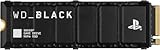
- Officially licensed M.2 SSD for PlayStation 5 consoles[4] so you can easily install and play with no concern of compatibility. [4]For PlayStation 5 system software compatibility, please visit the official WD_BLACK site.
- With capacities ranging from 1TB to 8TB[1], your PS5 console has the additional space to store up to 200 games[3] (8TB model) [1]1GB = 1 billion bytes and 1TB = one trillion bytes. Actual user capacity may be less depending on operating environment. [3] Number of games based on a 36GB average per game. The number of games will vary based on file size, formatting, other programs, and factors.
- Experience uninterrupted gameplay with a brand-new, optimized heatsink designed especially for the PS5 console for an easy, worry-free installation into the M.2 slot.
- Play directly from the drive and eliminate the need to transfer or delete games from your console with tested and approved storage for your PS5 console[4].
- Push the envelope of PCIe Gen 4 technology with read speeds up to 7,300MB/s[2], giving you seamless gameplay and incredibly short load times. [2]1 MB/s = 1 million bytes per second. Based on internal testing; performance may vary depending upon host device, usage conditions, drive capacity, and other factors.
Trade-off: do not treat the “530R” family name as a substitute for checking the individual model. This recommendation is about a suitable heatsink-equipped Gen4 configuration, not a claim that it is the fastest PS5 drive or a quantified endurance winner in every capacity.
Best for maximum capacity: WD_BLACK SN850P 8TB
The 8TB SN850P is the most straightforward choice for users who want the largest expansion Sony currently supports. It is aimed at players with large digital libraries, frequent downloads, limited internet bandwidth, or a strong dislike of moving games between storage devices.
An 8TB label does not mean 8TB of space will appear in the PS5’s storage menu. Formatting and system functions reduce usable capacity, and the number of games it holds depends heavily on individual installation sizes. Avoid fixed claims such as “it stores exactly 200 games”; that kind of estimate varies with the games in your library and the formatted capacity.
PC Slower Than It Used to Be?
A free scan shows the junk files, broken settings and background clutter dragging Windows down - then fixes them in one click.Free scan · Windows 10 & 11Outdated Drivers Are Slowing You Down
One free scan finds every outdated or missing driver and matches the right update for your exact hardware.Free scan · exact hardware matchChoose it if: you regularly keep dozens of large PS5 games installed and the current price per terabyte is acceptable.
Trade-off: the 8TB capacity is a specialist purchase. A 2TB or 4TB drive plus USB storage for archived PS5 games may be a better use of the budget for many players.
How much PS5 SSD capacity should you buy?
| Capacity | Who it suits | What to consider |
|---|---|---|
| 1TB | Players with a rotating library who want a modest expansion | It is the lowest practical step for many buyers, but the usable capacity is smaller than the label suggests and may fill quickly with large games |
| 2TB | Most players | The best general-purpose balance between extra room and purchase cost; it is the safest default if you are unsure |
| 4TB | Players with many large PS5 titles or slow internet connections | Reduces re-downloads and transfers, but compare the price per terabyte with two smaller drives or a USB archive strategy |
| 8TB | Very large digital libraries and users who want to minimize storage management | It is Sony’s current expansion limit and usually a specialist buy; verify the price, model, and usable space before committing |
Capacity is not a performance tier. A 4TB drive is not inherently faster for PS5 games than a 2TB version of the same family, and a larger SSD does not bypass Sony’s interface or cooling requirements. Choose capacity based on how many games you keep installed and how costly it is for you to redownload them.
Do you need a 7,000MB/s PS5 SSD?
No. Sony recommends sequential read performance of at least 5,500MB/s. That makes it a sensible screening number, but it is not a promise that every drive above or below it will perform identically in every game.
The Tool Desk
Outbyte PC Repair FREEClear out junk files and repair common Windows errorsFree Scan →Outbyte Driver Updater FREEScan for outdated or missing drivers - takes under a minuteDriver Scan →Sequential read figures are usually manufacturer-rated PC measurements. PS5 game loading can involve different queues, file sizes, compression, CPU work, and background activity. Once an SSD is sufficiently fast, the practical difference between several compliant Gen4 drives can be much smaller than the numbers on their boxes suggest. Prioritize the following in order:
- PCIe Gen4 x4 NVMe compatibility and M Key interface.
- A complete assembly that fits Sony’s width and thickness limits.
- Effective heat dissipation.
- At least Sony’s 5,500MB/s recommended sequential read speed.
- Capacity, warranty, seller reliability, and price.
The SN850P and 990 PRO exceed the speed recommendation, but that should be viewed as specification headroom rather than a guarantee of faster console loading. A cheaper drive that meets the same requirements can be the better value.
Rank #4

- PCIe 4.0 Gen4: The high-performance Predator GM7 delivers uncompromising speeds up to 7400 MB/s read- and 6500 MB/s write-speeds using the PCIe 4.0 interface and NVMe 2.0. It is the ideal SSD for enthusiasts to ace their games, enabling content creation without any hassle.
- HMB+SLC Cache: Predator GM7 supports HMB (Host Memory Buffer) and is equipped with SLC Cache to provide next-level performance, enabling faster game loads and files transmission.
- Powerful controller and NAND Flash: Equipped with the latest PCIe controller technology and state-of-the-art flash, the Predator GM7 boasts an excellent performance at lower power consumption creating less heat.
- Excellent temperature control: Predator GM7 adopts Thermal Throttling, and Power Management to achieve automatic temperature control, overcoming heat issues even under heavy workload.
- Biwin Intelligence is multifunctional management software, designed to support Predator branded storage products. For a more convenient and more secure storage experience, this software helps users manage their drives with features like performance test, data migration, drive cloning, and more.
Heatsinks: why they matter and what can go wrong
Do not install a bare SSD without effective heat dissipation. Sustained storage activity creates heat, and Sony specifically warns that the M.2 drive needs an appropriate heat-dissipation mechanism such as a heatsink and thermal-transfer material.
An integrated-heatsink model is the simplest option because the manufacturer has designed the components as a unit. If you already own a bare compatible drive, a PS5-compatible SSD heatsink can be an accessory solution, but the cooler is not automatically compatible just because it is marketed as “M.2.” Check all of the following:
Free tools Windows power users keep installed
One-click scans. No signup required.
- The SSD is 2230, 2242, 2260, 2280, or 22110 as applicable.
- The complete assembly is no wider than 25mm.
- The complete assembly is no thicker than 11.25mm.
- The thermal pad contacts the controller and NAND components correctly.
- No extra cover, clip, pad, or bottom plate pushes the assembly beyond the limit.
- The cooler does not prevent the M.2 bay cover from closing normally.
Do not stack multiple thermal pads or add a second heatsink to an SSD that already has one. Excess thickness can prevent correct installation or put pressure on the slot and cover.
PS5 and PS5 Pro compatibility
The same broad expansion requirements apply to the PS5 Pro: PCIe Gen4 x4 M.2 NVMe, 250GB to 8TB capacity, the supported M.2 lengths, and the same maximum dimensions including the cooling mechanism.
The PS5 Pro includes 2TB of built-in SSD storage, but that does not eliminate the usefulness of its expansion slot. A compatible additional M.2 drive can store and launch PS5 and PS4 games just as an expansion drive does on other PS5 models with the M.2 slot. Check the exact console model and the current Sony installation guidance before opening the enclosure.
How to install an M.2 SSD in a PS5
Before opening the console
- Update the system software. From the PS5 home screen, open Settings > System > System Software > System Software Update and Settings, then install any available update. Menu wording can vary slightly by system-software release.
- Confirm the drive specifications. Check PCIe Gen4 x4 NVMe, M Key, capacity from 250GB to 8TB, supported length, sequential read speed of at least 5,500MB/s where possible, and the dimensions of the complete heatsink-equipped assembly.
- Back up anything important. The first formatting operation erases everything on the new M.2 SSD. Do not use a drive containing files you need until those files are backed up elsewhere.
- Prepare a clean, stable workspace. Shut the console down completely rather than leaving it in Rest Mode, disconnect the cables, and let it cool. Keep a suitable cross-head screwdriver available and avoid static-prone surfaces.
Physical installation
- Place the powered-off console in the position specified for your PS5 model. Remove the stand or outer cover only as necessary to expose the expansion bay; the exact panel-removal motion differs between console revisions.
- Remove the M.2 bay cover and the retaining screw and spacer. Move the spacer to the hole corresponding to the SSD’s length, such as 2280.
- Align the SSD’s connector with the slot and insert it at an angle. It should slide into place without force. Press the free end down and secure it with the retaining screw.
- Reinstall the bay cover and the console’s outer cover. The cover should close normally; do not use pressure to accommodate a heatsink that exceeds the clearance.
- Reconnect the console and start it. The PS5 should display an M.2 SSD formatting prompt. Select the option to format the M.2 SSD and wait for the process to finish.
The formatting prompt is expected on first installation. It is not an error, but it does erase the drive. The console may also show a measured read speed after formatting. Treat that measurement as a console-specific check rather than a direct reproduction of the manufacturer’s maximum PC benchmark.
Do these 3 things before closing this tab:
1Repair Windows errors before they cause bigger problems2Fix the driver behind crashes, sound loss and screen glitches3Clear out junk files and repair common Windows errorsSet the installation location and move games
After formatting, open Settings > Storage > Installation Location and choose the M.2 SSD for PS5 games and apps if you want new installations to go there. You can also move installed games through the storage-management controls or from the game library’s options menu. The available labels can change slightly between PS5 system-software versions.
Games on the M.2 SSD can be launched directly. This applies to PS5 games and PS4 games. The M.2 drive is therefore different from an ordinary USB extended-storage drive, which is primarily useful for archiving PS5 games and running PS4 games.
Independent reader supportYour contribution helps us test, update, and keep practical guides available for everyone.Internal M.2 SSD versus USB extended storage
| Use case | Internal M.2 expansion | USB extended storage |
|---|---|---|
| Store PS5 games | Yes | Yes |
| Launch PS5 games directly | Yes | No; move the game to console storage or the M.2 SSD first |
| Launch PS4 games directly | Yes | Yes |
| Best role | Permanent, playable expansion for PS5 games | Lower-cost archive and transfer storage |
If your main goal is to play PS5 games without moving them back and forth, buy an internal M.2 expansion drive. A USB SSD can still be useful if you want to keep games downloaded, preserve a rotating library, or move installations more quickly than redownloading them, but it is not a substitute for the M.2 slot’s direct-launch capability.
Common buying mistakes
- Buying an M.2 SATA SSD. M.2 is only the shape. The PS5 needs PCIe Gen4 x4 NVMe with an M Key interface.
- Choosing PCIe Gen3 because it is cheaper. It does not meet Sony’s current recommended expansion specification.
- Measuring only the bare drive. Width and thickness limits apply to the SSD, heatsink, thermal material, and attached components together.
- Buying a bare SSD without a cooling plan. The drive needs effective heat dissipation, not merely a compatible connector.
- Assuming every capacity in a product family is identical. Capacities can have different controllers, rated speeds, dimensions, heatsinks, or availability.
- Paying for the highest sequential-speed number. A 7,450MB/s PC rating does not guarantee proportionally faster PS5 loading than a compliant 5,500MB/s-class drive.
- Expecting the labeled capacity to be fully usable. Formatting and system functions consume some space.
- Confusing official licensing with a universal performance guarantee. Licensing mainly reduces compatibility uncertainty; it does not make every game load faster.
- Buying an external USB SSD for direct PS5 play. USB extended storage can store PS5 games, but those games must be moved to internal or M.2 storage before they can be played.
What to do if the PS5 does not recognize the SSD
- Shut the console down completely, disconnect it, and reseat the M.2 drive. Make sure the connector is fully inserted and the retaining screw holds the drive flat.
- Confirm that the drive is NVMe PCIe Gen4 x4 and not M.2 SATA or PCIe Gen3.
- Check the capacity and physical length, then remeasure the complete heatsink assembly. An oversized cooler can prevent the drive from sitting correctly.
- Verify that the heatsink and thermal pad are attached properly and that the bay cover can close without pressure.
- Install the latest PS5 system software and try again.
- If the console recognizes the drive but reports less capacity, remember that formatted usable space is lower than the advertised number.
- If the measured speed is unexpectedly low, check the exact model’s specification, seating, firmware guidance, and cooling. Do not assume the advertised maximum is a guaranteed console measurement.
If the drive remains undetected after these checks, remove it rather than repeatedly forcing the cover or connector. Test the SSD in another compatible device only if doing so will not risk the data, and contact the drive manufacturer or console support with the exact model and capacity.
Best Value

- 【7450MB/s・Amazing Speed】Maximum read speed of 7450MB/s and maximum write speed of 6500MB/s (random read/ write speed of up to 1000K IOPS) realises the workflow of high-performance desktop PCs and notebook PCs. Ideal for power users who are looking for market-leading speeds.
- 【PCIe Gen4×4 for Superior Performance】Biwin NV7400 M.2 SSD utilizes the latest PCIe Gen 4x4 and 3D TLC NAND, choosing high-quality premium NAND flash chosen through our automated selection. Capacities of up to 4 TB are available, providing ample storage space and eliminating the anxiety of insufficient storage.
- 【PMIC Power Management & Graphite Heat Sink】NV7400 M.2 SSD adopts a composite power supply IC (PMIC), which improves power saving and energy saving performance by increasing the efficiency of power distribution, and effectively extends the durability of the SSD. Moreover, it is equipped with a 0.5mm graphene aluminium heat sink to prevent overheating with excellent heat dissipation performance and maintain stable top performance.
- 【Enhanced System Stability】The NV7400 delivers stable performance for demanding applications. Enhanced by Host Memory Buffer (HMB) technology, it ensures stable operation even under heavy workloads. The integration of Smart Cache optimizes data retrieval, while Zip data compression maximizes storage efficiency.
- 【Free Biwin Intelligence Software】Biwin Intelligence is multifunctional management software, designed to support Biwin consumer-brand storage products. For a more convenient and more secure storage experience, this software helps users manage their drives with features like performance test, data migration, firmware update, and more.
Which PS5 SSD should you buy?
Buy the WD_BLACK SN850P if you want the clearest compatibility-first choice and a built-in PS5-oriented heatsink. Buy the Samsung 990 PRO with Heatsink if you want a premium Gen4 drive and are comfortable paying for performance headroom that may not translate into major PS5 loading gains. Choose the Crucial T500 with heatsink when its current price makes it a genuine value, or the Seagate FireCuda 530R with Heatsink when its exact listing, warranty, and dimensions work for you. For the largest library, the WD_BLACK SN850P 8TB reaches Sony’s current expansion ceiling.
Whichever model you choose, compatibility comes before benchmark numbers: PCIe Gen4 x4 NVMe, M Key, 250GB–8TB, a supported length, at least Sony’s recommended 5,500MB/s sequential read speed, and a complete heatsink-equipped assembly no wider than 25mm and no thicker than 11.25mm.
Frequently Asked Questions
Are these SSDs compatible with PS5 Pro?
Yes. Sony’s current PS5 Pro guidance supports an additional PCIe Gen4 x4 M.2 NVMe SSD with 250GB–8TB capacity, the supported M.2 lengths, and the same 25mm width and 11.25mm complete-assembly thickness limits. The PS5 Pro includes 2TB of built-in storage, but compatible M.2 expansion remains supported.
Do I need a 7,000MB/s SSD for PS5?
No. Sony recommends at least 5,500MB/s sequential read speed, but a higher PC-rated figure does not guarantee proportionally faster PS5 loading. Interface, cooling, game workload, and console behavior matter more than the headline number once the drive is sufficiently fast.
Is a heatsink required for a PS5 M.2 SSD?
Yes, the drive needs effective heat dissipation. Use an integrated-heatsink model or add a PS5-compatible heatsink with thermal-transfer material. The complete assembly must remain within Sony’s 25mm width and 11.25mm thickness limits.
Can I use any M.2 SSD in a PS5?
No. M.2 SATA drives are not supported. The PS5 requires a PCIe Gen4 x4 M.2 NVMe SSD with an M Key interface. PCIe Gen3 drives also fail to meet Sony’s current recommended specification.
Can PS5 games be played from an external USB SSD?
An M.2 SSD can store and launch PS5 and PS4 games. USB extended storage can store PS5 games, but PS5 games must be moved to the console’s internal storage or M.2 SSD before they can be played. PS4 games can be played directly from compatible USB extended storage.
The Bottom Line
Bottom line: The WD_BLACK SN850P is the safest all-round PS5 SSD recommendation in 2026, with the 2TB version the best default for most players. A correctly sized, cooled, compliant Gen4 NVMe drive can also be excellent value, so do not pay a large premium solely for a higher PC-rated sequential-speed number.
Quick Recap
Product prices and availability are accurate as of the date/time indicated and are subject to change. Any price and availability information displayed on Amazon at the time of purchase will apply.




