The claim that the human eye can see only 30 or 60 FPS is false. Human temporal vision is not a single frame-rate meter. Sensitivity to change depends on brightness, contrast, spatial detail, motion, eye movements, retinal location, and the task.
That does not mean everyone consciously sees every frame from a 500 FPS sequence as a separate image. It means flicker-fusion numbers cannot be turned into a universal limit for games. Higher FPS and refresh rates can improve smoothness and reduce display-side timing intervals when the game, hardware, frame pacing, and display support them.
The eye is not a camera with a fixed frame rate
Human vision does not operate at 30 FPS, 60 FPS, or any other single universal rate. The visual system continuously processes changes in light and space, and its sensitivity to timing depends on factors such as brightness, contrast, stimulus size, retinal location, motion, eye movements, spatial detail, and the task being performed.
That does not mean every person consciously sees every frame in a 500 FPS sequence as a separate image. It means the claim that human vision stops detecting useful temporal information above 30, 60, or 120 FPS is scientifically wrong. There is no single human-vision FPS ceiling that can settle every display or gaming question.
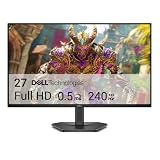
#1 Best Overall

- Smooth motion: 240Hz refresh rate and fast 0.5ms response time provide crisp visuals and fluid movement with less input lag.
- Seamless gaming: FreeSync Premium and HDMI VRR eliminate tearing for smooth, responsive PC and console gameplay.
- Fast IPS: Faster 0.5ms response with excellent color accuracy across wide IPS viewing angles.
- Rich color: 99% sRGB color coverage delivers vivid, detailed imagery with strong accuracy.
- Eye comfort: TÜV Rheinland 3‑star certified display lowers blue light while preserving color quality.
Where the myth comes from
The usual argument combines several unrelated facts:
- Film is commonly shown at roughly 24 frames per second.
- Television systems historically used approximately 50 or 60Hz refresh systems.
- Critical flicker-fusion thresholds are sometimes reported in a range such as 50–90Hz.
From those facts, it is tempting to conclude that the brain cannot benefit from anything faster. But frame rate, refresh rate, flicker fusion, motion perception, temporal-order perception, and conscious experience are different measurements. They overlap, but none is a universal substitute for the others.
What critical flicker fusion actually measures
Critical flicker fusion, or CFF, is the frequency at which a particular flickering light begins to appear continuous. It is a useful measure in studies of temporal vision, but it is a test of one stimulus under particular conditions—not a measurement of the maximum frame rate humans can see.
A CFF result can change with:
- Brightness and contrast
- The size and color of the stimulus
- Where it falls on the retina
- Viewing conditions and adaptation
- The observer and the task
A uniform light flashing on and off is also very different from a game rendering a moving character, a high-contrast edge, or a detailed scene. A person may fail to describe a uniform flicker as separate flashes while still detecting timing differences, motion changes, or display artifacts in a spatially structured image.
That is why flicker fusion cannot prove that 60Hz is the upper limit of useful gaming refresh rate. It answers a narrower question: when does this particular flickering stimulus stop looking like flicker?
Temporal vision is more complicated than a stream of movie frames
The eye and brain do not receive reality as a literal sequence of discrete frames. Photoreceptors and neural circuits integrate incoming light over time, but different visual pathways preserve and use timing information differently.
There is a trade-off involved. In dim conditions, a longer integration period can improve sensitivity to light, but it can also increase motion blur. When more light is available, shorter integration can support better temporal resolution. The result is not a universal cutoff; it is a changing balance between sensitivity, detail, motion, and timing.
Rank #2
- Smooth motion: 240Hz refresh rate and fast 0.5ms response time provide crisp visuals and fluid movement with less input lag.
- Seamless gaming: FreeSync Premium and HDMI VRR eliminate tearing for smooth, responsive PC and console gameplay.
- Fast IPS: Faster 0.5ms response with excellent color accuracy across wide IPS viewing angles.
- Rich color: 99% sRGB color coverage delivers vivid, detailed imagery with strong accuracy.
- Eye comfort: TÜV Rheinland 3‑star certified display lowers blue light while preserving color quality.
Other visual tasks demonstrate the same point. Temporal-order judgments ask whether one event occurred before another. Under suitable spatial arrangements, people can resolve very small asynchronies even though a flickering-light test might produce a much larger fusion threshold. This does not mean people consciously experience the world as thousands of individual frames. It means different tests reveal different capabilities.
Free tools Windows power users keep installed
One-click scans. No signup required.
Conscious perception adds another distinction. The subjective feeling of a continuous visual stream, or the apparent timing grain of awareness, is not identical to the speed of early visual encoding. A perceptual integration window does not establish a hard FPS limit for every visual task.
Can humans detect changes above 60Hz or 90Hz?
Yes, under some conditions. The careful claim is not that everyone will notice every update from every display. The defensible claim is that human visual systems can remain sensitive to temporal modulation and display artifacts above commonly cited 50–90Hz ranges when the stimulus, spatial structure, viewing conditions, or eye movements make those changes detectable.
One peer-reviewed study reported that observers perceived flicker artifacts above 500Hz when a display contained high-frequency spatial edges. That result does not make 500Hz a universal requirement, and it does not show that every viewer will consciously distinguish 500 separate full-screen images per second. It demonstrates that the upper limit depends strongly on what is displayed and how it is viewed.
Edges matter because a moving eye does not necessarily sample every part of a display in the same way. Temporal changes can also become visible as artifacts or motion differences rather than as obvious flashing. A single CFF number cannot capture all of those cases.
What’s actually slowing this PC down?
Pick the symptom - the matching free tool is one click away.
FPS, refresh rate, and frame time are not the same thing
Gaming discussions often use FPS and Hz as if they were interchangeable. They are not.
| Term | What it describes | Example |
|---|---|---|
| Frame rate | How frequently the game engine or renderer produces frames | 120 FPS means the game is producing about 120 frames per second |
| Refresh rate | How frequently the display can update | 144Hz gives the monitor up to 144 refresh opportunities per second |
| Frame time | The time represented by each rendered or displayed update | At 120Hz, one refresh interval is about 8.33 milliseconds |
| Flicker-fusion threshold | When a particular flickering stimulus appears continuous | A condition-dependent laboratory measurement, not a universal FPS ceiling |
The nominal refresh intervals are:
| Refresh rate | Interval between refreshes |
|---|---|
| 60Hz | 16.67 milliseconds |
| 120Hz | 8.33 milliseconds |
| 144Hz | 6.94 milliseconds |
| 240Hz | 4.17 milliseconds |
These are timing facts, not biological thresholds. Moving from 60Hz to 120Hz cuts the display’s nominal update interval in half. Moving from 120Hz to 240Hz cuts it in half again. That can affect motion presentation and waiting time in the display pipeline without giving the viewer a new biological sense.
Rank #3
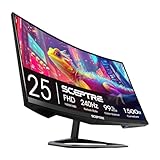
- 240Hz Refresh Rate: Stay above the pack with 240Hz, giving you an edge in performance as frames transition instantly.Specific uses for product - Gaming
- 1ms Response Time: Colors fade and illuminate instantly with a 1ms response time, eliminating ghosting and piecing together precise imagery during action-packed scenes and gaming.
- 1500R Curvature: The 1500R degree curved design immerses you into all of the action no matter where you choose to sit in the room.
- AMD FreeSync Premium: By accelerating the frame rate to at least 120Hz at 1080P FHD resolution and delivering low latency to prevent visible delay in data processing, AMD FreeSync Premium allows gameplay to reach the highest echelons of performance.
- Built-In Speakers: Perfectly suited to work & gaming settings, built-in speakers deliver robust & smooth audio while saving space on your desk.
Why FPS and monitor Hz can bottleneck each other
A 240Hz monitor does not create 240 unique game frames if the game or GPU is producing only 70 FPS. The display has more update opportunities, but the game is not supplying a new rendered frame for each one.
The opposite mismatch matters too. If a game renders at 200 FPS while the monitor refreshes at 60Hz, the display cannot show every rendered frame as a distinct full-screen update. Some of the extra rendering work may not become separate visible updates on that display.
PC Slower Than It Used to Be?
A free scan shows the junk files, broken settings and background clutter dragging Windows down - then fixes them in one click.Free scan · Windows 10 & 11Crashes, No Sound, or Screen Glitches?
Random freezes, missing sound and display glitches usually trace back to one bad driver. Find and replace yours safely.Free scan · under a minuteThat does not make either number meaningless. A faster display reduces the interval before another update can be presented, while a faster renderer supplies more possible updates. The visible result depends on how those two clocks interact, as well as on frame pacing and synchronization.
What a higher-refresh display can actually improve
Motion smoothness
When a game supplies frames frequently enough, more frequent display updates can make camera movement, object motion, and scrolling appear less coarse. The improvement is not a magical increase in vision speed. It is a change in how often the display samples and presents the changing scene.
Whether the difference is obvious depends on the game, the movement on screen, the frame rate, image quality, viewing conditions, and the person looking at it. A fast competitive game with frequent camera movement presents a different test from a slow strategy game or a locked 30 FPS cinematic title.
Display-side timing
A newly rendered frame may have to wait for the next display update opportunity. At 60Hz, those opportunities are separated by about 16.67ms; at 240Hz, they are separated by about 4.17ms. A higher refresh rate can therefore reduce the possible wait between a frame becoming available and the display presenting it, assuming the game and the rest of the system can take advantage of the faster schedule.
This is only one part of latency. Total input-to-photon latency can include the input device, game processing, render queues, GPU workload, display scanout, pixel response, and synchronization settings. A 240Hz panel cannot erase delays introduced elsewhere.
Rank #4

- 27” 240Hz 1500R Curved FHD 1080P Gaming Monitor for Game Play.
- Prioritizes Gaming Performance: Up to 240Hz high refresh rate, more immersive 1500R Curvature, FreeSync, MPRT 1ms Response Time, Black Level adjustment(shadow booster), Game Modes Preset, Crosshair.
- Cinematic Color Accuracy: 130% sRGB & DCI-P3 95% color gamut, 4000:1 contrast ratio, 300nits brightness, HDR, Anti-flicker; Anti-Glare.
- Plug & Play Design: HDMI & DP1.4 & Audio Jack(No built-in speakers), durable metal stand, tilt -5°~15, VESA 100*100mm compatible.
- Warranty: Money-back and free replacement within 30 days, 1-year quality warranty and lifetime technical support. Pls contact SANSUI service support first if any product problem.
Frame-pacing and synchronization quality
Frames that arrive at irregular intervals can make motion feel uneven even when the average FPS looks high. A stable 100 FPS sequence may feel better than a sequence that swings between much higher and lower rates if its timing is inconsistent.
Variable refresh rate, or VRR, is designed to address this mismatch. AMD describes FreeSync as synchronizing a compatible display’s refresh rate with the GPU’s frame rate to reduce problems including tearing, stuttering, and input latency. AMD’s FreeSync Premium tier includes at least 120Hz at minimum Full HD resolution and low-framerate compensation.
NVIDIA describes G-SYNC as matching the monitor’s refresh rate to the GPU’s frame rate, with goals that include reducing tearing, stutter, and input lag. NVIDIA also distinguishes full G-SYNC displays from G-SYNC Compatible monitors that have been validated for a basic VRR experience. Exact capabilities and operating ranges vary by display, so the label alone is not a complete specification.
What the gaming evidence does—and does not—show
A 2024 preprint examined first-person-shooter play at 30Hz, 60Hz, 120Hz, 144Hz, and 240Hz with 26 participants. Its reported significant performance effect was concentrated at 30Hz. That supports the practical conclusion that very low refresh rates can be harmful, but it should not be inflated into a promise that every jump above 60Hz produces the same objective improvement for every player.
Another study examining variable frame timing found that timing variation affected perceived smoothness. However, its performance experiment did not find completion-time differences between sequences that participants judged equally smooth. This is an important distinction: a display can look or feel smoother without every objective task producing a faster measured result.
The evidence therefore does not support either extreme. It does not support saying that 240Hz is automatically transformative, and it does not support saying that everything above 60Hz is placebo. The task, the test, the frame timing, and the complete hardware pipeline matter.
Independent reader supportYour contribution helps us test, update, and keep practical guides available for everyone.When should a higher refresh rate matter to a gamer?
Use this checklist instead of asking where human vision supposedly stops.
Recommended Free Tools
Best Value
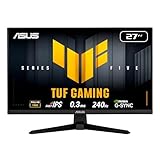
- 27-inch Full HD Fast IPS Display: Features a 1920 x 1080 resolution Fast IPS panel with 240Hz refresh rate for fast paced gameplay
- Ultra-Fast Response Time: ASUS Fast IPS technology enables a 0.3ms (min) response time for sharp gaming visuals with high frame rates
- Adaptive Sync Technology: FreeSync Premium and G-Sync compatible delivers a seamless, tear-free gaming experience
- Advanced Motion Blur Reduction: ASUS Extreme Low Motion Blur Sync (ELMB SYNC) technology enables ELMB together with variable refresh rate, eliminating ghosting and tearing for sharp gaming visuals with high frame rates
- Convenient Monitor Control: DisplayWidget Center enables easy OSD access and monitor settings adjustments with a mouse
- What do you play? Fast first-person shooters, racing games, fighting games, and other motion-heavy titles provide more opportunities to notice changes in motion presentation than static menus or slow-paced games.
- What FPS can your system sustain? Match the monitor to the frame rates your GPU and CPU can actually deliver in the games you play. A high refresh rate is most useful when the game supplies sufficiently frequent frames.
- How stable is the frame time? Check consistency, not just the largest number shown by an FPS counter. Uneven delivery can undermine the apparent benefit of a high average.
- Does the display support suitable VRR? FreeSync, G-SYNC, and G-SYNC Compatible features can help align irregular frame delivery with display timing. Confirm that the monitor, GPU, connection, resolution, and refresh mode work together.
- What is your task? Competitive play, visual tracking, ordinary single-player gaming, video playback, and desktop work may produce different benefits and different priorities.
- Can you compare the displays under controlled conditions? If possible, use the same game, resolution, settings, and camera movement. Change one variable at a time and pay attention to smoothness, responsiveness, and stability rather than expecting a universal dramatic transformation.
If you want to test the practical difference for yourself, compare a 240Hz gaming monitor with VRR support against your current display while checking that your system can actually sustain the target frame rate. Treat it as a system-matching decision, not as proof that every person needs 240Hz.
Claims to stop making
- Do not say: The human eye can only see 30 FPS.
Say instead: Human temporal vision has no universal FPS cutoff. - Do not say: Humans cannot see above 60 FPS.
Say instead: People can remain sensitive to some temporal changes above 60Hz, depending on the stimulus and task. - Do not say: Anything above 120 FPS is placebo.
Say instead: The benefit of higher frame rate and refresh rate varies with the game, frame timing, display, and viewer. - Do not say: A 240Hz monitor makes everyone twice as fast.
Say instead: A higher refresh rate shortens display-update intervals and may improve smoothness or timing in supported conditions. - Do not say: Flicker fusion proves the maximum useful refresh rate.
Say instead: Flicker fusion measures one condition-dependent response and is not a general motion-perception limit. - Do not say: More monitor Hz automatically means more game FPS.
Say instead: Refresh rate and rendered FPS are separate parts of the display pipeline.
The accurate verdict
The human eye does not stop at a universal FPS number. Flicker fusion is not the same as motion perception, temporal-order perception, or display usefulness. Under suitable conditions, people can detect temporal changes and display artifacts above familiar 50–90Hz thresholds, while the usefulness of higher refresh rates still depends on the stimulus and the task.
For gaming, higher refresh can provide more frequent display updates, smoother motion, and lower display-side timing intervals. Those advantages are conditional: the game must render enough frames, frame delivery must be reasonably consistent, the display and connection must support the chosen mode, and synchronization must be configured appropriately.
Frequently Asked Questions
Does film at 24 FPS prove that humans cannot see more than 24 FPS?
No. Film’s roughly 24 FPS convention reflects production, presentation, and artistic choices, not a proven limit of human temporal vision. A film sequence is also a different stimulus from a game with interactive motion and changing spatial detail.
Do these 3 things before closing this tab:
1Fix the driver behind crashes, sound loss and screen glitches2Clear out junk files and repair common Windows errors3Scan for outdated or missing drivers - takes under a minuteIs FPS the same as monitor refresh rate?
No. FPS describes how frequently a game produces frames, while Hz describes how frequently a display can update. A 240Hz monitor cannot show 240 unique game frames per second if the game is rendering only 70 FPS.
Is a 240Hz monitor always better than a 144Hz monitor?
Not necessarily. A 240Hz monitor shortens the display interval to about 4.17 milliseconds, but its practical value depends on whether the game and GPU can supply frames at a suitable rate, how consistent frame timing is, and whether the display pipeline is configured well.
Does higher refresh rate make everyone perform better?
No. A study cited in the research reported a significant performance effect concentrated at 30Hz, but that does not establish an identical performance gain at every higher refresh rate. Higher refresh can improve smoothness or timing in some tasks without making every player objectively faster.
What do FreeSync and G-SYNC actually do?
VRR synchronizes display timing more closely with irregular GPU frame delivery. FreeSync and G-SYNC are different vendor ecosystems, and G-SYNC Compatible monitors are displays validated by NVIDIA for a basic VRR experience. Compatibility and feature ranges vary by model.
The Tool Desk
Outbyte PC Repair FREERepair Windows errors before they cause bigger problemsFix Now →Outbyte Driver Updater FREEScan for outdated or missing drivers - takes under a minuteDriver Scan →Why is flicker fusion not the maximum FPS humans can see?
A flicker-fusion result tells you when one particular flickering stimulus appears continuous under particular conditions. It does not measure every form of motion perception, temporal-order judgment, or sensitivity to spatially structured display artifacts.
The Bottom Line
Bottom line: There is no single human-vision FPS ceiling. A 240Hz display will not make every game or player twice as fast, but dismissing all refresh rates above 60Hz as invisible is just as inaccurate. Judge the upgrade by the game, sustained FPS, frame pacing, VRR support, latency, and your own viewing task.
Quick Recap
Product prices and availability are accurate as of the date/time indicated and are subject to change. Any price and availability information displayed on Amazon at the time of purchase will apply.