What’s actually slowing this PC down?
Pick the symptom - the matching free tool is one click away.
The best overall graphics card for the Ryzen 7 7800X3D is the AMD Radeon RX 9070 XT—provided its U.S. street price is reasonably close to its $599 launch price. It delivers strong rasterized performance, 16GB of VRAM, and a straightforward power connection for high-refresh 1440p and value-focused 4K gaming.
Choose the GeForce RTX 5070 Ti instead if ray tracing, DLSS, CUDA, NVENC, or creator software matters more than conventional gaming value. For premium 4K, the RTX 5080 is the more sensible high-end choice; the RTX 5090 is the fastest but is difficult to justify for ordinary 7800X3D gaming because of its price, power, size, and availability.
| # | Preview | Product | Price | |
|---|---|---|---|---|
| 1 |

|
AMD Ryzen 7 7800X3D 8-Core, 16-Thread Desktop Processor | $379.49 | Buy on Amazon |
| 2 |

|
AMD RYZEN 7 9800X3D 8-Core, 16-Thread Desktop Processor | $444.00 | Buy on Amazon |
| 3 |
|
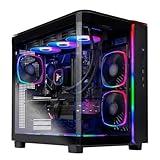
Skytech Gaming King 95 Gaming PC, Ryzen 7 7800X3D, RX 9070 XT | $2,099.99 | Buy on Amazon |
| 4 |

|
Skytech Gaming Azure 3 Gaming PC, Ryzen 7 7800X3D, RTX 5060 Ti 16GB | $1,999.99 | Buy on Amazon |
Prices and availability in this guide are U.S. market signals checked on August 16, 2026. Retail prices can change daily and vary by board partner, cooler, retailer, and stock.
There is no single “matching” GPU for the 7800X3D
The Ryzen 7 7800X3D remains an excellent gaming processor, but it does not dictate one correct graphics-card tier. It has 8 cores, 16 threads, a maximum boost clock of 5.0GHz, a 120W default TDP, and PCIe 5.0 platform support, according to AMD’s Ryzen 7000 quick-reference guide.
#1 Best Overall
- Processor provides dependable and fast execution of tasks with maximum efficiency.Graphics Frequency : 2200 MHZ.Number of CPU Cores : 8. Maximum Operating Temperature (Tjmax) : 89°C.
- Ryzen 7 product line processor for better usability and increased efficiency
- 5 nm process technology for reliable performance with maximum productivity
- Octa-core (8 Core) processor core allows multitasking with great reliability and fast processing speed
- 8 MB L2 plus 96 MB L3 cache memory provides excellent hit rate in short access time enabling improved system performance
Your monitor, resolution, refresh rate, graphics settings, ray tracing, game type, and budget matter more than the CPU model alone. At 1440p and 4K, the GPU usually does most of the rendering work. At 1080p with a 240Hz or faster display, or in CPU-heavy simulation and strategy games, the 7800X3D can still be the limiting component.
That is why this ranking separates value, ray tracing, premium 4K performance, and extreme workloads rather than declaring the most expensive card universally best.
Quick comparison
| Rank | GPU | Best target | VRAM | Launch price | Price signal checked Aug. 16, 2026 | Main drawback |
|---|---|---|---|---|---|---|
| 1 | AMD Radeon RX 9070 XT | High-refresh 1440p; value 4K | 16GB GDDR6 | $599 | About $719.99 | Weaker ray tracing and software ecosystem than Nvidia |
| 2 | Nvidia GeForce RTX 5070 Ti | 1440p/4K with RT and DLSS | 16GB GDDR7 | $749 | About $1,029.99 | Poor value when heavily marked up |
| 3 | Nvidia GeForce RTX 5080 | Premium 4K | 16GB GDDR7 | $999 | About $1,289.99 | Expensive, and still limited to 16GB |
| 4 | Nvidia GeForce RTX 5090 | Maximum 4K and professional workloads | 32GB GDDR7 | $1,999 | About $4,399 | Extreme price, power, heat, and case requirements |
| 5 | Nvidia GeForce RTX 5070 | Sensible Nvidia 1440p | 12GB GDDR7 | $549 | $549 MSRP signal | Less VRAM headroom for 4K and future games |
Launch prices come from Nvidia’s RTX 50-series announcement and AMD’s RX 9000 launch material. The later market snapshots are not permanent prices or guaranteed listings. PC Gamer’s GPU price watch reported the approximate August 14 U.S. figures shown above.
How to choose for your resolution
| Target | Practical choices |
|---|---|
| 1080p, 240Hz or higher | RTX 5070 or RX 9070 XT for demanding games; the CPU may limit performance in esports titles |
| 1440p, 165Hz | RX 9070 XT, RTX 5070 Ti, or RTX 5070 |
| 1440p with ray tracing | RTX 5070 Ti or RTX 5080 |
| 3440×1440 ultrawide | RX 9070 XT, RTX 5070 Ti, or RTX 5080 depending on settings |
| 4K, up to 120Hz | RTX 5080 or RTX 5090; RX 9070 XT is the value-oriented option with compromises |
| 4K path tracing or maximum settings | RTX 5090, with RTX 5080 as the more attainable alternative |
These are planning categories, not guaranteed frame-rate tiers. Results vary by game engine, preset, driver, upscaling mode, ray-tracing implementation, and frame-generation settings.
Free tools Windows power users keep installed
One-click scans. No signup required.
1. AMD Radeon RX 9070 XT — Best overall
The RX 9070 XT is the default recommendation for most gaming-focused 7800X3D systems. It offers the right combination of strong conventional raster performance, 16GB of VRAM, and a $599 launch price that undercut the RTX 5070 Ti by $150.
AMD specifies 16GB of GDDR6 on a 256-bit interface, up to 640GB/s of memory bandwidth, 304W board power, and a 750W recommended power supply. AMD’s official reference specification also lists two 8-pin power connectors, although a partner card can differ. Check the exact model before buying at AMD’s graphics specifications page.
Why pair it with the 7800X3D?
At 1440p, the 7800X3D gives the RX 9070 XT a strong CPU foundation for high frame rates without requiring a more expensive processor. At 4K, the card remains a sensible value choice if you are willing to adjust ray tracing, use upscaling, or accept less consistent maximum-quality performance than an RTX 5080 or RTX 5090.
Its 16GB framebuffer is more comfortable than the RTX 5070’s 12GB for high-resolution textures, demanding releases, and some modded games. That does not make it automatically faster or permanently future-proof: architecture, drivers, game support, and actual price still matter.
Quick wins for a faster PC:
Fix the driver behind crashes, sound loss and screen glitchesFind Drivers →Repair Windows errors before they cause bigger problemsFix Now →When not to buy it
- Choose Nvidia instead if you specifically need CUDA, a CUDA-dependent AI package, Nvidia Studio support, NVENC, Broadcast, or a creator application that performs better on Nvidia hardware.
- Choose Nvidia if your priority is heavy ray tracing or path tracing and the price difference is acceptable.
- Reconsider it if the RX 9070 XT approaches or exceeds the RTX 5070 Ti’s actual price. The value argument depends on street pricing.
2. Nvidia GeForce RTX 5070 Ti — Best Nvidia choice
The RTX 5070 Ti is the most balanced Nvidia alternative for a 7800X3D gaming build. It combines 16GB of GDDR7 with Nvidia’s ray-tracing, DLSS, creator, and software ecosystem advantages.
Nvidia lists 16GB of GDDR7 on a 256-bit interface and 896GB/s of memory bandwidth. It is a particularly strong fit for 1440p with ray tracing, ultrawide gaming, and 4K when DLSS or suitable settings are part of the plan. Specifications are available in Nvidia’s comparison table.
Rank #2
- The world’s fastest gaming processor, built on AMD ‘Zen5’ technology and Next Gen 3D V-Cache.
- 8 cores and 16 threads, delivering +~16% IPC uplift and great power efficiency
- 96MB L3 cache with better thermal performance vs. previous gen and allowing higher clock speeds, up to 5.2GHz
- Drop-in ready for proven Socket AM5 infrastructure
- Cooler not included
Why pay more than the RX 9070 XT?
The premium is justified when you will use the features behind Nvidia’s performance advantage rather than only comparing rasterized frame rates. DLSS support, Nvidia’s ray-tracing performance, CUDA compatibility, NVENC, Broadcast, and Studio-oriented workflows can all be more important than a lower purchase price.
Software support must still be judged application by application. “Nvidia is better for creators” is too broad without naming the workload: CUDA-dependent rendering and AI applications are different from video encoding, 3D viewport work, or a game that supports both FSR and DLSS.
The warning is price. A roughly $1,030 market price is very different from a $749 MSRP. If you only want conventional rasterized gaming and the RX 9070 XT is substantially cheaper, the AMD card is usually the more rational purchase.
3. Nvidia GeForce RTX 5080 — Best premium 4K option
The RTX 5080 is the high-end choice for buyers with a premium 4K display who want more performance than the RX 9070 XT or RTX 5070 Ti without paying RTX 5090 money.
It has 16GB of GDDR7 and a $999 launch MSRP. A reported U.S. market snapshot around August 14 placed an example at approximately $1,289.99. Its position above the RX 9070 XT in Tom’s Hardware’s 2026 GPU hierarchy makes it appropriate for high-quality 4K gaming, particularly when ray tracing and Nvidia’s upscaling features matter.
The 7800X3D is capable of supporting this class of GPU at 4K. At lower resolutions and very high refresh rates, however, some games will become CPU-limited before the RTX 5080 is fully utilized. Do not buy one for a 1440p/60Hz display unless you have a clear upgrade path or a non-gaming workload.
Its 16GB VRAM is adequate for many premium gaming scenarios, but it is not an unlimited 4K buffer. Heavy texture packs, path tracing, mods, and future engines can change the memory requirement. Exact board-partner PSU, connector, length, and thickness requirements must be checked for the model you select.
4. Nvidia GeForce RTX 5090 — Fastest, not best value
The RTX 5090 belongs on this list because it is the uncompromising performance option, not because it is the sensible default. Nvidia lists 32GB of GDDR7, a 512-bit memory interface, and 1,792GB/s of bandwidth; Nvidia describes it as its most powerful GeForce GPU on the official RTX 5090 product page.
Its $1,999 launch price was already extreme. The approximately $4,399 market example reported in the August 14 price snapshot makes its gaming value particularly poor. At that price, it is difficult to recommend unless the buyer explicitly wants maximum available performance, 32GB of VRAM for demanding creator or AI work, or a premium 4K setup where compromise is unacceptable.
System requirements are part of the purchase
The reference-card quick-start guide specifies a 304mm length and 61mm thickness, while partner cards can be substantially larger. Read the exact dimensions, slot count, power recommendation, connector requirements, and cable-clearance instructions before ordering. The relevant guide is Nvidia’s RTX 5090 quick-start documentation.
Recommended Free Tools
Rank #3
- AMD Ryzen 7 7800X3D 4.2GHz (5.0GHz Turbo Boost) CPU Processor | 1TB Gen4 NVMe M.2 SSD – Up to 30x Faster Than Traditional HDD | 360mm AIO Liquid CPU Cooler with ARGB Fans, say goodbye to outdated and inefficient air coolers.
- AMD Radeon RX 9070 XT 16GB GDDR6 Graphics Card (Brand may vary) | 24GB DDR5 RAM 6000 Non-RGB Gaming Memory with Heat Spreader | Windows 11 Home
- WI-FI 5 802.11ac | No Bloatware | Graphic output options include 1 x HDMI, and 1 x Display Port Promised, Additional Ports may vary | USB Ports Including 2.0, 3.0, and 3.2 Gen1 Ports | HD Audio & Mic | Free Gaming Keyboard & Mouse
- High-spec AIO liquid coolers used, delivering unmatched cooling performance for a perfect operational experience and unparalleled cooling performance. With hardware unrestricted by temperature limits, you can unleash its full potential. Whether gaming, creating, or working, you'll never suffer from thermal throttling again. | Showcase Your PC with the Stunning King 95 Case - Black | 1 Year Warranty on Parts and Labor | Free Technical Support | Assembled in the USA
- This powerful gaming PC is capable of running all your favorite games such as Elden Ring Nightreign, Baldur's Gate 3, Cyberpunk 2077, Hogwarts Legacy, Helldivers 2, Diablo IV, Starfield, Valorant, Counter-Strike 2, Forza Horizon 5, Resident Evil 9, Alan Wake 2, Warhammer 40,000: Space Marine 2, God of War Ragnarök, Overwatch 2, Dragon's Dogma 2, Marvel's Spider-Man, Clair Obscur: Expedition 33,, more at Ultra settings, detailed 4K Ultra HD resolution, and smooth 60+ FPS gameplay.
You also need a high-quality PSU with appropriate native connector support, adequate case airflow, and enough room around the power cable. A PCIe slot that accepts the card does not guarantee that the card will fit with the side panel, front radiator, storage cage, or nearby expansion cards installed.
5. Nvidia GeForce RTX 5070 — Best lower-cost Nvidia pairing
The RTX 5070 is a sensible Nvidia choice for 1440p gaming, especially when the budget is closer to its $549 launch price than to the RTX 5070 Ti’s market pricing. The 7800X3D can drive high frame rates with this card, although the GPU remains the limiting component in many demanding games at higher settings.
The important compromise is memory: Nvidia lists 12GB of GDDR7, compared with 16GB on the RTX 5070 Ti. Twelve gigabytes is not already unusable, and it can be entirely reasonable for 1440p today. It is less comfortable for 4K, heavy texture packs, path tracing, mods, and future releases. VRAM use depends on resolution, texture quality, ray tracing, engine behavior, and asset streaming.
If the price gap to the RX 9070 XT or RTX 5070 Ti is modest, prefer one of the 16GB cards for greater headroom. Keep the RTX 5070 when you want Nvidia features and the savings are meaningful, or when your target is 1440p rather than 4K.
RX 9070 XT versus RTX 5070 Ti
This is the most important comparison for most 7800X3D owners.
| Choose the RX 9070 XT when… | Choose the RTX 5070 Ti when… |
|---|---|
| You prioritize rasterized gaming value. | You prioritize ray tracing and DLSS. |
| You want 16GB of VRAM at the lowest price. | You need CUDA or a specific Nvidia-dependent application. |
| The AMD card is close to its $599 launch price. | NVENC, Broadcast, Studio, or Nvidia creator support matters. |
| You prefer the reference-style two-8-pin arrangement, subject to partner-model verification. | Your games and workflow benefit from Nvidia’s software ecosystem. |
AMD uses 16GB of GDDR6 with up to 640GB/s bandwidth, while Nvidia’s RTX 5070 Ti uses 16GB of GDDR7 at 896GB/s. Bandwidth alone does not determine total performance. Independent testing should be separated into raster and ray-traced results, and should identify whether it used native rendering, upscaling, ray reconstruction, or frame generation.
Tom’s Hardware notes that the FSR 4.x experience can trail DLSS 4.5 in image quality and adoption in its tested coverage. That is not a universal result for every game or mode, so treat upscaling quality as an implementation-specific feature rather than a permanent law of the hardware.
RTX 5070 Ti versus RTX 5080
Move to the RTX 5080 when you have a 4K high-refresh display, use demanding ray tracing regularly, or want more performance headroom than the 5070 Ti provides. Stay with the 5070 Ti when you play primarily at 1440p or when the 5080’s current price premium is too large for the improvement you will see on your monitor.
Do these 3 things before closing this tab:
1Fix the driver behind crashes, sound loss and screen glitches2Clear out junk files and repair common Windows errors3Scan for outdated or missing drivers - takes under a minuteBoth cards have 16GB of GDDR7, so the 5080’s advantage is performance rather than a larger memory capacity. Exact board models can differ considerably in power, cooling, dimensions, and noise.
Independent reader supportYour contribution helps us test, update, and keep practical guides available for everyone.RTX 5080 versus RTX 5090
The RTX 5090 is a maximum-performance purchase. The RTX 5080 is the better recommendation for most premium 4K systems because it avoids much of the 5090’s cost and system-design burden while still targeting high-end gaming.
Rank #4
- AMD Ryzen 7 7800X3D 4.2GHz (5.0GHz Turbo Boost) CPU Processor | 1TB Gen4 NVMe M.2 SSD – Up to 30x Faster Than Traditional HDD | 360mm AIO Liquid CPU Cooler with ARGB Fans, say goodbye to outdated and inefficient air coolers.
- NVIDIA GeForce RTX 5060 Ti 16GB GDDR7 Graphics Card (Brand may vary) | 16GB DDR5 RAM 6000 Gaming Memory with Heat Spreader | Windows 11 Home 64-bit
- WI-FI 5 802.11ac | No Bloatware | Graphic output options include 1 x HDMI, and 1 x Display Port Promised, Additional Ports may vary | USB Ports Including 2.0, 3.0, and 3.2 Gen1 Ports | HD Audio & Mic | Free Gaming Keyboard & Mouse
- High-spec AIO liquid coolers used, delivering unmatched cooling performance for a perfect operational experience and unparalleled cooling performance. With hardware unrestricted by temperature limits, you can unleash its full potential. Whether gaming, creating, or working, you'll never suffer from thermal throttling again. | Skytech Azure Gaming Case with Tempered Glass, White | 1 Year Warranty on Parts and Labor | Free Technical Support | Assembled in the USA
- This powerful gaming PC is capable of running all your favorite games such as Elden Ring, Baldur's Gate 3, Cyberpunk 2077, Hogwarts Legacy, Black Myth: Wukong, Helldivers 2, Diablo IV, Starfield, Valorant, Counter-Strike 2, Forza Horizon 5, Resident Evil 4, Alan Wake 2, Warhammer 40,000: Space Marine 2, God of War Ragnarök, Overwatch 2, Dragon's Dogma 2, Marvel's Spider-Man, more at Ultra settings, detailed 1080p Full HD resolution, and smooth 60+ FPS gameplay.
Choose the 5090 only if you have a clear reason to pay for its additional performance and 32GB memory: maximum 4K or path-traced gaming, heavy AI or rendering workloads, or a professional workflow that can use the hardware. Do not buy it simply because it is the fastest card, especially for ordinary 1440p gaming.
Older cards worth considering
A discounted or carefully inspected used card can alter the ranking. The RTX 4080 Super, RTX 4090, Radeon RX 7900 XTX, and RX 7900 XT may be attractive if their current prices are clearly below comparable new alternatives.
Check the remaining warranty, seller reputation, cooler condition, temperatures, fan noise, power consumption, and return policy. A used RTX 4090 can be compelling for raw 4K performance, but it lacks newer-generation features and carries greater condition and warranty risk. More VRAM alone is not enough to rank an older card above a newer one; price, architecture, ray tracing, upscaling, drivers, and workload support all matter.
Does the 7800X3D bottleneck these GPUs?
“Bottleneck” is not a permanent property of a CPU-GPU pairing. It changes with resolution, settings, frame rate, game engine, and background workload.
- 1080p at 240Hz or above: CPU limits are more likely, particularly in esports games and titles with very high simulation or draw-call demands.
- 1440p: The GPU usually carries more of the workload, and all five cards can be reasonable depending on the desired refresh rate and visual settings.
- 4K: The graphics card is generally the limiting component, so even an RTX 5090 can make sense for a buyer prioritizing maximum image quality.
- Simulation, strategy, MMO, and poorly threaded games: The CPU can remain the limit even with a powerful GPU.
Low GPU utilization does not automatically prove a CPU bottleneck. A frame cap, V-Sync, game-engine limit, background process, thermal throttling, or incorrect power setting can produce the same appearance.
Frame-generation warning
Frame generation can increase displayed FPS without proportionally increasing native rendering performance or reducing input latency. Compare native or upscaled rendering performance separately from generated-frame results, and consider 1% lows and latency rather than average FPS alone. Nvidia’s published performance claims often use DLSS and frame-generation settings, so those results describe a feature experience rather than a direct native-rendering comparison; see Nvidia’s RTX 50-series performance notes.
Crashes, No Sound, or Screen Glitches?
Random freezes, missing sound and display glitches usually trace back to one bad driver. Find and replace yours safely.Free scan · under a minutePC Slower Than It Used to Be?
A free scan shows the junk files, broken settings and background clutter dragging Windows down - then fixes them in one click.Free scan · Windows 10 & 11Build compatibility checklist
- Confirm the target display: Match the card to resolution, refresh rate, HDR expectations, and whether the monitor uses FreeSync, G-SYNC Compatible, or another adaptive-sync mode. Verify the actual monitor’s DisplayPort and HDMI limits.
- Check the exact GPU model: Record its length, height, slot thickness, recommended PSU, connector type, and required cable bend clearance. Partner cards can be much larger than reference specifications.
- Use an appropriate PSU: Verify wattage and quality, native GPU connector availability, the number of PCIe leads, and whether an adapter is required. Do not choose one universal PSU rating based only on the GPU family name.
- Plan airflow: Ensure sufficient intake and exhaust capacity, especially for a large RTX 5090. Check clearance around a front radiator, side panel, drive cage, and adjacent expansion slots.
- Verify the AM5 platform: Use a compatible motherboard and current BIOS, and install a suitable DDR5 memory configuration. Enable Resizable BAR or Smart Access Memory where supported.
- Install a stable driver: Use the latest stable driver available for your GPU at the time of purchase, with its version and date checked at publication or installation. If switching between AMD and Nvidia, remove the old driver cleanly before installing the new package.
- Check the workload: If you use CUDA, a particular AI package, a rendering engine, NVENC, Broadcast, or Studio drivers, verify support for that exact application rather than relying on a general brand comparison.
How to interpret GPU reviews
Do not combine unrelated charts into one supposed performance score. A fair comparison should identify:
- Native resolution versus spatial upscaling.
- Upscaling quality mode and whether ray reconstruction was enabled.
- Ray-traced or path-traced settings versus conventional raster settings.
- Frame generation or multi-frame generation status.
- Average FPS, 1% lows, input latency, power consumption, and thermals.
- The game selection, driver version, and test date.
Tom’s Hardware’s 2026 GPU coverage places the RTX 5080 above the RX 9070 XT and RTX 5070 Ti in overall performance while continuing to recognize the AMD card’s lower launch price. That distinction is important: the fastest card is not automatically the best value.
Final buying advice
- Buy the RX 9070 XT if you mainly play rasterized games at 1440p or value-oriented 4K, want 16GB of VRAM, and find it near its normal price.
- Buy the RTX 5070 Ti instead if you want stronger ray tracing, DLSS, CUDA, NVENC, Broadcast, Studio support, or a specific Nvidia-dependent creator or AI workflow.
- Step up to the RTX 5080 if you have a premium 4K display and want more high-end performance without the RTX 5090’s extreme price and physical requirements.
- Only buy the RTX 5090 if maximum performance or a demanding professional workload genuinely justifies its cost, power, cooling, connector, and case demands.
- Choose the RTX 5070 if you want a lower-cost Nvidia 1440p build, understand the 12GB VRAM compromise, and the 16GB alternatives are meaningfully more expensive.
The practical default remains the RX 9070 XT near its normal price. If its street price rises toward the RTX 5070 Ti, reassess the feature trade-off instead of buying by rank alone. Prices, stock, and board-partner requirements can change the answer on any given day.
Quick Recap
Product prices and availability are accurate as of the date/time indicated and are subject to change. Any price and availability information displayed on Amazon at the time of purchase will apply.
The Tool Desk
Outbyte Driver Updater FREEFix the driver behind crashes, sound loss and screen glitchesFind Drivers →Outbyte PC Repair FREERepair Windows errors before they cause bigger problemsFix Now →



