
Do these 3 things before closing this tab:
1Clear out junk files and repair common Windows errors2Fix the driver behind crashes, sound loss and screen glitches3Repair Windows errors before they cause bigger problemsExzisus is a 1987 Taito horizontal side-scrolling space shooter, first released in Japan in August 1987. You pilot a humanoid craft over an infested planet, fire at enemies, drop missiles, deploy bird- and dog-like helper robots, and collect lettered power-ups. It supports one active player at a time, with a second player taking an alternating turn.
The often-repeated “multi-screen” description needs qualification. The documented cabinet record specifies one horizontal, standard-resolution raster monitor in an upright/standard cabinet; no reliable source examined establishes a multi-monitor Exzisus cabinet. The safest description is therefore “Taito’s 1987 horizontal arcade shooter,” not a confirmed multi-screen game.
As an Amazon Associate I earn from qualifying purchases.
Exzisus at a glance
| Item | Documented detail |
|---|---|
| Developer and publisher | Taito (Japan) |
| Japanese release | August 1987, according to Arcade History |
| Genre | Horizontal side-scrolling space shooter |
| Controls | Eight-way joystick and two buttons |
| Players | One simultaneous player; two maximum players with alternating turns |
| Cabinet record | Horizontal orientation, standard-resolution raster display, upright/standard cabinet |
| Hardware note | Arcade History lists four Z80 CPUs; that does not demonstrate multiple screens |
| Known later releases | Taito Legends for PlayStation 2 and Windows; Taito Memories II Joukan for PlayStation 2 |
Arcade History identifies the game as Exzisus © 1987 Taito, game ID B23. The International Arcade Museum independently classifies it as a side-scrolling space shooter from 1987. Those records establish the game’s identity and broad format without supporting a dual-monitor design.
Free tools Windows power users keep installed
One-click scans. No signup required.
How the arcade game plays
Movement, shooting and missiles
The documented control panel uses an eight-way joystick and two buttons. One button fires your regular shot; the other drops missiles. The horizontal layout keeps the action moving across the planet’s surface while enemies approach from the scrolling field. A Windows Taito Legends manual summarizes the objective as: “Destroy enemies as you fly over the surface of an infested planet.”
#1 Best Overall

- Officially licensed Atari titles. Titles include Asteroids, Centipede, Millipede, Breakout, Missile Command, Crystal Castles and many more. Game save options.
- Packed with over 200 built-in Atari games + bonus titles. Pac-Man & Galaga not included. Full Game list listed below.
- Includes Atari console, games instructions, 2 wireless joysticks, USB power cable, HDMI cable, and user manual. System connects directly to TV.
- Includes two 2.4 GHz wireless joysticks, inspired by the original Atari joysticks, include paddles for paddle games like Breakout, Warlords and many more.
- User Guide Languages: English, French, Spanish, Italian, Portuguese, German, Dutch, Japanese and Arabic. Dynamic RGB LED lights.
Robots as offensive support
Exzisus adds companions to the standard shooter formula. The game can send bird-like and dog-like robots against enemies, giving your attack more than a single forward projectile. The available descriptions do not document a separate robot-control button or a detailed command system, so these helpers should be understood as part of the game’s weapon and power-up system rather than as independently controlled characters.
One player at a time
The museum cabinet record lists one simultaneous player and two maximum players with alternating play. Two people can therefore share a machine, but Exzisus is not documented as simultaneous cooperative play. The second player waits for the first turn to end and then starts their own run.
What the Exzisus power-up letters mean
Power-ups are identified by letters. Arcade History records the following set:
What’s actually slowing this PC down?
Pick the symptom - the matching free tool is one click away.
| Letter | Recorded meaning | Qualification |
|---|---|---|
| L | Laser Light Blaster | Listed as a weapon power-up |
| D | Disruption or Destruction | The wording varies with the game’s palette or version record |
| M | Missile | Strengthens or supplies the missile attack category |
| F | Full Automatic | Changes the firing behavior |
| A | Aerodynamic Power | Listed as a performance-related enhancement |
| O | Option | Adds the listed option-style support |
| B | Barrier | Present in some versions, not documented as universal |
The “some versions” warning matters. Exzisus had a Taito conversion-kit form and an export release licensed to TAD, and the available historical record does not guarantee identical power-up sets across every board or region. In particular, Barrier should not be assumed to appear on every cabinet.
What happens after a hit
Arcade History states that a hit returns Exzisus to regular humanoid form. That rule is important when evaluating a power-up-heavy run: being struck does not simply remove a life in the description; it also changes the powered state back to the normal form. The source does not provide a complete damage, life, or scoring table, so exact recovery behavior beyond that transformation should not be inferred.
Was Exzisus really a multi-screen arcade game?
There is no reliable evidence in the documented cabinet records that Exzisus used two monitors or an extended multi-screen display. The International Arcade Museum lists a horizontal, standard-resolution raster monitor and an upright/standard cabinet. It does not list multiple monitors, a split display, or a linked-screen arrangement.
Why the claim can be misleading
Arcade History lists four Z80 CPUs for the game. A multi-CPU board can support many tasks, but processor count alone says nothing about how many displays a cabinet had. Treating the four-Z80 detail as proof of multiple screens is a hardware inference, not a documented feature.
What the evidence does and does not prove
The available records support a conventional single-monitor horizontal shooter. They do not prove that every obscure conversion, regional cabinet, or undocumented prototype was identical, so it would be too strong to claim that no unusual variant ever existed. What can be said accurately is that the standard historical cabinet description does not establish a multi-screen Exzisus.
Release history and regional versions
Japanese Taito release
Arcade History dates the Japanese release to August 1987 and identifies Taito as the Japanese developer and publisher. This is the baseline arcade version used when describing the game’s controls, scrolling format and power-up system.
Conversion kit
The same database records a Taito conversion kit. A conversion kit lets an operator reuse an existing cabinet rather than install a wholly new dedicated cabinet. The record does not specify every cabinet model that received the kit, so individual restorations should be identified by their actual board and cabinet documentation.
TAD-licensed export
An export release licensed to TAD is also listed. Licensing and regional distribution can explain differences in title screens, attract-mode text, cabinet decals or power-up presentation, but the supplied historical listings do not provide a complete regional feature matrix. Do not assume that a Japanese board and a TAD-licensed export are interchangeable without checking board labels and manuals.
Rank #2
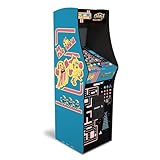
- Classic Arcade Experience: Enjoy 12 legendary games from 1981 on a full-size cabinet with real-feel joysticks, buttons, and authentic arcade-style gameplay
- Vibrant 17" Display: Features a crisp BOE 17" LCD screen that brings retro graphics to life with bright colors and sharp details for immersive gaming fun
- Wi-Fi Leaderboards: Connect to Wi-Fi and compete with players nationwide by posting high scores on global leaderboards—no subscription required
- Premium Retro Design: Over 5 feet tall with a sleek cabinet, light-up marquee, and faux coin door for a nostalgic look that enhances any game room or space
- Crisp Stereo Sound: Dual speakers deliver classic arcade soundtracks and effects just like you remember, bringing every game to life with rich audio
Where Exzisus appeared after the arcade
Arcade History lists Exzisus in two later compilation lines: Taito Legends on PlayStation 2 and Windows, and Taito Memories II Joukan on PlayStation 2. The Windows Taito Legends manual confirms that Exzisus is included and provides menus for game descriptions, controls, options, high scores, hints and tips, and gamepad setup.
| Version | Platform | What is documented | Current status |
|---|---|---|---|
| Original arcade board | Arcade PCB or Taito conversion kit | Horizontal standard-resolution cabinet; alternating two-player support | Availability, price and restoration condition are not established |
| Taito Legends | PlayStation 2 | Compilation includes Exzisus | Historical release; check region, disc condition and console compatibility |
| Taito Legends | Windows | Compilation includes Exzisus; manual documents controls and gamepad setup menus | Historical release; modern operating-system compatibility is not established |
| Taito Memories II Joukan | PlayStation 2 | Compilation listing includes Exzisus | Historical release; check regional hardware and software requirements |
Taito’s 2021 announcement for the Egret II Mini lists its included games and expansion set; Exzisus is not on those published lists. That omission describes that product line only and is not a guarantee about every later Taito release. No current official Exzisus release, retailer stock, price or platform compatibility has been verified.
Independent reader supportYour contribution helps us test, update, and keep practical guides available for everyone.How to choose a way to play
If you want the original arcade behavior
Look for a documented Exzisus PCB or Taito conversion kit and verify the board’s region and revision. Confirm that the cabinet has a horizontal, standard-resolution display and that the control panel provides an eight-way joystick and two buttons. Because the historical record identifies version differences, photograph board markings and compare the power-up set before treating a cabinet as a specific release.
If you want the easiest documented home version
The historically specific search phrase is “Taito Legends PS2,” because that compilation is documented to include Exzisus. Before buying, confirm the disc region, the console’s regional compatibility and whether the package is complete. A Windows copy likewise requires checking the original system requirements and whether the game runs on the reader’s current operating system; modern compatibility was not established in the available records.
If you are comparing compilations
Use three practical checks:
- Platform: choose arcade PCB, PlayStation 2 or Windows according to the hardware you already have.
- Region and license: distinguish Japanese Taito releases from TAD-licensed exports and region-specific compilation discs.
- Condition and compatibility: verify disc or board condition, console region, display requirements and controller support before purchasing.
There is no verified current listing price or guaranteed source of supply, so availability should be checked at the time you shop rather than assumed from the historical release lists.
A practical first-play routine
- Identify the version. Note whether you are using an arcade board, a conversion kit or a compilation. This determines which power-up letters and regional presentation you may see.
- Set the controls. On the arcade machine, confirm the joystick moves in eight directions and test both buttons. On the Windows compilation, open the gamepad-setup menu documented by the manual.
- Start with survival. Keep the craft aligned with the horizontal route, use the regular shot for approaching enemies and reserve missiles for targets that require the second attack.
- Read each letter before collecting it. L, D, M, F, A and O have distinct recorded roles; B may be absent on your version. Do not assume a letter has the same behavior across every regional board.
- Watch the powered state. After a hit, the documented rule returns Exzisus to regular humanoid form. Rebuild your attack rather than expecting the previous powered configuration to remain.
- For two-player sessions, alternate deliberately. The cabinet record describes turns, not simultaneous co-op. Treat the first player’s run as complete before handing over the controls.
Common points of confusion
“Multi-screen” versus horizontal scrolling
A wide horizontal playfield can be mistaken for a multi-screen cabinet, especially in photographs or videos that show the entire cabinet and its bezel. The documented Exzisus cabinet has a horizontal monitor, but no verified second display.
Four Z80 CPUs versus four screens
CPU count is an internal hardware specification. It does not reveal the number of monitors, so the four-Z80 listing should not be used to support a dual-screen claim.
Alternating play versus co-op
Two maximum players means two people can play the machine, while one simultaneous player means only one is active at any moment. It is not evidence of two ships operating together.
The Tool Desk
Outbyte Driver Updater FREEScan for outdated or missing drivers - takes under a minuteDriver Scan →Outbyte PC Repair FREEClear out junk files and repair common Windows errorsFree Scan →Barrier appearing on every release
Barrier is specifically qualified as appearing in some versions. If a cabinet lacks the B power-up, that may reflect a legitimate regional or revision difference rather than a fault.
What is firmly established—and what remains unknown
- Established: Exzisus is a 1987 Taito horizontal side-scrolling space shooter with an eight-way joystick, two buttons, missiles, helper robots and lettered power-ups.
- Established: The standard cabinet record describes one horizontal, standard-resolution raster display and alternating two-player turns.
- Established: Japanese, conversion-kit and TAD-licensed export entries are recorded, as are later PlayStation 2 and Windows compilations.
- Not established: A multi-monitor cabinet, a complete board-by-board regional feature list, current official availability, current pricing or modern Windows compatibility.
That distinction resolves the title’s central problem: Exzisus is historically well documented as a horizontal Taito shooter, while “multi-screen” remains an unsupported description rather than a confirmed hardware feature.
Quick Recap
Product prices and availability are accurate as of the date/time indicated and are subject to change. Any price and availability information displayed on Amazon at the time of purchase will apply.

