Recommended Free Tools
Verdict: The Ryzen 5 7600X was the better launch-era gaming value, while the Ryzen 7 7700X was the stronger all-rounder for gaming combined with streaming, compiling, rendering, encoding, and heavy multitasking. Both delivered a major Zen 4 performance uplift, but their early value was weakened by the cost of moving to AM5, DDR5, and a separate CPU cooler.
This is a historical review of AMD’s mainstream Zen 4 desktop launch. The processors debuted on September 27, 2022, and the original review was published on November 23, 2022. Their launch conclusions should not be confused with an automatic 2026 buying recommendation.
As an Amazon Associate I earn from qualifying purchases.
Ryzen 5 7600X vs. Ryzen 7 7700X: the short answer
Choose the Ryzen 5 7600X for a gaming-focused AM5 build when it is meaningfully cheaper than the 7700X and the saved money can improve the graphics card, SSD, or monitor. Choose the Ryzen 7 7700X when you also stream, record, compile, render, encode video, run virtual machines, or routinely multitask while gaming.
The 7700X is not automatically much faster in games. Its two additional cores and four additional threads matter most in workloads that scale beyond six cores. At 1440p and 4K, the graphics card commonly limits performance and narrows the gaming difference between the chips.
#1 Best Overall

- The Socket AM5 socket allows processor to be placed on the PCB without soldering
- Ryzen 5 product line processor for your convenience and optimal usage
- 5 nm process technology for reliable performance with maximum productivity
- Hexa-core (6 Core) processor core helps processor process data in a dependable and timely manner with maximum productivity
- 6 MB L2 plus 32 MB L3 cache memory provides excellent hit rate in short access time enabling improved system performance
The bigger launch-era problem was platform cost. Both CPUs required an AM5 motherboard and DDR5 memory, and neither included a boxed cooler. Intel’s competing systems could use less-expensive DDR4, while existing AM4 owners could upgrade their CPU without replacing the motherboard and memory. HotHardware’s review identified this complete-system cost as the central value concern.
Specifications
| CPU | Cores / threads | Base clock | Max boost | Total cache | Default TDP | Launch price |
|---|---|---|---|---|---|---|
| Ryzen 5 7600X | 6 / 12 | 4.7 GHz | Up to 5.3 GHz | 38 MB | 105W | $299 |
| Ryzen 7 7700X | 8 / 16 | 4.5 GHz | Up to 5.4 GHz | 40 MB | 105W | $399 |
Both are unlocked Zen 4 processors for the AM5 socket. They use TSMC 5nm compute dies and a 6nm I/O die, support DDR5 memory, PCIe 5.0, AMD EXPO memory profiles, Precision Boost Overdrive, Curve Optimizer, and include basic integrated Radeon graphics. Neither processor includes a boxed cooler. See AMD’s official Ryzen 7 7700X specifications and launch announcement.
What Zen 4 changed
Zen 4 raised performance through higher clock speeds, architectural refinements, and a claimed average IPC improvement of approximately 13 percent over Zen 3. IPC varies by workload, so that figure is not a universal performance multiplier. AMD also doubled L2 cache per core compared with earlier Ryzen generations and moved the compute dies to TSMC’s 5nm process.
Free tools Windows power users keep installed
One-click scans. No signup required.
The platform changes were just as important as the CPU design. Ryzen 7000 introduced:
Rank #2

- Pure gaming performance with smooth 100+ FPS in the world's most popular games
- 6 Cores and 12 processing threads, based on AMD "Zen 5" architecture
- 5.4 GHz Max Boost, unlocked for overclocking, 38 MB cache, DDR5-5600 support
- For the state-of-the-art Socket AM5 platform, can support PCIe 5.0 on select motherboards
- Cooler not included
- AM5: a new socket replacing AM4.
- DDR5-only desktop memory: AM5 boards do not accept reusable AM4 DDR4 modules.
- PCIe 5.0: useful for future storage and expansion devices, although the practical benefit depended on the motherboard and available hardware.
- Integrated graphics: useful for display output and troubleshooting, but not a replacement for a discrete gaming GPU.
- AVX-512 support: beneficial only in software that uses the instruction set.
AMD positioned AM5 as a longer-lived platform, promising support “through 2025 and beyond.” That was a platform direction, not a guarantee that every AM5 board would support every later CPU. Firmware, chipset, VRM capability, and vendor support still matter.
7600X and 7700X performance
The review tested processor and system performance across Cinebench, POV-Ray, Blender, Y-Cruncher, audio and video encoding, gaming, and power consumption. Those tests stress different parts of a CPU, so no single result defines either chip.
Rendering and sustained workloads
The 7700X’s eight cores and 16 threads gave it the obvious advantage in rendering, encoding, compiling, and other sustained multithreaded work. HotHardware reported that it performed impressively in Cinebench, approaching the Ryzen 9 5900X and Core i5-13600K in that test while beating the Core i5-12600K. The full application results also show why software matters: Zen 4 was generally strong in single-threaded work, but POV-Ray was less favorable to it.
The 7600X remained a capable six-core processor for ordinary desktop work and many creative applications. It was not the sensible choice for users whose primary workload was heavily threaded rendering or simulation. Neither chip matched the throughput of Ryzen 9 processors with 12 or 16 cores.
Rank #3

- Pure gaming performance with smooth 100+ FPS in the world's most popular games
- 6 Cores and 12 processing threads, based on AMD "Zen 4" architecture
- 5.3 GHz Max Boost, unlocked for overclocking, 38 MB cache, DDR5-5200 support
- AMD AM5 Socket: Supports AMD Ryzen 7000 Series Processors
- DDR5 Compatible: 4*DIMMs with AMD EXPO & Intel XMP Memory Module Support
Gaming
Zen 4’s high single-threaded performance made both CPUs strong choices for CPU-limited games. The 7600X was particularly attractive with a high-end graphics card at 1080p or high refresh rates. Six cores were sufficient for mainstream gaming at launch; describing the chip as inadequate simply because the 7700X had more cores would be misleading.
The 7700X supplied more background-task and future-workload headroom, but its extra cores did not guarantee a proportional frame-rate gain. At 1440p and especially 4K, GPU limits often dominate. Average FPS also does not tell the whole story: frame-time consistency and 1% lows depend on the game, software version, memory settings, graphics card, and background activity.
For the review’s game results and power discussion, see HotHardware’s gaming and verdict page. Later X3D processors changed the gaming-value hierarchy, so these launch results should not be treated as a current ranking.
What’s actually slowing this PC down?
Pick the symptom - the matching free tool is one click away.
Power, temperature, and cooling
Both processors have a 105W default TDP and a specified maximum operating temperature of 95°C. TDP is not the same thing as wall power or guaranteed heat output. Actual package power depends on the workload, motherboard limits, BIOS, memory settings, and boost behavior.
Rank #4
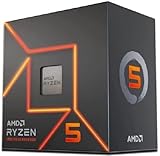
- POWERFUL GAMING STARTS HERE
- 6 Cores and 12 processing threads, based on AMD "Zen 4" architecture
- 5.2 GHz Max Boost, unlocked for overclocking, 38 MB cache, DDR5 support
- For the state-of-the-art Socket AM5 platform, can support PCIe 5.0 on select 600 Series motherboards
- AMD Wraith Stealth cooler included
AMD recommends a premium air cooler for optimal 7700X performance, and an aftermarket cooler is appropriate for either chip, particularly under sustained all-core loads or with Precision Boost Overdrive enabled. A processor reaching its specified temperature target is not automatically defective; boost algorithms can use available thermal headroom. The “up to 5.3 GHz” and “up to 5.4 GHz” figures are maximum boost specifications, not guaranteed all-core clocks.
HotHardware observed relatively high idle power with its X670E test platform. That result should not be generalized to every AM5 motherboard: idle power varies considerably with board design, firmware, memory configuration, connected devices, and measurement method.
Independent reader supportYour contribution helps us test, update, and keep practical guides available for everyone.AM5 platform cost was the real launch trade-off
The CPU price was only the beginning of the purchase:
- AM5 motherboard
- DDR5 memory
- Aftermarket CPU cooler
- Possibly thermal compound and BIOS-flashback capability
That made the correct comparison a complete build rather than a CPU-versus-CPU calculation:
Best Value

- Raphael AM5 6-Core Desktop Processor
- 6MB L2, 96MB L3 Cache, 6 Cores, 12 Threads
- AMD A620, B650, B650E, B840, B850, X670, X670E, X870, X870E Chipsets
- 128GB DDR5-5200 Memory Supported
- Heatsink Not Included
Complete 7600X AM5 system versus complete 7700X AM5 system versus Intel DDR4 system versus an existing AM4 upgrade.
AM5 offered PCIe 5.0, DDR5, integrated graphics, EXPO support, and a prospective upgrade path. However, a buyer with a strong Ryzen 3000 or Ryzen 5000 system had to account for the cost of replacing a functioning motherboard and memory. In some cases, an AM4 CPU upgrade delivered better value even if the new Zen 4 processor was faster.
USB 4, the number of USB ports and M.2 slots, networking, VRM quality, and expansion layout are motherboard-dependent. They should not be assumed merely because the CPU supports AM5.
Which processor should you choose?
| Use case | Better fit | Reason |
|---|---|---|
| Pure gaming on a budget | Ryzen 5 7600X | Strong gaming performance while leaving more budget for the GPU. |
| Gaming plus streaming or recording | Ryzen 7 7700X | Extra cores provide more multitasking headroom. |
| Rendering, encoding, or compiling | Ryzen 7 7700X | Eight cores and 16 threads are better suited to sustained parallel workloads. |
| Existing AM4 owner | Compare an AM4 upgrade first | Keeping the board and DDR4 memory may be substantially cheaper. |
| High-end GPU at 1080p | Either | Choose based on the price gap and whether background workloads matter. |
| Long-term AM5 plan | Either | The 7700X offers more immediate thread headroom; the 7600X lowers entry cost. |
Important buying checks
- Memory: Buy DDR5. AM5 is not compatible with AM4 DDR4 memory.
- BIOS: Check the motherboard’s CPU support list and required firmware version.
- Cooler: Confirm AM5 mounting hardware. Many AM4 coolers are reusable, but not all are.
- Integrated graphics: The basic Radeon GPU is for display output and troubleshooting, not serious gaming.
- Current value: Do not reuse the original $299/$399 launch comparison as a 2026 price judgment. Retail pricing, availability, tax, and newer CPUs must be checked at publication time.
For buyers considering newer AM5 processors, compare the complete system. A reasonably priced X3D chip may be preferable for gaming, while a newer eight-core processor may offer better performance or efficiency. The right choice depends on the price gap, motherboard BIOS support, and whether the workload is gaming-first or productivity-first.
Final verdict
As mainstream Zen 4 processors at launch, the Ryzen 5 7600X and Ryzen 7 7700X were fast, capable, and technologically significant. The 7600X was the sharper gaming-value option; the 7700X was the better mixed-use eight-core CPU. Their weakness was the cost of entry into AM5, not a lack of CPU performance.
For a new system in late 2022, the 7600X made the most sense when gaming dominated and the price difference funded a better GPU. The 7700X justified its premium for sustained multithreaded work and heavier multitasking. In 2026, treat both as historical Zen 4 options and compare their total platform cost against newer CPUs and available X3D alternatives rather than relying on their launch verdict alone.
Quick Recap
Product prices and availability are accurate as of the date/time indicated and are subject to change. Any price and availability information displayed on Amazon at the time of purchase will apply.




