Recommended Free Tools
Verdict: The ASUS TUF Gaming VG34VQL1B remains a strong value if you want a 34-inch 3440×1440 ultrawide with deep VA contrast, adaptive sync, and refresh rates up to 165Hz. It is especially appealing around $250–$300 for RPGs, racing games, simulations, strategy titles, and general desktop use. However, visible dark-scene smearing keeps it from being a top choice for competitive shooters, while its DisplayHDR 400 support delivers limited—not premium—HDR.
ASUS’s U.S. store recently displayed the monitor at $299, but price, stock, warranty terms, and return rights can change. Treat that figure as a dated price signal rather than a permanent MSRP. Check ASUS’s current listing before buying.
As an Amazon Associate I earn from qualifying purchases.
ASUS TUF Gaming VG34VQL1B: specifications at a glance
| Specification | Detail |
|---|---|
| Screen | 34-inch, 21:9 ultrawide |
| Resolution | 3440×1440 |
| Panel | VA |
| Curve | 1500R |
| Refresh rate | 144Hz native; up to 165Hz through DisplayPort overclocking |
| Adaptive sync | AMD FreeSync Premium; ASUS documents Adaptive-Sync compatibility with supported NVIDIA GPUs |
| HDR | VESA DisplayHDR 400 / HDR10-class support |
| Response claim | 1ms MPRT with ASUS ELMB; not a guarantee of universally fast pixel transitions |
| Connectivity | Two HDMI inputs, two DisplayPort inputs, and an integrated USB hub |
| Extra features | PIP/PBP, Variable OD, ELMB, GameVisual, GamePlus, Shadow Boost, blue-light filter |
See the official ASUS specifications and user manual for regional details and operating limitations.
The Tool Desk
Outbyte PC Repair FREERepair Windows errors before they cause bigger problemsFix Now →Outbyte Driver Updater FREEScan for outdated or missing drivers - takes under a minuteDriver Scan →Who should buy it?
- Buy it if you want a large, immersive 3440×1440 display at a discount and value contrast more than perfect motion clarity.
- Buy it for RPGs, racing and flight simulators, strategy games, exploration, cinematic games, and mixed gaming and work.
- Compare alternatives if you mainly play fast competitive shooters, need wide viewing angles, expect impressive HDR, require USB-C video, or plan to use it primarily with a console.
At roughly $250–$300, it is a strong buy. Around $300–$350, the decision becomes conditional on how much you value VA contrast and the ultrawide format. Above $350, faster IPS, Mini-LED, or discounted OLED options may offer better value, depending on current pricing.
#1 Best Overall

- Immersive Curved Display: 34-inch WQHD (3440x1440) 1500R curved gaming monitor with ultra-fast 165Hz (supports 144Hz) refresh rate designed for professional gamers and immersive gameplay
- Ultra-Fast Response Time: ASUS Extreme Low Motion Blur (ELMB ) technology enables a 1ms response time (MPRT) to eliminate ghosting for sharp gaming visuals at high frame rates
- Smooth Gaming Performance: FreeSync Premium technology to eliminate screen tearing and choppy frame rates
- Enhanced Visual Quality: High Dynamic Range (HDR) technology with professional color gamut delivers contrast and color performance that meets the DisplayHDR 400 certification
- Versatile Connectivity Options: Extensive connectivity with DisplayPort 1.4 x2, HDMI (v2.0) x2, USB Hub ports
Design, curve, stand, and connectivity
The 1500R curve suits the wide 21:9 panel, bringing the edges into your peripheral vision without making the screen feel excessively bent. The 3440×1440 resolution also gives you useful room for a game, chat window, browser, or monitoring tools side by side.
The stand provides height and swivel adjustment, but independent testing found the overall ergonomics less impressive than the monitor’s gaming feature list. A monitor arm can help, provided its VESA compatibility and weight rating match the display. The supplied manual lists two HDMI and two DisplayPort inputs, plus a USB hub and PIP/PBP support. There is no USB-C video input indicated in the supplied documentation, so this is not a single-cable laptop-docking monitor.
DisplayPort is the connection to try first if you want the highest refresh mode. Your graphics card, cable, output settings, and game performance still determine whether 165Hz is practical.
What’s actually slowing this PC down?
Pick the symptom - the matching free tool is one click away.
Image quality: excellent contrast, ordinary VA compromises
The VA panel’s main strength is contrast. In a dim room, dark scenes look substantially deeper than they typically do on a fast IPS monitor, making games and ultrawide films more immersive. Reflection handling and brightness are suitable for many bright rooms as well, according to RTINGS’ testing.
Text is reasonably sharp at 3440×1440 on a 34-inch screen, and the extra horizontal space is genuinely useful for office work, timelines, spreadsheets, and multitasking. The limitations are typical of VA technology: viewing angles are narrower than IPS, so the sides can look less consistent when viewed from off-center. The curve may also be unsuitable for workflows that demand perfectly flat geometry.
Rank #2

- Ultra-Wide QHD Curved Display: 34-inch QHD (3440x1440) 1500R curved gaming monitor with ultra-fast 180Hz refresh rate designed for immersive gameplay
- Fast Response Time and Motion Blur Reduction: 1ms MPRT response time for smooth gameplay, and ASUS Extreme Low Motion Blur (ELMB ) SYNC technology to further reduce ghosting and motion blur
- FreeSync Premium Technology: Delivers a seamless, tear-free gaming experience by enabling VRR (variable refresh rate) by default
- High Dynamic Range and Color Performance: HDR technology with professional color gamut covering 90% of the DCI-P3 color space delivers enhanced contrast and color performance
- Complete Package Contents: DisplayPort cable, USB Type-B to A cable, L-shaped Screwdriver, Power cord, Quick start guide, and Warranty Card included in the box
The monitor’s wide color coverage can make games and media look more saturated, but a wide gamut is not the same as accurate factory calibration. For professional photo or video work, use a colorimeter and a color-managed workflow. Uniformity, clouding, backlight bleed, and gray performance can vary between individual units; RTINGS specifically cautions against treating every result from one sample as a guarantee for every panel.
Gaming performance
3440×1440 and up to 165Hz
3440×1440 provides a wider field of view than a conventional 16:9 monitor in games that support ultrawide resolutions. It is particularly effective for racing, simulation, open-world, strategy, and cinematic games. The trade-off is GPU load: driving 4.95 million pixels at high frame rates requires considerably more graphics power than 1080p or standard 1440p.
144Hz already feels much smoother and more responsive than 60Hz or 75Hz. The advertised 165Hz mode is an overclocked DisplayPort mode, not the panel’s native refresh rate. ASUS notes that the mode depends on the graphics card, source output, and content. You may also need to choose between 165Hz and 10-bit output: RTINGS reports that 10-bit over DisplayPort is limited to 144Hz in its testing.
The black-smearing problem
Dark-scene motion is this monitor’s defining weakness. VA pixels commonly take longer to transition between dark shades, producing a dark trail behind moving objects against dark backgrounds. On the VG34VQL1B, RTINGS found visible black smearing across overdrive settings.
You may notice it while turning quickly through a dark game, scrolling bright text on a dark page, or tracking a moving object against a shadowy background. It can be barely relevant in a slower RPG and immediately distracting in a competitive shooter. Stronger overdrive does not solve the underlying limitation: it can reduce some trailing while adding bright or colored overshoot, particularly at lower refresh rates.
Rank #3

- Immersive Curved Gaming Display: 31.5-inch WQHD (2560x1440) 1500R gaming monitor with ultrafast 165Hz refresh rate (supports 144Hz) designed for professional gamers and immersive gameplay
- Extreme Low Motion Blur Technology: ASUS ELMB technology enables a 1ms response time (MPRT) together with Adaptive-sync, eliminating ghosting and tearing for sharp gaming visuals with high frame rates
- FreeSync Premium Support: Variable refresh rates through DisplayPort and HDMI ports provide low latency, stuttering-free and tearing-free performance while gaming
- Shadow Boost Enhancement: Enhances image details in dark areas, brightening scenes without over-exposing bright areas for better visibility during gameplay
- HDR-10 Support: Supports HDR-10 to enhance bright and dark area contrast, delivering lifelike gaming visuals and improved color accuracy
That makes the VG34VQL1B fast enough for most casual and enthusiast gaming, but not a motion-performance leader. A fast IPS ultrawide is a better fit if clean transitions matter more than black levels.
Adaptive sync, ELMB, and possible VRR flicker
FreeSync Premium and Adaptive-Sync can reduce tearing when frame rates fluctuate. ASUS documents Adaptive-Sync compatibility with NVIDIA GeForce GTX 10-series, GTX 16-series, RTX 20-series, and newer GPUs. That is manufacturer-stated compatibility; it should not automatically be described as formal G-SYNC certification.
ELMB and ELMB Sync are intended to reduce perceived motion blur, but backlight strobing can reduce brightness or introduce artifacts and generally works best over a narrower refresh-rate range. It does not eliminate VA response-time limitations, so test it separately from ordinary adaptive sync.
Some owners have reported VRR brightness flicker, but those reports are anecdotal rather than evidence of a known failure rate. To test your unit, enable Adaptive-Sync, play something with a highly variable frame rate, and look for brightness pulsing in dark areas. Disable VRR and repeat the scene. If the flicker disappears, you may prefer fixed refresh or a narrower frame-rate range.
HDR: usable, but not a reason to buy it
The VG34VQL1B supports DisplayHDR 400-class HDR and HDR10-compatible content. Its high native VA contrast and wide color coverage can make HDR games look more saturated and give some highlights extra impact, particularly in a dark room.
Outdated Drivers Are Slowing You Down
One free scan finds every outdated or missing driver and matches the right update for your exact hardware.Free scan · exact hardware matchWindows Errors? Fix Them Before They Spread
Repair common Windows errors and clear accumulated junk for a smoother, more stable PC - no reinstall needed.Free scan · no reinstallRank #4
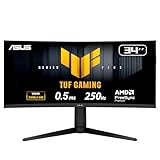
- Ultra Wide QHD Curved Display: 34-inch WQHD (3440 x 1440) 1500R curved gaming monitor with overclock to 250Hz refresh rate designed for professional gamers and immersive gameplay
- Fast Response Time: 0.5ms(min) response time to further reduce ghosting creates fluid gaming experience
- FreeSync Premium Pro Technology: Delivers a seamless, tear-free gaming experience by enabling VRR (variable refresh rate) by default
- ASUS Extreme Low Motion Blur Sync: ELMB SYNC technology enables ELMB together with variable refresh rate, eliminating ghosting and tearing for sharp gaming visuals with high frame rates
- High Dynamic Range Support: HDR technology with DisplayHDR 400 compliance supports HDR-10 format to enhance bright and dark areas
But HDR400 is an entry-level implementation. There is no local dimming, so the monitor cannot brighten a small highlight while keeping the surrounding black area truly dark. Bright objects can therefore look less dramatic, and HDR will not approach the contrast, highlight control, or black levels of a good OLED or Mini-LED display.
For ordinary desktop work, SDR will usually be the more consistent choice. In Windows HDR mode, the desktop may look washed out or overly bright depending on system configuration. HDR is more worthwhile when you are actually playing an HDR game or watching HDR video in a dark room. If 10-bit color is more important than the final few hertz, 144Hz may be preferable to 165Hz depending on your GPU and connection.
Office work and content creation
This monitor is a capable hybrid display. The ultrawide canvas accommodates two windows comfortably, while the resolution is sharp enough for normal text and productivity. The curve is helpful for immersive use and timelines, though users who share the screen frequently may prefer IPS viewing angles.
For content creation, it is well suited to video timelines, editing interfaces, general photography, and non-critical creative work. It is less suitable as the sole reference display for color-critical production because of VA viewing-angle behavior, possible unit-to-unit uniformity differences, and the need for calibration.
Free tools Windows power users keep installed
One-click scans. No signup required.
Console compatibility
Do not treat this as a universal console monitor. In RTINGS’ testing, the PS5 supported 1440p output, but PS5 variable refresh rate was not compatible with the monitor’s tested adaptive-sync behavior. RTINGS also found that Xbox Series X|S did not support 1440p at 120Hz on the tested display.
Best Value

- 34-inch WQHD (3440x1440) 1500R curved gaming monitor with ultra-fast 165Hz (supports 144Hz) refresh rate designed for professional gamers and immersive gameplay
- ASUS Extreme Low Motion Blur (ELMB ) technology enables a 1ms response time (MPRT) to eliminate ghosting for sharp gaming visuals at high frame rates
- FreeSync Premium technology to eliminate screen tearing and choppy frame rates
- High Dynamic Range (HDR) technology with professional color gamut delivers contrast and color performance that meets the DisplayHDR 400 certification
- Extensive connectivity with DisplayPort 1.4 x2, HDMI (v2.0) x2, USB Hub ports
Those results can depend on firmware, cables, console updates, and test configuration, so verify the exact mode you need before buying. If console gaming is your priority, favor a monitor with explicitly confirmed support for your console’s resolution, refresh rate, and VRR standard.
Useful OSD features and setup
The monitor’s center button on the five-way control opens the on-screen display. The manual places Variable OD under Gaming → Variable OD and documents a 0–100 adjustment range.
- Connect through DisplayPort if you want to test the 165Hz overclocked mode.
- Choose 144Hz or 165Hz based on whether you prioritize 10-bit output or maximum refresh, and confirm what your GPU exposes.
- Enable FreeSync or Adaptive-Sync on the monitor and in your graphics driver.
- Open Gaming → Variable OD and test several levels in actual games.
- Use the lowest setting that reduces trailing without producing obvious bright or colored halos.
- Repeat the test at the frame rates you actually use—such as 60Hz, 100Hz, 144Hz, and 165Hz. There is no universally correct overdrive number for every unit and refresh range.
- Use Shadow Boost sparingly. It can reveal details in dark areas, but lifting black tones reduces the contrast that makes this monitor attractive.
- Leave HDR off for normal desktop use if the image looks worse, and enable it for HDR games or video when the result is visibly better.
GamePlus supplies a crosshair, timer, FPS counter, and display alignment tools. GameVisual offers seven presets. PIP/PBP can show multiple sources, and the blue-light filter offers up to a stated 70% reduction. The USB hub can be enabled or disabled during standby, and holding the down button for more than five seconds toggles Key Lock.
How it compares with alternatives
| Choose this type | Why | What you give up |
|---|---|---|
| ASUS VG34VQL1B | High contrast, ultrawide immersion, broad gaming features, and value pricing | Dark smearing, narrower viewing angles, and limited HDR |
| Fast IPS ultrawide | Cleaner motion and wider viewing angles; the LG 34GN850-B is an example of this positioning | Usually weaker contrast and less convincing blacks |
| Gigabyte G34WQC or AOC CU34G2X | Comparable budget VA concepts | Differences in refresh rate, response behavior, brightness, and ergonomics; compare current prices |
| Dell S3422DWG | Credible VA alternative with different response and uniformity characteristics | The ASUS offers slightly higher refresh and higher contrast in RTINGS’ comparison |
| OLED ultrawide | Much faster motion, perfect black levels, and stronger HDR contrast | Higher cost and burn-in considerations |
| Mini-LED ultrawide | Higher HDR brightness and local dimming | Higher cost and possible blooming |
RTINGS’ comparison with the LG 34GN850-B captures the central choice: the LG is better for motion clarity and viewing angles, while the ASUS offers stronger contrast, wider gamut, and a value-oriented feature set. Current pricing and availability should determine whether those differences justify switching.
Buying advice and panel checks
Because this is an older model, avoid relying on launch-era prices. Confirm the live price, stock, warranty, and return policy—especially for open-box or refurbished units. A return window matters because uniformity, clouding, backlight bleed, and dead pixels can vary between samples.
After installation, inspect a black screen in a dark room, a gray screen for uneven patches, bright red/green/blue screens for stuck pixels, and dark-scene gameplay for smearing. Also test your intended refresh rate, HDR mode, adaptive sync, and console resolution before the return deadline expires.
Final verdict
The ASUS TUF Gaming VG34VQL1B is still a sensible bargain ultrawide, not a universally excellent gaming monitor. Its 3440×1440 format, deep VA contrast, 1500R curve, 144Hz native refresh, 165Hz DisplayPort overclock, adaptive sync, USB hub, and useful OSD controls make it versatile and immersive.
Its black smearing is the unavoidable compromise. If you mostly play cinematic or slower-paced games and can buy it near $300 or below, the VG34VQL1B is easy to recommend. If you play competitive shooters, demand premium HDR, need USB-C, or want reliable console VRR and 120Hz support, spend more on a faster IPS, OLED, Mini-LED, or a console-focused model instead.
Quick Recap
Product prices and availability are accurate as of the date/time indicated and are subject to change. Any price and availability information displayed on Amazon at the time of purchase will apply.




