The Tool Desk
Outbyte Driver Updater FREEScan for outdated or missing drivers - takes under a minuteDriver Scan →Outbyte PC Repair FREEClear out junk files and repair common Windows errorsFree Scan →Yes—but the headline needs an important correction. The documented project runs Command & Conquer: Red Alert, the 1996 real-time strategy game, on a Pimoroni Pico Plus 2 W. That is a Pico 2-class board built around the RP2350B, not the ordinary Raspberry Pi Pico 2 used by itself.
The experimental port uses extra PSRAM, larger flash storage, an SD card and dedicated VGA hardware. Missions have been completed and multiplayer has reportedly been tested between two Pico devices, but this is not a finished, plug-and-play release—and it does not mean that the entire Command & Conquer franchise runs on a Pico.
As an Amazon Associate I earn from qualifying purchases.
What was actually ported?
The demonstrated game is Command & Conquer: Red Alert, rather than every game carrying the Command & Conquer name. The result should not be confused with Red Alert 2, Tiberian Sun, Generals or the Command & Conquer Remastered Collection.
The public source fork also contains work related to the original Command & Conquer, commonly known as Tiberian Dawn. However, the Pico milestone reported by Hackaday centers on Red Alert.
#1 Best Overall

- The Raspberry Pi Pico is a beginner-friendly microcontroller board that uses MicroPython to give you a taste of the Internet of Things and microcontrollers. The RP2040 is a well-designed microprocessor that can be utilized in almost any Internet of Things project. It has enough power to complete the task quickly.
- 【Raspberry Pi RP2040 Microcontroller】Raspberry Pi Pico features Dual-core ARM Cortex M0+ processor, flexible clock running up to 133 MHz. With 264KB of SRAM, and 2MB of on-board Flash memory.Supports up to 16 MB of off chip flash memory via a dedicated QSPI bus
- 【Multiple Software Support】Pico has rich and complete software support, it comes with a complete Rasberry Pi official C/C++ SDK, Micropython SDK.The programming and burning of Pico need to be carried out on the computer. Supported operating systems and computers include:Raspberry Pie with Raspberry Pi OS,Other platforms equipped with Debian based Linux system Computer with MacOS, Computers with Windows, etc.
- 【Rich Hardware Interface】Raspberry Pi Pico has 30 GPIO pins, 4 pins for analog signal input and 26 × multi-function GPIO pins, 2 × SPI, 2 × I2C, 2 × UART, 3 × 12-bit ADC, 16 × controllable PWM channels.USB 1.1 supported by host and device, The installation mode can be flexibly selected by users to facilitate welding with other development boards.
- 【Build Project in Tiny Size】Only 2.1cm*5.1cm ( as small as your thumb). Pico has been designed to use either soldered 0.1" pin-headers or can be used as a surface-mountable 'module'.
This is a source-level port, not an emulator running the original Windows executable. The engine has been adapted to a new processor, storage system, display path and input environment.
Why an embedded port is possible
Electronic Arts released source code for several classic Command & Conquer games under the GPLv3. That gave developers the legal and technical foundation to adapt the engine to operating systems and architectures that did not exist when the games were written.
The Pico project is based on EA’s public Red Alert repository and additional portability work in the Daft-Freak fork. A 2D strategy game from the 1990s is also a more realistic embedded target than a modern 3D title: its rendering workload and general hardware expectations are far smaller, even though its legacy code and asset requirements remain substantial.
Open-source engine code does not automatically include every original commercial asset. Game data files, distribution rights and licensing obligations remain separate. Anyone reproducing the project should obtain the required data through legitimate means and follow the applicable licenses.
The hardware behind the demonstration
The most important detail is the board choice. The setup described in the report used a Pimoroni Pico Plus 2 W, not an unmodified official Pico 2.
Rank #2
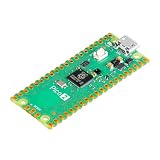
- Note: The Pico 2 comes with no program by default, so you won’t see any lights when plugged in. Please upload a simple blink program to verify it's working.
- High-Performance RP2350 Chip: Dual-core Arm Cortex-M33 with FPU and Hazard3 RISC-V cores, delivering double the speed and flexibility of the RP2040.
- Increased RAM: Equipped with 520 KB of on-chip RAM, facilitating efficient data handling for complex applications.
- Expanded Flash Storage: Provides 4 MB of onboard flash memory, suitable for storing extensive codebases and data.
- Backward Compatibility: Maintains full compatibility with the existing Pico ecosystem, ensuring a smooth transition for users upgrading from previous models.
| Hardware | Role in the project |
|---|---|
| Raspberry Pi Pico 2 | Official RP2350 development board and useful low-cost comparison point, but not established as a drop-in replacement for this port. |
| Pimoroni Pico Plus 2 W | Documented board used for the Red Alert work. It is based on the RP2350B and adds 8 MB of PSRAM, 16 MB of flash and wireless hardware. |
| SD card | Stores game data that cannot simply be placed in the microcontroller’s internal memory. |
| Pimoroni Pico VGA Demo Base | Provides the reported VGA output arrangement and an integrated SD-card slot. |
Raspberry Pi lists the standard Pico 2 from $5 and specifies an RP2350 with dual Arm Cortex-M33 or dual Hazard3 RISC-V cores, clocked at up to 150 MHz, plus 520 KB of on-chip SRAM. Those specifications make the board interesting for experimentation, but the $5 figure is not the cost of reproducing the reported setup.
The extra memory on the Pico Plus 2 W is central to the story. A PC game makes assumptions about available RAM and file access that do not map neatly onto a microcontroller with only a small amount of internal SRAM. PSRAM and SD storage provide room for a more practical adaptation, while flash holds firmware and other resources.
Free tools Windows power users keep installed
One-click scans. No signup required.
What works—and what remains unknown?
The reported project progressed from barely booting to completing missions. Multiplayer was also demonstrated between two Pico devices. Those are meaningful milestones, but they do not prove full compatibility with every campaign, cutscene, sound function, save system or networking mode.
| Feature | Current evidence or status |
|---|---|
| Red Alert starts | Demonstrated. |
| Menus | Supported by the underlying portable fork. |
| Campaign missions | Some missions have been completed. |
| Full campaign | Not verified. |
| VGA output | Demonstrated with Pico VGA hardware. |
| SD-card game data | Required in the documented setup. |
| Multiplayer | Reported between two Pico devices. |
| Audio | Unverified from the available documentation. |
| Save/load reliability | Unverified. |
| All missions and cutscenes | Unverified. |
| Standard Raspberry Pi Pico 2 support | Unverified; it should not be treated as a guaranteed substitute. |
The report was published on April 6, 2025 and described the work as early-stage. The repository is similarly cautious, describing the games as “somewhat functional,” noting that later missions may still be broken and reporting only limited multiplayer testing on desktop. Repository status and branch contents can change, so the current tiny branch should be checked before attempting a build.
How the codebase is organized
The project is primarily C++ with additional C, assembly, Pascal and WebAssembly components. Its portable desktop path uses CMake and SDL2. The repository includes areas such as:
Rank #3

- RPi Pico 2 W Microcontroller Board (pre-soldered header (color-coded)), Based on Official RP2350 Chip, Dual-core & Dual-architecture Design. Upgraded hardware from Pico 2 with wireless communication, onboard antenna, features 2.4GHz 802.11n WIFI and Bluetooth 5.2.
- Adopts unique dual-core and dual-architecture design: dual-core Arm Cortex-M33 processor and dual-core Hazard3 RISC-V processor, flexible clock running up to 150 MHz.
- Onboard Infineon CYW43439 wireless chip, supports WIFI 4 wireless and Bluetooth 5.2.
- 520KB of SRAM, and 4MB of on-board Flash memory.
- Castellated module allows soldering direct to carrier boards. USB 1.1 with device and host support. Low-power sleep and dormant modes. Drag-and-drop programming using mass storage over USB.
portPICOLIBSDLLIBLAUNCHLAUNCHERRAVQWINVQ
For a general desktop build, the README gives:
cmake -Bbuild
cmake --build build
That is not an end-to-end Pico flashing procedure. It demonstrates the desktop-oriented build system and should not be mistaken for proof that a firmware image will be produced for an RP2350 board. A Pico build also needs the correct Pico SDK configuration, board definition, linker settings, storage and display integration, and the appropriate Pico-specific target.
PC Slower Than It Used to Be?
A free scan shows the junk files, broken settings and background clutter dragging Windows down - then fixes them in one click.Free scan · Windows 10 & 11Crashes, No Sound, or Screen Glitches?
Random freezes, missing sound and display glitches usually trace back to one bad driver. Find and replace yours safely.Free scan · under a minuteA desktop executable such as tdsdl or rasdl can therefore be useful for understanding the codebase, but compiling it successfully does not establish that the embedded target will build or run.
What reproducing the project requires
A reader aiming to match the documented configuration should plan for:
- A Pimoroni Pico Plus 2 W, or hardware with equivalent memory and storage capabilities.
- An SD card for the required game data.
- A Pico VGA Demo Base or another supported display arrangement if VGA output is desired.
- A VGA monitor, adapter or other compatible display equipment.
- Input hardware capable of providing the controls the selected build expects.
- USB power and data connectivity.
- A development computer with the required compiler, CMake, SDL2 and Pico-target toolchain components.
- The source repository and legally obtained game data.
The exact controller, keyboard-and-mouse arrangement, firmware commit and complete flashing sequence are not established by the available report. That makes this a development project rather than a parts-and-clicks installation guide.
Why the port is technically difficult
Memory and storage
The standard Pico 2’s 520 KB of on-chip SRAM is extremely constrained for a PC real-time strategy game. The documented use of 8 MB PSRAM and an SD card indicates that the port must carefully separate fast working memory from larger external data. Assets cannot simply be assumed to reside in conventional PC RAM.
What’s actually slowing this PC down?
Pick the symptom - the matching free tool is one click away.
Rank #4

- Note: The Pico 2 W comes with no program by default, so you won’t see any lights when plugged in. Please upload a simple blink program to verify it's working.
- Built-in Wireless Connectivity: Integrated Wi-Fi (802.11b/g/n) and Bluetooth 5.2 for seamless IoT and embedded applications.
- High-Performance RP2350 Chip: Dual-core Arm Cortex-M33 with FPU and Hazard3 RISC-V cores, delivering double the speed and flexibility of the RP2040.
- Increased RAM: Equipped with 520 KB of on-chip RAM, facilitating efficient data handling for complex applications.
- Expanded Flash Storage: Provides 4 MB of onboard flash memory, suitable for storing extensive codebases and data.
Graphics output
Producing VGA output from a microcontroller involves more than connecting a USB cable. The board, base hardware and firmware must generate the required video timing and pixel data. The Pico VGA Demo Base supplies a practical hardware path, but a different display setup may require different software and wiring.
Legacy code
The repository contains old low-level components alongside modern portability layers. Assembly and platform-specific assumptions make migration harder than recompiling ordinary application code. Each subsystem that expected DOS- or Windows-era services must be replaced, isolated or adapted.
Assets, video and audio
Red Alert’s original multimedia systems were designed around 1990s PCs. File access, video playback and audio output all need embedded equivalents. The available evidence confirms the SD-card requirement and VGA demonstration, but does not establish complete audio, video or save-system support.
Networking
Two-Pico multiplayer has been reported, which shows that networking is not merely theoretical. It does not establish universal multiplayer support, reliable matchmaking, complete synchronization or which exact transport path the demonstration used. The Pico Plus 2 W’s wireless hardware may be relevant, but the available sources do not provide enough detail to claim that every multiplayer feature uses it.
Common mistakes when attempting it
- Buying a regular Pico 2 and expecting the demo to work unchanged. The documented board has additional PSRAM, flash and wireless hardware. A standard Pico 2 may be a useful development target, but its compatibility is not established.
- Compiling the desktop target and calling it a Pico build. The basic CMake commands build the general project path; they are not a complete embedded firmware recipe.
- Ignoring game data. A successful engine build can still fail at runtime if required files are absent, incomplete or stored where the firmware cannot find them.
- Expecting USB to provide a display. The reported setup uses dedicated VGA hardware. A board powered over USB does not automatically produce a game image.
- Assuming controls are solved. A playable strategy game needs a practical input path, and the exact keyboard or mouse arrangement is build-dependent.
- Calling multiplayer fully supported. The supportable claim is that multiplayer was demonstrated between two Pico devices.
- Treating the project as finished. The report and README describe an evolving, partially functional port.
Standard Pico 2 or Pico Plus 2 W?
Choose the official Pico 2 if your goal is learning RP2350 development, investigating how far the port can be reduced, or contributing code. Do not choose it on the assumption that it is the cheapest route to the demonstrated Red Alert setup.
Best Value

- Latest Version: Higher core clock speed, double memory, more powerful Arm cores, optional RISC-V cores (compared to the 1 series) (This W version has onboard wireless LAN and Bluetooth)
- Switchable Cores: Allows users to choose between dual industry-standard Arm Cortex-M33 cores and dual open-hardware Hazard3 cores
- Compatibility: Delivers a significant performance boost, while retaining software- and hardware-compatible with the 1 series
- Detailed Tutorial: Provides step-by-step guide with MicroPython, C and Processing (Java) Code (The download link can be found on the product box) (No paper tutorial)
- Example Projects: Each project has schematics, wiring diagrams, complete code and detailed explanations (Need extra items)
Choose the Pico Plus 2 W when the priority is reproducing the reported configuration and having the additional memory, flash and wireless hardware available. Add the VGA Demo Base when integrated VGA and SD-card connectivity are part of the intended prototype.
The real cost is therefore more than the microcontroller board: storage, display hardware, input equipment, cables, power and development time all matter. The standard Pico 2’s low starting price is useful context, but it is not a complete project budget.
What this achievement does—and does not—show
It shows that a modern microcontroller can host a recognizable, playable adaptation of a classic PC real-time strategy game when developers combine open-source code, external memory, removable storage and custom video hardware.
Recommended Free Tools
It does not show that the full Command & Conquer franchise runs on the Pico, that the ordinary Pico 2 is a drop-in replacement, or that every feature of Red Alert works reliably. It is best understood as an impressive proof of concept and an active embedded-porting project.
Quick Recap
Product prices and availability are accurate as of the date/time indicated and are subject to change. Any price and availability information displayed on Amazon at the time of purchase will apply.




