Windows Errors? Fix Them Before They Spread
Repair common Windows errors and clear accumulated junk for a smoother, more stable PC - no reinstall needed.Free scan · no reinstallOutdated Drivers Are Slowing You Down
One free scan finds every outdated or missing driver and matches the right update for your exact hardware.Free scan · exact hardware matchGabe Newell is involved in brain-computer-interface research through Starfish Neuroscience—but this is not yet a consumer Steam brain chip. The company has disclosed a miniature neural-recording and stimulation chip intended as a building block for future wireless, battery-free implants. There is no established evidence of a consumer launch, human implantation, clinical approval, or Steam integration.
Yes—Gabe Newell is involved in brain-computer-interface research through Starfish Neuroscience. But the evidence does not support the more sensational version of the story: Newell is not known to be launching a brain chip for Steam players, and Starfish has not publicly established that its technology is a consumer product, has been implanted in people, or has entered clinical use.


As an Amazon Associate I earn from qualifying purchases.
The most concrete development is a miniature neural-recording and stimulation chip that Starfish announced in May 2025. The company describes it as a building block for future wireless, battery-free implants—not as a finished gaming device.
Free tools Windows power users keep installed
One-click scans. No signup required.
What Gabe Newell is actually working on
Newell, the co-founder and longtime leader of Valve, is listed as a co-founder of Starfish Neuroscience. The company’s public research agenda is broader than gaming and is primarily framed around neuroscience, medical technology, and potential therapies.
Starfish says it is investigating neural interfaces that can operate across multiple connected brain regions. Its argument is that some neurological disorders involve disrupted circuits rather than a problem confined to one small area. A useful treatment may therefore need to measure and influence activity in several locations at once.
The company’s publicly described programs include:
- Implantable neural interfaces: minimally invasive systems designed to record and stimulate neural activity across distributed brain regions.
- Transcranial magnetic stimulation: more precise and personalized TMS guided by real-time measurements of brain state, machine learning, and robotics. Starfish mentions conditions including depression, bipolar disorder, and stroke as possible areas of impact.
- Thermal modulation: precision hyperthermia research, including potential targeted oncology applications. This is a separate program and should not be confused with the company’s neural-interface chip.
That distinction matters. Newell’s gaming background explains why the story attracts attention, but Starfish’s own descriptions do not present the company’s current work as a consumer gaming implant or a Steam accessory.
The Starfish neural chip: what has been disclosed
On May 20, 2025, Starfish announced an ultra-low-power electrophysiology chip developed in partnership with imec. The stated long-term goal is to integrate technology of this kind into a fully wireless, battery-free implant.
The disclosed specifications are unusually specific for an early-stage neural-interface announcement:
| Specification | What Starfish disclosed |
|---|---|
| Chip size | 2 × 4 millimeters |
| Package | 0.3 mm ball-grid-array pitch |
| Recording power | 1.1 milliwatts total in normal recording operation |
| Electrode sites | 32 |
| Simultaneous recording channels | 16 |
| Sampling rate | 18.75 kHz |
| Signals | Neural spikes and local field potentials |
| Stimulation | Biphasic pulses from one current source through arbitrary electrode pairs |
| Monitoring | Electrode impedance and stimulation-voltage transients |
| Manufacturing process | TSMC 55 nm |
In plain English, the device is intended to do two jobs. It can record electrical activity from neural tissue, including fast spike activity and slower local field potentials. It can also stimulate tissue by delivering controlled electrical pulses.
The chip includes onboard digital processing and spike detection. That could reduce the amount of raw data that must be transmitted wirelessly. Lowering the data rate is important in an implant because wireless communication consumes power, and power is one of the central constraints on anything placed inside the body.
Do these 3 things before closing this tab:
1Scan for outdated or missing drivers - takes under a minute2Clear out junk files and repair common Windows errors3Fix the driver behind crashes, sound loss and screen glitchesStarfish also described design options for different power and bandwidth budgets. Some amplifiers could be disabled, data could be filtered or downsampled, and unused channels could be omitted. The company said it was separately developing small electronics for sending power and data through tissue.
Rank #2

- Advanced Controller Protection: Secure your Oculus Quest 3 /3S with AMZDM's Controller Grips, ensuring a safe and steady grip during your gaming sessions, offering an added layer of protection for your device.
- Unmatched Comfort & Control: Dive into extended gaming sessions with ease. Their ergonomic design offers a superior fit, allowing you to play for extended periods without discomfort. The enhanced non-slip surface reduces palm sweat and fatigue, ensuring precise control and lasting comfort. Plus, our package includes a pair of textured joystick
- Customizable & Convenient: These Oculus controller straps feature vegan leather elastic knuckle straps, offering excellent abrasion resistance, elasticity, and slip resistance. They are comfortable and easily adjustable to fit hands of most of sizes, providing a secure gaming experience and ensuring you can access all the buttons with ease.
- Built to Last: Crafted from premium silicone material with a unique non-slip pattern, these grips offer lasting durability and safeguard your Oculus Quest 3 /3S from sweat, dust, and scratches. After long-time gaming playing, you could clean it by water or damp cloth with ease.
- Easy to Use: Specifically designed for Oculus Quest 3 /3S touch controllers, these grips offer a perfect fit and are incredibly easy to install and remove. Elevate your VR gaming setup without the hassle of complicated setup processes.
Why small, low-power hardware matters
A brain-computer interface is not simply a device that “reads thoughts.” It is a chain of hardware and software that must detect electrical signals, interpret them, and—if it is a bidirectional system—possibly deliver stimulation back to the nervous system.
Every part of that chain creates engineering problems. An implant must be small enough to place with acceptable surgical risk, consume little power, avoid excessive heating, communicate through tissue, and produce useful data without requiring an impractically large number of wires or batteries.
Starfish’s distributed-interface concept adds another challenge: multiple small devices may need to work across different brain regions. The company argues that current clinical interfaces often concentrate on one area and become difficult to scale because of their physical size, power requirements, bandwidth, and surgical burden.
Quick wins for a faster PC:
Fix the driver behind crashes, sound loss and screen glitchesFind Drivers →Clear out junk files and repair common Windows errorsFree Scan →A 2 × 4 mm chip does not solve all of those problems by itself. It is one component in a possible future system. The eventual implant would also require electrodes, packaging, wireless power and communications, surgical procedures, signal-processing software, safety testing, and regulatory authorization.
Did Starfish launch the chip?
Not on the evidence established in the available primary material.
Starfish’s May 2025 announcement said the company anticipated receiving its first chips in late 2025 and invited collaborators working on wireless power, wireless communications, and custom implanted neural interfaces. That is a projected milestone, not confirmation that the milestone occurred.
The official Starfish pages reviewed for this report do not establish that the chip:
What’s actually slowing this PC down?
Pick the symptom - the matching free tool is one click away.
- was delivered on schedule;
- was implanted in a human;
- was used in a registered clinical trial;
- received regulatory authorization;
- produced human performance results; or
- went on sale as a commercial product.
There is also no established evidence that Newell personally tested the chip or had it implanted. Claims that he is preparing to use it himself should not be treated as fact without a direct, authoritative announcement.
Rank #3
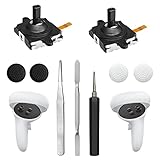
- 【2 × 3D Left/Right Thumb Sticks + 4 × Thumbstick Caps】Perfect replacement analog joysticks for oculus quest 2 controller and quest 3 controller, work for left and right oculus quest 2/3 controller, repair your worn-out, damaged and drift analog joystick. The thumb stick caps can protect your joystick from scratches, corrosion, spallingor other damage. It made of high-quality silicone material, very safe, soft and comfortable.
- 【The 3rd Generation Joystick】The 3rd Generation Joystick is sturdy and durable. This is newest version, we improve internal spring, increase the number of grooves to strengthen the 2nd gen. change the cable to highly conductive one. It's easier to install than previous versions. You can replace the damaged original one to reduce the frequency of replacement and replacement costs.
- 【T5 Screwdriver, Tweezer, Pry Tool】The meta quest 2 controller replacement kit is equipped with a T5 screwdriver, switch at any time according to your needs. Comfortable and easy to open the oculus controller without much force. In addition, we also provide Tweezer, Pry Tool. (Note:Professional installation is highly recommended)
- 【Complete Repair Kit】Package include –2 x Replacement joystick, 4 x Thumb Stick Caps, 1 × Tweezer, Pry Tool, 1 × Metal Pad Tool, 1 x T5 Screwdriver, 1 x T5 Small Screwdriver.
- 【Note】This repair set for oculus quest 2 controller and quest 3 controller does not include meta quest 2 controllers.
Where does gaming fit in?
Gaming is relevant context, but it is not proof of Starfish’s product direction.
Valve has shown interest in brain-computer interfaces, and a separate project involving OpenBCI’s Galea headset has been associated with Valve-related BCI exploration. Galea is a non-invasive wearable research system. It can collect synchronized signals from the brain, muscles, skin, heart, and eyes and stream them to a connected computer.
That makes Galea fundamentally different from the Starfish chip:
| Starfish neural-interface work | OpenBCI Galea | |
|---|---|---|
| Form | Minimally invasive or potentially implantable research | Wearable, non-invasive headset |
| Primary public emphasis | Medical and therapeutic neuroscience | Research, biosensing, and mixed-reality applications |
| Signals | Neural activity recorded through implanted electrodes, alongside stimulation capabilities | Brain, muscle, skin, heart, and eye signals measured externally |
| Consumer gaming product? | Not established | No; it is specialized research hardware |
What exists today?
The OpenBCI Galea biosensing headset is useful as a comparison, not as evidence that Starfish has released an implant. OpenBCI’s official shop has listed Galea at $42,980 and marked it sold out, which places it firmly in the category of specialized research equipment rather than an ordinary gaming accessory. Availability and price can change, so prospective researchers should verify them directly with OpenBCI.
In other words, the current landscape has two separate paths: wearable systems that measure multiple biological signals from outside the body, and experimental implantable systems intended to record or stimulate neural tissue more directly. Neither should automatically be described as a Steam-compatible brain controller.
Is this the same as Neuralink?
It is safer not to label Starfish a “Neuralink competitor” as though that were an established company position. Starfish’s official material reviewed here does not frame the organization that way.
The companies may be discussed in the same broad category because both relate to implanted neural interfaces, but that does not mean their technology, surgical approach, business model, clinical status, or goals are equivalent. Starfish’s public emphasis is on small, distributed, low-power interfaces and related therapeutic research. The disclosed chip is not evidence that it has matched another company’s human trials or clinical achievements.
The Tool Desk
Outbyte PC Repair FREEClear out junk files and repair common Windows errorsFree Scan →Outbyte Driver Updater FREEFix the driver behind crashes, sound loss and screen glitchesFind Drivers →How far has brain-computer-interface technology come?
The wider field is real and has moved beyond science-fiction demonstrations. NIH has reported long-duration independent use of an intracortical BCI for speech and cursor control, showing that implanted interfaces can support useful communication and computer interaction in clinical research.
That progress provides important context, but it is not Starfish performance data. A result from another research group cannot be presented as evidence that Starfish has achieved speech decoding, cursor control, gaming control, or any other specific capability.
Gaming research is advancing as well. Yale reported in June 2026 on a BCI that enabled human participants to play video games using brain signals. Again, that demonstrates activity across the broader BCI field—not a Valve product launch and not a Starfish commercial release.
Independent reader supportYour contribution helps us test, update, and keep practical guides available for everyone.What Newell’s project could mean for games
If Starfish’s engineering goals are eventually achieved, smaller and lower-power neural interfaces could make future clinical devices less burdensome and more capable of operating across several neural sites. That could eventually influence how researchers think about assistive communication, rehabilitation, neurological treatment, and perhaps human-computer interaction.
Recommended Free Tools
But the path from a chip specification to a game controller is long. A gaming application would need reliable signal interpretation, low latency, a practical user setup, safety validation, software integration, and a compelling advantage over controllers, keyboards, eye tracking, voice input, and existing wearable sensors.
There are also questions the current announcement does not answer: How long could the electrodes remain stable? How would the system be implanted and removed? How would wireless power work during movement? What signals could be decoded consistently from person to person? Could stimulation be performed safely and precisely? What would regulators require?
Those unanswered questions are why “Gabe Newell is building a brain chip for gamers” goes beyond the evidence. The stronger and more interesting story is that a major gaming executive is backing serious early-stage work on the hardware required for future neural interfaces.
The accurate takeaway
Gabe Newell is working on brain-computer-interface technology through Starfish Neuroscience, and the company has disclosed a real miniature electrophysiology chip with recording, stimulation, signal-processing, and low-power features.
What has not been established is just as important: there is no confirmed consumer implant, no confirmed Steam integration, no confirmed human implantation, and no confirmed clinical or commercial launch in the primary material reviewed. Starfish’s late-2025 chip-arrival statement should remain described as a target unless a later official source verifies that it happened.
Best Value

- Not easy to fall off, protect the controller: Non-slip finely woven nylon straps of the controller straps for quest 3S for Quest 3 controller grips prevents the controller from sliding or accidentally falling off during use, adding some sort of grip to the controllers and providing extra protection for your device.
- Immersive gaming experience: Using the controller straps for meta quest 3S for Quest 3 controller grips reduced the in-game jittery, shakiness of the controls by around 90% and allows for such a greater precision in-game to a degree and allowing you to enjoy an immersive gaming experience.
- Suitable for large and small hands: The finely woven nylon strap of the active straps for quest 3S/3 accessories has excellent elasticity and anti-slip properties, which increases the friction with the hand. It's easily adjustable and non-deformable, fits huge hands and can be resized to fit smaller hands, doesn't add perceivable weight to the controllers and helps keep the controller straps for quest 3S for Quest 3 controllers closer to your palm so you can press buttons easier.
- Easy access to the batteries,100% Signal: Easy to access the batteries, easy to wear, easy to take off. The minimalism also benefits the controller grips compatible with meta quest 3S/3 accessories as there is no concern regarding sensor LEDs being blocked.
- Durable: The controller straps for oculus quest3S for Quest 3 controller grips is made of ABS plastic which has strong impact resistance. The metal buckle below makes the controller difficult to fall off and is more durable.
For now, this is a research-stage neuroscience venture—not the announcement of a brain-powered Steam Deck.
Galea is a separate OpenBCI product and should not be confused with Starfish Neuroscience’s implantable-chip research.
Frequently Asked Questions
Is Gabe Newell making a brain chip for Steam gamers?
No. Starfish has not established a consumer brain implant, Steam integration, or gaming product. Its public materials emphasize medical and therapeutic neural-interface research.
What does Starfish Neuroscience’s chip do?
Starfish announced a 2 × 4 mm, ultra-low-power electrophysiology chip that can record neural signals, detect spikes, and deliver biphasic stimulation through electrode pairs. It is intended as a component for future wireless, battery-free implants.
Has Starfish implanted its brain-computer interface in humans?
No human implantation, clinical trial, regulatory authorization, commercial sale, or confirmed chip delivery was established in the primary material reviewed. Starfish’s statement that it expected first chips in late 2025 was a target, not proof that the target was met.
Is Starfish’s chip the same as OpenBCI Galea?
No. Galea is a separate, non-invasive wearable research headset associated with OpenBCI and Valve-related BCI exploration. It measures brain and other body signals externally, while Starfish is researching potentially implantable neural interfaces.
The Bottom Line
Bottom line: Gabe Newell is involved in legitimate brain-computer-interface research through Starfish Neuroscience, whose disclosed 2 × 4 mm chip is designed as a building block for future low-power, wireless neural implants. The evidence does not show a consumer gaming implant, Steam integration, human implantation, clinical approval, or commercial launch.
Quick Recap
Product prices and availability are accurate as of the date/time indicated and are subject to change. Any price and availability information displayed on Amazon at the time of purchase will apply.




