
What’s actually slowing this PC down?
Pick the symptom - the matching free tool is one click away.
Yes, a PC running SteamOS can play games on a television, but it does not automatically turn every desktop into an officially supported console. SteamOS is Valve’s Linux-based operating system with a controller-first Steam interface, quick suspend/resume, and a conventional Linux desktop. A Steam Deck is the clearest supported TV path; a living-room desktop PC is possible, but Valve’s current support statement is narrower than “works on any PC.”
For a desktop, the computer connects directly to the TV through the graphics card or motherboard output. A Steam Deck needs a USB-C dock or compatible hub for convenient HDMI or DisplayPort connectivity. In either case, game compatibility, resolution, refresh rate, HDR, and variable refresh rate depend on the particular hardware, television, cable, SteamOS release channel, and game.
As an Amazon Associate I earn from qualifying purchases.
What SteamOS actually does
Valve describes SteamOS as its Linux-based operating system. The Steam Client is the main shell: it connects to Steam services, presents a gamepad-oriented interface, and provides features such as quick suspend and resume. You can switch to a standard Linux desktop for web browsing, file management, other launchers, and software installation.
That console-like presentation is an interface choice, not proof that the underlying computer has console-level compatibility. Valve explicitly says users should not consider SteamOS a replacement for their desktop operating system. Desktop mode remains available, but keyboard-and-mouse tasks and Linux troubleshooting are still part of the experience.
#1 Best Overall
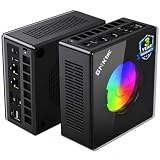
- AMD Ryzen 9 8945HS Processor - GMKtec K11 mini pc equipped with the AMD Ryzen 9 8945HS CPU, featuring 8 cores, 16 threads, and boost up to 5.4 GHz. It offers superior multitasking performance for demanding tasks like gaming and content creation, with energy-efficient power management at 35W TDP (upgradable to 70W)
- 32GB DDR5 + 1TB PCIe 4.0 SSD - GMKtec K11 mini computers comes with 32GB(dual-channel) DDR5 RAM at 5600 MT/s , which can be expanded to 128GB and 1TB PCIe 4.0 M.2 2280 SSD supports dual PCIe Gen4 x4 SSD slots expanded up to 8TB, ensures lightning-fast read/write speeds
- WHY CHOOSE DDR5 5600MHz DUAL CHANNEL (2×16GB) - With a 5600MHz clock—a 17% frequency uplift over 4800MHz—this kit delivers massive bandwidth gains that elevate real-world performance. Gamers enjoy higher minimum FPS and less stutter in open-world and sim titles for a smoother competitive experience. Video editors and 3D creators benefit from faster 4K/8K timeline scrubbing, quicker renders in DaVinci Resolve and Premiere, and swifter asset loading. For AI/LLM workloads, the superior throughput reduces I/O bottlenecks, cuts token generation latency, and accelerates model fine-tuning by keeping processing cores fed with data—so you wait less and create more.
- Oculink Port - The Oculink port enables higher bandwidth capabilities, better frame rates and lower lag. The standard also operates at PCIe x4 speeds, compared to Thunderbolt's x3. Gamers and content creators can benefit from Oculink's higher bandwidth, resulting in better performance and lower lag for eGPU setups
- 4-Screen 4K Display Support - K11 mini pc supports simultaneous 4K display output on 4 screens via HDMI 2.1 (4K@60Hz), DisplayPort 2.1 (4K@60Hz), and USB4 (up to 40Gb/s). Ideal for multitasking, it provides an immersive experience for professional work, gaming, and entertainment
Valve says SteamOS “plays tens of thousands of games” and separately describes Proton as enabling “over 18,000 titles last we checked.” Those are undated statements on Valve’s product page, not a current independent count. The practical question is always whether the particular game works acceptably on your hardware and release channel.
See Valve’s current SteamOS product and FAQ page for the operating-system overview and support information.
Can you install SteamOS on a TV gaming PC?
Technically, you can test SteamOS on hardware beyond the devices it ships with. Official support is the important qualification. On the FAQ page retrieved in October 2026, Valve identifies Steam Deck and Lenovo Legion Go S as officially supported devices and says compatibility has improved for other AMD-powered handhelds. It does not establish blanket official support for a general-purpose desktop gaming PC.
The Tool Desk
Outbyte Driver Updater FREEScan for outdated or missing drivers - takes under a minuteDriver Scan →Outbyte PC Repair FREEClear out junk files and repair common Windows errorsFree Scan →That leaves three different situations:
- Officially supported hardware: a listed SteamOS device, with Valve’s intended update and hardware-support path.
- Experimental installation: SteamOS installed on hardware Valve says users may test, but where drivers, firmware, sleep behavior, audio, Wi-Fi, controllers, or external displays may need troubleshooting.
- Unsupported PC configuration: a system that may boot and run games but has no assurance that a future update will preserve every function.
A desktop PC can therefore be a useful SteamOS TV machine, but describe it as an experiment or an unsupported configuration unless the exact model is covered by Valve’s current support statement. Do not assume that an AMD graphics card, an NVIDIA card, or a particular motherboard makes the entire system officially supported.
How SteamOS reaches the television
Desktop gaming PC
On a conventional desktop, the signal path is straightforward: connect the TV to an available HDMI or DisplayPort output on the graphics card. If the system uses integrated graphics, the motherboard output may be appropriate; which connector is correct depends on how that PC is built. The dock used by a Steam Deck is not required.
The TV is simply an external display. Its maximum resolution, refresh rate, HDR behavior, VRR support, audio return, and input latency depend on the graphics hardware, output standard, cable, TV input, and SteamOS graphics stack. There is no single “SteamOS TV setting” that guarantees a particular result for every computer.
Steam Deck with a dock
A Steam Deck uses USB-C for accessories. Valve’s Docking Station provides HDMI 2.0 and DisplayPort 1.4, networking, USB ports, power passthrough, and external-display support. Valve lists up to 4K at 60 Hz or 1440p at 120 Hz for the dock. These are dock capabilities, not a promise that every game or Deck title will render at those settings.
Recommended Free Tools
Valve says the official dock adds connectivity and charging but no performance benefit. Third-party USB-C hubs and docks can also be used with a Deck. A dock is therefore a convenience and connection device, not a graphics upgrade. Read the specifications on Valve’s Steam Deck Docking Station page before choosing one.
Rank #2

- Built to Conquer. Ready to Rule: Powered by the AMD Ryzen 9000 Series processor, ROG GR70 delivers elite-tier gaming performance once reserved for bulky desktops—now in a compact form that answers your call for more power, less space.
- Every Frame. Every Kill—Faster: Paired with NVIDIA GeForce RTX 50-Series mobile GPU, ROG GR70 ensures ultra-smooth gameplay with high FPS and low latency. Dominate every match with lightning-fast reflexes and no dropped frames.
- Always Connected. Always Ahead: Featuring Wi-Fi 7 with certified Bluetooth 5.4, ROG GR70 is built to eliminate bottlenecks and get you ahead—whether you're online, syncing gear, or booting into the next match.
- Cool. Quiet. Ruthless: Advanced thermal design with custom cooling system keeps temperatures down and acoustics low—even under intense loads. It’s deadly silent and deadly fast.
- Mini Size. Mega Impact: ROG GR70 fits power and aesthetics into an ultra-compact, silver-hued chassis. It’s desk-friendly, travel-ready, and designed to stun—without compromising what's under the hood.
What happens when a game launches
Native Linux games
Some Steam games include Linux builds. SteamOS can run those without translating Windows API calls, although the game still depends on its own engine, drivers, anti-cheat support, and graphics requirements.
Windows games through Proton
For Windows-only releases, Valve supplies Proton, a compatibility layer that lets developers distribute many Windows games without creating a separate Linux port. Proton is not an emulator that makes every title identical to its Windows version. A game can launch, perform well, lack a feature, show a launcher problem, or fail entirely.
Valve’s Verified program communicates how well a game works on SteamOS. Check the individual game’s Steam page and its current Verified or compatibility label rather than treating the total catalog as a guarantee. Multiplayer anti-cheat, third-party launchers, video codecs, kernel-level tools, and unusual controller or launcher behavior are common reasons a title may need extra work.
Outdated Drivers Are Slowing You Down
One free scan finds every outdated or missing driver and matches the right update for your exact hardware.Free scan · exact hardware matchPC Slower Than It Used to Be?
A free scan shows the junk files, broken settings and background clutter dragging Windows down - then fixes them in one click.Free scan · Windows 10 & 11Other launchers and desktop software
Valve says desktop mode can be used for other launchers and software. That flexibility is useful on a PC connected to a TV, but it also means the machine behaves like a Linux computer when you leave the Steam interface. A wireless keyboard or mouse may be necessary for account sign-in, launcher setup, file operations, or recovery.
Setting up a desktop SteamOS TV system
Valve’s published material does not define one universal desktop image, hardware list, cable, controller, or resolution. Use this sequence as a decision checklist, then follow the installation instructions applicable to the hardware you are testing.
- Confirm the support category. Check whether the exact computer is an officially supported SteamOS device. If it is not, record that you are testing an experimental or unsupported installation.
- Check the graphics path. Identify the output you will use, whether it is on a discrete graphics card or the motherboard. Confirm that the TV has a matching input and that the cable is rated for the resolution and refresh rate you intend to try.
- Install or test SteamOS using Valve’s current instructions. Do not assume that a Steam Deck recovery image, a desktop installation, or a handheld image has identical hardware requirements. Keep a recovery route for the PC’s previous operating system and personal files.
- Complete updates before judging TV behavior. System components, kernel support, desktop-session behavior, display compatibility, and controller handling can change between releases. Reboot after updates when the installer or system requests it.
- Connect the TV and select the display mode supported by both devices. Start conservatively if the screen is blank, then increase resolution or refresh rate one variable at a time. HDR and VRR should be treated as separate capabilities, not assumed merely because the TV advertises them.
- Pair a controller and test the Steam interface. A controller is the natural input for SteamOS’s game-focused shell. Keep keyboard and mouse access available for desktop mode and troubleshooting.
- Check each game before downloading large files. Read its SteamOS/Proton status and Verified label, then test a representative title from your library. A successful launch does not prove that every multiplayer mode, cutscene, overlay, or peripheral works.
- Test suspend, resume, audio, networking, and shutdown. A PC that renders a game may still have problems returning from sleep, switching displays, routing sound to the TV, or reconnecting a controller.
SteamOS releases: stable versus beta TV features
Display behavior is tied to the software channel. Valve’s stable SteamOS 3.7.8 release, dated May 22, 2025, moved to a newer Arch Linux base, Linux kernel 6.11, and KDE Plasma 6.2.5. Its notes mention frame limiting with VRR displays, compatibility improvements for some displays, and better switching between desktop and game modes. The documented details are in Valve’s SteamOS 3.7.8 release notes.
Later SteamOS 3.8.7 beta notes describe KDE Plasma 6.4.3, Wayland as the default desktop session, improved out-of-box scaling on televisions, and support for external HDR and VRR displays. Those notes are explicitly for Beta/Preview software, not a universal stable-release promise. They also mention a TCL television issue that required a dock firmware update. Read the SteamOS 3.8.7 Beta notes if you are evaluating preview software.
Valve’s official feed also reports SteamOS 3.7.23 released to all users, but the listing available for this guide did not provide a complete stable-release note set. Consequently, 3.7.8 is a dated reference for documented features, not a claim that it is the latest stable release. Do not present beta-only scaling, HDR, or VRR behavior as guaranteed on every stable installation.
Rank #3

- Office Gaming Mini PC - UPGRADED GMKtec Nucbox M5 Ultra Series is equipped with the powerful AMD Ryzen 7 7730U processor, 8 Cores/16 Threads, Base 2.00GHz (Power Saving Quiet Mode) with Turbo Boost up to 4.50GHz (Performance Mode) in BIOS settings, Based on the ZEN 3+ architecture, this small but powerful mini pc delivers satisfying results in productivity, office work, and gaming. 35% Performance increase over AMD Ryzen 5 7430U/ Ryzen 7 5700U, 5600U, 5560U, 5500U.
- 16GB DDR4 RAM & 256GB PCIe SSD - Installed with DDR4 16GB RAM (1x16GB), the Nucbox M5 Ultra mini pc support expansion to 64GB RAM. Featured with 256GB M.2 2280 PCIe 3.0 SSD, support dual slot expansion to 4TB SSD. (Upgrades not included)
- DUAL NIC LAN 2.5G RJ45 - Fast Network Speeds: Enjoy up to 2500Mbps data transmission speed without worrying about lagging. Ideal for working, gaming, and surfing the internet. Great for Untangle, Pfsense or as a server office PC.
- Mini Desktop Computer with 4K Triple Screen Display - Nucbox M5 Ultra integrates AMD Radeon Graphics 8 Cores 2000 MHz GPU to deliver powerful graphics processing power to easily handle the demands of complex design software, 4K@60Hz UHD video editing, and playback. It can connect to 3 display screens simultaneously.
- Fast Internet WiFi 6E + BT5.2 Connection - GMKtec Mini PC with WiFi-6E Wireless, have 2.5G/5G/6G triple band, more faster and lower latency. Bluetooth 5.2 allowing you more quickly to connect other wireless devices (headset, mouse, keyboard, etc.) Interface features 2*USB3.2 ports, 2*USB2.0 ports, 1*HDMI 2.0 port(4K@60Hz), 1*USB-C port(PD/DP/DATA), 1*DP Port, 1*Audio 3.5mm (HP&MIC), 1*DC Power Port.
Choosing between a Steam Deck and a desktop SteamOS PC
| Decision factor | Steam Deck | Desktop gaming PC running SteamOS |
|---|---|---|
| Support status | Listed by Valve as officially supported. | Generally an experimental or unsupported configuration unless the exact model is covered by Valve. |
| TV connection | USB-C dock or compatible hub; Valve’s dock offers HDMI 2.0 and DisplayPort 1.4. | Direct HDMI or DisplayPort from the graphics card or appropriate motherboard output. |
| Dock performance | Dock provides charging and connectivity, not extra rendering performance. | No Deck dock is required; the PC’s own graphics hardware determines rendering performance. |
| Portability | Integrated handheld controls and a supported SteamOS device. | Depends on the case, power, cooling, and peripherals you choose. |
| Maintenance | More appliance-like, while still offering desktop mode. | More flexibility, but more responsibility for drivers, firmware, display issues, and recovery. |
| Keyboard and mouse needs | Usually optional for game mode, but useful in desktop mode. | Strongly recommended for installation, launchers, account setup, and troubleshooting. |
The right choice depends on which trade-off matters: a supported device with a predictable handheld-to-TV path, or a more powerful or already-owned desktop whose SteamOS behavior you are prepared to maintain.
Common TV problems and practical fixes
The television shows no picture
- Verify that the cable is connected to the active graphics output rather than an unused motherboard connector.
- Select the correct TV input and try a lower resolution or refresh rate first.
- Reboot with the TV already switched on, then test another output or cable if available.
- If the system is a Deck, check dock power, firmware, and USB-C seating. Valve’s beta notes document a TCL-specific case where a dock firmware update was required.
HDR or VRR is unavailable
Check the entire chain: TV input mode, cable, GPU output, operating-system release, and game. Features described in SteamOS 3.8.7 beta notes should not be expected on every stable build. A TV can support HDR or VRR while a particular PC output, cable, game, or software channel does not.
A controller works in games but not in desktop mode
That is consistent with SteamOS’s design. Game mode is optimized for controller navigation; desktop applications may require a keyboard and mouse. Pair both input types before moving the PC into a living-room location.
A game launches but has missing features
Review its current Verified status and Proton notes. Try the supported compatibility option offered by Steam, but treat community workarounds as title-specific rather than a system-wide fix. Multiplayer anti-cheat or a separate launcher may remain incompatible even when the main executable starts.
Switching between desktop and game mode is unreliable
Install the latest release available for your support category, reboot after system updates, and test with a simple display configuration. SteamOS 3.7.8 specifically included improvements to switching between desktop and game modes, but an unsupported PC can still expose hardware-specific bugs.
Is SteamOS a good console replacement for the living room?
It can provide a console-like front end when the library, controller, and display all cooperate. The strongest case is a supported Steam Deck connected to a suitable TV, where the operating system, suspend behavior, and controller interface are designed to work together.
A desktop SteamOS PC is better understood as a Linux gaming computer with a console-style shell. It may offer more upgradeable hardware and direct TV connectivity, but you must accept experimental support, game-by-game Proton checks, and occasional desktop troubleshooting. SteamOS’s interface reduces friction after setup; it does not remove the underlying PC responsibilities.
Do these 3 things before closing this tab:
1Repair Windows errors before they cause bigger problems2Scan for outdated or missing drivers - takes under a minute3Clear out junk files and repair common Windows errorsBefore committing, verify three things: the exact hardware’s support status, the games you actually play, and the TV features you need. Those checks matter more than a generic promise that SteamOS works on “a PC.”
What Valve’s partner plans mean for TV PCs
Valve says it is working with select partners on licensed “Powered by SteamOS” devices. That indicates a possible future category of officially integrated living-room hardware, not evidence that every partner device is available, supported in your region, or covered by a referral program. Confirm the model and current support documentation before treating a future device as equivalent to a Steam Deck.
Quick Recap
Product prices and availability are accurate as of the date/time indicated and are subject to change. Any price and availability information displayed on Amazon at the time of purchase will apply.

