AMD Software: Adrenalin Edition can record games and the Windows desktop, save recent gameplay with Instant Replay, capture screenshots or GIFs, and stream to services such as Twitch, YouTube, and Facebook. You do not need a separate paid capture application: install the full/default Adrenalin package, open Record & Stream Settings, and configure the feature for your Radeon hardware.
This guide covers recording, Instant Replay, livestreaming, codecs, audio, overlays, and the most common capture problems.
As an Amazon Associate I earn from qualifying purchases.
What AMD Record & Stream does
The feature formerly associated with Radeon ReLive is now built into AMD Software: Adrenalin Edition as Record & Stream. Its main functions are:
- Record: Save gameplay or desktop footage locally.
- Instant Replay: Maintain a rolling buffer and save the preceding seconds or minutes when something worth keeping happens.
- Live Stream: Broadcast gameplay or desktop content, with microphone and camera support, to a supported service or custom RTMP destination.
Availability depends on the Radeon product, driver, Windows configuration, and installation type. AMD says the feature requires at least Video Coding Engine 1.0 support; not every Radeon card exposes every codec or option.
#1 Best Overall

- The Geforce 210 is with a 589MHz core clock,up to 1066Mbps effective,perfect for working,video and photo editing,allows good fluency,which can effectively meet your needs.
- PCI Express 2.0 interface,offers compatibility with a range of systems. Also includes VGA and HDMI outputs for expanded connectivity,supports up to 2 monitors.Good for adding a simple low profile gpu to a small form factor pc.
- The computer graphics cards is small in size and saves more space,easy to install,plug and play,you can build a compact PC system easily for slim/ITX chassis.
- This low profile video card is good value option for entry level, if you just want basic upgrade graphics and daily simple work for your computer, or not be AAA gamer.(include low profile bracket)
- No external power supply and the all-solid-state capacitor keeps low power consumption and high performance,supports Windows 10/8/7/Vista/XP(not compatible with windows 11).
Before you begin
- A compatible AMD Radeon graphics product.
- AMD Software: Adrenalin Edition installed with the Full or Default installation option.
- A current or compatible Radeon driver.
- Enough free storage for recordings. AMD’s documented default folder is
<drive>:Users<username>VideosRadeon ReLive. - A microphone and webcam if you plan to commentate or appear on stream.
- A stable upload connection and an account with the streaming service you intend to use.
AMD’s installation documentation identifies the Default installation as the option that provides the full gaming, recording, streaming, and performance-control set. Minimal or driver-only installations may omit Record & Stream.
Install or repair AMD Software
- Open AMD’s official Drivers and Support page.
- Select your Radeon product or use AMD’s detection tool.
- Download the current compatible Adrenalin package.
- Choose the Full or Default installation rather than a minimal driver-only option.
- Restart Windows if prompted.
- Open AMD Software and search for Record.
Driver releases change, so use AMD’s live support page rather than assuming a particular release is always the latest. The exact controls shown also vary with the GPU and system configuration.
Open Record & Stream Settings
- Launch AMD Software: Adrenalin Edition.
- Type Record in the application’s search box.
- Select Record & Stream Settings.
- Use the setup wizard for a quick configuration, or adjust the Recording and Media sections manually.
This search-based route is more reliable than older instructions that refer to fixed tabs from Radeon ReLive. AMD documents the same path in its Record & Stream FAQ.
Configure local recording
Enable desktop capture when needed
Turn on Record Desktop when you want to capture Windows, an application, or content outside a supported game. Desktop capture is not universal: AMD notes that OpenGL applications may be captured through Record Desktop when running in windowed mode, while its broader documentation says OpenGL game recording through Record & Stream is unsupported. Protected movies and TV content cannot be recorded.
Choose a codec
| Codec | Best starting use | Trade-off |
|---|---|---|
| AVC/H.264 | Compatibility, editing, troubleshooting, and platforms with limited codec support | Usually needs more bitrate than newer codecs for similar quality |
| HEVC/H.265 | Local recordings where smaller files are useful and the player or editor supports HEVC | Less universal compatibility |
| AV1 | Supported modern Radeon hardware and software that accepts AV1 | Not available on every Radeon generation, player, editor, or streaming service |
AMD’s compatibility information identifies AV1 encoding support for RDNA 3 and RDNA 4, not RDNA 2 or the original RDNA generation. Do not assume that an RX 6000-series card can encode AV1. Codec acceleration also depends on compatible media-player support being installed.
Set resolution, frame rate, quality, and bitrate
Higher bitrate generally preserves more detail and reduces blockiness, especially in fast-moving games, foliage, particles, and dark scenes. It also creates larger files and requires more upload bandwidth when streaming. Recording and streaming are separate targets: a bitrate that works for a local 1440p file may exceed a platform’s livestream limit.
Use AMD’s quality and bitrate controls as a starting point, then make a short test recording. There is no single ideal bitrate for every resolution, codec, game, and service. If the output is soft or shows artifacts, increase bitrate; if the file is too large or gameplay stutters, reduce bitrate, resolution, or frame rate.
Enhanced Filtering can improve AVC quality in some situations, but AMD warns that it may affect gaming performance. Disable it if recording causes stutter or a noticeable frame-rate loss.
Configure audio and microphone capture
Depending on the driver version, the Recording section can include:
Rank #2
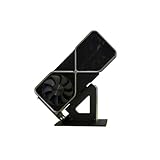
- Display your graphics cards as you would trophies using this display stand. This is a great way to show off your older graphics cards and give them an appreciation for their service. Great for shelving and display cases!
- Display your graphics cards as you would trophies using this display stand. This is a great way to show off your older graphics cards and give them an appreciation for their service. Great for shelving and display cases!
- You can watch the display of the last image in our picture description.
- Audio Channels: Automatic or Stereo.
- Record Microphone: Enables microphone capture.
- Microphone Level: Sets microphone volume.
- Push to Talk: Lets you toggle the microphone during recording.
- Audio Boost: Off, Low, or High.
- Separate Microphone Track: Saves microphone audio independently for later editing.
Choose the audio device and enable microphone recording before you start capturing. AMD says Dolby and DTS encoded audio are not supported for Record & Stream recording; ordinary stereo/PCM output is the safer expectation.
Choose a save location
Open the Media or recording storage controls and select a drive with plenty of free space. Frequent high-resolution recording is better directed to a fast SSD that is not nearly full. Instant Replay also consumes storage when saved, and long sessions can create very large files.
What’s actually slowing this PC down?
Pick the symptom - the matching free tool is one click away.
Record a game or the desktop
- Open Record & Stream Settings.
- Set the codec, resolution, frame rate, quality, bitrate, audio, and save location.
- Open the application’s Hotkey settings.
- Select the recording hotkey tile and assign a shortcut. Press Delete to unbind a shortcut if necessary; some combinations require Ctrl and/or Alt.
- Launch the game or desktop application.
- Trigger recording with the assigned shortcut, or use the Record & Stream controls.
- Stop recording with the same shortcut or control.
- Open the configured media folder and play the file.
Do not rely on an old article’s default shortcut. Hotkeys can differ by release, be changed, or be unbound. Make a 10–20-second test recording first and check the picture, game audio, microphone, save location, and frame rate.
Use Instant Replay
Instant Replay continuously maintains a rolling buffer. When you save it, AMD writes the preceding portion of gameplay to a file; it cannot recover footage from before the buffer was enabled.
- Open Record & Stream Settings.
- Enable Instant Replay.
- Set the replay duration. AMD’s current documentation describes up to 20 minutes, adjustable in 15-second increments; older releases may show different increments.
- Assign and verify the Instant Replay save hotkey in Hotkey settings.
- Play normally, then use the save shortcut after the event you want to keep.
A longer buffer uses more disk space and may add GPU, encoder, or storage overhead. If gameplay stutters or storage usage becomes excessive, shorten the duration or disable Instant Replay.
Take screenshots and make GIFs
AMD Software can save screenshots to the configured media location. Instant GIF supports clips from 1 to 30 seconds. AMD documents these GIF quality presets:
The Tool Desk
Outbyte Driver Updater FREEFix the driver behind crashes, sound loss and screen glitchesFind Drivers →Outbyte PC Repair FREEClear out junk files and repair common Windows errorsFree Scan →- High: 1280×720
- Medium: 960×540
- Low: 640×360
GIFs are convenient for short sharing clips but are not a substitute for high-quality archival video.
Stream to Twitch, YouTube, Facebook, or custom RTMP
- Open AMD Software and search for Record.
- Select Record & Stream Settings.
- Choose Live Streaming in the setup wizard.
- Select your microphone and camera, if applicable.
- Choose a listed service and sign in, or select a custom stream configuration.
- Choose a quality preset and finish the wizard.
- Open Live Stream from the Record & Stream menu.
- Confirm the account, microphone, camera, frame rate, bitrate, and archive settings.
- Select Go Live.
AMD documents Facebook, Twitch, YouTube, and Custom Stream destinations, although the available list can change. A custom destination requires a stream URL and stream key. Treat the destination platform’s current documentation as authoritative for allowed codecs, bitrate, resolution, frame rate, account permissions, and regional availability. AMD’s preset is not a universal platform recommendation.
Live Stream controls can include:
- Connected account
- Microphone and camera toggles
- Microphone level
- 30 or 60 FPS
- Video and audio bitrate
- Enhanced Filtering
- Archive Stream
- Media save location
Enable Archive Stream if you want a local copy, and confirm where it will be saved. Stream audio settings must be configured before going live. If audio works in a local file but not on the stream, check the Live Stream microphone toggle and selected input separately.
Rank #3

- Robust 4GB Memory & Quad Display Ready: Equipped with 4GB of fast GDDR5 memory to smoothly handle daily graphics tasks. Features four built-in HDMI ports, enabling a seamless quad-monitor setup directly out of the box—perfect for multi-tasking offices, digital signage, or trading desks.
- Plug-and-Play Installation & Wide Compatibility: Utilizes a standard PCI Express interface for broad compatibility with most desktop PCs. Offers straightforward plug-and-play installation and stable driver support for modern Windows and Linux operating systems, ensuring a hassle-free setup.
- Quiet, Cool & Compact Design: Engineered with a silent fan and efficient cooling system for near-silent operation, making it ideal for noise-sensitive environments. Its low-profile design fits easily into small form factor cases, with both half-height and full-height brackets included for flexible installation.
- Enhanced Multimedia & Everyday Performance: Delivers smooth 1080P video playback and supports hardware-accelerated decoding, offering an excellent experience for home theater PCs (HTPC). Provides capable performance for everyday applications, multimedia tasks.
- Complete Package & Reliable Support: Includes the graphics card, both low-profile and standard brackets, a quick start guide, and screwdriver, which make it simple and quick setup process.
Add webcam layouts and overlays
Adrenalin’s Scene Editor can provide layouts and on-screen elements such as webcam placement, camera frames, chroma key, a chroma color, custom image overlays, browser sources, and branding. The exact controls have changed across Adrenalin releases, so use the labels shown in your installed version. Older AMD documentation specifically describes PNG overlays and browser sources.
Outdated Drivers Are Slowing You Down
One free scan finds every outdated or missing driver and matches the right update for your exact hardware.Free scan · exact hardware matchWindows Errors? Fix Them Before They Spread
Repair common Windows errors and clear accumulated junk for a smoother, more stable PC - no reinstall needed.Free scan · no reinstallFor multi-scene production, alerts, transitions, detailed audio mixing, or many simultaneous sources, OBS Studio is usually the more flexible option.
Prevent performance metrics from appearing in video
AMD Software can place performance metrics such as FPS, temperature, utilization, or other statistics in captured output. If those statistics unexpectedly appear in a recording or stream, open the performance metrics settings and disable Show In Video/Stream Output. Leaving it enabled is useful for benchmarking footage but distracting in ordinary gameplay videos.
AVC, HEVC, or AV1: which should you choose?
- Choose AVC when compatibility is the priority, you are troubleshooting, or the platform/editor does not clearly support newer codecs.
- Choose HEVC for local recording when your player and editing software support it and smaller files matter.
- Choose AV1 only when your Radeon hardware provides AV1 encoding and the destination software or platform accepts it.
Newer codecs can be more efficient, but “best quality” is not universal. Results depend on bitrate, resolution, motion, encoder generation, player support, and the service’s own re-encoding.
AMD has documented a driver-timeout issue involving HEVC hardware encoding on some RX 6000 systems in Fortnite. If that specific problem occurs, open Record & Stream settings, change Video Encoding Type to AVC, and test again. This is an issue-specific workaround, not evidence that HEVC is generally unusable.
Quick wins for a faster PC:
Clear out junk files and repair common Windows errorsFree Scan →Fix the driver behind crashes, sound loss and screen glitchesFind Drivers →Repair Windows errors before they cause bigger problemsFix Now →Troubleshooting AMD Record & Stream
There is no Record & Stream option
- Check that AMD Software itself is installed, not only a display driver.
- Confirm that the installation used the Full or Default option.
- Update through AMD’s official support page.
- Check the exact Radeon model and any laptop/OEM driver limitations.
- Restart Windows, reopen AMD Software, and search for Record.
Feature availability varies by product and driver branch, so a missing option does not necessarily indicate a broken installation.
The recording is black or blank
- Enable Record Desktop for desktop content.
- Try borderless-window or windowed mode.
- Test a DirectX or Vulkan game rather than an OpenGL application.
- Disable Xbox Game Bar/Game DVR and other simultaneous capture tools. AMD says Radeon capture and Microsoft Game DVR cannot be used simultaneously.
- On a laptop, check hybrid-graphics routing and whether the game and AMD Software are using the expected GPU.
- Update or roll back the driver if the issue began immediately after an update.
- Do not attempt to capture DRM-protected video.
The microphone is missing
- Select the intended Audio Capture Device.
- Enable Record Microphone.
- Adjust the microphone level.
- Check Windows microphone permissions and input-device selection.
- Make a short test recording before changing other settings.
- If using a separate microphone track, look for the additional audio file rather than expecting everything in one track.
Recording causes stutter or lowers game performance
- Reduce resolution or frame rate.
- Reduce bitrate.
- Disable Enhanced Filtering.
- Shorten or disable Instant Replay.
- Record to a fast drive with substantial free space.
- Disable competing overlays and capture applications.
- Use AVC as a compatibility baseline.
- Compare with OBS using AMD hardware encoding.
Hardware encoding reduces CPU work but is not performance-free: the encoder, GPU, memory, storage, and game can still compete for resources.
HEVC causes a crash or driver timeout
For the documented RX 6000/Fortnite issue, change the recording codec from HEVC to AVC and test again. If the problem affects a different game or GPU, check the relevant driver release notes rather than assuming the same workaround applies.
The stream drops frames
Separate the symptom:
- Dropped frames: Usually a network, Wi-Fi, upload, route, or platform-ingest problem.
- Skipped frames: Usually an encoding or GPU-capacity problem.
- Missed frames: Usually a rendering or scene-overload problem.
Lower stream bitrate or frame rate only after identifying the category. Also compare your settings with the destination’s current guidance.
Recommended Free Tools
Rank #4

- NVIDIA GT 730 graphics cards offer basic display capabilities for office work and light multimedia,which with 1000 MHz Memory Clock 4GB DDR3 on Kepler architecture, support multiple monitors and HD video playback,easily upgrading for convenient usage to save your budget for your old pc
- The low-profile design of the PC graphics card saves installation space, easy to install,plug &play,making it easy to build a compact computer system, even compatible with ITX chassis.
- The 4x outputs enables multi-monitor productivity on up to 4 monitors simultaneously,including 2x HDMI,VGA,DP.Designed for full-size chassis and small case installations.
- PCI Express based PC is required with one X8 lane graphics slot available on the motherboard. 300 Watt or greater power supply. This video card can automatically install new drivers and support Win11,DirectX 12.
- 30W low power,no external power supply and the all-solid-state capacitor keeps low power consumption and high performance.If you have any problems about this card,please contact us via amazon messages.
Audio works locally but not in the stream
Check the Live Stream microphone toggle, selected device, microphone level, Windows permissions, and whether the stream was started before changing the audio settings. AMD also documents Dolby/DTS encoded audio as unsupported for Record & Stream recording.
AMD Record & Stream versus OBS Studio
| Choose AMD Software when… | Choose OBS Studio when… |
|---|---|
| You want fast recording or Instant Replay with minimal setup. | You need multiple scenes, sources, transitions, alerts, browser sources, or plugins. |
| You already own a supported Radeon GPU and want built-in capture. | You need detailed audio mixing and flexible application/audio routing. |
| You want quick screenshots, GIFs, or straightforward streaming. | You want a more customizable or cross-platform production workflow. |
| You do not need elaborate layouts. | You want more granular control over recording and streaming encoders. |
OBS Studio is free and supports AMD’s Advanced Media Framework hardware encoding on Windows and Linux, according to its hardware-encoding documentation. It is more capable, but it also takes longer to configure. You do not need OBS merely to record or stream from a supported Radeon system.
What you may need
- Already have a supported Radeon GPU? Start with the free Adrenalin software.
- Need advanced scenes or audio control? Try the free OBS Studio.
- Need AV1? Check AMD’s current product and compatibility information before buying; Radeon generation matters.
- Record frequently? Use a fast SSD with enough free space.
- Stream with commentary? Add a compatible microphone, webcam, and suitable lighting.
Frequently Asked Questions
Can AMD Radeon Software record the Windows desktop?
Yes. Enable Record Desktop in Record & Stream settings. Some applications, OpenGL modes, hybrid-graphics configurations, and protected content may not capture correctly.
Can AMD Record & Stream record OpenGL games?
AMD says OpenGL game recording is unsupported. An OpenGL application may be captured through desktop recording when it runs in windowed mode.
Free tools Windows power users keep installed
One-click scans. No signup required.
Where does AMD save recordings?
The documented default is <drive>:Users<username>VideosRadeon ReLive, but you can change the media-save location.
Does AMD Software support separate microphone audio?
Yes. Where the option is available, enable Separate Microphone Track to save microphone audio independently for editing.
Can AMD Software stream to Twitch and YouTube?
AMD documents Twitch, YouTube, Facebook, and Custom Stream destinations, although availability can vary by driver and configuration.
Can AMD Record & Stream capture protected movies?
No. Protected movies and TV content are not supported.
Should I use AMD Software or OBS Studio?
Use AMD Software for quick recording, Instant Replay, and simple streaming. Use OBS Studio for complex scenes, plugins, advanced audio routing, and more detailed production control.
Quick Recap
Product prices and availability are accurate as of the date/time indicated and are subject to change. Any price and availability information displayed on Amazon at the time of purchase will apply.




