Yes—but not with an HDMI cable alone. Meta Quest HDMI Link lets a Quest 2, Quest 3, Quest 3S, or Quest Pro display video from many consoles, handhelds, laptops, tablets, phones, and cameras as a large virtual screen. The crucial hardware is a USB capture card: the source sends HDMI or DisplayPort video to the card, which converts it into a USB video stream for the Quest.
That makes HDMI Link useful for private, portable 1080p gaming and screen viewing. It does not give the headset a native HDMI input, turn it into a 4K monitor, or reliably display HDCP-protected streaming video.
As an Amazon Associate I earn from qualifying purchases.
The short version
- You need a compatible Quest headset and the Meta Quest HDMI Link app.
- You need a UVC-compatible USB capture card; UAC support is needed for captured audio.
- The source connects to the capture card’s HDMI input.
- The capture card connects to the Quest’s USB-C port with a USB 3.0 SuperSpeed cable.
- 1080p at 60 frames per second is the sensible target, subject to the card, cable, source, and app.
- HDCP-protected video can result in a blank picture or audio without video.
- A powered hub may be needed if you want to charge the headset or source during use.
Meta’s app listing identifies Quest 2, Quest 3, Quest 3S, and Quest Pro as compatible headset families. Availability can vary by region and software environment, so check the app listing on your own headset before buying accessories. Quest 1 is not listed as supported. See the app listing.
How HDMI Link works
Console / laptop / handheld / phone
        ↓ HDMI or DisplayPort
USB capture card
        ↓ USB 3.0, UVC video and UAC audio
Meta Quest HDMI Link
        ↓
Resizable virtual 2D screen inside the Quest
The Quest does not contain a conventional HDMI input. HDMI Link is an app, not a hardware modification. The capture card performs the HDMI-to-USB conversion, and the Quest displays the resulting feed as a 2D panel that you can resize and reposition.
#1 Best Overall

- Compatible with Meta Quest & Pico Headsets: The VR link cable is compatible with Meta Quest 3S / Quest 3 / Quest 2 / Quest Pro / Pico 4. Connect your headset to a gaming PC to unlock SteamVR and PC VR content for a stable, immersive wired experience. Note: This cable is NOT for charging—please do not use it to charge your headset!
- Designed for PC VR Gaming: Perfect for wired PC VR and room-scale VR gameplay, supporting seated, standing, or full-body movement. Keeps your VR experience stable and smooth during long gaming sessions, avoiding latency or signal issues associated with wireless streaming.
- USB 3.0 High-Speed Performance: Features a USB-A to USB-C connection with USB 3.0 support, providing up to 5Gbps data transfer (typical 2–3Gbps in real-world VR use). Ensures low latency and reliable signal. For best results, plug into a USB 3.0 / 3.1 / 3.2 port and keep your headset and PC Link software updated.
- Comfortable & Secure Design: The L-shaped USB-C connector reduces headset port strain and improves comfort during long VR sessions. Includes a Velcro strap to keep the cable in place and prevent disconnection. Flexible, tangle-free design allows smooth, unrestricted movement.
- Durable and Reliable Build: Constructed with flexible, abrasion-resistant materials and reinforced stress points for long-term use. Comes with a user guide, 18-month warranty, and dedicated Syntech customer support.
In practice, this feels more like looking at a huge virtual monitor than entering a VR version of your console or PC. The app can reportedly operate as a panel alongside other 2D content, and launch coverage described use within some VR environments depending on software support. Do not assume that every Quest application can freely host the HDMI panel.
What you need
Required
- A supported Meta Quest headset.
- The free Meta Quest HDMI Link app, subject to regional and software availability.
- A USB 3.0 UVC/UAC HDMI capture card.
- An HDMI cable from the source to the capture card.
- A SuperSpeed USB cable from the capture card to the Quest.
Optional
- A USB-C-to-HDMI adapter or hub for handheld PCs, tablets, and phones.
- A powered USB-C hub or power-delivery accessory for longer sessions.
- A capture card with HDMI pass-through if you also want to feed a television or monitor.
- A battery pack or charger for the source device.
Look for explicit wording such as USB Video Class (UVC), USB Audio Class (UAC), USB 3.0 or SuperSpeed, and 1080p60 capture. An HDMI output or pass-through port is optional; the essential connector is a clearly labeled HDMI input.
Do not confuse a capture card with an “HDMI-to-USB-C cable.” USB-C describes the connector, not what the device does. Many such cables are display-output adapters or passive one-way cables, not UVC capture devices.
Recommended Free Tools
How to connect HDMI Link
- Install Meta Quest HDMI Link from the Quest store or its app distribution page.
- Connect the source’s HDMI output to the capture card’s HDMI input.
- Connect the capture card’s USB output to the Quest’s USB-C port.
- If the source only provides USB-C video, connect it to a suitable USB-C-to-HDMI adapter or hub first.
- Put on the Quest and open HDMI Link.
- Approve requested USB, camera, audio, and device permissions.
- Accept the USB-device prompt if the headset displays one.
- Choose an available capture format and start the stream.
- Begin with 1920×1080 at 60 fps, then lower the setting if the feed stutters or disconnects.
- Resize and position the virtual screen for comfortable viewing.
The app can reportedly auto-launch when it detects a USB capture device and includes controls for video format, resolution, and frame rate. Exact menu labels may change with app and Quest software updates.
Connection examples
Console
Console HDMI out
→ capture card HDMI in
→ capture card USB output
→ Quest USB-C
Gameplay from a PS5, Xbox, Switch, or similar console can work when the output is clean and the capture card supports the signal. On consoles that expose an HDCP setting, disabling HDCP may be necessary for gameplay capture. This is not a universal solution for streaming services or protected movies, and changing the setting can affect protected-media playback. TechRadar’s PS5 example illustrates the general gameplay setup.
Steam Deck or another handheld PC
A handheld with HDMI output can connect directly to the capture card. A USB-C-only handheld needs a video-capable USB-C hub or adapter. If the handheld must charge at the same time, use a hub that can provide power delivery as well as video output. UploadVR’s iPad and Steam Deck guide covers examples of this arrangement.
Rank #2
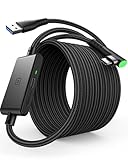
- [Designed for Oculus Quest 3/2/Pro] Our 2023 version features a separate USB-C charging port, enabling rapid 3A power delivery for uninterrupted gameplay. Use with a PD/QC fast adapter for optimal charging speed. Please note: This is a VR link cable and DO NOT use it to charge your phone, tablet, laptop, etc.
- [SAFE Charging via SmartProtect2.0] Link cable built-in SmartProtect2.0 chip balances the electricity and data sync, controls the current for a safe battery range of around 78%, safe and sufficient power use is now in your Oculus.
- [16FT/5M for Wider Range of Motion] Reaching 16ft/5m long USB A to USB C cable, plus the anti-wear FLYWEAVE coat, never worry about your freedom of movement or if it is damaged by a stampede(Cable length slightly affects transfer speed).
- [Steady Your Game Connection] 90° USB-C hooks the VR glasses firmly, a flexible joint that is intact after 45000+ bend tests, plus a sticky buckle to secure the connection, all of these can up your game to the next level.
- [What You Get] INIU 16ft/5m USB 3.0 link cable*1, Quick Start Guide*1, user manual*1, INIU industry-leading 3-year iNiu Care and technical support.
Laptop
Connect the laptop’s HDMI output to the capture card. This can be useful when a direct monitor is unavailable, but it is a poor substitute for a proper display if you need 4K, HDR, high refresh rates, VRR, accurate color, or the lowest possible latency.
The Tool Desk
Outbyte PC Repair FREEClear out junk files and repair common Windows errorsFree Scan →Outbyte Driver Updater FREEScan for outdated or missing drivers - takes under a minuteDriver Scan →iPhone or iPad
Use the appropriate Lightning-to-HDMI or USB-C-to-HDMI video-output adapter, then connect that HDMI signal to the capture card. USB-C devices may need a hub when the same port must provide both video output and charging. Some mobile devices and apps may still restrict external video or enable HDCP.
Resolution, frame rate, and latency
HDMI Link is generally documented and discussed as supporting up to 1080p at 60 fps, depending on the capture card, USB mode, source signal, and available app options. Treat that as the practical ceiling—not as a promise that every card, cable, or source will sustain it.
A 4K-branded capture card does not make the Quest a 4K monitor. The card may accept or record higher-resolution signals for other workflows, while the HDMI Link path remains constrained by the app’s practical output target.
Capture also adds delay. The signal must be converted, transported over USB, decoded, and drawn as a virtual panel. The exact latency varies substantially by capture card, source format, USB connection, hub, and software. A premium device may advertise low latency for its own computer-capture workflow, but that does not guarantee monitor-like latency inside a Quest. Elgato’s Cam Link 4K specifications, for example, require USB 3.0 and an unencrypted HDMI source while describing low-latency capture in its intended workflow.
Do these 3 things before closing this tab:
1Clear out junk files and repair common Windows errors2Fix the driver behind crashes, sound loss and screen glitches3Repair Windows errors before they cause bigger problemsFor casual console and handheld gaming, the delay may be acceptable. Competitive players who depend on immediate input response should use a conventional gaming monitor or television instead.
Rank #3

- Compatible with Meta Quest 3S/Quest3/2/Pro/Pico 4 Accessories: Syntech 2-in-1 link cable offers additional interface options for both USB A and Type C ports. It can connect your VR devices to a gaming PC, providing perfect PC VR experience. The color and design match perfectly with the headset. (Note: Quest3 VR headsets recently updated v64, If your device is identified as USB 2.0 or cannot connect, please update your Quest3 and PC Link software to the latest version, then restart them.)
- Excellent Link Performance: This cable and the USB adapter both support USB 3.0 transmission speed. Stable and fast data synchronization working with sustained and reliable current brings you a smooth VR gaming experience. The attached velcro strap fixes the cable and Oculus Quest 3S/Quest3/2/Pro/Pico4 to prevent disconnection during movement. Note: Whether you use an adapter or not, please make sure that the transmission protocol of the computer port you are connecting to is USB 3.0 or higher.
- Upgraded 2-in-1 High Speed VR Cable: Designed for seamless virtual reality experience, this USB 3.0 Type-C cable delivers data transfers up to 5Gbps (practical speeds 2-3Gbps). The included USB 3.0 adapter ensures stable data connectivity for phones, computers, tablets, and other devices. Note: This is NOT a charging cable—do not use it for charging!
- Flexible and Sturdy: Experience complete freedom of movement with this 16ft long cable that allows you to fully immerse yourself in the VR world without any restrictions. Crafted from highly durable materials, this cable offers exceptional stretch and abrasion resistance, making it a reliable option for long-term use. The upgraded L-shaped Type-C interface ensures a robust and reliable connection, while the cable is reinforced to withstand over 5000 bends without any damage.
- Quality Assurance and Customer Service: We have upgraded the Type-C interfaces on both ends of the cable, increasing the breaking force to over 15G to enhance durability. We provide a USER GUIDE tutorial to help you smoothly enable cable link and provide solutions for some of the problems you may encounter while using wired link. In addition, Syntech provides an 18-month worry-free period and Friendly Customer Service Support for this link cable.
HDCP warning: protected video may be blank
HDMI Link cannot display a signal when the capture card receives HDCP-protected content. Common examples include Netflix or Disney+ playback, rented or purchased movies, Blu-ray players, some set-top boxes, and certain phone or tablet video paths.
The symptom can be particularly confusing: you may hear audio while seeing no picture. That does not necessarily mean the Quest app is broken; it can indicate that the video is protected. HDMI Link is intended for clean, unprotected output such as gameplay, a desktop, or a camera feed. Do not treat HDCP-bypass hardware as a normal troubleshooting fix. Meta’s app information documents this limitation, and Elgato explains the same restriction for Cam Link 4K.
USB 3.0 matters
A USB-C cable can silently negotiate at USB 2.0 speeds. Symptoms include a very low frame rate, dropped frames, stuttering, failed 1080p60 modes, or repeated disconnections. HDMI Link’s statistics overlay may identify the connection as “Hi-Speed” rather than “SuperSpeed.”
What’s actually slowing this PC down?
Pick the symptom - the matching free tool is one click away.
- Use a cable explicitly rated for USB 3.0 or higher.
- Connect the capture card directly to the Quest while troubleshooting.
- Avoid questionable hubs, extensions, and adapters.
- If the cable appears orientation-sensitive, unplug it and try the other orientation.
- Drop from 1080p60 to 1080p30 if the source or card cannot sustain 60 fps.
Power and charging limitations
The capture card occupies the Quest’s only USB-C port. Without a compatible powered hub or power-injecting accessory, you generally cannot charge the headset through that same connection while HDMI Link is running.
A powered hub can also charge a Steam Deck, phone, or tablet, but it adds bulk, power-management complexity, and another possible failure point. Not every hub passes power and USB data in a configuration the Quest, capture card, and source can all use. Some capture cards also draw enough power to accelerate battery drain.
For a long session, plan for separate power for the Quest and source, or test a powered hub with the complete setup before relying on it for travel. UploadVR reported successful hub-and-power arrangements in particular iPad and Steam Deck configurations, but those results are not universal.
Rank #4

- No Data Speed Drop Even When Hard Twisted: The kink-resistant, braided exterior and internal twisted-pair structure work together to prevent performance loss, ensuring consistently stable USB 3.0 data transfer speeds up to 5Gbps through intense bending and daily wear
- Fast Charging Chip: AMVR link cable with charging features the latest max 36W charging port, with a significantly upgraded internal charging board compatible with Meta Quest 3S/3/2, enabling a seamless experience of charging while playing. For optimal charging speed, use the official or a higher-power charger adapter. Note: This VR cable is not designed for charging phones, computers, tablets, or other devices.
- 2-in-1 PC Connection: The included USB 3.0 A-to-C adapter allows this meta quest link cable to connect flexibly to both USB-A and USB-C ports on your PC, offering greater convenience. It supports a 5Gbps (SuperSpeed) data transmission rate, providing minimal latency and a stable connection for a smooth PC VR gaming experience. For best performance, please plug it into a USB 3.0 port.
- Extended Service Life and Cost Savings: This VR link cable is made of super durable nylon braided material, offering excellent flexibility and wear resistance. Bending the cable will not affect its transmission performance. The A-to-C adapter can withstand over 10,000 insertion cycles. The reinforced L-shaped USB-C connector can endure a maximum tensile force of 100 Newtons. The tough PVC sheath has withstood over 3,000 bending tests, ensuring long-lasting durability even during prolonged intense exercise.
- Compatible with Quest 3S/3/2/1/Pro accessories and Pico 4: AMVR charging link cable specifically compatible with Quest 3S/3/2/Pro/Pico4 headsets, this cable ensures a stable USB 3.0 connection. It supports fast charging while enabling smooth gameplay, and is an essential accessory for Q3S/3/2/Pro/Pico 4.
Troubleshooting HDMI Link
Blank screen
- Make sure the source is connected to the capture card’s HDMI input, not its output.
- Confirm that the device is a UVC capture card rather than a simple USB-C display adapter.
- Reconnect the card and approve the Quest’s USB and other requested permissions.
- Try another HDMI cable.
- Set the source to 1080p, 60 Hz or 30 Hz, and SDR.
- Disable HDR and unusual color modes.
- Disable HDCP where the source permits it for gameplay.
- Test an unprotected laptop desktop or camera feed.
- Connect the card directly to the Quest.
- Replace the USB-C cable with a SuperSpeed-rated cable.
Audio works but video does not
Suspect HDCP first, then check the capture card’s video format and HDMI input. Other possibilities include incomplete UAC/UVC support, an incorrect source output mode, or an HDMI handshake problem.
Video works but there is no audio
Verify that the card supports UAC audio, that HDMI Link has the required audio permission, and that the source is sending sound over HDMI rather than routing it to headphones or another output. Test without the hub and reconnect the HDMI cable to refresh the handshake.
Frame rate is low or unstable
Check for “SuperSpeed” in the app’s streaming statistics. Replace USB 2.0-only cables, bypass the hub, select a format supported by the card, and reduce 1080p60 to 1080p30 if necessary.
The device repeatedly disconnects
Test the simplest chain—source to capture card to Quest—with no hub or extension. If that works, investigate insufficient USB power, an unstable hub, an unsupported 60 Hz timing, a marginal cable, or a defective card.
The source works on a TV but not in Quest
A television may accept more HDMI formats than the capture card. Force the source to 1080p, SDR, 60 Hz, and a standard RGB or YCbCr output. If appropriate for gameplay, disable HDCP and test again.
Quick wins for a faster PC:
Repair Windows errors before they cause bigger problemsFix Now →Scan for outdated or missing drivers - takes under a minuteDriver Scan →The capture card is not detected
Open HDMI Link before connecting the card, reconnect it, and approve the USB dialog. Test another UVC device or capture card. If the accessory needs proprietary computer drivers, it may not be class-compliant enough for direct Quest use.
Best Value

- High-Speed Link Cable: VR Cable connects your VR device to your gaming PC,5Gbps Super speed,enjoy the higher display resolution and refresh rate supported by PC to provide clearer visual effects for your games.Providing the perfect PCVR experience.
- Widely compatible: Link cable compatible with Meta Quest 3S/Quest3/Quest2/Pro/Pico 4 Accessories and PC/Steam VR.Ensure that the USB A port is plugged into your computer’s USB 3.0/3.1/3.2 port.Additionally, for a better VR experience, we do not recommend using this cable as a charging cable.
- 16Feet/5M Ultra-Long VR Link Cable:The ultra-long 16 feet link cable provides you with more free and flexible VR games, and the L-shaped design of the Type-C connector is safer than the straight Type, which can prevent the connection from being unstable when moving and enhance the user's comfort.
- Excellent Material, Strong and Durable:10000+ Bending test VR cable can be bent freely without breaking, and has good flexibility, tensile resistance and wear resistance.Included is Velcro tape with fixed cable and VR to prevent interruption during movement.
- Hassle-Free Purchase & Excellent Customer Service:16 Feet Long Link Cable bring you superior VR experience.If you have any questions, please feel free to contact us, we will answer you within 24 hours.
Which capture card should you buy?
Choose for reliable 1080p60 UVC/UAC operation, not for the biggest number printed on the box. The minimum sensible specification is:
- USB 3.0 SuperSpeed data.
- UVC video capture.
- UAC audio support.
- HDMI input.
- Stable 1080p60 capture.
- Clear compatibility information and a return option.
HDMI pass-through is worthwhile if you want to switch between the Quest and a television. For travel, a compact card can be convenient, but small generic cards vary widely in reliability, color handling, audio support, and frame pacing.
The Elgato Cam Link 4K is an established premium example with USB 3.0, HDMI input, and 1080p60 support. Its official page showed a $99.99 USD price during the supplied research period; prices can change. Elgato recommends avoiding hubs for best performance, which matters because a Quest setup may need a hub for charging. It is not an official Meta-certified accessory, so treat compatibility as a class-compliant capture-card use case.
Launch coverage reported compatible cards from roughly $30 and cited the Genki ShadowCast 2 at about $50 at the time of its 2024 report. Those are historical price signals, not current prices. A cheaper card can work, but “4K capture” alone says little about Quest compatibility, UVC reliability, audio, or latency.
HDMI Link versus the alternatives
| Option | Best for | Main drawbacks |
|---|---|---|
| HDMI Link | Private, very large wired screen for consoles, handhelds, laptops, and cameras | Capture latency, 1080p practical ceiling, battery drain, cables, HDCP limits |
| Normal monitor | Competitive gaming, long work sessions, 4K, HDR, high refresh, VRR | Less portable and not private |
| Portable monitor | Travel, direct connections, sharing, charging pass-through | Smaller apparent image and no headset-based privacy |
| Wireless PC streaming | A gaming PC already connected to a suitable network | Depends on Wi-Fi and does not solve console or camera inputs |
HDMI Link is attractive when you already carry a Quest, want a private screen, and do not want to depend on Wi-Fi. A portable monitor is usually better for long work sessions, shared viewing, accurate colors, direct console connections, and easy charging. Wireless PC streaming is usually cleaner for a PC that supports it. A conventional monitor remains the better choice for demanding competitive gaming and high-end display requirements.
Who should use it?
HDMI Link is a good fit if you want a huge private display while traveling, already own a Quest, use a Switch or handheld PC, or need to view a clean HDMI camera or computer signal without carrying a physical monitor.
It is a poor fit if you primarily want Netflix or other protected video, require 4K/HDR/VRR, need competitive-grade latency, dislike wearing a headset for ordinary screen use, or expect a one-cable setup that works while charging.
Quick Recap
Product prices and availability are accurate as of the date/time indicated and are subject to change. Any price and availability information displayed on Amazon at the time of purchase will apply.




