
Do these 3 things before closing this tab:
1Fix the driver behind crashes, sound loss and screen glitches2Repair Windows errors before they cause bigger problems3Scan for outdated or missing drivers - takes under a minuteThe MSI Claw does not have one single GPU equivalent. The original 2024 Claw A1M is roughly in Radeon 780M territory in real handheld gaming, while the Claw 7 AI+ and Claw 8 AI+ A2VM use Intel Arc 140V graphics in the broader Radeon 890M performance class. The 2026 Claw 8 EX AI+ is a separate, substantially faster model with Intel Arc G3 Extreme graphics.
That means the model number matters more than the MSI Claw name. These are Windows handheld gaming PCs, and their results vary with power mode, cooling, drivers, memory bandwidth, resolution and upscaling.
As an Amazon Associate I earn from qualifying purchases.
First, identify your MSI Claw model
Check the model name in Windows or on the device label before comparing benchmark results. Reviews of the original Claw A1M should not be used to predict the performance of the later Arc 140V models.
| Model | Processor generation | Integrated GPU | Practical graphics equivalent |
|---|---|---|---|
| Claw A1M | Core Ultra Series 1, including Core Ultra 7 155H and Core Ultra 5 135H | First-generation Intel Arc, up to 8 Xe cores | Approximately Radeon 780M-class, with substantial game-to-game variation |
| Claw 7 AI+ / Claw 8 AI+ A2VM | Core Ultra 7 258V | Intel Arc 140V, 8 Xe cores | Broadly Radeon 890M-class |
| Claw 8 EX AI+ | Newer 2026 platform | Intel Arc G3 Extreme, 12 Xe3 cores | A higher premium tier, above the Arc 140V generation |
MSI’s A1M specifications confirm the first model’s Core Ultra and Arc configuration. The later Claw 8 AI+ specifications identify the Arc 140V platform.
#1 Best Overall

- High-Performance Computing: Harness the power of the AMD Ryzen Z2 Extreme processor to effortlessly handle demanding tasks. Enjoy reliable, high-performance computing wherever you go.
- Simplistic Design: Enjoy the latest generation of Windows 11 Home for your everyday needs. MSI recommends Windows 11 Pro for business use.
- Perfection Through Anthropometry: As a handheld device, Claw has achieved the optimal balance between its grip and weight. We have meticulously polished various design details, from the curvature that fits the palm, to the finger grip positions and trigger force.
- Best-in-Class Battery Life: Unlock exceptional gaming endurance with our breakthrough battery capacity. It's where efficient power meets robust performance—more game, less charge.
- 8-inch Smoothness Ready: Dive into the ultimate gaming experience with our 8-inch premium 120Hz gaming display, with exceptional color reproduction and smooth action.
Claw 8 AI+ GPU equivalent: Radeon 890M class
The Claw 8 AI+ A2VM uses Intel Arc 140V integrated graphics with eight Xe cores. In the commonly listed U.S. configuration, it pairs a Core Ultra 7 258V processor with 32GB of LPDDR5x-8533 memory, an 8-inch 1920×1200 120Hz touchscreen, an 80Wh battery and a 1TB PCIe 4.0 SSD. See the MSI store specification for that specific SKU.
The most useful comparison is AMD’s Radeon 890M, not the older Radeon 780M. Independent laptop testing has found Arc 140V competitive with, and in some workloads ahead of, Radeon 890M. Notebookcheck’s Arc 140V analysis is useful for identifying the broad performance tier, but laptop results do not guarantee identical results in a handheld with a different power and cooling envelope.
A fair summary is: Arc 140V is broadly Radeon 890M-class and usually well ahead of Radeon 780M at comparable power limits. It is not an identical GPU, and there is no fixed FPS multiplier that applies to every game.
The Tool Desk
Outbyte Driver Updater FREEScan for outdated or missing drivers - takes under a minuteDriver Scan →Outbyte PC Repair FREERepair Windows errors before they cause bigger problemsFix Now →Why the equivalent is only approximate
- It is integrated graphics. Arc 140V has no dedicated VRAM. It shares system memory with the CPU.
- Power changes performance. A handheld running around 17W can perform very differently from one allowed to use 25W or 30W.
- Memory matters. The speed and configuration of soldered LPDDR5x memory affect an integrated GPU more directly than they affect a discrete graphics card.
- Drivers matter. Game support and optimization can move one GPU ahead in a particular title.
- Xe-core counts are not interchangeable. Eight Intel Xe cores cannot be directly converted into AMD compute units or NVIDIA CUDA cores.
Intel reported that driver version 32.0.101.6734 delivered up to a 10% average improvement over version 32.0.101.6732 across selected titles on the Claw 8 AI+. This was Intel’s own test using selected games and should not be treated as a universal gain. The company’s performance index provides the methodology and qualification.
Original Claw A1M GPU equivalent: closer to Radeon 780M
The 2024 Claw A1M also used Intel Arc branding and up to eight Xe cores, but it was based on the first-generation Arc graphics integrated into Meteor Lake Core Ultra processors. That does not make it equivalent to the later Arc 140V.
Rank #2

- AI-Powered Performance: Harness the capabilities of the latest Intel Core Ultra 7 processor to effortlessly manage demanding tasks. Extend your productivity with the most powerful and reliable performance on the go.
- Simplistic Design: Enjoy the latest generation of Windows 11 Home for your everyday needs. MSI recommends Windows 11 Pro for business use.
- Perfection Through Anthropometry: As a handheld device, Claw has achieved the optimal balance between its grip and weight. We have meticulously polished various design details, from the curvature that fits the palm, to the finger grip positions and trigger force.
- Best-in-Class Battery Life: Unlock exceptional gaming endurance with our breakthrough battery capacity. It's where efficient power meets robust performance—more game, less charge.
- 8-inch Smoothness Ready: Dive into the ultimate gaming experience with our 8-inch premium 120Hz gaming display, with exceptional color reproduction and smooth action.
On paper, the A1M can look competitive with Radeon 780M hardware. In practical handheld gaming, however, its more defensible comparison is Radeon 780M-class performance, or weaker in some games depending on drivers and settings. Its launch reputation was shaped by both hardware limitations and software maturity.
If you are considering a discounted A1M, set expectations closer to an older 780M handheld than to the Claw 8 AI+. Confirm the exact processor, current BIOS and driver support, and the price before buying.
PC Slower Than It Used to Be?
A free scan shows the junk files, broken settings and background clutter dragging Windows down - then fixes them in one click.Free scan · Windows 10 & 11Crashes, No Sound, or Screen Glitches?
Random freezes, missing sound and display glitches usually trace back to one bad driver. Find and replace yours safely.Free scan · under a minuteClaw 8 EX AI+: a different graphics tier
The Claw 8 EX AI+ should not be treated as an Arc 140V refresh. It uses Intel Arc G3 Extreme graphics, described in contemporary coverage as a 12-Xe3-core design, and targets buyers seeking a premium 2026 Windows handheld.
Reviews have placed the Claw 8 EX AI+ above previous Claw models and competing current integrated graphics in many tests. Windows Central reported a 3DMark Time Spy score of 6,726 in its review, while other coverage described it as leading its test suite in many games. Those are review-specific results, not an official universal performance guarantee. See Windows Central’s review for the test context.
Its meaningful competitors are newer premium AMD handhelds, including Z2 Extreme-class devices, rather than the Steam Deck or the base ROG Ally. It may deliver the highest integrated-handheld performance in a particular test, but its premium price, first-generation hardware considerations and software maturity remain part of the buying decision.
Rank #3
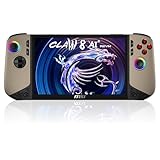
- Intel Core Ultra 7 258V – AI-Powered Efficiency: Next-gen Series 2 processor delivers 50% better GPU performance and 40% higher efficiency. 47 NPU TOPS accelerate local AI tasks – from Copilot+ to real-time game optimization.
- 8" 120Hz VRR Touch Display: FHD+ IPS screen with 500 nits sunlight readability. 16:10 golden ratio and VRR support eliminate tearing. Perfect for AAA gaming, streaming, or productivity on the go.
- 80Whr Battery + Fast Charge: Massive 80Whr capacity beats most handhelds. Fast charge gets you back in action quickly. Game longer, worry less – whether on a flight or a long commute.
- Revolutionary Intraflow Cooling: Redesigned airflow keeps internal components cool, preventing thermal throttling. Hall Effect analog sticks and triggers offer drift-free, microscopic precision – built to last.
- Unlimited Expansion: Connect external GPU for desktop-class graphics, dual 4K displays, or high-speed storage. Wi-Fi 7 delivers 5.8 Gbps and 2ms latency – lag-free cloud gaming and downloads.
MSI Claw versus the ROG Ally, Ally X, Steam Deck and Legion Go
ROG Ally and Ally X
The ROG Ally family commonly uses AMD Radeon 780M-class graphics through Ryzen Z1 Extreme hardware. The Arc 140V Claw 8 AI+ is generally the stronger graphics platform in the same low-to-mid-power range, particularly when both devices are configured similarly. It can also be more efficient at lower power limits.
What’s actually slowing this PC down?
Pick the symptom - the matching free tool is one click away.
That does not make the Claw automatically better. AMD handhelds have mature community tuning, broad familiarity and game-specific advantages. The exact model matters: Radeon graphics in a Z1, Z1 Extreme and newer AMD platform should not be treated as interchangeable. Compare the precise processor, TDP and price.
Steam Deck
The Steam Deck’s Van Gogh GPU belongs to a lower modern-game graphics class than Arc 140V. However, its 1280×800 target is less demanding than the Claw 8 AI+’s 1920×1200 panel, and SteamOS can provide a more console-like experience.
The Claw runs Windows 11, which is useful for PC Game Pass, non-Steam launchers and games whose anti-cheat systems do not work on SteamOS. The Steam Deck can still be the better choice for buyers who value Valve’s interface, shader-cache approach and integrated software experience over maximum graphics performance.
Lenovo Legion Go
Many Legion Go configurations use AMD graphics and compete in the same Windows handheld market. The Legion Go’s larger display and detachable-controller design may matter more than a small GPU-tier difference. Compare render resolution, power mode and price rather than assuming that every Legion Go has the same Radeon performance.
Rank #4
![EXCaliberPC [2025] MSI Claw 8 AI+ A2VM-001US (Intel Core Ultra 7 258V, 32GB LPDDR5X RAM, 1TB NVMe SSD, 8' FHD+ 120Hz, Windows 11) Gaming Handheld](https://m.media-amazon.com/images/I/413pN5OZb5L._SL160_.jpg)
- Display: 8" FHD+ (1920x1200) 120Hz 100% sRGB IPS-level Touch Screen
- Processor: Intel Core Ultra 7-258V 8 Cores (2.2GHz-4.8GHz, 12MB Intel Smart Cache)
- Graphics Card: Intel Arc Graphics 140V
- RAM: 32GB (Onboard) LPDDR5x-8533MHz | Hard Drive: 1TB NVMe SSD Gen4x4 2230
- OS: Microsoft Windows 11 Home | Warranty: 1-Year MSI USA Warranty Parts & Labor (include 1 Year Global Warranty) + Lifetime Tech Support from EXCaliberPC
What games can the Arc 140V run?
Think in terms of workload and settings rather than the GPU name alone.
Competitive and older games
Arc 140V is suited to esports, older PC games and less demanding titles at high frame rates. The Claw 8 AI+’s 120Hz display can be useful here, although a 120Hz panel does not mean demanding modern games will run at 120 frames per second.
Modern AAA games
A realistic starting point is 720p to 900p internal rendering, low or medium settings and an upscaler such as XeSS where available. Depending on the game, a reasonable target is roughly 30 to 60 FPS. The display can still output 1920×1200 while the game renders internally at a lower resolution.
For demanding titles, test the game with frame generation disabled first. Frame generation can improve displayed smoothness, but it does not remove the input latency and rendering limits of the underlying frame rate.
Recommended Free Tools
Ray tracing and emulation
Ray tracing is supported by modern integrated graphics but usually carries a large performance penalty. It should be treated as an optional feature, not the basis for the GPU comparison.
Best Value

- Exposure: 8" FHD (1920 x 1200), Touchscreen, 120Hz Refresh Rate, 100% sRGB (Typical), 500 Nits (Typical), VRR, IPS Level Panel
- Processor: AMD Ryzen Z2 Extreme
- Hall effect analog activators and sticks built to last with microscopic precision
- RAM: 24GB (Onboard) LPDDR5x-8533MHz | Hard Drive: 1TB NVMe Gen4x4 2230 SSD
- Revolutionary Cooler Boost HyperFlow technology redirects airflow to internal cooling components.
Emulation is even harder to predict from a GPU label. CPU performance, emulator version, operating system, game-specific compatibility and driver behavior can all matter. Arc 140V does not automatically guarantee better PlayStation 3, Switch or other demanding emulation results.
How to get the best Arc 140V performance
- Install Windows updates and reboot.
- Update MSI Center and the handheld’s firmware from the appropriate MSI support resources. Menu names and package availability can change.
- Install a current Intel graphics driver that supports the device. If a game becomes unstable after an update, compare with the MSI-validated package rather than assuming the newest generic driver is best.
- Test sustained performance at approximately 17W, 20W and 25W–30W. Maximum wattage is not always the best choice once heat, fan noise and battery drain are included.
- Use XeSS when the game supports it, then compare image quality and frame pacing with the upscaler disabled.
- Measure sustained FPS after several minutes of play. A short peak benchmark can hide thermal throttling.
- Monitor temperature, fan noise, battery drain and frame-time consistency, not just the average FPS number.
When comparing reviews, record the game version, graphics preset, render resolution, upscaler, frame-generation setting, driver version and TDP. Without those details, two apparently conflicting results may both be valid.
Should you buy an MSI Claw?
- Choose the Claw 8 AI+ when: you want Arc 140V’s high-end integrated graphics, an 8-inch 1920×1200 display, Windows compatibility and good low-power performance, especially at a competitive sale price.
- Choose an AMD handheld when: the model is substantially cheaper, you value established community tuning, Linux or Bazzite support, or a specific game is known to run better on Radeon graphics.
- Choose the original A1M only when: it is heavily discounted and you accept performance closer to a 780M-class handheld.
- Choose the Claw 8 EX AI+ when: maximum integrated-handheld performance matters more than price and you are comfortable buying a premium, newer platform.
- Choose the Steam Deck when: SteamOS simplicity and a console-like interface matter more than Windows launcher compatibility or peak graphics performance.
Do not compare one model’s sale price with another model’s launch price. The Claw 8 AI+ was listed at $899.99 for a U.S. 32GB/1TB configuration in review-era coverage, while the Claw 8 EX AI+ has been reported around $1,799. Retail prices vary by country, SKU and promotion, so verify the exact configuration before purchasing.
Bottom line
The best single answer is model-specific: the MSI Claw 8 AI+ is roughly a Radeon 890M-class handheld, the original Claw A1M is closer to Radeon 780M territory, and the Claw 8 EX AI+ is a separate Arc G3 Extreme flagship above both. None has a precise desktop-GPU equivalent. For a meaningful comparison, match the handheld’s power mode, resolution, memory, drivers and game settings—not just the GPU name.
Quick Recap
Product prices and availability are accurate as of the date/time indicated and are subject to change. Any price and availability information displayed on Amazon at the time of purchase will apply.

