Quick wins for a faster PC:
Repair Windows errors before they cause bigger problemsFix Now →Fix the driver behind crashes, sound loss and screen glitchesFind Drivers →Clear out junk files and repair common Windows errorsFree Scan →Direct answer: The easiest dependable way to play legally obtained SNES content in RetroArch is to install the official build, download the Nintendo – SNES / Famicom (Snes9x) core, load one game directly, configure a gamepad, and use a 4:3 or core-provided aspect ratio. RetroArch is the frontend; Snes9x, Mesen-S, and bsnes-family modules are the emulators that run the content.
Start with Snes9x rather than chasing maximum accuracy immediately. It gives most players the best balance of compatibility, performance, and features, while Mesen-S and bsnes variants remain useful upgrade paths for specific accuracy or compatibility needs.
As an Amazon Associate I earn from qualifying purchases.
RetroArch is the frontend; the core is the SNES emulator
RetroArch does not emulate the Super Nintendo by itself. It provides the menus, controller configuration, video options, save states, shaders, playlists, netplay, and other frontend features. A core is the emulator module that actually runs the game. For SNES software, the core you will usually want is Nintendo – SNES / Famicom (Snes9x).
What’s actually slowing this PC down?
Pick the symptom - the matching free tool is one click away.
The relationship is:
RetroArch frontend → Snes9x or another SNES core → legally obtained game content
#1 Best Overall

- ✅【Compatibility】Compatible with Raspberry Pi, Windows PC, Linux ,Mac. Specifically designed for playing classic old school retro snes games on computer or laptop.This is the USB controller what has a USB plug for PC, NOT compatible for Original SNES super Nintendo console
- ✅ 【Ergonomic Design】Super precise cross key and function buttons,the cross direction key adopts frosted concave design,anti-sweat and anti-slip.The shape of the controller is designed to fit the contour of your hands,easy and comfortable to hold.
- ✅ 【Advanced Game Experience】PC running operating system:Windows 98/2000/ ME/XP/Vista/Win7/8/8.1/11 or later,or Mac running OS X 10.0/Mac OS X or above.It works with most of emulators you wish to download and use,such as VirtuaNES(PC),sens9x,Zsens,sensgt,Uosnesw,RetroArch,OpenEmu(MAC),NESEmu and Jnes etc.
- ✅ 【Wired USB Connection】Standard USB 2.0 port with a 1.5 meters (5ft) cable, don't need to install any drivers, you must manually set the buttons and directionals within the emulator you're using, and the controller not automatically assigns buttons/directional axes. Notice: please download the game emulator first before start the games, you can download the emulator “VirtuaNES” on PC and “OpenEmu”on MAC.
- ✅【Satisfaction】Third party controller(USB Version), not for original snes console and not support for switch. If there is an incompatibility on MAC or Raspberry Pi , please contact the seller for a support.
That distinction explains most setup problems. RetroArch can open normally while a game fails because no compatible core is installed, and a game can be usable even when RetroArch cannot identify it during a playlist scan.
At the time this guide was researched, the official RetroArch platform page listed version 1.22.2 as the current stable release and showed support across desktop, mobile, and console platforms. Releases, menus, and capabilities can change, and a storefront build may not be identical to the full desktop download. Verify the version and limitations for your operating system on the official platform and download pages.
The recommended setup for most people
For a desktop, laptop, or mobile device, start with Snes9x. It offers the most practical balance of compatibility, speed, features, and simplicity for ordinary SNES use. Use the full desktop RetroArch build when you want the broadest feature set and the built-in updater, provided that build is available for your platform. Then:
- Install RetroArch from an official RetroArch download source.
- Install the Snes9x core through
Main Menu > Online Updater > Core Downloader. - Use game files you are legally entitled to use.
- Launch one game directly before building a playlist.
- Configure a real gamepad and keep the image close to the SNES’s original 4:3 presentation.
- Use core, folder, or game overrides for special settings instead of changing the global configuration.
Only move to Mesen-S or a bsnes-family core when a particular game, accuracy concern, or troubleshooting case gives you a reason.
What you need before installing
- RetroArch: Choose the official build for your operating system. Desktop builds obtained through package managers or storefronts can have different permissions, bundled components, or missing features.
- An SNES game file: RetroArch does not provide copyrighted games. The importing documentation assumes that you have already obtained your content legally.
- A controller: A keyboard can work for testing, but a SNES-style USB gamepad is the most natural choice for two-button, shoulder-button, and directional-pad games. Do not assume that every controller or adapter will have the same plug-and-play behavior on every operating system.
- Organized storage: Put SNES files in a stable folder such as
Games/SNES/. Keeping the folder and filenames consistent helps RetroArch find battery saves, save states, and playlists later.
Step-by-step: install and run your first SNES game
1. Install the right RetroArch build
Download RetroArch from the official RetroArch platform or download page, selecting your operating system and architecture. On a modern desktop, prefer the complete desktop build if you want the broadest capabilities and access to RetroArch’s built-in updater.
Storefront versions can be convenient, but they may not include every updater or directory-access feature available in the standalone build. If a menu described in this guide is absent, check the documentation for that specific distribution rather than assuming your installation is broken.
Launch RetroArch once after installation. This lets it create its configuration and user directories before you install a core or import content.
Windows Errors? Fix Them Before They Spread
Repair common Windows errors and clear accumulated junk for a smoother, more stable PC - no reinstall needed.Free scan · no reinstallCrashes, No Sound, or Screen Glitches?
Random freezes, missing sound and display glitches usually trace back to one bad driver. Find and replace yours safely.Free scan · under a minute2. Install Snes9x through Core Downloader
Open Main Menu > Online Updater > Core Downloader, then select Nintendo - SNES / Famicom (Snes9x). The exact menu arrangement can vary slightly by platform and build.
If Core Downloader is missing, the installation may have been supplied by a package manager that disables downloading cores from inside RetroArch. In that case, either install the core through the package manager or configure the core and system directories as required by that distribution. Installing a second, official desktop build is often simpler than mixing files from unrelated packages.
To confirm that the core is installed, open Main Menu > Load Core. You should see Snes9x in the list. Installing a core does not install games, BIOS files, or copyrighted content.
3. Prepare legally obtained game files
Common Snes9x file extensions include:
.smc, .sfc, .swc, .fig, .bs, and .st
Put the files in your organized SNES folder. A file extension alone does not prove that a file is valid, complete, or legally distributed, and a filename such as game.sfc does not tell RetroArch whether the contents match its database.
RetroArch itself does not supply ROMs. Nintendo’s legal and support materials identify downloading pirate copies and distributing unauthorized Nintendo game files as infringement. Use content you are legally entitled to use, and consult the law that applies where you live for questions about dumping cartridges, making backup copies, patches, translations, and BIOS or firmware files. Owning a physical cartridge does not automatically answer every jurisdiction-specific copying question.
4. Test a game directly
The fastest first test is:
- Choose
Main Menu > Load Content. - Browse to the game file.
- When RetroArch asks which core to use, select
Snes9x. - Wait for the game to start.
Testing a single file first separates core and content problems from playlist problems. If the game starts, the basic installation is working even if the file did not appear in a playlist.
You can also load the core first with Main Menu > Load Core, then choose Load Content. Manually selecting Snes9x is useful when another installed core has claimed the file type or when automatic core association is incorrect.
5. Import games into a playlist
Use Main Menu > Import Content and choose a scan option. RetroArch can compare files against the Libretro database, including identifying information such as CRC data, and then create a playlist with recognized titles and metadata.
Recommended Free Tools
Rank #2

- Wired Controller, USB cable: 1.8M.
- Compatible with Switch (version 3.0.0 or above), Windows, Raspberry Pi devices.
- Rumble vibration.
- Support turbo function.
There are two important scanning behaviors:
- Strict database scanning is tidy and can provide accurate names and metadata, but it depends on the file matching a known database entry. A different dump, translation, patch, header, revision, or naming arrangement may not match.
- Loose or manual scanning is more permissive. It can add playable files that are not recognized by the database, although the resulting playlist may have less accurate naming and artwork.
A failed scan does not necessarily mean that the game is unusable. First try loading the file directly with Snes9x. If it works, use loose scanning or add it manually. If the scanner behaves unexpectedly, run Online Updater > Update Core Info Files and Online Updater > Update Databases, then scan again. Labels may differ slightly between builds.
6. Configure the controller
Connect the controller before starting the game when possible. RetroArch normally maps a recognized controller to its virtual RetroPad, but you should verify the result in Settings > Input. Depending on the build, the relevant screen may be called RetroPad Binds, Port 1 Controls, or a similar input-binding page.
For a normal SNES layout, check that:
- the directional pad moves correctly;
BandAare assigned to the expected face buttons;XandYare assigned correctly;LandRreach the shoulder buttons;- Start and Select are easy to reach;
- the RetroArch hotkey combination does not conflict with an important in-game control.
Do not confuse RetroArch’s frontend hotkeys with the SNES buttons. The game receives the core’s controller mapping, while shortcuts such as opening the Quick Menu are handled by RetroArch.
7. Use the Quick Menu for game-specific work
While a game is running, open the Quick Menu using your configured hotkey or the platform’s menu shortcut. This is where you will find options such as:
Free tools Windows power users keep installed
One-click scans. No signup required.
- save states and state-slot selection;
- per-game controls and remapping;
- cheats;
- shaders;
- screenshots;
- recording;
- core options;
- overrides and restart or close-content commands.
Do not change every setting globally while trying to fix one game. Make the change, test it, and save it at the narrowest useful level: one game, one content folder, or one core.
Which SNES core should you use?
| Core | Best starting use | Important trade-off |
|---|---|---|
| Snes9x | General SNES and Super Famicom play on desktop, laptop, or mobile | The practical default; do not interpret that recommendation as proof that it is the most accurate option for every title or edge case |
| Mesen-S | Troubleshooting a title, seeking an accuracy-oriented alternative, or using supported SNES, Game Boy, Game Boy Color, or Super Game Boy features | Can carry a higher performance cost than Snes9x; additional accuracy options do not guarantee a visibly different result in every game |
| bsnes family | Readers deliberately exploring accuracy-focused emulation | There are multiple variants, so performance and behavior should be judged for the exact variant and version rather than generalized across the family |
Snes9x: the sensible default
The current Libretro Snes9x documentation describes it as a port of up-to-date upstream Snes9x and documents highly accurate SNES emulation, simplified MSU-1 support, softpatching, subsystem support, saves, save states, rewind, netplay, cheats, remapping, and controller support. Its documentation also recommends it for netplay.
That feature combination makes Snes9x the best first core for most readers. It is easy to configure, supports common cartridge-image formats, and avoids making the initial setup depend on the most demanding accuracy settings.
Mesen-S: an accuracy-focused alternative
Mesen-S is documented by Libretro as a high-accuracy, high-compatibility core for SNES and Super Famicom software. It also supports Game Boy, Game Boy Color, and complete Super Game Boy functionality. Its documented features include save states, rewind, netplay, cheats, controls, remapping, and softpatching.
Do these 3 things before closing this tab:
1Clear out junk files and repair common Windows errors2Scan for outdated or missing drivers - takes under a minute3Repair Windows errors before they cause bigger problemsChoose Mesen-S when Snes9x exposes a title-specific problem, when you want to investigate a behavior with another emulator implementation, or when its additional options are relevant to your setup. The official documentation indicates a higher performance cost than Snes9x in its achievement-support comparison. That is a reason to test it rather than an indication that every game will run better or look visibly different.
Where bsnes fits
The official Libretro core list includes several bsnes variants alongside Snes9x and Mesen-S. bsnes is commonly considered an accuracy-oriented family, but the variants are not interchangeable for purposes of performance or feature claims. If you choose one, read the documentation for that exact core and version, then test the games and settings that matter to you.
ROM formats, patches, and firmware
For ordinary SNES cartridges, Snes9x generally needs only a compatible game image. Optional firmware files are relevant to particular functions, such as BS-X or Sufami Turbo support, not to normal cartridge games.
Snes9x documents softpatching, which can allow a compatible patch to be applied at launch without permanently modifying the original game file. Support and expected file naming depend on the core and patch format. Keep an untouched backup of your original legally obtained content and treat patched files as separate working copies.
Do not download BIOS files, ROMs, or firmware from random sites simply because a game fails to load. First identify whether the title actually requires that component. Ordinary SNES software should not be turned into a BIOS-hunting exercise.
Video settings: preserve the SNES presentation first
Begin with the core-provided aspect ratio or a correctly configured 4:3 presentation. SNES output was designed around a 4:3 display, so forcing it to fill a modern widescreen monitor can make characters and backgrounds look unnaturally wide.
In the running game, open the Quick Menu and inspect the Snes9x core options. Depending on the version, you may find controls for preferred aspect ratio, region, overscan cropping, NTSC filtering, audio interpolation, and other compatibility-related behavior. Use the default or core-provided choices first, then change one option at a time.
Rank #3

- 【Supported Operating System】The Game Controller is specifically designed for playing classic old school retro snes games on computer or laptop. Compatible with Windows 98 / ME / Vista / 2000/2003 / XP / 7 / 8 / 8.1 / 10/11, Mac OS X/ OS X 10.0 and beyond, Raspberry Pi, Raspberry PI 2 model B,Model A, Raspberry Pi 1 Model B+, Raspberry Pi 2,Raspberry Pi OS, Raspberry Pi 3 Model B+, Raspberry Pi 3, Raspberry Pi Zero.
- 【Simple USB Plug and Play】If your program or application accepts USB controller input, this classic game controller do not need install drivers or patches. 1.5 meter external cable(approx. 5 ft. Long). Notice: Please download the game emulator first before start the games, and then you must manually set the buttons and directionals within the emulator you're using, and the controller not automatically assigns buttons/directional axes. If on the Steam platform, you need to first enable Steam's "Universal Controller Configuration Support" and then restart Steam. After entering the game, you also need to manually bind key positions in the game
- 【High Sensitivity without Delay】Super sensitive buttons for precision control: 6 fire buttons, a 'Start' button and a 'Select' button, motion control cross. Play your favorite old school games with classic retro feel. Fits perfectly in the hand and also perfect for two player action.Note: Not applicable to Switch/PS games. Not Compatible with TV/ TV Box, third Mini Games Box and Tesla Model 3
- 【Supported Game Emulators】The game controller works with most emulators. Download any emulator you wish to download and use from Google and do the same with ROMS. Notice:Third party controller, not original controller. But it works phenomenal with the Raspberry Pi game emulation and so on
- 【Product Service】If you have any problem during use, send message to us and we will help you to solve the problem soon
Shaders are optional filters, not magic accuracy switches
RetroArch shaders are efficient graphical filters that can change the appearance of the rendered image. A light CRT-style shader can soften hard pixel edges or add scanline-like characteristics, while no shader gives you a clean digital presentation. Neither choice perfectly recreates original hardware on every display.
The Tool Desk
Outbyte PC Repair FREEClear out junk files and repair common Windows errorsFree Scan →Outbyte Driver Updater FREEFix the driver behind crashes, sound loss and screen glitchesFind Drivers →A good progression is:
- Start with no shader and confirm that the game is correctly proportioned.
- Try a light CRT-style preset if you want a softer presentation.
- Disable the shader again if video begins to stutter or the image becomes too dark, blurry, or distracting.
- Save the final choice as a core or game override rather than imposing it on every system.
Be cautious with hacks and unsafe options
Snes9x exposes options that can alter emulation behavior, including SuperFX overclocking, slowdown reduction, opposing-direction handling, sprite-flicker reduction, and memory randomization. These can be useful for a specific problem, but options labeled as hacks or unsafe can also introduce glitches or compatibility failures. Leave them off unless you understand the reason for enabling one and have tested the affected game.
Controls, two-player games, and unusual peripherals
For ordinary two-player SNES games, configure the first and second controller ports in RetroArch’s input settings. If Player 2 does not respond, check that a second physical controller is connected and that its port is not disabled or assigned to the wrong user.
Use the game’s Quick Menu remapping tools when a control scheme is uncomfortable or a particular title needs a different layout. Remapping changes the relationship between the core’s virtual buttons and your physical controller; it does not necessarily change the game’s own button prompts.
Some SNES software uses devices beyond a standard controller. Mesen-S documents support for SNES Controller, SNES Mouse, Super Scope, and multitap device types for applicable scenarios. Its documentation describes multitap use through the User 2 device type. Snes9x documents controller support and remapping, but that does not establish universal support for every original SNES peripheral. Select the appropriate core-level device type when required, and expect peripheral support to vary by core and game.
Save files and save states are different
Use both types deliberately:
- In-game battery saves are the normal saves created through the game’s own menu. Snes9x documentation identifies
.srmfiles for cartridge battery saves. - Save states are snapshots made by the emulator at an arbitrary moment. Snes9x documentation identifies
.state#files for save states, where the number represents the state slot.
Battery saves are the better long-term record of progress. Save states are convenient for difficult sections, experimentation, and games with infrequent save points, but they should not be your only backup.
Back up both your save files and your state files. Avoid casually moving, renaming, or replacing the game after creating them: filename and directory conventions affect whether RetroArch can discover the associated saves. If progress seems to have vanished, check that you launched the same content revision, that the game filename and folder are unchanged, and that RetroArch is using the expected save-file directory.
Overrides and remaps: keep a clean configuration
RetroArch gives you several levels at which to save changes:
- Global settings: affect many or all cores and games.
- Core overrides: apply settings to games using one core, such as all Snes9x content.
- Content-directory overrides: apply settings to a folder, useful for a specific collection or display setup.
- Game overrides: apply settings to one title.
- Remap files: save controller-button changes separately from broader core or video settings.
After changing a setting in a running game, open Quick Menu > Overrides and choose the appropriate save command, such as Save Core Override, Save Content Directory Override, or Save Game Override. For controls, use Quick Menu > Controls and save a core, directory, or game remap. Labels vary by version.
This hierarchy prevents a fix for one title from unexpectedly changing every SNES game. If a game-specific fix stops being useful, delete or replace the narrow override instead of rebuilding your entire RetroArch configuration.
Netplay: what must match
RetroArch includes netplay and a built-in lobby. Its implementation uses delayed network input together with invisible rewind and replay so clients can converge toward a consistent emulation state. That design reduces the effect of ordinary network delay, but it does not make online play immune to mismatches or poor connections.
Before hosting or joining, match as many variables as possible:
- RetroArch version and core version;
- the exact game dump or content revision;
- region and other core options;
- controller assignments;
- relevant overrides and cheats.
Snes9x is the practical first choice for netplay according to its Libretro documentation. If a session desynchronizes, align the core, content revision, region, and settings before experimenting with advanced network options. Do not assume that two files with the same displayed title are byte-for-byte identical.
The Tool Desk
Outbyte PC Repair FREERepair Windows errors before they cause bigger problemsFix Now →Outbyte Driver Updater FREEScan for outdated or missing drivers - takes under a minuteDriver Scan →Troubleshooting by symptom
RetroArch opens, but the game will not start
- Open
Load Coreand confirm that Snes9x is installed. - Load the core manually, then use
Load Content. - Confirm that the file has a format Snes9x supports and that it is not incomplete or corrupted.
- Try a known-good file that you are legally entitled to use, without changing several settings at once.
If another core is selected automatically, manually choose Snes9x and test again.
The game runs, but it is absent from the playlist
This is usually a database or scanning issue rather than an emulation issue. Update core information files and databases, retry the scan, and use loose or manual scanning if strict database matching does not recognize the file. Direct loading is still a valid way to play content that does not receive playlist metadata.
Rank #4
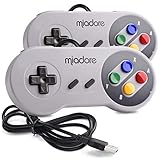
- ✔ Compatible with Windows98/ME/Vista/2000/2003/XP/7/8/8.1/10; Mac OS X and beyond ; Emulators ;Raspberry Pi ;Raspberry PI 2 model B ;Retro Pi OS; Retropi System.
- ✔ Simple USB plug and play, no drivers and software required. Note: If you have trouble with using this, make sure it is plugged in before starting your emulator. Also go into input settings and you may have to map the buttons.
- ✔ Work with any emulator you wish to download and use. Google S-N-E-S emulator and then the same for Roms. Way better than normal joypad and keyboard and mouse playing to really enjoy the emulator experience.
- ✔ Super sensitive buttons for precision control, Eight-way directional pad and six digital buttons. Play your favorite old school games with authentic retro feel. Arrowed D-pad, concave X and Y buttons, convex A and B buttons, rubber start and select buttons. Cord is approx. 5 ft. Long, providing a comfortable distance while playing.
- ✔ If you want to play S-N-E-S, N-E-S, PSX, Atari, Genesis, or any other types of this vintage of games... get this. You will not regret it. NOTE:Third party controller, not original S-N-E-S / N-E-S controller. But it works phenomenal with the Raspberry Pi game emulation and so on.
The controls are wrong
First check the detected controller and the Player 1 port in Settings > Input. Then open the game’s Quick Menu, use Controls to remap the buttons, and save a game- or content-directory remap. If every SNES title has the same problem, check the core-level mapping before creating individual game fixes.
The picture is stretched
Disable forced widescreen and choose the core-provided aspect ratio or 4:3. Check both RetroArch’s general video scaling settings and Snes9x’s core options, including overscan cropping. Apply a shader only after the geometry is correct; a shader cannot repair an incorrectly stretched image.
Audio or video stutters
Use a simple troubleshooting order:
- Disable demanding shaders.
- Turn off rewind, recording, and experimental or unsafe hacks.
- Restart the game and test Snes9x with its ordinary settings.
- Only then test a more demanding accuracy-oriented core such as Mesen-S, if you have a specific reason to do so.
This is a practical diagnostic sequence based on the documented feature and performance differences, not a hardware benchmark or a universal performance requirement.
The save or state is missing
Confirm that you launched the same game file and have not changed its filename or directory. Check the configured save-file location, verify that the correct core is loading the content, and look for both the .srm battery-save file and the relevant .state# file. Restore from a backup before deleting or overwriting anything.
Netplay desynchronizes
Make the content file, core, RetroArch version, region, settings, and cheats match on every system. Start with a fresh session and avoid changing core options after connecting. Advanced network adjustments should come after content and emulation state are synchronized.
Recording, streaming, and rights
RetroArch can record gameplay locally through its recording tools. That is different from a cloud service that repeatedly broadcasts a prerecorded file. If you create tutorials, setup demonstrations, or gameplay recordings for which you have the necessary rights, StreamNeo may fit an advanced workflow for cloud livestreaming for YouTube: upload your own prerecorded video, connect the channel, and let the service loop it with automatic recovery.
Recommended Free Tools
StreamNeo is not a replacement for RetroArch’s local recording, and it does not provide live netplay. More importantly, only stream gameplay, music, commentary, tutorials, and other material you have the right to publish. Owning a game or using an emulator does not automatically grant permission to rebroadcast copyrighted footage, music, or other assets under every platform’s rules.
You do not need a capture card when the game is already running locally inside RetroArch and you are recording that same computer. Capture hardware becomes relevant to a different workflow, such as recording output from a separate physical console or external device.
Optional Windows performance troubleshooting
RetroArch does not require a PC-cleanup utility. If SNES emulation is slow, begin with the documented fixes above: use Snes9x, disable demanding shaders and background features, check the official RetroArch build, and investigate drivers or competing processes.
If a Windows computer has broader problems with clutter, excessive background processes, missing updates, or general system performance, Outbyte PC Repair is an optional utility whose official product information describes cleanup, performance optimization, privacy and security checks, missing-update alerts, and an application-prioritization boost. Treat it as a conditional Windows troubleshooting tool, not as an emulator-specific fix. It does not replace official installers, hardware or graphics drivers, or antivirus protection, and results can vary.
What’s actually slowing this PC down?
Pick the symptom - the matching free tool is one click away.
A reliable final checklist
- Use an official RetroArch build appropriate for your platform.
- Check the installed version and remember that storefront builds can differ from the full desktop build.
- Install
Nintendo - SNES / Famicom (Snes9x)from Core Downloader or your distribution’s supported package source. - Use legally obtained game content; RetroArch does not include ROMs.
- Test direct loading before troubleshooting playlist scanning.
- Use loose or manual scanning when a playable file does not match the database.
- Configure Player 1 and Player 2 before starting multiplayer games.
- Use 4:3 or the core-provided aspect ratio before experimenting with shaders.
- Leave hacks and unsafe options disabled unless a specific title requires testing them.
- Back up both
.srmbattery saves and.state#save states. - Save game-specific changes as overrides or remaps rather than altering global settings.
- For netplay, match core versions, content revisions, regions, settings, and cheats.
Frequently Asked Questions
Does RetroArch come with SNES games?
No. RetroArch is a frontend and does not include copyrighted SNES games. You must provide content you are legally entitled to use, and jurisdiction-specific rules may apply to dumping or backup copies.
Which RetroArch core is best for SNES?
Start with Nintendo – SNES / Famicom (Snes9x). It is the most practical general-purpose choice for most desktop, laptop, and mobile users. Try Mesen-S for an accuracy-oriented alternative or a title-specific troubleshooting case.
Why is my SNES game missing from the RetroArch playlist?
Not necessarily. Strict playlist scanning depends on matching the Libretro database, so a file can be playable but unrecognized. Try loading it directly with Snes9x, update core information files and databases, or use loose or manual scanning.
What is the difference between an SNES save file and a RetroArch save state?
No. An in-game battery save is normally stored as an .srm file, while a save state is an emulator snapshot stored as a .state# file. Back up both, but rely on in-game saves for your primary long-term progress.
Free tools Windows power users keep installed
One-click scans. No signup required.
The Bottom Line
For most readers, the dependable path is the current official RetroArch desktop build, the Snes9x core, legally obtained SNES content, a properly configured gamepad, and a 4:3 presentation. Add Mesen-S, bsnes variants, shaders, special peripherals, or streaming tools only when a specific need justifies the added complexity.
Quick Recap
Product prices and availability are accurate as of the date/time indicated and are subject to change. Any price and availability information displayed on Amazon at the time of purchase will apply.




