A forgiving golf club reduces the performance penalty when the ball misses the center of the face. A driver head’s moment of inertia (MOI) is one official indicator: it measures resistance to twisting. But MOI is not a complete forgiveness score. Strike location, face design, center of gravity, launch and spin, and the golfer’s swing all affect what happens on a mishit.
What “forgiveness” means in a golf club
Forgiveness is about limiting the consequences of off-center contact—not simply making a club hit the ball farther. Depending on the strike and the club, those consequences can include lost ball speed or distance, a change in launch and spin, and a shot that finishes farther offline.
As an Amazon Associate I earn from qualifying purchases.
A toe strike and a heel strike do not necessarily produce the same result. The head’s tendency to twist, the face’s curvature (often discussed as bulge), and the club’s center-of-gravity (CG) position all influence the ball’s flight. Lower, deeper CG is often used to support easier launch and stability, but it is not a guarantee of better results for every golfer.
How MOI indicates forgiveness
Moment of inertia is a measure of resistance to angular acceleration around a specified axis. In practical terms, mass distributed farther from that axis can make a head more resistant to twisting when impact is off-center. That resistance may help preserve ball speed and limit distance loss or dispersion, though it cannot eliminate the effects of a mishit.
#1 Best Overall
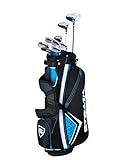
- The Strata 12-Piece Men's is designed to give you maximum performance right out of the box for more confidence from tee-to-green. The lightweight 460cc forged driver, fairway wood, hybrid, irons and putter make up a set that provides a great combination of distance, forgiveness and control, and is very easy to hit.
The USGA’s Equipment Rules describe driver-head MOI as “a measurement of its resistance to twisting and, therefore, it is one indication of the ‘forgiveness’ of a clubhead.” USGA Equipment Rules, Rule 4b(3)
The USGA driver limit
For the rule’s specified test, the club is set at a 60-degree lie angle and MOI is measured around the vertical axis through the clubhead’s center of gravity. The limit is 5,900 g·cm², with a 100 g·cm² test tolerance. This is a conformance limit for a defined driver-head measurement and setup—not a universal forgiveness rating for every club or a score that captures every aspect of playability. USGA Equipment Rules, Rule 4b(3)
Rank #2
![PGF Labs Men's BD-77 Complete Golf Club Package Set [14-Pieces][Flex: Regular] [Hand: Right] [Length: Standard]](https://m.media-amazon.com/images/I/51BmW4rGzCL._SL160_.jpg)
- Driver – High Launch & Maximum Forgiveness:Lightweight 460cc titanium driver designed for fast ball speed and easy distance. Features a deep, low center of gravity and a generous sweet spot to deliver straighter, more controlled drives. (Headcover included)
- #3 Fairway Wood – Effortless Distance:Oversized fairway wood built for easy launch and long carry. The aerodynamic profile and low CG help produce high-flying, stable shots from the tee or fairway. (Headcover included)
- Hybrids – Easy to Hit From Any Lie:Hybrid clubs engineered for versatility and confidence. A wide sole, low CG, and lightweight build promote fast swings and high launch, making tough lies easier to handle. (Headcover included)
- Irons Set (6I/7I/8I/9I/PW/ SW) – Forgiving & Consistent:Perimeter-weighted irons designed for stability and accuracy. Lower CG encourages higher launch, while the multi-purpose sole improves turf interaction for cleaner contact and more consistent results.
- Putter – Classic Balance & Better Alignment:Matte-finish putter with an L-neck hosel for natural alignment and smoother roll. High-contrast sight lines assist aim, while the parallel grip helps keep hand pressure even for a more repeatable stroke.
How forgiveness can be compared in practice
There is no single standardized consumer score that measures every dimension of forgiveness across clubs and golfers. The USGA’s MOI rule measures one defined component for driver heads. A useful comparison instead examines outcomes on strikes away from the center, ideally under controlled conditions and at locations that reflect the golfer’s usual misses.
Crashes, No Sound, or Screen Glitches?
Random freezes, missing sound and display glitches usually trace back to one bad driver. Find and replace yours safely.Free scan · under a minutePC Slower Than It Used to Be?
A free scan shows the junk files, broken settings and background clutter dragging Windows down - then fixes them in one click.Free scan · Windows 10 & 11- Ball-speed retention and distance loss: Compare how much speed or distance remains on heel, toe, and low-face strikes versus centered contact.
- Dispersion and curvature: Look at where those misses finish and how their flight changes, rather than assuming every high-MOI club will keep a mishit straight.
- Launch and spin: Check whether the club produces suitable launch and spin for the golfer’s swing, including on imperfect strikes.
- Fit and confidence: Consider head shape, shaft, loft, lie, adjustability, and any draw bias. A draw-biased head may suit a golfer whose common miss is a slice, but may be a poor match for someone who tends to miss left.
The USGA’s Distance Insights Report (2020) summarizes research associating higher MOI with lower distance loss and less offline dispersion on off-center strikes, including in irons. That is a performance tendency, not a promise that a particular mishit will travel farther or stay on line. Consumer strike testing can help compare outcomes, but it is not the USGA conformance test.
Rank #3
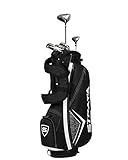
- Complete Set: Includes Driver, 5 Hybrid, 7 & 9 Irons, Sand Wedge, Putter, Stand Bag, and 2 Headcovers for comprehensive golfing
- Driver: Lightweight 460cc Forged Design with Large Sweet Spot and Titanium Head for Maximum Distance
- Oversized Fairway Wood for Long, High-Flying Shots with Ease
- Hybrid for Difficult Long Irons, Providing Versatility and Control
- Stainless Steel Irons for a Combination of Forgiveness and Control, Mallet Putter with Alignment for Accuracy
Why a golfer cannot verify official MOI at home
The USGA’s interpretation describes a specialized test that requires the clubhead to be de-shafted. A simple home measurement should not be presented as verification of conformance MOI. For a practical buying decision, use controlled product testing or a fitting to compare clubs against the golfer’s actual strike pattern and delivery. USGA, Rule 5 Interpretations: Moment of Inertia
Independent reader supportYour contribution helps us test, update, and keep practical guides available for everyone.Choosing a forgiving club for your miss
Start with where your imperfect strikes tend to land. A club that retains speed on toe strikes may not be the best choice if your common miss is low on the face; likewise, a head’s directional bias may help one golfer and hurt another. Compare the candidate clubs on the same relevant strike locations, then consider whether their launch, spin, shaft, lie, adjustability, and appearance work for you. There is no single most-forgiving driver for every player, because forgiveness depends on the miss and on the fit. Golf Monthly, forgiving-driver guide; Golf Monthly, forgiving-irons guide
Quick Recap
Best Value
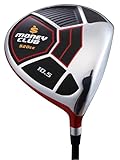
- Right Handed / 10.5° Loft
- 520cc Size (Non-Conforming by USGA Standards)
- Premium Standard Size Black Velvet Grip
- Premium Lightweight Graphite Shaft - Regular Flex
- 44 1/2 Inches TOTAL Length - SLIGHTLY SHORTER THAN MEN'S STANDARD LENGTH FOR BETTER CONTROL AND ACCURACY (Includes DRIVER Headcover)
Rank #4
![PGF Golf Gold TP Men's Complete Golf Club Package Set [17-Pieces][Flex: Regular] [Hand: Right] [Length: Standard]](https://m.media-amazon.com/images/I/71yy68nLETL._SL160_.jpg)
- #1 Driver:Lightweight 460cc titanium forged driver with low-back CG, large sweet spot, and optimized inertia system for maximum forgiveness, speed, and longer controlled drives. (Headcover included)
- #3 Fairway Wood:Oversized aerodynamic head with low CG for easy launch, high flight, and maximum distance with added forgiveness. (Headcover included)
- #3 & #4 Hybrids:Lightweight construction with low CG and versatile sole design for high-launching shots from any lie, boosting swing speed and confidence. (Headcovers included)
- Irons #5–PW, SW:Advanced perimeter weighting and lower CG promote high launch, forgiveness, and playability. Optimized sole geometry ensures smooth turf interaction for consistent performance.
- Putter:Classic matte L-neck putter with offset for improved roll. Bold sight lines enhance alignment, and parallel grip ensures equal pressure for a confident, stable stroke.
Product prices and availability are accurate as of the date/time indicated and are subject to change. Any price and availability information displayed on Amazon at the time of purchase will apply.
What’s actually slowing this PC down?
Pick the symptom - the matching free tool is one click away.




