Recommended Free Tools
The RTX 5070 Ti version of the 2025 Asus ROG Zephyrus G14 is almost as fast as the RTX 5080 version in games—but only because both GPUs are limited to 110 W. Notebookcheck’s testing found a typical gaming advantage of roughly 3–11% for the RTX 5080, while the cheaper RTX 5070 Ti model retains 12 GB of GDDR7 VRAM, a 3K OLED display and the same compact design.
That makes the RTX 5070 Ti the stronger gaming-value choice when the price gap is large. The RTX 5080 remains worthwhile for buyers who need 16 GB of VRAM, run demanding ray-traced games or creative workloads, or find the two configurations priced closely together.
As an Amazon Associate I earn from qualifying purchases.
The important detail: this is a 110-W comparison
The headline does not describe every laptop RTX 5070 Ti and RTX 5080. It describes the 2025 ROG Zephyrus G14 implementations, where both GPUs have an 85-W base power rating and up to 25 W of Dynamic Boost, for a 110-W maximum.
That power ceiling limits the RTX 5080 more than it would in a larger gaming laptop with a stronger cooling system. The RTX 5070 Ti can therefore run relatively close to its larger sibling, compressing the difference shown by the GPU names.
#1 Best Overall
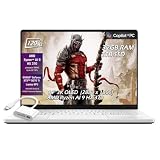
- ✔【Screen】 14 inches 2880 x 1800 OLED 3K 120Hz G-SYNC 500 nits;
- ✔【Memory & Storage】 32GB LPDDR5X 8000MHz megahertz and 2TB Solid State Drive (SSD) storag;
- ✔【Processor】 AMD Ryzen AI 9 HX 370 Processor 2 GHz (up to 5.1 GHz, 12-cores);
- ✔【Graphics】 NVIDIA GeForce RTX 5070 Ti 12GB GDDR7, DLSS 4 (Deep Learning Super Sampling), Ray tracing;
- ✔【Connectivity】 2 x USB-A 3.2, 1 x USB-C 3.2, 1 x USB-C 4, 1 x HDMI 2.1, Headphone Jack, Wireless Standard BE, WiFi 7, Bluetooth;
A higher-powered RTX 5080 laptop can be considerably faster. Compare the complete laptop implementation—TGP, cooling, BIOS profile and CPU—not just the GPU label.
Test configuration
Notebookcheck tested the RTX 5070 Ti model with an AMD Ryzen AI 9 HX 370 processor, 32 GB of onboard LPDDR5X-8000 memory and a 2 TB SSD. The review unit also included:
- 14-inch 2880 × 1800 OLED display at 120 Hz
- 12 GB GDDR7 VRAM
- 110-W maximum GPU power, including Dynamic Boost
- 73-Wh battery
- Wi-Fi 7, Bluetooth 5.4 and a 1080p IR webcam
- Windows 11 Home and a 200-W power adapter
- Approximately 1.576 kg (3.47 lb)
Exact specifications vary by region and SKU. Asus’s US listings can differ in memory, storage, operating system, display configuration and price, so check the model number before buying from a retailer.
Gaming performance: close, but not identical
The measured results support “almost as fast” in this chassis, although the RTX 5080 maintains a lead that varies by game, resolution and workload.
1080p results
| Test | RTX 5070 Ti | RTX 5080 | RTX 5080 lead |
|---|---|---|---|
| Cyberpunk 2077 Ultra, FSR off | 104.9 fps | 109.9 fps | About 5% |
| Gaming performance rating | 90.6 | 94.0 | About 4% |
At 1080p, some games become CPU-limited or fast enough that the extra GPU resources have limited practical impact. Baldur’s Gate 3, for example, reached 144 fps on the RTX 5080 in the listed comparison, but a single result should not be treated as a universal percentage.
Rank #2

- ✔【Screen】 14 inches 2880 x 1800 OLED 3K 120Hz G-SYNC 500 nits;
- ✔【Memory & Storage】 32GB LPDDR5X 8000MHz megahertz and 1TB Solid State Drive (SSD) storag;
- ✔【Processor】 AMD Ryzen AI 9 HX 370 Processor 2 GHz (up to 5.1 GHz, 12-cores);
- ✔【Graphics】 NVIDIA GeForce RTX 5070 Ti 12GB GDDR7, DLSS 4 (Deep Learning Super Sampling), Ray tracing;
- ✔【Connectivity】 2 x USB-A 3.2, 1 x USB-C 3.2, 1 x USB-C 4, 1 x HDMI 2.1, Headphone Jack, Wireless Standard BE, WiFi 7, Bluetooth;
QHD results
| Game and setting | RTX 5070 Ti | RTX 5080 | RTX 5080 lead |
|---|---|---|---|
| Cyberpunk 2077 Ultra, FSR off | 71.7 fps | 79.6 fps | About 11% |
| Baldur’s Gate 3 Ultra | 97.6 fps | 106.9 fps | About 10% |
| GTA V Highest | 117.3 fps | 120.6 fps | About 3% |
| F1 24 Ultra High | 60.4 fps | 66.8 fps | About 11% |
| Alan Wake 2 High | 54.6 fps | 60.3 fps | About 10% |
| QHD gaming performance rating | 93.9 | 98.0 | About 4% |
At the display’s native 2880 × 1800 resolution, the RTX 5080’s advantage is more visible in demanding games. Even so, the gap is usually incremental rather than transformative in this 110-W design.
Ray tracing, high-resolution texture packs and memory-heavy engines can widen the difference. Conversely, CPU-limited games, lower resolutions and settings that use upscaling can narrow it. DLSS Frame Generation should also be considered separately from rendered-frame performance: generated frames improve perceived smoothness but do not represent raw GPU throughput.
What’s actually slowing this PC down?
Pick the symptom - the matching free tool is one click away.
Synthetic benchmarks
Notebookcheck’s overall 3D performance rating gave the RTX 5070 Ti G14 89.8 points and the RTX 5080 G14 98.2 points. In 3DMark 11, the respective scores were 50,966 and 54,868, an advantage of approximately 8% for the RTX 5080.
These results show that the 5080 retains superior hardware capability, but they are less useful to most buyers than the game results. The shared power limit is the central reason the real-world gaming gap is smaller than the GPU hierarchy suggests.
What the RTX 5080 really adds
16 GB instead of 12 GB of VRAM
The biggest practical difference is memory capacity. The RTX 5070 Ti model has 12 GB of GDDR7; the RTX 5080 has 16 GB.
Rank #3

- AI-powered: Yes
- Processor Manufacturer: AMD
- Processor Type: Ryzen AI 9
- Processor Model: HX 370
- Processor Core: Dodeca-core (12 Core)
That extra 4 GB can matter when a game uses demanding ray tracing or high-resolution textures, and it gives the RTX 5080 more room for professional 3D work, GPU-accelerated video applications and local AI workloads. It does not guarantee a 33% frame-rate increase, but it can prevent memory limits that cause stuttering, reduced texture quality or an inability to use certain settings.
Outdated Drivers Are Slowing You Down
One free scan finds every outdated or missing driver and matches the right update for your exact hardware.Free scan · exact hardware matchWindows Errors? Fix Them Before They Spread
Repair common Windows errors and clear accumulated junk for a smoother, more stable PC - no reinstall needed.Free scan · no reinstallFor a buyer who primarily plays at 1920 × 1200 or uses sensible upscaling at 2880 × 1800, 12 GB is more immediately comfortable than the headline specification may suggest. For a long ownership period or memory-intensive work, 16 GB is the stronger specification.
How it compares with the 2024 G14
Notebookcheck found the 2025 RTX 5070 Ti G14 approximately 25% faster in gaming benchmarks than the 2024 G14 with an RTX 4070 Laptop GPU. It was also approximately 20% faster than an 85-W RTX 5070 configuration, particularly at QHD.
Those are review-platform comparisons, not guarantees for every laptop. TGP, cooling, drivers, CPU choice and BIOS settings can change the result. They nevertheless show that the RTX 5070 Ti configuration is a meaningful generational upgrade over the previous G14’s RTX 4070 model.
Display: excellent for games and creative work, with caveats
The tested G14 uses a 14-inch 16:10 OLED panel with a 2880 × 1800 resolution, 120-Hz refresh rate, G-Sync support and full DCI-P3 coverage. Asus lists Pantone validation, and the review described the factory calibration as very good.
Rank #4

- ✔【Screen】 14 inches 2880 x 1800 OLED 3K 120Hz G-SYNC 500 nits;
- ✔【Memory & Storage】 32GB LPDDR5X 8000MHz megahertz and 1TB Solid State Drive (SSD) storag;
- ✔【Processor】 AMD Ryzen AI 9 HX 370 Processor 2 GHz (up to 5.1 GHz, 12-cores);
- ✔【Graphics】 NVIDIA GeForce RTX 5070 Ti 12GB GDDR7, DLSS 4 (Deep Learning Super Sampling), Ray tracing;
- ✔【Connectivity】 2 x USB-A 3.2, 1 x USB-C 3.2, 1 x USB-C 4, 1 x HDMI 2.1, Headphone Jack, Wireless Standard BE, WiFi 7, Bluetooth;
OLED provides strong contrast and vivid color, making the display attractive for games, films and color-sensitive work. The drawbacks are equally relevant:
- The glossy surface can reflect windows and room lighting.
- Maximum HDR brightness is limited compared with the best high-brightness displays.
- The review recorded PWM flickering. Sensitivity varies between individuals, but buyers who are affected by PWM should check the panel in person or use a retailer’s return policy.
- Native 2880 × 1800 gaming is substantially more demanding than 1080p or 1920 × 1200. Upscaling and, where appropriate, Frame Generation may be needed in demanding titles.
Portability, thermals and noise
The G14’s main appeal is performance density. At roughly 1.576 kg and about 18.3 mm thick in the reviewed configuration, it is much easier to carry than most 16-inch gaming laptops. Asus’s advertised measurements vary by configuration, so the charger must be included in any realistic travel calculation: the 200-W adapter adds meaningful weight.
The trade-off is unavoidable. A Ryzen AI 9 HX 370 and a 110-W discrete GPU inside a thin 14-inch chassis create substantial heat, particularly during sustained gaming. Notebookcheck flagged loud fans and occasionally pulsating fan behavior. The laptop is best treated as a plugged-in performance machine when gaming; its compactness does not make it silent or equivalent to a low-power ultraportable.
Battery life and everyday use
The review rated battery performance positively and found an improvement over the prior generation. That should be read as a portability benefit, not as a promise of long, high-performance gaming away from an outlet.
Free tools Windows power users keep installed
One-click scans. No signup required.
Web browsing, video playback and light productivity can produce very different results from gaming. Brightness, 120-Hz operation, Optimus or discrete-GPU mode and the workload all affect runtime. Gaming on battery also reduces the performance available compared with using the 200-W adapter.
Best Value

- The AMD Ryzen AI 9 HX 370 Processor Blends Power and Performance with Ease Armed with 12 cores and 24 threads, AMD Ryzen AI 9 HX 370 Processor powers your laptop with ease. With up to 50 TOPS in AI Performance, its integrated AI Accelerators are ready to enhance your experience.
- Experience Cutting Edge Graphics With NVIDIA GeForce RTX 5080 Laptop GPU Maximize your gaming and creativity with NVIDIA GeForce RTX 5080 GPU. Game-changing features like DLSS 4 and ray racing technology bring game graphics to life by simulating sunlight and creating a realistic environment for an immersive gaming experience.
- OLED ROG Nebula Display and NVIDIA G-SYNC Uplevel your visual experience with the Zephyrus G14's OLED Display certified with the ROG Nebula Display standards. Enjoy rapid 0.2ms response times, a vivid 3K resolution, and a smooth 120Hz refresh rate. With NVIDIA G-SYNC, eliminate visual tearing, minimize stuttering, and reduce input lag.
- Windows Copilot+ AI Acceleration Meet Copilot+ in Windows – your AI-accelerated assistant for quick answers, creative inspiration, and focused tasks without breaking a sweat. Boost productivity with fast answers, image generation, and more. Elevate your Windows 11 experience and unleash creativity!
- Enjoy Seamless Multitasking With 32GB of LPDDR5X RAM Equipped with 32GB of LPDDR5X RAM running at up to 8000MHz speed, the Zephyrus G14 effortlessly handles multitasking demands whether you're gaming, creating, or simply browsing.
Other drawbacks to consider
- Memory is soldered. The 32 GB tested configuration has no upgrade path. Choose the capacity you expect to need for the laptop’s entire ownership period.
- The webcam is a weak point. The review rated its image quality poorly relative to the rest of the system.
- Fan noise is noticeable. The thin chassis prioritizes portability over quiet sustained performance.
- HDR is not a major strength. Peak brightness is limited, despite the OLED panel’s excellent contrast.
- The panel may not suit everyone. PWM and glossy reflections are personal and environmental concerns rather than universal failures.
Price and configuration advice
Prices vary by country, storage and exact SKU. Notebookcheck listed the European review configuration at €3,199 with 1 TB of storage and €3,399 with 2 TB. Asus’s US launch materials listed an RTX 5070 Ti configuration at $2,499.99 MSRP, while a family-level store page showed a lower starting price that should not be assumed to apply to the tested SKU. Treat launch prices and current store signals separately, and verify the exact model before comparing deals.
The RTX 5080 premium is easiest to justify when it buys 16 GB of VRAM at a modest additional cost. If the premium is large, the RTX 5070 Ti offers nearly the same gaming experience in this chassis. A larger laptop with a higher-powered RTX 5070 Ti may also deliver more gaming performance per dollar than a low-power G14 RTX 5080.
Which model should you buy?
Choose the RTX 5070 Ti G14 if:
- Gaming is your main use.
- The RTX 5080 model costs substantially more.
- You value a compact, approximately 1.6-kg gaming laptop.
- You play mainly at 1920 × 1200 or are comfortable using upscaling at native resolution.
- 12 GB of VRAM and 32 GB of non-upgradeable RAM meet your needs.
Choose the RTX 5080 G14 if:
- The price difference is relatively small.
- You use large 3D scenes, local AI models, high-resolution video workflows or other GPU-heavy applications.
- You play demanding ray-traced games and want 16 GB of VRAM.
- You plan to keep the laptop for many years and value additional memory headroom more than strict value.
Look beyond the G14 if:
- You need the highest possible RTX 5080 performance.
- You want upgradeable RAM.
- Quiet sustained operation is a priority.
- You do not want to pay for a thin-and-light chassis.
Verdict
The Asus ROG Zephyrus G14 2025 makes the RTX 5070 Ti unusually compelling. In this specific 110-W chassis, Notebookcheck measured the RTX 5080 only modestly ahead in many games—about 5% in its 1080p Cyberpunk test and commonly about 3–11% at QHD.
The RTX 5070 Ti is the better gaming-value configuration when it is meaningfully cheaper. The RTX 5080 is not a pointless upgrade, but its strongest arguments are 16 GB of VRAM and extra workload headroom, not a dramatic average frame-rate advantage. Buyers should compare exact SKUs and prices, then decide whether those extra four gigabytes and the higher specification justify the premium.
Quick Recap
Product prices and availability are accurate as of the date/time indicated and are subject to change. Any price and availability information displayed on Amazon at the time of purchase will apply.




