Recommended Free Tools
ASUS first showed its next-generation ROG Maximus Hero BTF motherboard as a Computex 2024 concept demonstration, not a finished retail product. The design later became two identifiable motherboards: the Intel-based ROG Maximus Z890 Hero BTF and the AMD-based ROG Crosshair X870E Hero BTF.
Both move many connectors to the rear of the motherboard and can supply up to 600 watts to a compatible ASUS BTF graphics card through a hidden motherboard connection. The result is a cleaner-looking gaming PC, but only if the case, graphics card, power supply and other components are planned as a compatible ecosystem.
As an Amazon Associate I earn from qualifying purchases.
From Computex concept to retail hardware
On June 4, 2024, ASUS presented the Next-Generation ROG Maximus Hero BTF at Computex. ASUS described it as a static concept demo aimed at Intel Arrow Lake processors expected in the second half of 2024. The demonstration focused on hidden connectors, motherboard-fed graphics-card power and PCIe Slot Q-Release Slim.
The eventual Intel product is the ROG Maximus Z890 Hero BTF. ASUS’s AMD counterpart is the ROG Crosshair X870E Hero BTF. Despite their shared BTF design, they are not the same board with different chipsets: they use different sockets, processors and platform firmware.
#1 Best Overall

- Ready for Advanced AI PCs: Designed for the future of AI computing, with the power and connectivity needed for demanding AI applications
- Intel LGA 1851 Socket: Ready for Intel Core Ultra Processors (series 2)
- Exclusive AI Technologies: ASUS AI Advisor, ASUS-exclusive AI Overclocking, AI Cooling II, and AI Networking II to simplify setup and improve performance
- Exclusive Overclocking & Memory Technologies: NitroPath DRAM Technology, NPU Boost, DIMM Fit, DIMM Flex and AEMP III to simplify setup and improve performance
- Robust Power Solution: 22(110A)+2(90A)+1(90A)+2(80A) power stages with ProCool II power connectors, MicroFine alloy chokes and premium metallic capacitors
What BTF means
BTF stands for Back-To-the-Future, ASUS’s name for a rear- or hidden-connector PC design. Selected motherboard connections—including major power connections, fan headers and USB headers depending on the model—are moved away from the visible front of the board. This lets cables exit through openings behind the motherboard tray rather than crossing the showcase side of the build.
The system does not make every cable disappear. Builders still need to plan storage, cooling, front-panel controls, RGB devices and other peripherals. BTF works best in a case specifically designed for rear-connector motherboards, with correctly positioned cutouts and enough space behind the tray.
Hidden graphics-card power
Both boards include a dedicated high-power connection for compatible ASUS BTF graphics cards. ASUS rates the motherboard-based path for up to 600 watts, allowing a supported graphics card to avoid a visible power cable on the front side of the case.
Free tools Windows power users keep installed
One-click scans. No signup required.
That is a maximum capability, not a recommendation that every system draw 600 watts. More importantly, it is not a universal replacement for conventional GPU connectors. The graphics card must have ASUS’s compatible BTF high-power gold-finger interface, and the motherboard, case and power-supply arrangement must support the installation. A standard graphics card will continue to use its normal power cables.
Rank #2
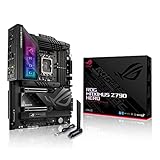
- Intel LGA 1700 socket: Ready for 14th, 13th and 12th Gen Intel Core processors and Windows 11, support PCIe 5.0 and DDR5
- Intelligent Control: ASUS-exclusive tools including AI Overclocking, AI Cooling II, AI Networking(GameFirst VI) and Two-Way AI Noise-Cancelation for easy configuration
- Robust Power Solution: 20+1 teamed power stages rated for 90 A, ProCool II power connectors, MicroFine alloy chokes and premium metallic capacitors
- Optimized Thermal Design: VRM heatsinks plus integrated aluminum I/O cover, high-conductivity thermal pad, triple M.2 heatsinks and dual with embedded backplates, and ROG Water-Cooling Zone
- High-performance Networking: Onboard WiFi 6E,Bluetooth V5.2, Intel 2.5Gb Ethernet, and ASUS LANGaurd
ROG Maximus Z890 Hero BTF: Intel platform
The Z890 Hero BTF is an ATX motherboard for Intel Core Ultra processors Series 2. It uses Intel’s LGA1851 socket and the Z890 chipset.
| Feature | ASUS-listed specification |
|---|---|
| Memory | Four DDR5 DIMM slots, up to 256GB |
| Memory overclocking | Up to 9200+ MT/s OC, depending on the CPU, kit, BIOS and configuration |
| Expansion | PCIe 5.0 x16, PCIe 4.0 x4 and PCIe 4.0 x1 |
| Storage | Six M.2 slots: three PCIe 5.0 and three PCIe 4.0 |
| Networking | Wi-Fi 7, Intel 2.5Gb Ethernet and Realtek 5Gb Ethernet |
| External high-speed I/O | Two Thunderbolt 4 USB-C ports |
| Power stages | 22(110A)+1(90A)+2(90A)+2(80A) |
ASUS also lists NitroPath DRAM Technology, DIMM Fit, DIMM Flex, AEMP III, NPU Boost, AI Overclocking, AI Cooling II, AI Networking II and ASUS AI Advisor. These are ASUS firmware and software features; their names do not independently establish gaming, acoustic or performance gains.
The Z890 board’s important lane-sharing warning
Its six M.2 slots are a major headline feature, but the detailed specification page states that enabling M.2_3 or M.2_4 causes the primary PCIe x16 slot to run at x8. That matters to buyers combining multiple Gen 5 SSDs with a high-end graphics card or other bandwidth-sensitive PCIe hardware. It may not be a practical problem for every gaming build, but it should be considered before finalizing the storage layout.
What’s actually slowing this PC down?
Pick the symptom - the matching free tool is one click away.
ROG Crosshair X870E Hero BTF: AMD platform
The Crosshair X870E Hero BTF is an ATX motherboard for AMD’s AM5 platform. ASUS lists support for Ryzen 7000-, 8000- and 9000-series desktop processors and uses AMD’s X870E chipset.
Rank #3

- Ready for Advanced AI PC: Designed for the future of AI computing, with the power and connectivity needed for demanding AI applications
- AMD AM5 Socket: Ready for AMD Ryzen 9000 & 8000 & 7000 Series Desktop Processors
- Intelligent Control: ASUS-exclusive AI Overclocking, AI Cooling II, AI Networking, and AEMP to simplify setup and improve performance
- ROG Overclocking Technologies: Dynamic OC Switcher, Core Flex, Asynchronous Clock and PBO Enhancement
- Robust Power Solution: 18(110A)+2(110A)+2 power stages with ProCool II power connectors, MicroFine alloy chokes and premium metallic capacitors
| Feature | ASUS-listed specification |
|---|---|
| Memory | DDR5 with ASUS AEMP and NitroPath DRAM Technology |
| Power stages | 18+2+2, with the main stages rated up to 110 amps |
| Expansion | PCIe 5.0 x16 SafeSlot with PCIe Slot Q-Release Slim |
| Storage | Five M.2 slots: three PCIe 5.0 and two PCIe 4.0 |
| Networking | Wi-Fi 7, Intel 2.5Gb Ethernet and Realtek 5Gb Ethernet |
| USB | Two USB4 ports and a front-panel USB 20Gbps Type-C connector |
Its AMD-oriented tuning features include Dynamic OC Switcher, Core Flex, Asynchronous Clock and PBO Enhancement, alongside ASUS’s AI Overclocking, AI Cooling II and AI Networking II tools. The board also includes BIOS FlashBack, Q-Dashboard, Q-Code, Q-LED, a Start button, Clear CMOS and FlexKey.
Intel Z890 versus AMD X870E
| ROG Maximus Z890 Hero BTF | ROG Crosshair X870E Hero BTF | |
|---|---|---|
| Platform | Intel Z890 | AMD X870E |
| Socket | LGA1851 | AM5 |
| Processor support | Intel Core Ultra Series 2 | Ryzen 7000/8000/9000 desktop processors |
| M.2 storage | Six total; three PCIe 5.0 and three PCIe 4.0 | Five total; three PCIe 5.0 and two PCIe 4.0 |
| High-speed external I/O | Two Thunderbolt 4 USB-C ports | Two USB4 ports |
| Power stages | 22+1+2+2 | 18+2+2 |
| GPU power path | Up to 600W with a compatible ASUS BTF GPU | Up to 600W with a compatible ASUS BTF GPU |
Choose between them based on the CPU platform first, not the BTF branding. An Intel processor cannot be installed on the AMD board, and an AM5 Ryzen processor cannot be installed on the LGA1851 board. The AMD product is also officially a Crosshair X870E, not a Maximus X870 model; Maximus is ASUS’s flagship Intel motherboard family, while Crosshair serves the AMD platform.
Independent reader supportYour contribution helps us test, update, and keep practical guides available for everyone.What a BTF build requires
Before buying either motherboard, verify the entire build rather than checking only the CPU socket.
The Tool Desk
Outbyte PC Repair FREEClear out junk files and repair common Windows errorsFree Scan →Outbyte Driver Updater FREEScan for outdated or missing drivers - takes under a minuteDriver Scan →- Case support: Confirm that the case explicitly supports ASUS BTF or rear-connector motherboards. “Good cable management” alone is not enough.
- Cutout alignment: Check that the rear motherboard openings align with this exact board and that the case accepts its ATX dimensions.
- Rear clearance: Make sure there is room behind the motherboard tray for power, fan, USB and other cables.
- Graphics card: If hidden GPU power is important, select an ASUS BTF Edition graphics card with the required interface. ASUS maintains a BTF graphics-card ecosystem page.
- Power supply: Choose a PSU based on the CPU, GPU, transient requirements and connector guidance—not simply on the fact that the motherboard hides a cable.
- Front-panel planning: Confirm that front USB, fan, RGB, storage and case-control connections remain accessible after installation.
- Firmware and memory: Check the current CPU-support list, BIOS requirements and ASUS memory QVL before selecting a processor or DDR5 kit.
ASUS’s BTF ecosystem information and case documentation can help identify compatible parts. The ROG Hyperion GR701 BTF Edition is one example of a case family designed around the concept, but compatibility should still be confirmed for the specific board and graphics card.
Rank #4

- Designed for 9th 8th Generation Intel Core processors maximize connectivity, speed with Dual M. 2, USB 3. 1 Gen 2, onboard 802. 11AC Wi-Fi and ASUS optimum II for better DRAM overclocking stability
- Revamped 5-way Optimization overclocks Intelligently based on smart prediction and thermal telemetry while FanXpert 4 delivers dynamic system cooling
- Aura Sync RGB lighting with addressable headers features a nearly endless spectrum of colors with the ability to synchronize effects across an ever-expanding ecosystem of AURA Sync enabled products
- Pre-mounted I/O shield ensures streamlined installation and represents ROG's attention to detail and quality
Who should buy one?
BTF makes the most sense for a new showcase gaming PC where appearance is a priority and the builder is willing to choose compatible parts together. It is particularly attractive if the system will use a BTF graphics card, a matching case, enthusiast-level storage and premium networking or I/O.
A standard motherboard is usually the better choice if you already own a conventional case or graphics card, expect to upgrade components piecemeal, need a compact or unusual chassis, or value the widest possible selection of replacement parts. ASUS also sells conventional counterparts such as the ROG Maximus Z890 Hero and ROG Crosshair X870E Hero.
The trade-off: cleaner interiors, narrower compatibility
BTF changes the physical layout of a PC more than its performance profile. It can hide connectors and improve the appearance of a showcase build, but it does not by itself make games run faster than they would on a comparable conventional motherboard. Nor do ASUS’s listed AI features independently prove better overclocking, cooling or networking results.
The central trade-off is simple: less visible cabling in exchange for greater ecosystem dependence. Buyers should also account for the Z890 board’s M.2 lane-sharing condition and treat advertised DDR5 speeds as overclocking targets rather than guarantees. Actual memory stability depends on the processor’s memory controller, DIMM configuration, kit, BIOS and tuning.
Bottom line
ASUS’s BTF story began as a Computex 2024 concept and became a real two-platform lineup: the Intel ROG Maximus Z890 Hero BTF and AMD ROG Crosshair X870E Hero BTF. They are premium ATX motherboards built for clean, carefully planned systems—not universal performance upgrades. Choose one when the hidden-connector aesthetic and compatible BTF parts are central to the build; choose a standard Hero motherboard when flexibility, reuse and broad component compatibility matter more.
Quick Recap
Product prices and availability are accurate as of the date/time indicated and are subject to change. Any price and availability information displayed on Amazon at the time of purchase will apply.




