The Tool Desk
Outbyte PC Repair FREERepair Windows errors before they cause bigger problemsFix Now →Outbyte Driver Updater FREEFix the driver behind crashes, sound loss and screen glitchesFind Drivers →For most modern gaming PCs, start with a well-reviewed 750W–1000W fully modular ATX 3.1 power supply that includes a native 12V-2×6 cable. Choose 750W for mainstream systems, 850W for many upper-midrange and high-end builds, and 1000W when pairing a demanding GPU with a high-power CPU or planning a substantial upgrade. The exact GPU recommendation, case dimensions, price, noise tolerance, and independent test results matter more than any single brand or efficiency badge.
Editorial note: This guide focuses on models prominent in the 2025 product cycle. Prices and availability change frequently; captured US prices below are historical manufacturer-store signals from the research pass, not guaranteed current prices.
As an Amazon Associate I earn from qualifying purchases.
Quick picks
| Use case | Candidate | Capacity | Format | Main reason to consider it | Important caveat |
|---|---|---|---|---|---|
| Best overall for many gaming PCs | Corsair RM850x | 850W | ATX | ATX 3.1, PCIe 5.1, native 12V-2×6, fully modular, zero-RPM mode, 10-year warranty | Confirm the exact revision, price, and case clearance |
| Alternative cable routing | Corsair RM850x SHIFT | 850W | ATX | Side-mounted connectors can simplify routing | Requires approximately 30mm of side clearance |
| Best-value direction | Cooler Master MWE Gold 850 V3 | 850W | ATX | ATX 3.1, PCIe 5.1, 10-year warranty, competitive pricing | Verify current price, exact revision, protections, and acoustic testing |
| High-end GPU and upgrade headroom | Corsair RM1000x or RM1000x SHIFT | 1000W | ATX | More capacity for demanding single-GPU systems | SHIFT version needs side clearance |
| Premium quiet build | be quiet! Straight Power 12 | Model-dependent | ATX | ATX 3.1 and PCIe 5.1 options with premium efficiency and cooling features | Compare model-specific noise tests; do not assume the whole series is quietest |
| Small-form-factor gaming PC | Corsair SF750 or SF1000 | 750W–1000W | SFX | High output in a compact enclosure | Check whether the case requires SFX or SFX-L and inspect cable length |
| Specialized workstation | Corsair HX1200i/HX1500i or a tested Seasonic Prime high-wattage model | 1200W–1600W+ | ATX | Useful for sustained, unusually high CPU/GPU loads | Usually excessive for an ordinary single-GPU gaming PC |
These are candidates, not a claim that every unit from a manufacturer is equally good. PSU platforms vary by series, capacity, revision, OEM, region, and connector set.
Best overall: Corsair RM850x
The RM850x is a sensible default for a broad range of current gaming PCs because 850W provides useful room above a typical mainstream system without immediately paying for an oversized 1200W or 1600W unit. Corsair lists the current model as fully modular, ATX 3.1 compliant, PCIe 5.1 supporting, Cybenetics Gold-certified, equipped with a zero-RPM fan mode, and covered by a 10-year warranty. Check the official product page for the exact SKU and regional terms.
#1 Best Overall
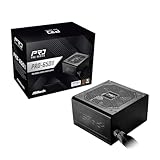
- 80 PLUS Bronze Efficiency: Provides reliable 650W power with 80 PLUS Bronze certification for energy-efficient operation
- ATX 3.1 Compatible: Meets latest ATX 3.1 standards with 200% power excursion capability for next-generation components
- Stable 12V Output: Delivers 54.1A on the +12V rail for consistent performance with modern CPUs and graphics cards
- Comprehensive Protections: Includes OCP, OVP, UVP, OPP, OTP, and SCP for complete system safety
- Quiet 120mm Cooling: Features a balanced fan design that maintains low noise levels during operation
The captured US listing showed $139.99 against a listed $169.99 original price, but that is a price snapshot rather than a permanent value claim. Confirm whether a sale, color variant, or older revision is being offered before buying.
It is a particularly good fit for an upper-midrange GPU, a high-performance gaming CPU, multiple drives, or a build where a future graphics-card upgrade is plausible. It is not automatically the right choice for a compact case, a low-cost office PC, or a system whose GPU manufacturer specifies a different minimum.
Best alternative for cable routing: RM850x SHIFT
The RM850x SHIFT uses side-mounted modular connectors. That layout can make cable routing easier in compatible cases, especially designs with a cable chamber or rear motherboard connectors. It can also make installation awkward—or impossible—when the PSU sits close to the side panel.
Corsair specifies approximately 30mm of required side clearance. Measure the case rather than assuming an ordinary ATX PSU opening guarantees compatibility. The captured US listing showed $139.99 for one variant, while another white or older listing was shown at $189.99 and out of stock. Similar names do not guarantee the same revision, color, stock status, or price.
Best-value direction: Cooler Master MWE Gold 850 V3
Tom’s Hardware’s 2025 roundup identifies the MWE Gold 850 V3 as a competitively priced 850W ATX 3.1/PCIe 5.1 unit with a 10-year warranty. That makes it a strong value candidate when its price is meaningfully below better-known alternatives.
“Best value” is price-sensitive. Before publication or purchase, check the exact model number, current retailer price, connector configuration, protection behavior, acoustic results, seller, and return policy. A discount can change the ranking quickly, and a similarly named older MWE model may not have the same standards or cable set.
Best mainstream 1000W choice
Choose a 1000W unit when the GPU has a high official PSU recommendation, the CPU can sustain substantial package power, or the extra capacity is inexpensive and physically compatible. The conventional Corsair RM1000x is the simpler option for cases designed around rear-mounted PSU connectors. The RM1000x SHIFT offers the alternative side-mounted layout, but requires the same clearance check as the 850W SHIFT.
What’s actually slowing this PC down?
Pick the symptom - the matching free tool is one click away.
Rank #2

- Delivers 600W Continuous output at plus 40℃. Compliance with Intel ATX 12V 2. 31 and EPS 12V 2. 92 standards
- 80 PLUS Certified – 80% efficiency under typical load. Power good signal is 100-500 millisecond
- Supports (2) PCI-E 6 plus 2pin Connectors. Active (PFC) Power Factor Correction, MTBF: 100, 000 hours
- Industry Grade Protections: (OPP) Over Power Protection, (OVP) Over Voltage Protection, (SCP) Short Circuit Protection
- Hold up time is 16 millisecond minimum within 60 percent load. Input frequency range 50 - 60 in Hz
The captured US listing showed $169.99 against a listed $209.99 original price for the RM1000x SHIFT. Treat that as a dated manufacturer-store signal, not a current guarantee. The conventional RM1000x, Seasonic Focus or Vertex 1000W models, and tested Super Flower Leadex alternatives can all be sensible depending on regional pricing and model-specific reviews.
Premium quiet options
The be quiet! Straight Power 12 series includes ATX 3.1 and PCIe 5.1-compatible options, premium efficiency tiers, and semi-passive cooling on relevant models. It is a promising direction for a noise-sensitive build, but do not call it the quietest without comparing model-specific measurements at light, gaming, and sustained-load levels.
Corsair RMx and HXi, Seasonic Prime and Vertex, and suitable Super Flower Leadex units are credible alternatives. Compare measured noise, fan-stop behavior, ripple, regulation, transient response, protections, warranty terms, and price. A zero-RPM mode can make a PSU nearly silent at low load, but it does not predict its noise during rendering or extended gaming. Coil whine is also sample-dependent.
When 1200W or more makes sense
Corsair’s HX1200i and HX1500i, Seasonic Prime high-wattage models, and MSI’s high-end MEG units are specialized choices for unusually demanding workstations, sustained CPU/GPU loads, or multi-GPU-class configurations. The captured Corsair category listing showed selected HX1200i and HX1500i prices of $299.99 and $399.99.
PC Slower Than It Used to Be?
A free scan shows the junk files, broken settings and background clutter dragging Windows down - then fixes them in one click.Free scan · Windows 10 & 11Crashes, No Sound, or Screen Glitches?
Random freezes, missing sound and display glitches usually trace back to one bad driver. Find and replace yours safely.Free scan · under a minuteTom’s Hardware treats units above roughly 1500W as specialized and expensive. Do not buy one merely because it is technically more powerful. A 1600W PSU does not prove higher quality, and a larger unit can cost more, occupy more space, and spend more of its life at very low utilization. Buy enough capacity to avoid operating constantly near the upper limit, but do not treat excess wattage as a quality rating.
Best SFX direction for compact PCs
For small-form-factor systems, the case specification is decisive. Corsair SF750 remains a sensible capacity for many compact gaming PCs, while the SF1000 is aimed at higher-power GPUs and CPUs where the enclosure supports it. Corsair lists the SF1000 as fully modular and 80 PLUS Platinum; the captured US category price was $269.99.
Thermaltake Toughpower SFX models are another direction; Cybenetics’ database includes SFX units such as the Toughpower SFX 750W ATX 3.1. An SFX PSU may need an adapter bracket in a larger ATX case, while an SFX-L unit may not fit an enclosure that specifies only SFX. Compact units can also run their smaller fans harder and may include shorter cables, so check the build layout carefully.
Rank #3

- 80+ Gold Certified: The power supply boasts an impressive 80+ Gold Certified rating, guaranteeing exceptional efficiency
- Non-Modular Design: This power supply eliminates clutter and ensures neat cable management, promoting optimal airflow and a much cooler system
- Single 12V Output for Higher Power Usage: Power supply delivers reliable and stable power, even in demanding situations that require high amperage
- Global Voltage Adaptation: Whether you're travelling or working abroad, the Global Voltage Adaptation feature of the Segotep GN-650 Power Supply is perfect for use worldwide
- Four PCI-E 6+2 Pin Connectors: All wires can be separated from the power supply, making the inside of the case look cleaner. Four 12V 6+2 Pin cables support 40-series graphics cards
How much wattage does a PC need?
| System | Practical starting range |
|---|---|
| Office PC or integrated graphics | 350W–550W |
| Entry-level gaming GPU | 550W–650W |
| Mainstream gaming PC | 650W–750W |
| Upper-midrange gaming PC | 750W–850W |
| High-end single-GPU PC | 850W–1000W |
| Flagship GPU, high-power CPU, or serious overclocking | 1000W–1300W |
| Extreme workstation or multi-GPU-class system | 1300W–1600W+ |
These ranges are starting points, not replacements for the exact GPU recommendation or independent measurements. Calculate your requirement in this order:
Recommended Free Tools
- Start with the GPU manufacturer’s official recommended PSU wattage.
- Add the CPU’s realistic package power, not only its advertised base TDP.
- Include the motherboard, drives, fans, pump, USB devices, capture cards, and other expansion cards.
- Allow headroom for short-duration GPU transients and planned upgrades.
- Compare the next capacity tier when the price increase is small and the larger PSU still fits.
If a calculator recommends surprisingly little, it may use nominal TDP, contain an outdated GPU database, omit pumps or drives, or fail to model transient demand. Cross-check with the exact GPU specification and independent power measurements.
ATX 3.1, PCIe 5.1, and 12V-2×6 explained
| Term | What it means | What it does not prove |
|---|---|---|
| ATX 3.0 | A PSU standard with stronger requirements for short-duration power excursions from modern GPUs | That the unit is obsolete or electrically excellent |
| ATX 3.1 | The newer ATX revision and generally the preferred specification for a new purchase when price and availability are similar | That every model has superior regulation, noise, or build quality |
| PCIe 5.0/5.1 | Terminology associated with the PCIe power-delivery ecosystem and compatible cables/connectors | A complete quality assessment |
| 12VHPWR | The earlier 16-pin high-power GPU connector | That it is the updated 12V-2×6 design |
| 12V-2×6 | The updated 16-pin connector associated with newer PCIe 5.1 implementations | That an adapter or cable from another PSU is safe |
ATX 3.0 units are not automatically bad or unusable. For a new 2025-era purchase, ATX 3.1 with a native 12V-2×6 cable is cleaner when the price is comparable. Corsair’s compatibility guidance identifies current models with PCIe 5.1 support, but verify the exact PSU listing rather than relying on a family name.
Safe 16-pin installation
- Use the cable supplied with that PSU whenever possible.
- Push the connector fully into the GPU until it is completely seated.
- Avoid a sharp bend immediately at the connector.
- Confirm the cable is appropriate for the exact PSU model.
- Never mix modular cables from different brands or PSU families.
80 PLUS versus Cybenetics
80 PLUS primarily reports efficiency at defined load points. Gold, Platinum, and Titanium describe efficiency tiers—not voltage regulation, ripple suppression, transient response, protections, fan noise, construction, or customer service. MSI identifies Titanium as the highest 80 PLUS level, but that hierarchy remains an efficiency classification.
Gold is usually the practical balance for a gaming PC. Platinum or Titanium can make sense for a system that runs many hours at high load, has strict noise goals, or costs only slightly more. A low-power PC that spends most of its time idle may save little electricity by moving from Gold to Titanium.
Cybenetics publishes separate efficiency and noise certifications, and its performance database includes efficiency, noise ratings, standards, test records, and test dates. Use those records alongside independent laboratory reviews. A lower-efficiency PSU with strong electrical testing can be a better purchase than a poorly tested Platinum model.
What to evaluate beyond the badge
Electrical performance
Look for independent measurements of voltage regulation, ripple and noise, transient response, hold-up time, efficiency at realistic loads, and protection behavior. A product page promising “gaming” performance is not a substitute for testing.
Rank #4

- Low Noise Fan
- DC-DC Circuit Design
- Active PFC design
- Industrial level protection with OVP,OCP,OPP,OTP, SCP
Connectors
Check for a native 12V-2×6 cable, enough 8-pin PCIe connectors, sufficient EPS/CPU connectors, appropriate cable lengths, and support for the GPU’s required cabling. When a GPU calls for multiple PCIe cables, use separate PSU cables where the manufacturer recommends it rather than overloading one cable.
Modularity
Fully modular units let you remove every detachable cable. Semi-modular units usually fix the motherboard cables while allowing peripheral cables to be removed. Non-modular units attach everything permanently and are often cheaper. Modularity improves installation and cable management; it does not automatically improve electrical quality.
Free tools Windows power users keep installed
One-click scans. No signup required.
Warranty and support
A long warranty is a useful signal, not proof that a PSU cannot fail. Check the coverage region, shipping responsibility, repair-versus-replacement process, transferability, local support, and replacement-cable availability. Current Corsair RM850x, RM1000x, and RMx SHIFT pages list 10-year warranties, subject to the manufacturer’s regional terms.
Independent reader supportYour contribution helps us test, update, and keep practical guides available for everyone.Case and installation checklist
- Confirm ATX, SFX, or SFX-L compatibility.
- Check maximum PSU length, including room for cable plugs.
- Measure side-panel clearance for side-connector designs such as SHIFT.
- Check GPU connector bend space and nearby radiator or drive-cage interference.
- Use only the modular cables supplied for the PSU, unless the manufacturer explicitly confirms compatibility.
- Fully seat the motherboard, CPU, PCIe, and 12V-2×6 connectors.
- Inspect cables for crushing, sharp bends, heat, discoloration, or damage.
- Keep the PSU intake unobstructed and orient it according to the case’s airflow design.
Diagnosing common PSU problems
The PC shuts down during gaming
Possible causes include PSU overload or poor transient response, a loose 12V-2×6 connector, PSU overheating, a faulty cable, a defective GPU or motherboard, an unstable overclock or undervolt, or wall-power and surge-protection problems. A higher-wattage PSU is not automatically the fix. Test settings, connections, temperatures, cables, and components systematically.
The GPU cable is hot or discolored
- Shut down the computer.
- Disconnect AC power.
- Inspect the GPU-side and PSU-side connections.
- Replace damaged cables or connectors.
- Do not operate the system until the cause is resolved.
- Contact the PSU or GPU manufacturer if there is heat damage.
Do not continue using a partially inserted or heat-damaged connector.
The PSU clicks or buzzes
A relay click or fan-start sound can be normal. Coil whine and fan-bearing noise may be irritating but are different from electrical arcing. Crackling, smoke, an electrical smell, visible damage, or repeated shutdowns are not normal: switch the system off immediately and disconnect it.
Do these 3 things before closing this tab:
1Repair Windows errors before they cause bigger problems2Scan for outdated or missing drivers - takes under a minute3Clear out junk files and repair common Windows errorsShould you keep an older PSU?
A quality older PSU may continue to work with a new GPU, but check its age, independent testing, official wattage recommendation, available connectors, adapter requirements, warranty, and condition. For a new high-end build, a current ATX 3.1 model with native 12V-2×6 support is generally the cleaner choice when similarly priced.
Best Value

- 80 PLUS GOLD CERTIFIED
- 10-year limited warranty, guaranteeing long term reliable operation
- Fully modular design
Community “A-tier” lists can help discover models, but they may combine different capacities, revisions, OEM platforms, and regional versions. Treat them as a starting point, never as the sole evidence for a purchase. The same caution applies to brand-level claims: not every PSU from Corsair, Seasonic, be quiet!, Super Flower, MSI, Thermaltake, or Cooler Master uses the same platform or deserves the same recommendation.
Final buying checklist
- What exact GPU and CPU are you installing?
- What PSU wattage does the GPU manufacturer recommend?
- Does the PSU have reasonable transient headroom?
- Does it include a native 12V-2×6 cable if your GPU needs one?
- Does the exact model have independent electrical and acoustic testing?
- What are its regulation, ripple, protection, efficiency, and noise results?
- Does it physically fit, including cable and side-panel clearance?
- Are the warranty and regional RMA terms useful where you live?
- Can the manufacturer supply replacement cables?
- Is the current price, seller, stock status, and return policy acceptable?
Frequently Asked Questions
Is 850W enough for a modern gaming PC?
Often, yes, for an upper-midrange or high-end single-GPU system. Check the exact GPU recommendation, CPU power, transient headroom, connector requirements, and planned upgrades before deciding.
Should I buy ATX 3.1 instead of ATX 3.0?
For a new purchase, ATX 3.1 is preferable when price and availability are similar, particularly when it includes a native 12V-2×6 cable. ATX 3.0 is not automatically obsolete, and neither standard replaces model-specific electrical testing.
Is an 80 PLUS Titanium PSU automatically better?
No. Titanium indicates the highest 80 PLUS efficiency tier, not superior regulation, ripple suppression, transient response, protections, acoustics, or warranty service.
Can I reuse modular cables from my old PSU?
No, unless the manufacturer explicitly confirms compatibility for the exact PSU families. Modular cables are not universally wired the same way.
The Bottom Line
For most 2025-era gaming builds, buy a thoroughly tested 750W–1000W ATX 3.1 PSU with native 12V-2×6 support. The Corsair RM850x is a strong general-purpose starting point; move to 1000W for a more demanding GPU or upgrade plan, choose SFX/SFX-L for compact cases, and reserve 1200W-plus models for genuinely high sustained loads. Verify the exact SKU, independent test results, case fit, warranty, current price, and cable compatibility before ordering.
Quick Recap
Product prices and availability are accurate as of the date/time indicated and are subject to change. Any price and availability information displayed on Amazon at the time of purchase will apply.
Quick wins for a faster PC:
Clear out junk files and repair common Windows errorsFree Scan →Fix the driver behind crashes, sound loss and screen glitchesFind Drivers →Repair Windows errors before they cause bigger problemsFix Now →



