Do these 3 things before closing this tab:
1Repair Windows errors before they cause bigger problems2Fix the driver behind crashes, sound loss and screen glitches3Clear out junk files and repair common Windows errorsSome links on this page are affiliate links: if you buy through them we may earn a commission, at no extra cost to you.
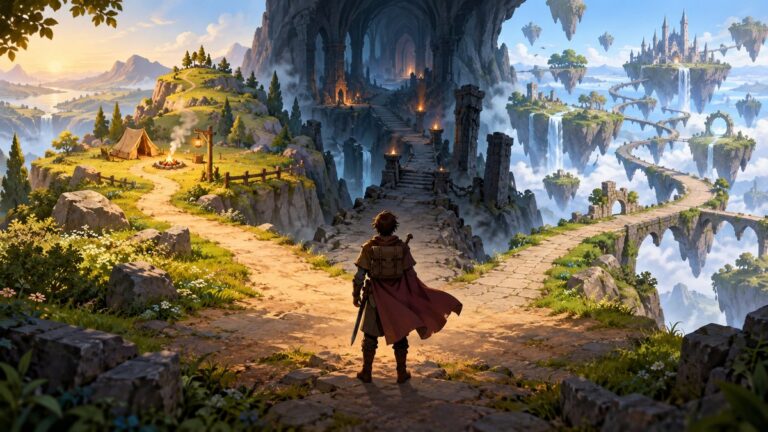
Dimensional travel becomes a platforming mechanic when a change in perspective, world state, or gravity changes where the player can go or how movement works. In FEZ, for example, the player rotates a 3D world in quarter-turns so its geometry lines up with a 2D route. That is different from a visual filter or a simple warp to another level: the change affects the spatial rules the player uses to navigate and solve puzzles.
What does dimensional travel mean in a platformer?
It means the game changes the player’s usable traversal space by changing how the world is represented, connected, or governed. The player might rotate a level, switch between 2D and 3D movement, enter a portal, move between alternate versions of a place, or follow a new direction of gravity. The shared feature is not a particular visual effect; it is a change to the spatial relationships that matter for movement.
As an Amazon Associate I earn from qualifying purchases.
A practical test is to ask whether the change affects any of the following:
- Reachable geometry: A platform, path, or surface becomes accessible or inaccessible.
- Collision relationships: Objects that were separated, hidden, or non-solid now interact differently.
- Movement rules: The character’s available directions, gravity, or attachment to surfaces changes.
- Puzzle state: A route or solution depends on which representation or world is active.
If the player only changes location through a level-select warp, or the camera changes without affecting routes, movement, collisions, or puzzle solutions, that alone does not make the transition a dimensional-travel mechanic. The term is most useful for changes that alter the player’s working model of space.
Popular on Amazon

- Read Before You Buy — No Video Output: These adapters support charging and USB 2.0 data transfer, but cannot transmit video signals. Except for standard USB webcams (which use USB data only), they are not compatible with HDMI/DisplayPort cables, video-capable USB-C hubs, or docking stations with video output.
- Convert USB-A Ports to USB-C: Designed to connect USB-C earphones, cables, flash drives, card readers, and other USB-C accessories to standard USB-A ports. Plug-and-play with no drivers or software required.
- Aluminum Alloy Housing: Built with a sturdy aluminum alloy shell that aids in heat dissipation and protects against daily wear and scratches. Designed to maintain a stable and secure connection.
- Compact & Travel-Friendly: The ultra-compact design allows the adapter to stay plugged into your device without blocking adjacent ports or adding bulk, reducing wear and tear on your original USB ports.
- 12-Month Warranty: Backed by a 12-month manufacturer warranty for peace of mind. Designed to meet strict quality control standards for reliable everyday performance.
How does FEZ’s rotation mechanic work?
FEZ presents a 2D puzzle-platformer inside a 3D world. The player rotates that world in ninety-degree increments; each orientation changes how its geometry lines up with the playable 2D plane, potentially turning a previously unusable arrangement into a traversable route.
This is best understood as projection-controlled traversal, not as literal teleportation to an unrelated place. The underlying world is being shown from another orientation. The character’s platforming remains legible in 2D, while the spatial arrangement behind that plane changes. The player uses the new projection to make surfaces and pieces of geometry line up.
That distinction explains why rotation can be a puzzle action rather than a camera flourish. A change of view matters when it changes which parts of the world can form a continuous path for the character. The player is not just looking around to gather information; changing the orientation is part of making movement possible.
The design also depends on teaching the player to reason across two representations. A useful learning sequence establishes ordinary 2D movement first, then introduces rotation as a way to make routes usable that were hidden or misaligned from the current orientation. The player can then bring familiar platforming expectations to a less familiar spatial puzzle.
That 2D/3D duality is central to FEZ’s design. Its technical postmortem describes the project’s “2D/3D nature” as a major challenge affecting level construction, camera behavior, collision interpretation, and tools. The mechanic’s premise may be easy to state, but a game built around it has to keep those systems consistent enough for players to predict what a rotation will do. Developer Phil Fish described the game’s design context this way: “The game is inspired by Mario, Ico and Zelda.” That is context for its influences, not a definition of dimensional travel.
Also popular on Amazon

- 5-in-1 USB-C Hub: Experience comprehensive connectivity featuring a Power Delivery input, two USB-A 2.0 ports, a USB-A 3.0 port, and an HDMI port. (Note: The USB-C power delivery input port is only for connecting an external wall charger to power your laptop and cannot power peripheral devices.)
- 90W Pass-Through Charging: Achieve optimal charging with 90W pass-through power to your laptop, supported by a total input of 100W, with the hub reserving 10W for operational efficiency. (Note: Wall charger not included.)
- Quick Data Transfers: Accelerate your productivity with rapid data transfers using a high-speed 5Gbps USB 3.0 port and two 480Mbps USB 2.0 ports.
- 4K HDMI Display: Enhance your visual experience with a hub capable of delivering 4K resolution at 30Hz in both mirror and extend modes. Please note that this hub is compatible with MacBook (macOS 12 and newer), Windows 10 and 11, ChromeOS, and laptops equipped with DP Alt Mode and Power Delivery. Note: This device is not compatible with Linux.
- What You Get: Anker USB-C Hub (5-in-1, 4K HDMI), welcome guide, 18-month warranty, and our friendly customer service.
What are the main kinds of dimensional-travel mechanics?
Platformers can change traversal space in several distinct ways. Comparing them is easier if you separate what changes from how the player triggers the change.
Perspective rotation and re-projection
A world or camera turns through fixed orientations, changing how geometry lines up with the player’s movement plane. FEZ is the defining example in this discussion. The core design question is whether the world itself rotates, the camera rotates, or a 3D scene is collapsed into a 2D traversal rule. Those choices can look similar but create different expectations about what remains fixed.
Explicit 2D/3D mode switching
In this family, the player toggles between side-on 2D and 3D representations or movement modes. The switch is mechanical when it changes legal moves, visible routes, collisions, or puzzle solutions—not merely because the camera angle changes. Super Paper Mario is discussed in scholarly work on multidimensional game worlds as a game where players can switch between 2D and 3D views for limited periods, making the transition a puzzle tool. Toodee and Topdee is described as requiring players to jump between 2D and 3D to solve challenges.
Alternate-world or state switching
Here, the player changes which version of a place is active. In What Lies in the Multiverse, switching between existences supports both platforming and narrative puzzles. The important question is whether the versions affect traversal: they may have different geometry, hazards, or objects. If the change is only a palette swap or decorative variation, it is primarily cosmetic rather than a systemic change to the level.
This approach carries a substantial design cost. The developer’s design discussion identifies the challenge of making two versions of every place the player can visit. Each world state needs to feel coherent, and the transition must help players understand which properties have changed and which still apply.
What’s actually slowing this PC down?
Pick the symptom - the matching free tool is one click away.
Also popular on Amazon

- Sleek 7-in-1 USB-C Hub: Features an HDMI port, two USB-A 3.0 ports, and a USB-C data port, each providing 5Gbps transfer speeds. It also includes a USB-C PD input port for charging up to 100W and dual SD and TF card slots, all in a compact design.
- Flawless 4K@60Hz Video with HDMI: Delivers exceptional clarity and smoothness with its 4K@60Hz HDMI port, making it ideal for high-definition presentations and entertainment. (Note: Only the HDMI port supports video projection; the USB-C port is for data transfer only.)
- Double Up on Efficiency: The two USB-A 3.0 ports and a USB-C port support a fast 5Gbps data rate, significantly boosting your transfer speeds and improving productivity.
- Fast and Reliable 85W Charging: Offers high-capacity, speedy charging for laptops up to 85W, so you spend less time tethered to an outlet and more time being productive.
- What You Get: Anker USB-C Hub (7-in-1), welcome guide, 18-month warranty, and our friendly customer service.
Portals and discontinuous spatial connections
A portal connects places that would otherwise be separate, creating a route across a discontinuity in space. Godot’s official rooms-and-portals documentation describes a 3D level as a set of rooms connected by portals. In a platforming puzzle, a portal becomes part of dimensional travel when crossing it changes the player’s spatial relationship to the environment or creates a nonlocal route that matters to solving the challenge.
Portal is a useful adjacent comparison because portal interaction is its central puzzle system, rather than simply a loading transition between stages. Not every warp zone qualifies: a fast-travel gate that only moves the player to a different location changes destination, but may not change the rules or spatial relationships that make movement possible.
Gravity and surface reorientation
Some games make the player adhere to surfaces or change the effective direction of gravity. In Etherborn, described as a 3D exploration platformer, perspective changes automatically and the character sticks to curved surfaces. In this family, “dimension” can feel less like a separate universe and more like a change to the coordinate system that defines movement and orientation.
How can you tell whether a game changes the level or only the camera?
Look at the consequences of the transition, not its visual presentation. A camera can move dramatically while the player’s available routes and rules remain the same; conversely, a small-looking switch can have major effects if it changes collisions or makes a path possible.
Quick wins for a faster PC:
Clear out junk files and repair common Windows errorsFree Scan →Fix the driver behind crashes, sound loss and screen glitchesFind Drivers →- Representation: Does the game rotate a world, switch between 2D and 3D, or replace one world state with another?
- Trigger: Does the player choose the change, activate a portal, enter a region, or experience an automatic transition?
- Physics: Do gravity, surface adhesion, collision rules, or movement controls change?
- Geometry: Are platforms revealed, realigned, duplicated, removed, or reconfigured?
- Purpose: Does the mechanic serve navigation, puzzle solving, combat, exploration, or narrative disclosure?
- Learning: Does the game introduce the change after ordinary platforming, or ask the player to infer its effects immediately?
These questions distinguish a change in appearance from a change in play. They also help compare games without treating every portal, camera turn, or alternate-world effect as the same mechanic.
Also popular on Amazon

- Dual Converters, Infinite Potential:Includes 2× USB C male to USB A female adapters and 2× USB A male to USB C female adapters. Perfect for a wide range of uses—tablets with Bluetooth keyboards, expand USB ports on macbook, and more. Two different converters for all your daily needs
- Next-Level 10Gbps & 3A Charging: No more slow 480Mbps, this usb to usb c adapter has a transfer speed of up to 10Gbps, allowing you to do more transferring in less time. This usb adapter fits both USB A and USB C charger, supporting up to 3A fast charging
- Upgraded Exquisite Craftsmanship: With an aluminum alloy housing and metal connector, the usbc to usb adapter is extremely durable and sturdy. Rigorously tested to withstand more than 10,000 times of plugging and unplugging, ensuring long-lasting performance
- Widely Compatible: Transform any USB-C port into a USB-A port and USB-A port into a USB-C port, and connect up a wide range of USB-C(including MacBook, iPad Pro/Air/Mini, iPhone models with USB C ports, Samsung Galaxy series, and Google Pixel series. ) and USB A devices(including external hard drives, phones, mice, printers, and more)
- Please Note: To reach 10Gbps speed, keep the cable under 3.3 ft. For USB A Male to USB C adapters, try flipping the USB C connector. USB C Male to USB A adapters support bidirectional 10Gbps transfer within 3.3 ft
Why are dimensional platformers difficult to design?
Every additional representation or state multiplies the cases a level designer must account for. A level may need different geometry, collision interpretations, camera states, transition animations, and puzzle conditions depending on the active orientation or world. FEZ’s postmortem emphasizes the challenge of building around a 2D/3D split and the need for a custom tool chain; the developer of What Lies in the Multiverse points to the work of creating two versions of every place the player can visit.
The challenge is not only to render another version of a room. The game must make the change understandable and reliable. If a platform appears to move but its collision behavior does not match what the player sees, or if the game changes gravity without making the new orientation clear, a puzzle can feel arbitrary instead of demanding useful spatial reasoning.
For players to form reliable expectations, the design has to communicate:
- What changed and what stayed the same.
- Which objects persist across orientations or world states.
- Which surfaces are solid, reachable, or usable for movement now.
- Whether the controls, gravity, or surface attachment changed.
- How the player can reverse the transformation or use it to progress.
Clear, consistent signals let players anticipate the result of a rotation, switch, portal crossing, or gravity change before committing to a jump. That predictability is especially important when the transformation itself is the puzzle’s main verb.
Independent reader supportYour contribution helps us test, update, and keep practical guides available for everyone.What makes a dimensional change satisfying to play?
A satisfying change gives the player a meaningful spatial problem and enough consistency to reason about it. The transformation should create a route, alter a hazard, change a puzzle condition, or reveal something important about the space; a purely decorative shift does not provide the same traversal payoff.
Also popular on Amazon

- 5-in-1 Connectivity: Equipped with a 4K HDMI port, a 5 Gbps USB-C data port, two 5 Gbps USB-A ports, and a USB C 100W PD-IN port. Note: The USB C 100W PD-IN port supports only charging and does not support data transfer devices such as headphones or speakers.
- Powerful Pass-Through Charging: Supports up to 85W pass-through charging so you can power up your laptop while you use the hub. Note: Pass-through charging requires a charger (not included). Note: To achieve full power for iPad, we recommend using a 45W wall charger.
- Transfer Files in Seconds: Move files to and from your laptop at speeds of up to 5 Gbps via the USB-C and USB-A data ports. Note: The USB C 5Gbps Data port does not support video output.
- HD Display: Connect to the HDMI port to stream or mirror content to an external monitor in resolutions of up to 4K@30Hz. Note: The USB-C ports do not support video output.
- What You Get: Anker 332 USB-C Hub (5-in-1), welcome guide, our worry-free 18-month warranty, and friendly customer service.
The strongest designs also let players connect cause and effect. If a rotation realigns platforms, or a world switch changes which objects can be used, the result should be readable in the active view. Gradual teaching helps: ordinary movement provides a baseline, and new transformations can then extend that baseline rather than asking the player to learn movement, physics, and puzzle logic all at once.
For designers, the practical trade-off is expressive power versus systemic complexity. More world states can create more routes and puzzle combinations, but each state increases the burden of maintaining coherent geometry, collisions, transitions, and cues. Dimensional travel works best when the added state space yields decisions the player can understand and exploit.
Outdated Drivers Are Slowing You Down
One free scan finds every outdated or missing driver and matches the right update for your exact hardware.Free scan · exact hardware matchPC Slower Than It Used to Be?
A free scan shows the junk files, broken settings and background clutter dragging Windows down - then fixes them in one click.Free scan · Windows 10 & 11Frequently Asked Questions
Does dimensional travel in a platformer always mean parallel universes?
No. It is a design description for changes to traversal space, and can refer to a rotated projection, a portal connection, a different movement coordinate system, or an alternate world state. The fiction may call these dimensions, realities, or simply orientations.
Why do some games limit how long a 2D or 3D switch lasts?
A time limit makes the active representation part of the immediate puzzle pressure: players must use that view during its available window. In the case of Super Paper Mario, scholarly discussion describes the 2D/3D toggling as available for limited periods.
Can a portal be dimensional travel if it only connects two rooms?
Yes, if the connection changes spatial relationships or provides a nonlocal route that the player uses to solve a platforming problem. If it only functions as a transition to another stage, the word “portal” by itself does not make the mechanic dimensional.
Why might a game use automatic perspective changes instead of player-controlled shifts?
Automatic changes can make orientation or surface relationships part of the environment the player explores, rather than a mode the player selects. Etherborn is described as using automatic perspective changes alongside movement on curved surfaces.
Quick Recap
Product prices and availability are accurate as of the date/time indicated and are subject to change. Any price and availability information displayed on Amazon at the time of purchase will apply.