
A large open-world game stays affordable when you budget the player experience and the repeatable work that creates it—not the number of square miles on a map. Define the fantasy and minimum shippable game, prove the riskiest systems in a final-quality vertical slice, measure the labor and rework required for representative content, and scale only after those numbers hold up. Treat every milestone as a scope-control gate with an explicit decision to expand, simplify, cut, delay, or stop.
A map is not a production plan
“Large” describes geography, but geography does not tell you how much game must be built. A seemingly empty valley still needs streaming, collision, lighting, navigation, traversal rules, performance testing, environmental storytelling, save-state coverage and a reason for the player to cross it. A dense district may cover less area while requiring more missions, NPC schedules, animation, dialogue, combat encounters and quality assurance.
As an Amazon Associate I earn from qualifying purchases.
Start with outcomes the player must experience. Write a short scope constitution that becomes the reference for every feature request.
What’s actually slowing this PC down?
Pick the symptom - the matching free tool is one click away.
- Core fantasy: the activity or identity the player should feel they are living.
- Target platforms: hardware, operating-system versions and launch timing that affect memory, CPU, GPU, input, certification and support.
- Camera and controls: first-person, third-person, vehicle, strategy or hybrid assumptions that determine animation and level-design needs.
- Primary loop: the repeatable sequence of exploration, combat, social play, crafting, investigation or other actions.
- World-density promise: how often meaningful discoveries, encounters or services appear during travel.
- Narrative promise: linear, branching, systemic or character-driven commitments.
- Minimum shippable experience: the smallest complete game that fulfills those promises from opening to ending.
Anything outside that constitution is conditional. A feature earns budget only when it strengthens a stated promise or is required for a platform, rating, accessibility commitment or signed business obligation. This gives producers a defensible answer when a new biome, vehicle or faction is proposed: what promise does it serve, and what measured work does it add?
#1 Best Overall

- BLUE LIGHT BLOCKING GLASSES: Our blue light glasses for women boast UV400 protection, blocking harmful blue rays from computer screens. With these bluelight glasses women, you can enjoy gaming, reading, or watching TV with no worries of eye strain.
- EYE RELIEF: Our blue light glasses are engineered to reduce blurry vision or strain caused by prolonged screen time. These womens blue light glasses aid in better sleep by preventing blue light from disrupting your natural sleep cycle, helping you fall asleep faster and enjoy a more restful night's sleep, making them the perfect christmas present.
- COMFORTABLE: Crafted from durable material, our trendy blue light glasses for woman or blue light glasses men ensure long-lasting comfort. The high-transmittance lenses accessories, gamer gifts for men, help keep your eyes relaxed. Perfect stocking stuffers, gifts for gamers men, christmas gifts for men, halloween costumes.
- LIGHTWEIGHT: These clear blue light glasses feature a lightweight frame, meaning they’ll stay comfy for long-term wear. Perfect as blue blockers glasses for women or mens blue light glasses, these non-prescription fake glasses for men can be worn throughout the day. The blue light blocking glasses women feature polycarbonate HD lenses, which are anti-reflective and restore true color.
- WORRY-FREE PURCHASE: If you experience any issues, our support team is ready to assist you quickly. These are the perfect costume glasses for cosplay dressing up.
Prototype the assumptions most likely to break the plan
Do not begin by blocking out a continent. First identify the assumptions that could invalidate the project even if the map is beautiful:
- Does traversal feel good at the distances the world requires?
- Can streaming load and unload cells without visible stalls, memory spikes or broken quests?
- Do combat and systemic interactions remain readable when many actors are active?
- Can the intended NPC density meet frame-time and memory targets?
- Can designers author missions, dialogue conditions and quest state without engineering intervention for every change?
- Do save and load operations preserve world changes, inventory, AI state and mission progress?
- Can the team profile and optimize representative scenes on the weakest target device?
- Can the planned staff create content at the required quality and throughput?
Build short, disposable prototypes for the highest-risk questions. A traversal test should include the real camera, acceleration, collision, streaming distances and target frame rate. A mission test should exercise failure, re-entry, branching state, save/load and localization-sensitive text. A crowd test should use the intended animation, navigation and perception budgets rather than placeholder capsules.
Ubisoft describes conception as a period for prototypes and proofs of concept, followed by preproduction devoted to developing and evaluating the tools and processes needed for content production. That order matters: a tool that works for one demonstration may fail when hundreds of designers, artists and testers use it concurrently.
Recommended Free Tools
Make the vertical slice a financial experiment
A vertical slice is not a trailer level or a polished cutscene. It is a small, final-quality portion of the game that exercises the complete player-facing loop and the production workflow. Godot’s official guidance defines the idea plainly: “The idea of a vertical slice is to have a small chunk of your game, but this chunk must be final quality.”
Include representative versions of:
- Traversal across the intended terrain and streaming boundaries.
- The primary combat, interaction or systemic loop, including failure and recovery.
- At least one mission with objectives, state changes, dialogue, rewards and save/load.
- World streaming, UI, audio, animation, AI and input on the target hardware.
- Authoring tools, review steps, source-control conventions and build integration.
- Performance profiling, bug triage, regression testing and accessibility checks.
- Outsourced handoffs or external dependencies if the full project will use them.
Measure calendar time, staff-days, contractor invoices, review cycles, integration, bug fixing, optimization and rework. Record who had to unblock whom. If the slice requires a specialist who is not on the planned team, that is a staffing cost, not an anecdote.
Rank #2

- WINDEX GAMING WIPES: effortlessly clean all your gaming gear and gaming electronics in one easy step with our new Windex Gaming Wipes
- AMMONIA FREE: our ammonia-free formula is safe to use on all of your favorite gaming equipment like consoles, headsets, controllers, screens, keyboards, and more
- PRE-MOISTENED WIPES: each wipe instantly removes dust, dirt, and stubborn smudges and fingerprints leaving a streak-free shine
- ANTI-STATIC: great for cleaning and wiping down your gaming gear and electronics leaving behind no visible residue
- COMPACT RESEALABLE PACKAGE: store your pack of Windex Gaming Wipes anywhere in your home for whenever a quick and easy wipedown is needed
Godot uses an illustrative extrapolation: if a genuinely representative 10% slice costs $20,000, a simple multiplication suggests about $200,000 for 100%. That arithmetic is a method, not a universal ratio. It becomes misleading when the slice omits difficult systems, uses temporary assets, receives unusual senior attention or represents an easier region than the rest of the game. Use multiple slices or weighted production units when complexity is uneven.
Budget repeatable production units
After the slice, turn the game into units that can be counted, assigned and re-estimated. A unit should have a definition of done and include all work required to ship it, not just the first asset pass.
| Production unit | What to measure | Hidden work to include |
|---|---|---|
| Main mission or questline | Design, scripting, level work, dialogue and content review | State bugs, cinematic integration, localization, accessibility and regression |
| Side activity or repeatable event | Rules, encounter layouts, rewards and variation | Restart behavior, edge cases, save-state coverage, balancing and telemetry if used |
| Biome or environment kit | Modular assets, materials, set dressing and lighting | Collision, navigation, streaming, memory, optimization and reuse documentation |
| Settlement or dense point of interest | Buildings, interiors, NPCs, services and authored encounters | Schedules, pathing, dialogue permutations, performance and accessibility routes |
| Enemy family | Models, animation set, behaviors and encounter design | AI edge cases, difficulty tuning, VFX readability, multiplayer or co-op implications if applicable |
| NPC archetype | Model, rig, animation, dialogue and behavior package | Facial or lip-sync work, localization, memory cost and quest-state combinations |
| Traversal mode | Vehicle, mount, climbing or other movement system | Camera, physics, animation transitions, collision, streaming and control accessibility |
| Platform pass | Porting, optimization and platform-specific implementation | Certification fixes, submission time, patches and long-term support |
| Localization and accessibility pass | Text, audio, captions, controls and visual alternatives | Rebuilds after late text changes, linguistic testing and compliance review |
| QA and regression cycle | Test staffing, environments and defect throughput | Retesting fixes, save compatibility, performance sweeps and release-candidate verification |
For every unit, capture internal labor, outsourcing, tools, dependencies, producer and review time, integration, defect fixing, optimization and rework. Add production management, build engineering, analytics where applicable, certification, localization, marketing support and post-launch patching or porting. A budget that counts only artists and programmers will appear healthy until these obligations arrive.
Use capacity and throughput, not headcount alone
List each discipline’s available capacity by milestone and subtract work that is not content creation: meetings, hiring, onboarding, vacations, leave, tools, bug fixing and support for other teams. Then compare planned unit throughput with the measured throughput from the slice. If one mission takes six weeks for a designer, scripter, animator and QA partner, “twenty missions” is not a wish; it is a demand for roughly twenty measured units plus dependencies and variance.
Track planned, committed, completed and reworked units separately. A team that completes ten units but reopens four has not delivered ten units of net capacity. Rework often signals unclear acceptance criteria, unstable tools or an over-ambitious quality bar rather than poor individual performance.
Rank #3

- Ergonomic & Adjustable Design: Fight "text neck" and improve your posture. Designed for comfort, it offers an adjustable height (7.1in-8.5in) (1.4in adjustable range) and angle (5°-85°) Please note: cell phone stand is only 9 inches tall—the length of a standard pencil
- Without blocking subtitles Perfect for office desk Tiktok Face Time Zoom video—this is the ultimate kitchen desk essential for phones! Perfect viewing experience while reducing neck back strain, A must-have for gamers streamers desk, and anyone who values both style and support!
- Sleek & Stable Design fits Otterbox Case: Say goodbye to bent cables, tangles, and tip-overs! LISEN’s stylish adjustable desk phone holder features a built-in charging hole and smart cable management, keeping your phone secure and your workspace clutter-free cool gadgets for men
- ANTI-SLIP DESIGN free hands: The under 10.00 items easy gadgets back and the bottom of this kitchen essentials for women are fully covered by anti-skid silicone, which LISEN stand up desk decor can provide maximum protection device from any scratches and slides
- Your Perfect Viewing Companion:If your product arrives damaged or breaks within 365 days, reach out to LISEN for a quick and hassle-free solution. Struggling with assembly, like tightening the screw? We’ve got your back! Your experience matters to us. (Product including: phone Holder stand*1, screw*1, hexagon screwdriver*1, specification*1)
Interpret cost examples carefully
Published figures are useful only when their conditions are attached. Eastshade Studios reported an initial budget of $200,000 in 2020 and an additional $60,000 for post-launch porting and patching. The studio also estimated approximately $700,000 in economic value at normal hired-labor economics. Those numbers reflect a single indie project using personal-savings and subsistence-cost conditions; they are not a staffed-AAA benchmark or a cost-per-square-kilometer formula.
Do these 3 things before closing this tab:
1Repair Windows errors before they cause bigger problems2Scan for outdated or missing drivers - takes under a minute3Clear out junk files and repair common Windows errorsUnity’s 2026 report, based on a 2025 Cint survey of 300 respondents, said 52% of surveyed studios had shifted toward smaller, more manageable projects and 20% reported significantly shortened development cycles. The survey is an industry signal, not a census of every studio, and it cannot substitute for your measured unit costs.
Use such examples to ask better questions: Which labor was paid, deferred or donated? Were ports and patches included? What platforms, quality bar, schedule and post-launch obligations were assumed? Your estimate should state those conditions beside every total.
Use milestone gates as scope controls
A milestone date has value only when it has exit criteria. A practical sequence is:
- Conception: prove the core fantasy and the highest-risk technical and design assumptions with prototypes.
- Preproduction: validate tools, workflows, staffing, performance targets and representative content creation.
- First playable or vertical slice: demonstrate the intended player experience at representative quality and record measured unit economics.
- Production: scale content only after the pipeline repeatedly meets its quality, throughput and performance targets.
- Alpha: make the complete game structure and major systems playable end to end. Ubisoft defines Alpha as the point at which all features, systems and modes let players reach and experience the intended end state.
- Beta: shift emphasis to polish, balancing, playtesting, optimization and defect reduction.
- Master: approve final content and functionality for release.
- Operations: budget post-launch content, patches, ports and support separately from launch scope.
At every gate, write one decision: expand, hold, simplify, cut, delay or stop. Tie it to completed units, remaining budget, burn rate, defect trends and performance results. Do not use enthusiasm, sunk cost or a nearly finished asset as evidence that the next region is affordable.
Quick wins for a faster PC:
Fix the driver behind crashes, sound loss and screen glitchesFind Drivers →Clear out junk files and repair common Windows errorsFree Scan →Scan for outdated or missing drivers - takes under a minuteDriver Scan →Rank #4

- Easy Installation: Our gaming lights have been designed to enhance your entertainment experience. Simply position the led light bar next to your TV or game console to create a game room environment with ease. They come with USB power and a 60 inch cord for direct mounting and mobility
- Audio Syncing & Extensive Mode: The built-in high-sensitivity music sensor allows you to sync the TV led lights to your favorite music. Lights react and move to the beat of music, film and game audio, creating an incredible immersive sound and light experience – and all without the need for an additional hub. You can choose from 64+ patterns, including strobe, illusion, jump, energy, gradient, running, chasing, fluttering mode etc. Each mode can be applied to different scenes
- 64+ Chasing IC+RGB & W Effect: The independent control design of IC+RGB and white all-in-one multifunctional rgbw led bar lights monitor backlight allows you to easily switch the led lights for desk between IC+RGB and white to enjoy a variety of lighting effects, you can choose white lighting mode with high brightness for better illumination when working, etc. Choose IC+RGB lighting mode when you need to create an entertaining atmosphere for the light show, 16 million colours of Color changing rgb light bar let you dance to the beat and create a dynamic party atmosphere
- Dynamic and Dimmable Lights: 1%-full brightness free brightness adjustment gives you the flexibility to adjust dimmable led light bar for room decorations or a variety of occasions
- USB Powered: USB light bars for room can be powered by powernank, usb charger, TV, Monitor, laptop PC mainframe, making behind TV led lighting bar easy to install in any location.TV led lights are powered by the TV usb interface / PC mainframe, can be turned on/off synchronously with TV / PC
Set measurable exit criteria
- A defined percentage of representative units meets the acceptance checklist without critical defects.
- Builds meet frame-time, memory, loading and save/load targets on the weakest planned hardware.
- Authoring tools let the planned disciplines produce and revise content without unplanned engineering queues.
- QA can reproduce, prioritize and regress defects at the rate production creates them.
- The remaining budget and calendar cover known units, integration, certification and release support.
Design for density, not empty scale
For each region, document the player behavior it enables, its unique visual or mechanical identity, the missions or systems that require it, and the authored hours and QA cases it creates. Then ask whether a smaller, denser space can deliver the same value.
A region that exists only to separate two objectives may be cheaper to remove than to populate. A compact area with layered routes, meaningful shortcuts, reactive NPCs and reusable encounter rules can provide a stronger travel fantasy than a much larger area filled with low-value distance. Density also reduces the number of streaming boundaries, locomotion edge cases and navigation configurations that QA must cover.
Do not confuse density with constant activity. Quiet space can be intentional when it supports pacing, discovery or narrative contrast. It still needs a documented purpose and an affordable test strategy.
Independent reader supportYour contribution helps us test, update, and keep practical guides available for everyone.Automate repetition while keeping human judgment
Reusable kits, data-driven systems, procedural generation, world streaming, profiling and authoring tools can reduce repetitive labor. Epic’s interview with Hotta Studio describes Unreal Engine 5’s World Partition, PCG and Mass systems being used to manage a vast world, populate buildings and vegetation quickly, support crowded scenes and avoid busywork. The producer said an update process that would have taken days manually could be completed in a fraction of the time through an automated, data-driven pipeline.
Free tools Windows power users keep installed
One-click scans. No signup required.
Automation changes the cost curve; it does not erase production. Generated content still needs design rules, validation, memory and performance budgets, accessibility review, localization analysis, save-state testing and QA coverage. Budget the rule authoring, tool maintenance, review and exception handling alongside the generation step.
Best Value
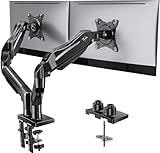
- Compatible with Wide Screens - To ensure compatibility with the dual monitor mount, your each monitor must meet three conditions at the same time: First, computer screens size range: 13 to 32 inches. Second, screen weight range: 4.4 to 19.8 lbs. Third, the back of the monitor screen must have VESA mounting holes with a pitch of 75x75mm or 100x100mm.
- Regarding the compatibility with desks - Your desk must meet three conditions at the same time: First, desk material: Only wooden desks are recommended, plastic or glass desks cannot be used. Second, desk thickness range: 0.59" - 3.54". Third, the bottom of the desk should not have any cross beams or panels, as this will interfere with installation. We recommend carefully checking that your desk and monitors meets all above conditions before purchasing.
- Dual C-Clamp Hold - Worried your dual monitors might wobble or slip? Our upgraded base uses a larger platform plus a dual C-clamp structure to lock the dual monitor arm firmly to your desk. Each arm safely keeps your screens steady while you type, click and game—no shaking, no sliding, just a clean and secure setup you can trust every day. It also provides Grommet Mounting installation choice, both options ensure stable and secure fixation for your 0.59" - 3.54" desk.
- Full-Motion Adjustment For Comfortable View - Pull the screen closer when you’re deep in a spreadsheet, push it back to watch videos, or rotate to portrait for coding — moving everything smoothly with just one hand. The monitor stand offers +85°/-50° tilt, ±90° swivel and 360° rotation. Raise your monitor up to 15.75″ to support a healthy sitting posture. Whether you’re working from home, gaming through the night, or switching between video calls and documents, getting the screens to your natural line of sight helps relieve neck, shoulder and back strain so you can stay focused longer with less fatigue.
- Keep Your Desk Organized: By lifting both screens off the desktop, this dual monitor stand opens up valuable space for your keyboard, notebook, docking station or a simple, clutter-free work area. Built-in cable management guides wires along the arms, keeping cords out of sight and out of the way. Enjoy a tidy, modern workstation that looks as good as it feels to use.
Ask whether the team can repeatedly generate, inspect, fix and ship the required quality at a predictable cost. A button that creates a thousand trees is not useful if artists must hand-correct every forest, if foliage breaks navigation, or if the resulting memory footprint fails the target console.
Choose trade-offs deliberately
| Decision | Benefit | Cost or risk | Control question |
|---|---|---|---|
| Hand-authored content | Distinctive spaces and direct creative control | Lower throughput and more manual iteration | Which areas truly need bespoke authorship? |
| Procedural or data-driven content | Faster repetition and broader variation | Tooling, validation and review burden | Can generated results meet quality and performance rules consistently? |
| One continuous world | Seamless travel fantasy | Streaming, memory, traversal and global-state complexity | Does seamlessness create player value worth its infrastructure cost? |
| Several dense regions | Focused production and stronger content density | Transitions, loading and less continuous geography | Can region boundaries support pacing rather than feel like limits? |
| Multi-platform launch | Wider initial reach | Optimization, certification and support across devices | Does launch reach justify delaying or constraining the core game? |
| Staged platform rollout | Smaller initial test matrix | Later port cost and delayed audiences | Can the business fund and schedule the later release? |
| More systems | Broader interactions and emergent possibilities | More tutorials, balance work, QA and edge cases | Which system deepens the primary loop rather than merely adding options? |
| Internal team | Context, control and easier iteration | Hiring, idle capacity and fixed overhead | Is there enough durable work to keep each specialty productive? |
| Outsourcing | Additional capacity or specialist expertise | Briefing, handoff, review, integration and vendor risk | Can the team specify, inspect and accept work without slowing the pipeline? |
Cut breadth before identity when the forecast breaks
When the estimate exceeds the money or schedule, preserve the core fantasy and the best version of the primary loop. Remove breadth and optional complexity first:
- Reduce map area or merge adjacent regions.
- Lower biome, settlement, faction or side-quest counts.
- Consolidate enemy families while preserving the meaningful behaviors players rely on.
- Remove traversal modes that do not strengthen the central loop.
- Reduce systemic combinations that create disproportionate QA and balancing work.
- Simplify cinematic complexity or reactive narrative branches that add little player value.
- Stage platform launches instead of compromising performance everywhere.
- Move nonessential post-launch content out of the launch commitment.
Do not remove the signature traversal, combat interaction, narrative reactivity or world simulation that gives the game its reason to exist unless you are consciously redefining the project. A successful cut leaves a smaller, denser and more reliable game; it does not leave the same promise with its defining feature missing.
The Tool Desk
Outbyte PC Repair FREERepair Windows errors before they cause bigger problemsFix Now →Outbyte Driver Updater FREEScan for outdated or missing drivers - takes under a minuteDriver Scan →Make cuts as product decisions
For each candidate cut, record the units removed, staff and calendar released, dependencies invalidated, QA cases eliminated, player promise affected and migration work required. A cut that saves two months but forces six months of re-authoring is not a saving. Freeze the decision, update the scope constitution and remove the work from plans, outsourcing briefs and marketing promises.
Run a living forecast
Reforecast at a fixed cadence using actual completion data. Separate committed costs from estimates, launch costs from operations, and cash spending from economic labor value. Keep a risk register for unproven systems, vendors, platform requirements, technical debt and content whose acceptance criteria are still unclear.
Use three views of the plan:
- Base case: measured throughput and currently approved scope.
- Downside case: slower throughput, additional rework or a failed technical assumption.
- Cut case: the smallest set of reductions that protects the core fantasy if the downside occurs.
When a forecast moves, change scope, staffing, schedule or funding explicitly. Hiding the variance until the next milestone turns a manageable adjustment into a late cancellation or a rushed, low-quality release.
Quick Recap
A practical scope-and-budget checklist
- Write the scope constitution and minimum shippable experience.
- Rank assumptions by the damage they cause if wrong.
- Prototype traversal, streaming, save/load, AI, mission state and performance before large-scale production.
- Build a final-quality vertical slice that includes the complete loop and real workflow.
- Measure representative units, including integration, review, QA, optimization and rework.
- Convert the game into countable missions, activities, kits, locations, enemy families, platform passes and test cycles.
- Set milestone exit criteria and require an expand, hold, simplify, cut, delay or stop decision.
- Scale only after the pipeline repeatedly meets throughput, quality and performance targets.
- Use automation for repetition while budgeting authoring, validation and maintenance.
- Protect identity; cut map breadth, optional systems and launch commitments before the core loop.
- Reforecast with actual net throughput and keep post-launch work in a separate budget.
Product prices and availability are accurate as of the date/time indicated and are subject to change. Any price and availability information displayed on Amazon at the time of purchase will apply.

