Yes—but only at the right price. The Intel Core i7-13700K remains fast enough for high-refresh gaming and is especially capable when gaming is combined with rendering, compiling, streaming, encoding, or other threaded work. In 2026, however, it is no longer an automatic recommendation for a new gaming PC. It makes the most sense as a discounted processor, an upgrade for an existing LGA1700 system, or a hybrid gaming-and-productivity CPU.
For a new gaming-only build, compare the complete cost of the CPU, motherboard, memory, cooler, and power supply against newer AMD X3D and Intel alternatives. Also account for LGA1700’s limited upgrade path, high peak power, and Intel’s current BIOS and microcode guidance for affected 13th- and 14th-generation desktop processors.
As an Amazon Associate I earn from qualifying purchases.
Intel Core i7-13700K specifications
| Specification | Core i7-13700K |
|---|---|
| Architecture | Raptor Lake |
| P-cores / E-cores | 8 / 8 |
| Total cores / threads | 16 / 24 |
| Maximum turbo frequency | 5.4 GHz |
| L3 cache | 30 MB |
| L2 cache | 24 MB |
| Processor Base Power | 125 W |
| Maximum Turbo Power | 253 W |
| Socket | LGA1700 |
| Memory support | DDR4-3200 or DDR5-5600 |
| Integrated graphics | Intel UHD Graphics 770 |
| Quick Sync Video | Yes |
The specifications are from Intel’s product page. The 13700K is a 13th-generation desktop processor using Intel’s hybrid design: eight Performance-cores handle demanding foreground work while eight Efficient-cores add throughput for background and heavily threaded tasks. Its 24 threads make it substantially more versatile than a gaming-focused processor with fewer total cores.
Recommended Free Tools
The unlocked multiplier allows overclocking, but overclocking is not required to obtain strong gaming performance. The integrated graphics also distinguish the 13700K from the otherwise similar 13700KF: UHD Graphics 770 can provide display output, basic troubleshooting without a discrete GPU, and Quick Sync acceleration in supported video workflows.
#1 Best Overall
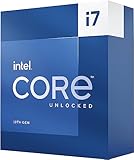
- 13th Gen Intel Core processors offer revolutionary design for beyond real-world performance. From extreme multitasking, immersive streaming, and faster creating, do what you do
- 16 cores (8 P-cores plus 8 E-cores) and 24 threads
- Up to 5.4 GHz unlocked. 30M Cache
- Integrated Intel UHD Graphics 770 included
- Compatible with Intel 600 series (might need BIOS update) and 700 series chipset-based motherboards
Gaming performance: still fast enough?
Yes. The 13700K remains a high-performance gaming CPU. It is unlikely to be the limiting component in most 1440p or 4K systems, where the graphics card usually determines frame rate. With a mainstream or upper-midrange GPU, the difference between this processor and newer high-end CPUs can become difficult to see outside benchmarks.
The gap matters more in a CPU-limited test: 1080p gaming with a very fast graphics card, high-refresh competitive play, or games that simulate large numbers of units and characters. Strategy games, MMOs, heavily modded titles, simulation games, and some open-world games can expose differences in frame-time consistency and 1% lows before average FPS looks dramatically different.
Historical reviews found the 13700K highly competitive and unusually strong as a combined gaming-and-productivity processor. Those launch-era results establish its capability, not its 2026 ranking. Newer gaming-specialist CPUs may deliver higher gaming performance or better efficiency, so a current recommendation must separate:
Do these 3 things before closing this tab:
1Repair Windows errors before they cause bigger problems2Scan for outdated or missing drivers - takes under a minute3Clear out junk files and repair common Windows errors- Average FPS: the overall frame-rate result.
- 1% lows and frame times: often more relevant to perceived smoothness.
- CPU-limited results: useful for comparing processors.
- GPU-limited results: more representative of many 1440p and 4K systems.
Tom’s Hardware’s 13700K review provides historical gaming and productivity context, while TechRadar’s comparison coverage explains why an X3D processor could be preferable for a gaming-only buyer when priced close to the Intel chip.
Where the 13700K is especially strong: gaming plus productivity
The 16-core, 24-thread configuration is the central reason to choose the 13700K over a gaming-specialist CPU. It has the capacity for video encoding, software compilation, 3D rendering, compression, streaming, and heavy multitasking while remaining a strong gaming processor.
This advantage depends on the workload. Applications that scale well across many threads can benefit substantially from the additional E-cores. Light office work and gaming alone will not necessarily use them, and a gaming-only buyer may get more value from a processor designed around gaming cache or lower power consumption.
Is the i7-13700K good value in 2026?
Intel’s original recommended customer price was $409, but that is not a reliable 2026 street-price signal. A current buying decision should use the actual total platform cost rather than the launch MSRP or CPU price alone.
Compare these seven costs:
- CPU price and whether it is boxed or tray.
- Motherboard price and BIOS support.
- DDR4 or DDR5 memory.
- A cooler capable of handling sustained loads.
- Power-supply capacity and system power consumption.
- Any replacement cost for an existing board or memory.
- The value of the alternative platform’s upgrade path.
At or near $409: the 13700K is difficult to recommend for a new gaming-only system.
Rank #2

- Game Without Compromise. Play harder and work smarter with Intel Core 14th Gen processors
- 20 cores (8 P-cores plus 12 E-cores) and 28 threads. Discrete graphics required
- Up to 5.6 GHz with Turbo Boost Max Technology 3.0 gives you smooth game play, high frame rates, and rapid responsiveness
- Compatible with Intel 600-series (with potential BIOS update) or 700-series chipset-based motherboards
- DDR4 and DDR5 platform support cuts your load times and gives you the space to run the most demanding games
At a meaningful discount: it can be attractive, particularly if you can reuse an LGA1700 motherboard and DDR4 memory.
At a deep discount: it becomes compelling for an existing LGA1700 owner or anyone who needs strong multithreaded performance.
Only slightly cheaper than a newer CPU or X3D platform: it is usually the weaker purchase once motherboard, memory, cooling, efficiency, and upgrade options are included.
Because live retailer pricing and stock change frequently, there is no honest universal “good price” without a dated price check. Compare the complete systems on the day you buy.
New build versus LGA1700 upgrade
For a new PC
The 13700K’s main drawback is not performance; it is platform value. LGA1700 is a completed platform, so a new buyer should not assume a meaningful future CPU-upgrade path. A new build may also require a motherboard, memory, cooler, and potentially a stronger power supply. That can erase an apparent saving over a newer platform.
DDR4 can lower the initial cost if compatible memory is already available, but a completely new high-end system may be better served by comparing DDR5 platforms directly. The 13700K supports DDR4-3200 and DDR5-5600, but a motherboard generally supports one memory type, not both.
For an existing LGA1700 PC
The calculation changes dramatically if you already own a compatible board, memory, and cooler. A CPU-only upgrade can be far cheaper than replacing the platform. The 13700K is most attractive here when upgrading from a 12th-generation Core i5 or another materially slower processor, provided the board’s power delivery and cooling are adequate.
Free tools Windows power users keep installed
One-click scans. No signup required.
Intel says 600- and 700-series motherboards may require a BIOS update for 13th- and 14th-generation processors. Update the BIOS before removing the old CPU whenever possible. Intel’s compatibility guidance explains the requirement. If the board lacks BIOS Flashback and cannot boot with the new processor, you may need an older supported CPU or retailer and motherboard service.
Rank #3

- Game Without Compromise. Play harder and work smarter with Intel Core 14th Gen processors
- 20 cores (8 P-cores plus 12 E-cores) and 28 threads. Integrated Intel UHD Graphics 770 included
- Up to 5.6 GHz with Turbo Boost Max Technology 3.0 gives you smooth game play, high frame rates, and rapid responsiveness
- Compatible with Intel 600-series (with potential BIOS update) or 700-series chipset-based motherboards
- DDR4 and DDR5 platform support cuts your load times and gives you the space to run the most demanding games
Cooling, power, noise, and efficiency
The 125 W Processor Base Power figure should not be treated as a worst-case system-design target. Intel lists a 253 W Maximum Turbo Power and says the thermal solution must support the processor’s operating range. Heavy all-core rendering or stress workloads can therefore demand substantially more cooling than a basic stock-style cooler.
A serious tower air cooler or a 240/280 mm-class liquid cooler may be appropriate, depending on the case, airflow, ambient temperature, motherboard limits, and noise target. Gaming loads can be much lighter than all-core workloads, but motherboard “enhanced” power profiles may remove expected limits and increase temperature, power, and noise.
For a responsible configuration, start with Intel Default Settings. A power limit can reduce heat and noise, potentially with a modest performance trade-off, but the exact effect depends on the workload and should be measured rather than assumed. Intel’s thermal guidance is the appropriate baseline.
Quick wins for a faster PC:
Fix the driver behind crashes, sound loss and screen glitchesFind Drivers →Clear out junk files and repair common Windows errorsFree Scan →13th-generation stability guidance: what buyers must do
Important: Intel acknowledges reports of Vmin Shift instability affecting some 13th- and 14th-generation desktop processors. The i7-13700K is among the eligible 13th-generation i7 products covered by Intel’s current guidance.
- Update the motherboard to the latest BIOS containing Microcode 0x12F or later.
- Select Intel Default Settings rather than an undocumented vendor-enhanced profile.
- Avoid unnecessary voltage, frequency, or power modifications.
- Test for crashes, freezes, application errors, and other instability at default settings.
- Keep the receipt, serial information, and BIOS details for any warranty claim.
Intel says eligible processors receive a two-year warranty extension, for coverage of up to five years from the original purchase date, subject to Intel’s terms and the sales channel. The extension does not mean every 13700K is defective, and a BIOS update should not be described as repairing silicon that has already degraded. It is recommended mitigation for future behavior, not a guaranteed recovery mechanism.
If instability continues, document the symptoms, update the BIOS, restore Intel Default Settings, and contact the retailer or Intel through the appropriate warranty channel. Intel also warns that changing clock frequency or voltage can reduce stability, performance, or product life and may affect warranty coverage. See Intel’s Vmin Shift guidance, eligible-product warranty information, and boxed-processor warranty terms.
Independent reader supportYour contribution helps us test, update, and keep practical guides available for everyone.Core i7-13700K versus 13700KF
The 13700KF removes the integrated graphics while retaining the same general core configuration. It can be a sensible choice for a gaming PC that will always use a discrete graphics card, but only when it is meaningfully cheaper.
The 13700K’s UHD Graphics 770 and Quick Sync support are useful for troubleshooting a graphics-card problem, running displays without a discrete GPU, and supported video encoding or transcoding workflows. Saving money on the KF is therefore a trade-off, not a free equivalent.
Rank #4

- Next‑Gen Platform Support: Compatible with Intel 800 Series Chipset‑based motherboards with LGA1851 Socket enabling PCIe 5.0/4.0 and high‑speed DDR5 memory (up to 7200 MT/s).
- High‑Performance Core Configuration: Features up to 24 cores (8 P‑cores + 16 E‑cores) for demanding gaming and creator
- Ultra‑Fast Boost Clocks: Reaches up to 5.5 GHz max turbo frequency for top‑tier responsiveness and performance
- Built for Enthusiasts: Unlocked for performance tuning when paired with Intel Z‑series chipsets, making it ideal for overclockers and power users.
- Robust Power & Thermal Design: Engineered with 125W base power and 250W max turbo power to sustain high‑intensity
Alternatives worth comparing
Core i7-14700K
The 14700K remains in the LGA1700 ecosystem and has a listed maximum turbo frequency of 5.6 GHz. It is not automatically the better purchase: compare the price difference, cooling requirements, motherboard power limits, and whether its additional capability helps your workload. It is also covered by Intel’s current 13th- and 14th-generation stability guidance. Use Intel’s official comparison page before deciding.
Ryzen 7 7800X3D
The Ryzen 7 7800X3D is a historically important gaming alternative and was often preferred for gaming-only systems when its price premium over the 13700K was small. It requires an AM5 motherboard and DDR5 memory, so compare the complete platform rather than CPU prices alone.
Ryzen 7 9800X3D
The newer 9800X3D is a more relevant X3D-class comparison for a new 2026 gaming build. Its exact price, availability, and performance lead should be verified at the time of purchase; they should not be inferred from older reviews or from a different test suite.
Lower-cost CPUs
If gaming is the priority, a cheaper Core i5 or Ryzen 5-class processor may leave more budget for a faster graphics card. That is not an absolute rule: the result depends on the target resolution, games, refresh rate, and GPU. At 1440p and 4K, spending more on the CPU often produces less visible benefit once the existing processor is already fast enough.
Buying used: an extra risk calculation
A used 13700K should be priced well below a boxed, warrantied processor. You cannot easily verify its previous voltage, power limits, motherboard BIOS, cooling, or possible degradation. Used buyers should also check proof of purchase, warranty-transfer conditions, seller reliability, return terms, and whether the processor came from an authorized channel.
Who should buy the Core i7-13700K?
- Buy it if you already own a suitable LGA1700 motherboard and memory, find a substantial discount, and need both gaming and threaded productivity performance.
- Consider it for a new build only when the complete platform is clearly cheaper than current alternatives and you accept the cooling, power, and upgrade-path trade-offs.
- Skip it if you want the best high-refresh gaming performance, low power consumption, quiet operation, a small-form-factor system, or a forward-looking upgrade platform.
- Choose carefully if you are buying used or unwilling to verify BIOS, microcode, Intel Default Settings, and warranty coverage.
Verdict
The Intel Core i7-13700K is still a very good gaming CPU, but “still fast” is not the same as “best value.” Its 16 cores and 24 threads make it a particularly strong hybrid gaming/productivity processor, and an existing LGA1700 owner can get excellent value from a CPU-only upgrade. For a brand-new gaming-only PC, however, the decision should be driven by the complete platform price and current comparisons with X3D and newer Intel options—not by the 13700K’s launch reputation.
Buy it discounted, cool it properly, run current BIOS and microcode with Intel Default Settings, and treat LGA1700 as a finished platform. Under those conditions, the 13700K remains a sensible bargain. At close to the price of a newer or more gaming-focused alternative, it is no longer the default choice.
PC Slower Than It Used to Be?
A free scan shows the junk files, broken settings and background clutter dragging Windows down - then fixes them in one click.Free scan · Windows 10 & 11Outdated Drivers Are Slowing You Down
One free scan finds every outdated or missing driver and matches the right update for your exact hardware.Free scan · exact hardware matchQuick Recap
Product prices and availability are accurate as of the date/time indicated and are subject to change. Any price and availability information displayed on Amazon at the time of purchase will apply.




