Some links on this page are affiliate links: if you buy through them we may earn a commission, at no extra cost to you.
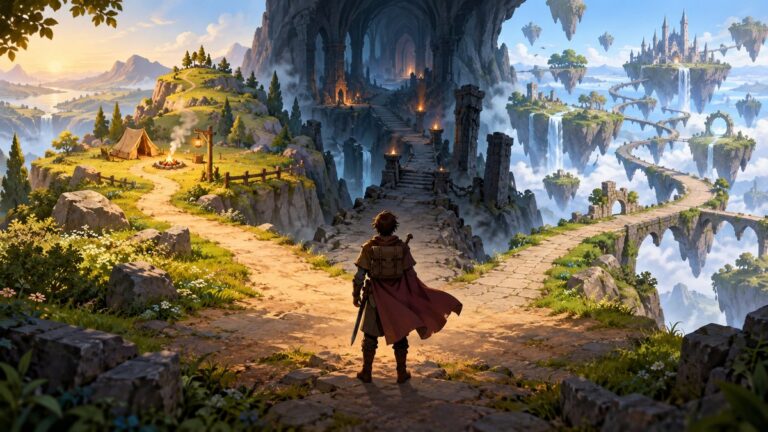
An open-world game feels repetitive when players can predict what an activity will ask them to do before they reach it—and when doing it changes little about what comes next. Repetition itself is not the enemy: familiar actions can teach a system or reinforce a theme. The problem is repetition without fresh decisions, context, discovery, mastery, or consequences. Developers can reduce that fatigue by varying the reasoning and stakes behind activities, making exploration and travel matter, and giving the world ways to respond to player choices.
Why do open-world games start to feel repetitive?
They feel repetitive when many different-looking places resolve into the same small set of actions. A player sees a marker, travels there, fights a group or collects an item, opens a reward, and moves on. After a few repetitions, the player is no longer wondering what might happen. They are executing a known template.
As an Amazon Associate I earn from qualifying purchases.
That pattern can wear thin even when the world is large. Map size and activity count measure how much content exists, not how many distinct experiences it offers. If several missions require the same decisions, use the same verbs, and produce interchangeable rewards, changing the location or enemy appearance may not create meaningful variety.
Repetition can also be deliberate and useful. A game may repeat an action so the player learns a mechanic, feels its rhythm, or understands a theme. Game designer Raph Koster has described repetition as a way to get a systemic or thematic message across. The design question is not simply “Does this happen again?” but “What does the player notice, decide, or understand differently this time?” Koster’s discussion of play and possibility spaces provides a useful lens: meaningful play depends on the possibilities an activity gives the player, not just on its surface presentation.
Popular on Amazon

- 【90 Degree Full Function USB C Adapter】Supports the latest USB4 standard for up to 40Gbps of bandwidth, 8K video support, and up to 240W Fast charging; Support USB PD 3.1 Extended Power Range (EPR) including 140W, 180W and 240W. Your productivity is easily doubled. *Warm Tip: For the best fit, please make sure the USB-C port is fully exposed; thick or bulky cases may affect compatibility.
- 【Reliable Quality】Made from high-quality, scratch-resistant aluminum alloy, delicate metal frame. get excellent wear resistance and heat dissipation. Non-Slip Design for easier insertion and removal.
- 【Small and portable】Ultra thin size, ultra compact design, a petite physique that matches the minimalist design of your modern laptops. Coming with a slim figure that won't block the port next to the one it's plugged into.
- 【Compatibility】Widely work with most usb c, thunderbolt 4/3 devices. Compatibilit for ROG Ally, Steam Deck, Switch, MacBook Pro, Quest 3 VR headset, Surface Book 2, iPhone 18/17/16/15, Samsung Galaxy S23/S22/S21, Note 20/10, Google Pixel, ChromeBook, etc.
- 【Excellence Customer Support】If you experience any issues or cable failure, simply reach out to our dedicated customer service team. We provide a prompt response within 18 hours, providing you with the necessary technical support to resolve any concerns.
What makes repeated activities feel like filler?
An activity feels like filler when it consumes time without adding a new choice, useful understanding, meaningful reward, or memorable context. Several design problems commonly combine to create that impression.
- The activity grammar never changes. If a map is full of icons that all lead to combat, stealth, collection, or a short puzzle in the same format, players learn the pattern and stop anticipating surprises. A different enemy skin is not necessarily a different activity if the player solves it in the same way.
- Rewards do not affect future decisions. Another interchangeable item or a modest increase in a number can be a reward, but it may not make a task matter if it does not change the player’s options or approach to later problems. A reward feels more connected when it opens a route, changes a relationship, teaches a tool, or gives the player a reason to reconsider a strategy.
- Side content is treated as lower-quality content. Side missions do not have to be as long as the central story, but they still need a reason to exist beyond adding hours. CD Projekt Red senior level designer Miles Tost has emphasized that variety and quality matter, rather than making optional content feel like a lesser “B” tier. A discussion of the challenges of open-world creation reinforces that content quality and variety are core design concerns, not polish added after the map is filled.
- The world is only a backdrop. If the same activity could be moved into a menu or a small linear arena without changing the decisions or experience, the open world may not be contributing much. Place, distance, factions, traversal, and local systems should shape what the player can do or discover.
- Travel has no payoff. A long ride or walk becomes a chore when the route offers no readable landmarks, discoveries, shifting threats, or choices. A route does not need an encounter every minute, but the player should have a reason to pay attention to the landscape or a clear reason to choose that route.
- The story’s urgency clashes with free exploration. When a story insists that a crisis is immediate but allows the player to spend hours clearing identical outposts, the fiction and the activity can undermine each other. The side activity may feel unimportant, while the supposedly urgent story loses force. Open-world design discussions identify this tension as a problem of narrative fit, not simply pacing.
- The game forgets what the player is doing. Open worlds invite players to switch between goals. Researcher Hughes characterizes them as “continuous task switching spaces,” where switching can itself be part of the experience. But if every goal leads to an equivalent encounter, switching locations does not create a new experience; it only changes the scenery. Hughes’s research on specific open-world experiences is useful context for thinking about that constant movement between tasks.
A 2025 thesis by Helena Ruiz Ramírez reports that participants described contemporary open-world content as “bland, bloated, and repetitive,” while preferring experiences they found meaningful, curious, creative, or emergent. The same thesis survey found that 63.1% of respondents valued meaningful side content, 55% valued being able to pause the main quest, and 53.2% valued an interesting overworld. These are findings from one survey, not universal market statistics; the author also cautions that three case studies are insufficient to establish statistical reliability. They are best read as evidence about that study’s participants and as prompts for design questions, rather than as a forecast of what every player wants. The thesis and its open-world engagement framework give the figures their research context.
Quick wins for a faster PC:
Scan for outdated or missing drivers - takes under a minuteDriver Scan →Repair Windows errors before they cause bigger problemsFix Now →How can developers make side quests feel meaningful?
Give each activity a purpose beyond occupying space. A side quest can reveal a character, change a settlement, teach a system, create a relationship, alter later encounters, or make a particular place memorable. It does not need to do all of those things; it should do at least one in a way that fits the world and rewards the time it asks of the player.
That purpose should be legible in the activity itself. A quest about protecting a community should make protection matter, rather than using a conversation as a pretext for an unrelated sequence of identical fights. An investigation can reward observation and inference; a negotiation can make the player weigh competing interests; a traversal challenge can ask the player to read terrain. The aim is to vary what the player thinks about and decides, not just the animation or setting.
Consequences do not have to be dramatic branching storylines. A small but visible change can make an action feel acknowledged: a character treats the player differently, a location opens up, a faction changes its behavior, or a future encounter reflects an earlier decision. If choices repeatedly produce no perceptible effect, players can learn that the game’s apparent agency is cosmetic. Conversely, a limited choice with a clear consequence can feel more meaningful than a grand choice that changes nothing the player can see.
Also popular on Amazon

- 5-in-1 Connectivity: Equipped with a 4K HDMI port, a 5 Gbps USB-C data port, two 5 Gbps USB-A ports, and a USB C 100W PD-IN port. Note: The USB C 100W PD-IN port supports only charging and does not support data transfer devices such as headphones or speakers.
- Powerful Pass-Through Charging: Supports up to 85W pass-through charging so you can power up your laptop while you use the hub. Note: Pass-through charging requires a charger (not included). Note: To achieve full power for iPad, we recommend using a 45W wall charger.
- Transfer Files in Seconds: Move files to and from your laptop at speeds of up to 5 Gbps via the USB-C and USB-A data ports. Note: The USB C 5Gbps Data port does not support video output.
- HD Display: Connect to the HDMI port to stream or mirror content to an external monitor in resolutions of up to 4K@30Hz. Note: The USB-C ports do not support video output.
- What You Get: Anker 332 USB-C Hub (5-in-1), welcome guide, our worry-free 18-month warranty, and friendly customer service.
The quest-design lessons shared by Paweł Sasko and other developers emphasize meaningful choice and consequence, narrative engagement, emotional impact, novelty, and the production challenges of non-linear stories. Those goals need to be balanced: a designer cannot promise a bespoke branching outcome for every small decision, but can choose where consequences matter most and make those moments clear. The GDC session on quest design in The Witcher 3 and Cyberpunk 2077 and its published takeaways discuss these challenges.
How should an open world reward exploration?
Exploration works best when players have reasons to look, infer, and choose a direction—not only follow a dense layer of identical markers. Landmarks, environmental clues, partial information, secrets, and discoveries specific to a place can invite curiosity. A useful discovery might provide a practical advantage, reveal something about the world, or simply create a memorable encounter; it does not always need to be powerful loot.
Information design matters. If every worthwhile activity is announced by the same icon, players can begin to treat the world as a checklist. Hiding every point of interest is not the answer either: players still need enough cues to orient themselves. The balance is to let fiction, sound, sightlines, factions, and environmental details guide attention without turning every destination into a standardized task label.
A practical design check is to remove map icons and activity labels from a test build. Can players still infer where to go from landmarks, the fiction, sound, faction behavior, or curiosity? If not, the interface may be doing all the work of making the world legible. Then compare activities that offer the same reward: if they require the same reasoning and actions, one may be redundant. This is a diagnostic prompt, not a universal rule—some players rely on navigation aids, and accessibility options should not be confused with a lack of world design.
How do systemic events create variety?
Systemic design lets the rules of a world combine to create situations that are not fully scripted in advance. A familiar location can play differently if characters, factions, traversal, weather, or other systems interact in ways the player can read and respond to. The benefit is not randomness for its own sake; it is a larger set of plausible situations and approaches.
Free tools Windows power users keep installed
One-click scans. No signup required.
Also popular on Amazon

- Sleek 7-in-1 USB-C Hub: Features an HDMI port, two USB-A 3.0 ports, and a USB-C data port, each providing 5Gbps transfer speeds. It also includes a USB-C PD input port for charging up to 100W and dual SD and TF card slots, all in a compact design.
- Flawless 4K@60Hz Video with HDMI: Delivers exceptional clarity and smoothness with its 4K@60Hz HDMI port, making it ideal for high-definition presentations and entertainment. (Note: Only the HDMI port supports video projection; the USB-C port is for data transfer only.)
- Double Up on Efficiency: The two USB-A 3.0 ports and a USB-C port support a fast 5Gbps data rate, significantly boosting your transfer speeds and improving productivity.
- Fast and Reliable 85W Charging: Offers high-capacity, speedy charging for laptops up to 85W, so you spend less time tethered to an outlet and more time being productive.
- What You Get: Anker USB-C Hub (7-in-1), welcome guide, 18-month warranty, and our friendly customer service.
The official Assassin’s Creed Unity postmortem describes non-player-centric systemic events designed to create spontaneous gameplay opportunities and replay value. The useful lesson is that events need not always be organized around a single player marker or mission trigger. When the world’s systems can produce situations worth noticing, travel and observation can become part of play rather than downtime. The GDC postmortem on systemic crowd events describes that approach.
Systems need readable rules and authored context. If players cannot understand why an event happened or what they can do about it, a surprising outcome may feel arbitrary. If every interaction produces the same result, the system offers little meaningful variation. Designers can support both legibility and surprise by placing systemic possibilities in authored spaces where their stakes make sense, and by giving players more than one useful way to respond.
Does procedural generation solve repetition?
Procedural generation can expand layouts, encounters, or connective material, but it cannot make an activity meaningful just by producing more variations. A hundred arrangements of the same unchanging objective may still feel like one task repeated a hundred times.
Generation works best when it serves authored intent: theme, pacing, difficulty, and the specific experience a space is meant to create. The thesis’s developer interviews describe procedural tools as enhancers of handmade content and warn that using them as a shortcut around bespoke design can result in empty, low-quality worlds that players recognize. That does not mean generated content is inherently empty. It means the tool should support a designed experience rather than substitute for the choices that give that experience shape. Ramírez’s thesis includes this distinction in its discussion of open-world design.
The Tool Desk
Outbyte Driver Updater FREEScan for outdated or missing drivers - takes under a minuteDriver Scan →Outbyte PC Repair FREEClear out junk files and repair common Windows errorsFree Scan →How can a team tell whether repetition is a problem?
Look at the player’s decisions and understanding, not only the number of activities completed. Focused observation can reveal whether people keep choosing to continue, switch goals, explore off-route, and remember what they were doing after a break. These behaviors are clues to investigate, not standalone proof that a design succeeds or fails.
Also popular on Amazon

- Portable and powerful USB-C HUB: BENFEI USB Type-C HUB, with super-soft and knot-free silicone woven design cable, meets most mobile office needs. Compact, lightweight, stylish, and powerful portable USB C Hub equipped with 1 x HDMI port, 1 x 100W charging, and 3 x USB ports. 18-month warranty, 24-hour response, to ensure you feel at ease when using our product.
- Design centered on comfort and reliability: Thanks to BENFEI's end-to-end in-house cable production capability, in-house PCBA and assembly capability, using the industry's most advanced silicone woven design and process, 20cm cable in length, no knots, super-soft, the HUB is easy to use in all scenarios: laptop, tablet, stand etc. Super-soft, 25000+ life cycles, to meet your daily carrying and office needs.
- 100W Charging: Support up to 90W USB C pass-through charging via Type-C port to keep your laptop powered. 10W is reserved for other interface operations. No data and video function on the Type-C port.
- 4K HDMI Display: The HDMI port supports media display at resolutions up to 4K 30Hz, keeping every incredible moment detailed and ultra vivid. Please note that the C port of the Host device needs to support video output.
- Transfer Files in Seconds: Transfer files and from your laptop at speeds up to 10 Gbps with USB A 3.2 port. Extra 2 USB A 2.0 ports are perfectly for your keyboards and mouse.
Build focused slices that let the team examine a specific experience: for example, whether an area rewards looking around, whether two similar missions actually ask different questions, or whether players understand the consequence of a choice. The 2025 thesis recommends rapid level iteration, custom tools, collaboration between engineers and designers, and focused playtesting. The point is to learn about a concrete slice of play rather than rely only on an aggregate completion figure that cannot explain why a player kept going—or stopped.
Use a consistent set of critique questions for each activity:
- Activity variety: Which verbs and decision types does it add, and how is it different from nearby tasks?
- Meaningful consequence: Does it affect a story, system, relationship, future access, or the player’s understanding?
- Exploration value: Is the discovery surprising, useful, or specific to this place?
- Systemic depth: Can the rules combine into situations the player did not see scripted?
- Narrative fit: Does the activity respect the urgency and fiction of the main story?
- Travel quality: Does movement offer opportunities or choices, rather than only consume time?
- Session resilience: Can the player pause, switch goals, and return without losing track?
- Authored-to-procedural balance: Does generation extend the intended experience or replace the design work that would give it meaning?
One result matters especially: can the player explain why this activity was worth doing? The answer need not be “I got the best item.” It might be “I learned how that faction works,” “I found a route I want to use again,” or “I saw the consequences of an earlier choice.” If the only answer is “the marker was there,” the task may be adding volume without adding much value.
Recommended Free Tools
How can developers make it easier to return after a break?
Open-world games can ask players to keep several goals, characters, and locations in mind, even though play often happens across separate sessions. Clear quest state, useful recap tools, readable re-entry points, and mechanics that can be relearned help people resume without turning every return into a memory test.
Refamiliarization is part of the experience, not merely a convenience feature. A player who comes back unsure what a quest requires may spend their session navigating menus or retracing steps rather than engaging with the world. A concise reminder of the current goal and relevant context can preserve the freedom to pause and switch activities—the qualities participants in Ramírez’s survey valued—while helping the player make a deliberate next choice.
Also popular on Amazon

- 【Read before You Buy】 Note: This adapter is USB 2.0 version and cannot transmit HDM, VGA, or other video signals. Nevertheless, they are fully capable of charging devices,duplicating files, and can be seamlessly integrated with USB-C earphones, wireless network adapters, and SD card adapters.
- 【Easy to Use and Safe】Thanks to modern manufacturing techniques, we've made these adapters sufficiently compact so that they can remain inserted in your device without noticeable protrusion or inconvenience. This means you don't have to constantly plug and unplug them, reducing the likelihood of wear and misalignment, and making them more convenient to carry around.
- 【Reliable Quality】Engineered for enhanced durability, durable aluminum alloy shell material,get excellent wear resistance and heat dissipation,the male USB C and female USB connectors & the male USB and female USB C connectors are designed to be plugged and unplugged up to 20000 times. Provides data transfer, device charging, memory space expansion, and additional computer peripherals.
- 【Think more for you】Do you need to connect a USB-C-enabled device to an odd device that only has USB-A ports? Then these USB-A male to USB-C female adapters are made for you.Simply insert the adapter into the USB-A port on the device, and you can instantly connect your USB-C device to the device that originally didn't have the correct connection port.
- 【Trusted xiwxi Quality and Service】As a responsible brand seller, you will receive xiwxi's 12-month Quality assurance and lifetime friendly customer service, you're not just buying a product,you're investing in peace of mind with all-round quality and exceptional customer service.
There is no single fix for repetition fatigue. A bigger map, more icons, more loot, or more generated encounters can increase quantity without changing the underlying pattern. The stronger test is whether each activity gives the player a reason to think, choose, discover, or care—and whether the world makes those actions matter.
Frequently Asked Questions
Is repetition always bad in a game?
No. Repeated actions can help players learn a rule, build mastery, or recognize a theme. It becomes tiring when the repetition asks for no new understanding and offers no meaningful change in context or stakes.
What is the difference between variety and randomness in an open-world game?
Variety changes the decisions, goals, or consequences available to the player; randomness changes what happens without necessarily making it meaningful. A surprising event is most satisfying when players can understand its rules and choose how to respond.
Can fast travel fix repetitive open-world travel?
Fast travel can reduce time spent crossing familiar ground, but it cannot make destinations or activities more interesting. If the journey itself is meant to carry discoveries or choices, players also need control over when to travel directly and when to engage with the route.
Why do players sometimes stop caring about map markers?
Markers lose persuasive value when they repeatedly lead to activities that feel interchangeable. Players may still use them for navigation, but the symbols stop promising discovery once the outcomes become predictable.