
Recommended Free Tools
Some links on this page are affiliate links: if you buy through them we may earn a commission, at no extra cost to you.
A game is most usefully called AI-generated when generative AI materially creates content that players experience—either content included in the released game or content generated while they play. That does not mean every game made with an AI tool qualifies: using a chatbot to brainstorm or help with code is usually production assistance, not a defining feature of the finished game. The key questions are what the AI creates, when it creates it, what players encounter, and whether the game depends on generation to deliver its central play experience.
What does “AI-generated game” mean?
There is no single universal definition that settles every use of the phrase. For players and developers, a practical definition is that generative AI has a material role in creating content the player consumes. That content might be a fixed asset made during development, such as dialogue or music, or something produced in response to play, such as an NPC conversation, quest, image, or level.
As an Amazon Associate I earn from qualifying purchases.
Quick wins for a faster PC:
Fix the driver behind crashes, sound loss and screen glitchesFind Drivers →Clear out junk files and repair common Windows errorsFree Scan →Scan for outdated or missing drivers - takes under a minuteDriver Scan →This definition separates how a game was made from what the game is like to play. A development team can use AI extensively behind the scenes while shipping a game whose content and play are conventional and unchanged. Conversely, a game may rely on a generative model during play even if much of its art, code, and design were created by people.
“AI-generated” is therefore best treated as a description of a particular use, not a claim that an entire game—or every asset in it—came from AI. When describing a game, say which material was generated and whether the generation happens before release or during play.
#1 Best Overall

- BLUE LIGHT BLOCKING GLASSES: Our blue light glasses for women boast UV400 protection, blocking harmful blue rays from computer screens. With these bluelight glasses women, you can enjoy gaming, reading, or watching TV with no worries of eye strain.
- EYE RELIEF: Our blue light glasses are engineered to reduce blurry vision or strain caused by prolonged screen time. These womens blue light glasses aid in better sleep by preventing blue light from disrupting your natural sleep cycle, helping you fall asleep faster and enjoy a more restful night's sleep, making them the perfect christmas present.
- COMFORTABLE: Crafted from durable material, our trendy blue light glasses for woman or blue light glasses men ensure long-lasting comfort. The high-transmittance lenses accessories, gamer gifts for men, help keep your eyes relaxed. Perfect stocking stuffers, gifts for gamers men, christmas gifts for men, halloween costumes.
- LIGHTWEIGHT: These clear blue light glasses feature a lightweight frame, meaning they’ll stay comfy for long-term wear. Perfect as blue blockers glasses for women or mens blue light glasses, these non-prescription fake glasses for men can be worn throughout the day. The blue light blocking glasses women feature polycarbonate HD lenses, which are anti-reflective and restore true color.
- WORRY-FREE PURCHASE: If you experience any issues, our support team is ready to assist you quickly. These are the perfect costume glasses for cosplay dressing up.
How can you classify AI’s role in a game?
Classify a game by where generation happens and how much it affects the player’s experience. These categories form a useful spectrum rather than mutually exclusive labels: one game could ship with fixed AI-created assets and also generate dialogue at runtime.
| Category | Where generation happens | Examples | Player-facing significance |
|---|---|---|---|
| AI-assisted production | Behind the scenes during development | Brainstorming, code suggestions, internal prototypes, editing | Usually low; removing the tool does not change the released game’s central experience. |
| Pre-generated AI content | During development; the output ships in the game | Art, music, dialogue, localization, or character concepts | The player encounters fixed content, but may never interact with a model. |
| Live-generated AI content | While the game is running | Dialogue, quests, characters, images, worlds, or mechanics | Potentially high, especially when outputs affect game state or player choices. |
| AI-native game | Runtime generation is constitutive of the core loop | Continuous generative NPC interaction, open-ended generated worlds, model-driven play | Defining; removing or trivially replacing the AI would fundamentally change the experience. |
The categories also help avoid a common overstatement: the presence of an AI-created image does not establish that a game’s art pipeline, code, or design was AI-generated. Attribute the role narrowly enough that readers can tell what the claim actually means.
A practical classification workflow
- Inventory the output. List every player-facing thing the system creates or helped create: text, voice, image, music, animation, 3D reference, character behavior, quest, level, world, or mechanic.
- Mark the timing. Record whether each item was generated offline during development, generated once and bundled, or generated repeatedly while the game runs.
- Measure player exposure. A hidden brainstorming prompt is different from a fixed illustration visible in a menu, which is different again from a model responding directly to a player.
- Apply the replacement test. Ask whether a curated table of authored alternatives could deliver substantially the same central play. If so, the game is generally assisted or enhanced; if not, generation is closer to native.
- Document controls. For live systems, identify moderation, prompt or output limits, reporting tools, and the notice that tells players when they are interacting with AI.
This process produces a precise description even when a game uses several kinds of AI at once. It also keeps a disclosure from being mistaken for a claim about the entire production pipeline.
Does using ChatGPT or an image generator make a game AI-generated?
Not by itself. A tool used for brainstorming, code help, editing, or an internal prototype may contribute to production without changing what players receive. A generated asset that ships in the game is a stronger reason to describe it as containing pre-generated AI content, but that still does not mean the game is built around AI.
Consider the difference between asking a text model for story ideas and putting model-written dialogue into a released game. The first is a development use; the second is player-consumed content. Likewise, an image generator used to explore visual directions differs from generated art that appears in the final build. The relevant distinction is not simply which tool was involved, but whether its output became part of the player-facing product.
AI can contribute across several development stages:
- Ideation and preproduction: concepts, mechanics, story branches, mood boards, or prototype dialogue.
- Asset production: images, textures, voices, music, animation, 3D references, clothing, and props.
- Systems and scripting: code assistance, test generation, localization drafts, balancing suggestions, and automation of production tools.
- Runtime content: dialogue, quests, item descriptions, images, levels, worlds, or game-state changes generated during play.
- Core-loop generation: the model is itself an interface or rules engine through which the player plays.
These examples are not all equivalent. Ideation and production assistance do not automatically make the finished game AI-generated under a player-facing definition. Shipped assets establish a connection between AI and the content players encounter; runtime generation can make that connection interactive and consequential.
What is the difference between AI-assisted and AI-native games?
An AI-assisted game uses AI as a tool in its creation or as an optional enhancement. An AI-native game depends on generative AI as a defining part of play: removing it, or replacing it with a simple fixed set of authored material, would collapse or fundamentally change the central experience. A 2026 survey on AI-native games proposes this core-play distinction.
Use this counterfactual test: If the generative model were removed or replaced by a fixed table of authored content, would the central play experience remain substantially the same?
Rank #2

- WINDEX GAMING WIPES: effortlessly clean all your gaming gear and gaming electronics in one easy step with our new Windex Gaming Wipes
- AMMONIA FREE: our ammonia-free formula is safe to use on all of your favorite gaming equipment like consoles, headsets, controllers, screens, keyboards, and more
- PRE-MOISTENED WIPES: each wipe instantly removes dust, dirt, and stubborn smudges and fingerprints leaving a streak-free shine
- ANTI-STATIC: great for cleaning and wiping down your gaming gear and electronics leaving behind no visible residue
- COMPACT RESEALABLE PACKAGE: store your pack of Windex Gaming Wipes anywhere in your home for whenever a quick and easy wipedown is needed
- If yes, describe the game as AI-assisted or AI-enhanced when that is relevant. The model may have helped make a concept image or a writing draft, but it does not define the way the game plays.
- If the released game includes fixed AI-created assets, call out the pre-generated content. Its origin may matter for disclosure and provenance even if the player never interacts with a model.
- If the game creates content during play, describe it as live-generated and specify what is generated, when it appears, and how it affects the game.
- If generation makes the central mechanic possible, AI-native is the clearest label. It communicates dependence on the model, not merely its presence.
This test is about the game’s central form of play, not whether AI is technically important somewhere in development. A model might save a team time or support a production pipeline without being necessary to the player’s experience. Conversely, runtime dialogue may be a defining mechanic if the player’s conversations and decisions depend on open-ended generation rather than a fixed script.
Free tools Windows power users keep installed
One-click scans. No signup required.
A hybrid is possible. A game can use authored rules, maps, and cinematics while an AI system creates the conversations that determine which quest branch opens next. In that case, call out both the fixed and live components and explain which one carries the core-loop dependence. “AI-native” does not mean that human-authored material has disappeared; it means the generative component is constitutive of the defining interaction.
What can generative AI create in game development?
Generative AI can affect more than dialogue or concept art. A 2025 review in IEEE Transactions on Games surveys uses across character workflows, including concept generation, clothing, modeling, props, cultural embedding, personality traits, and behavior. These areas can involve either development-stage work or player-facing systems, so the subject matter alone does not reveal how central the AI is.
For example, AI may help a designer explore character clothing and props during development; those assets can then be reviewed, revised, and fixed before release. A different system could generate character behavior or dialogue during a session. Both involve characters, but only the latter necessarily puts generation into the live play experience.
Microsoft Research’s WHAM project, developed with Ninja Theory, demonstrates a model that can generate game visuals, controller actions, or both. A related Nature paper identifies consistency, diversity, and persistence of user modifications as important capabilities for gameplay ideation, while noting that current systems still require iterative human tweaking. These examples show why “AI made a game” is too imprecise: a model might support ideation or generate elements of an experience, while people continue to shape and refine the result.
Consistency is especially important when output persists. A generated character who changes appearance, personality, or facts from one scene to the next can break continuity; a generated level that forgets a player’s modification can undermine progression. Diversity matters for avoiding repetitive dialogue or visually identical spaces, while persistence matters when a player expects a created object or world change to remain. The Nature work treats these as design capabilities, not guarantees that current systems provide automatically.
How do Steam and Roblox label games that use generative AI?
Steam and Roblox use platform-facing disclosure rules, not a single philosophical definition of what makes a whole game AI-generated. Their guidance focuses on what the AI does, how players encounter it, and—in some cases—how developers address safety and transparency.
What does Steam ask developers to disclose?
Steamworks’ generative-AI content survey focuses on AI-created content that ships with a game and is consumed by players. It distinguishes Pre-Generated content made during development from Live-Generated content created while the game is running. This operational distinction is useful even if a developer would not call the game itself AI-native.
Valve’s Steamworks documentation defines pre-generated content as content that ships with the game, is consumed by players, and was created with help from AI tools during development. It defines live-generated content as content created with AI tools while the game is running. Developers submitting live-generated content must describe guardrails intended to prevent illegal content.
Do these 3 things before closing this tab:
1Repair Windows errors before they cause bigger problems2Scan for outdated or missing drivers - takes under a minute3Clear out junk files and repair common Windows errorsRank #3

- Ergonomic & Adjustable Design: Fight "text neck" and improve your posture. Designed for comfort, it offers an adjustable height (7.1in-8.5in) (1.4in adjustable range) and angle (5°-85°) Please note: cell phone stand is only 9 inches tall—the length of a standard pencil
- Without blocking subtitles Perfect for office desk Tiktok Face Time Zoom video—this is the ultimate kitchen desk essential for phones! Perfect viewing experience while reducing neck back strain, A must-have for gamers streamers desk, and anyone who values both style and support!
- Sleek & Stable Design fits Otterbox Case: Say goodbye to bent cables, tangles, and tip-overs! LISEN’s stylish adjustable desk phone holder features a built-in charging hole and smart cable management, keeping your phone secure and your workspace clutter-free cool gadgets for men
- ANTI-SLIP DESIGN free hands: The under 10.00 items easy gadgets back and the bottom of this kitchen essentials for women are fully covered by anti-skid silicone, which LISEN stand up desk decor can provide maximum protection device from any scratches and slides
- Your Perfect Viewing Companion:If your product arrives damaged or breaks within 365 days, reach out to LISEN for a quick and hassle-free solution. Struggling with assembly, like tightening the screw? We’ve got your back! Your experience matters to us. (Product including: phone Holder stand*1, screw*1, hexagon screwdriver*1, specification*1)
Valve’s January 10, 2024 announcement said that the disclosure section asks developers to describe AI use in development and execution. It also described review of outputs for illegal or infringing material and an in-game reporting system for illegal live-generated content. These requirements address disclosure and content controls; they do not mean that every game using AI in production should be marketed as AI-generated.
Steam’s categories are therefore useful labels for a store submission, not a quality score or a measurement of how much of a studio’s workforce was replaced. A title with one AI-assisted texture and a title whose NPCs improvise every conversation may both require disclosure, but the player-facing implications are very different. A clear description should name the asset or feature and state whether it is fixed or generated during play.
What does Roblox require?
Roblox’s Creator Hub guidance says generative-AI integrations must follow its Community Standards. Roblox-served generation is moderated, while developers remain responsible for outputs produced through third-party tools. That distinction matters when a game connects to an external model: using a third-party service does not transfer the developer’s responsibility for what it generates.
Games with player interactions that trigger generative responses must disclose those interactions in the Content Maturity questionnaire. Extended chatbot-like interactions or cross-session memory require a Restricted label, and Roblox requires visible notices that a conversation is with AI. These are platform transparency requirements for the specified experiences, not a general rule that all AI-assisted production receives the same label.
Outdated Drivers Are Slowing You Down
One free scan finds every outdated or missing driver and matches the right update for your exact hardware.Free scan · exact hardware matchPC Slower Than It Used to Be?
A free scan shows the junk files, broken settings and background clutter dragging Windows down - then fixes them in one click.Free scan · Windows 10 & 11A developer should distinguish a short, bounded generated response from an extended chatbot-like relationship. The latter can involve memory across sessions and therefore falls under stricter labeling. In either case, the notice should be visible at the point of interaction rather than hidden in a distant policy page. Platform wording can change, so developers should check the current Steamworks and Roblox Creator Hub instructions when submitting an update.
How should you compare two games that use AI?
Do not compare games based only on whether either one “uses AI.” Identify the role of generation along five axes, then make the comparison specific enough for a player to understand what is different.
- Timing: Is the content generated offline during development, or live while the game runs?
- Modality: Is the output text, voice, image, music, a 3D asset, animation, a quest, a world, or a mechanic?
- Player exposure: Is AI only a hidden production aid, does a fixed generated asset appear in the game, or does the player interact with a model?
- Core-loop dependence: Is generation optional or peripheral, or does it make the central play possible?
- Governance: What disclosure, moderation, guardrails, provenance information, or reporting mechanisms apply?
A useful description might say that a game uses AI-generated dialogue at runtime for conversations with non-player characters, and then clarify whether those conversations affect quests or only add flavor. Another might say that a released game contains fixed AI-assisted illustrations, without implying that players interact with a model. These descriptions tell readers more than a blanket label because they identify the actual content and its effect.
For a side-by-side review, score each axis separately rather than assigning one vague percentage of “AI.” Two games may both use generated images, yet one created them once during preproduction and the other regenerates them as the player edits a world. Likewise, two games may both advertise AI dialogue, while only one lets that dialogue change objectives, relationships, or game state. Timing and consequence reveal the meaningful difference.
The Tool Desk
Outbyte Driver Updater FREEFix the driver behind crashes, sound loss and screen glitchesFind Drivers →Outbyte PC Repair FREERepair Windows errors before they cause bigger problemsFix Now →What should developers document before launch?
A concise internal record makes player disclosures more accurate and helps a team test its own claims.
Rank #4

- Easy Installation: Our gaming lights have been designed to enhance your entertainment experience. Simply position the led light bar next to your TV or game console to create a game room environment with ease. They come with USB power and a 60 inch cord for direct mounting and mobility
- Audio Syncing & Extensive Mode: The built-in high-sensitivity music sensor allows you to sync the TV led lights to your favorite music. Lights react and move to the beat of music, film and game audio, creating an incredible immersive sound and light experience – and all without the need for an additional hub. You can choose from 64+ patterns, including strobe, illusion, jump, energy, gradient, running, chasing, fluttering mode etc. Each mode can be applied to different scenes
- 64+ Chasing IC+RGB & W Effect: The independent control design of IC+RGB and white all-in-one multifunctional rgbw led bar lights monitor backlight allows you to easily switch the led lights for desk between IC+RGB and white to enjoy a variety of lighting effects, you can choose white lighting mode with high brightness for better illumination when working, etc. Choose IC+RGB lighting mode when you need to create an entertaining atmosphere for the light show, 16 million colours of Color changing rgb light bar let you dance to the beat and create a dynamic party atmosphere
- Dynamic and Dimmable Lights: 1%-full brightness free brightness adjustment gives you the flexibility to adjust dimmable led light bar for room decorations or a variety of occasions
- USB Powered: USB light bars for room can be powered by powernank, usb charger, TV, Monitor, laptop PC mainframe, making behind TV led lighting bar easy to install in any location.TV led lights are powered by the TV usb interface / PC mainframe, can be turned on/off synchronously with TV / PC
- Content inventory: note every shipped or runtime-generated output and the model or tool category used to create it.
- Human review: record where designers edit, select, or reject outputs, especially for fixed assets and localization.
- Runtime boundaries: define allowed topics, length limits, input filters, fallback text, and what happens when generation fails.
- State impact: explain whether an output is cosmetic, adds flavor, changes a quest, alters a level, or persists in a player’s world.
- Player notice and reporting: place disclosures where interaction occurs and provide the reporting path required by the platform.
- Third-party accountability: if an external model supplies output, assign responsibility for moderation and compliance rather than treating the vendor as the publisher.
These records also prevent accidental overclaiming. A team can truthfully say that AI helped prototype characters while clarifying that all final dialogue was authored and reviewed. Or it can say that live generation creates optional NPC conversations, while explaining that the main campaign remains scripted.
What should players look for in an AI claim?
When a store page, developer, or discussion calls a game “AI-generated,” ask what the label refers to. It may describe one fixed asset, a broad production workflow, an interactive system, or an experience whose core loop depends on generative AI. Those meanings have different implications for play and for a player’s expectations.
- Ask what was generated: art, music, dialogue, quests, characters, levels, or something else?
- Ask when it was generated: before release or in response to events during play?
- Ask what the player encounters: a fixed asset, changing content, or a direct conversation with a model?
- Ask what it changes: does generation alter choices and game state, or is it a production aid with little visible effect?
- For live systems, look for transparency and limits: how are outputs bounded, moderated, or reported, and does the game make clear when a player is interacting with AI?
A disclosure is not proof that the whole game was made by AI, nor does a single AI-created asset reveal the extent of a studio’s pipeline. Conversely, a game’s central reliance on live generation may be important even when the platform’s disclosure category is framed around specific content rather than the broader identity of the game.
Common classification mistakes
Several shortcuts produce misleading descriptions. First, do not treat every machine-learning system as generative AI. Enemy pathfinding, animation blending, matchmaking, and recommendation systems may use machine learning while selecting or executing authored behavior rather than creating new player-facing content.
Second, do not infer the scale of AI use from one disclosed asset. A generated portrait could be an isolated experiment, while the rest of the game is traditionally produced. Conversely, a small-looking dialogue feature might be deeply connected to progression and therefore central to play.
Third, do not collapse pre-generated and live-generated content into one category. Fixed content can be reviewed and locked before release; live output introduces questions of moderation, persistence, failure handling, and reporting. Those differences affect both development obligations and player expectations.
Finally, avoid describing a game as AI-native merely because its developers used AI heavily. The decisive question is whether removing or trivially replacing runtime generation would make the central experience substantially different.
Frequently Asked Questions
Is enemy AI the same as generative AI in a video game?
No. Conventional enemy behavior, pathfinding, animation blending, and recommendation systems are not automatically generative AI. The label is most useful when a system creates new content—such as dialogue, images, or quests—rather than selecting or executing behavior authored in advance.
Does an AI disclosure mean a game was mostly made by AI?
No. A disclosure can refer to a particular shipped asset or a particular live feature; it does not establish how much of the game’s art, code, or design came from AI. Look for a description of the specific use before drawing conclusions about the wider production process.
Best Value
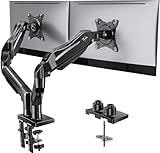
- Compatible with Wide Screens - To ensure compatibility with the dual monitor mount, your each monitor must meet three conditions at the same time: First, computer screens size range: 13 to 32 inches. Second, screen weight range: 4.4 to 19.8 lbs. Third, the back of the monitor screen must have VESA mounting holes with a pitch of 75x75mm or 100x100mm.
- Regarding the compatibility with desks - Your desk must meet three conditions at the same time: First, desk material: Only wooden desks are recommended, plastic or glass desks cannot be used. Second, desk thickness range: 0.59" - 3.54". Third, the bottom of the desk should not have any cross beams or panels, as this will interfere with installation. We recommend carefully checking that your desk and monitors meets all above conditions before purchasing.
- Dual C-Clamp Hold - Worried your dual monitors might wobble or slip? Our upgraded base uses a larger platform plus a dual C-clamp structure to lock the dual monitor arm firmly to your desk. Each arm safely keeps your screens steady while you type, click and game—no shaking, no sliding, just a clean and secure setup you can trust every day. It also provides Grommet Mounting installation choice, both options ensure stable and secure fixation for your 0.59" - 3.54" desk.
- Full-Motion Adjustment For Comfortable View - Pull the screen closer when you’re deep in a spreadsheet, push it back to watch videos, or rotate to portrait for coding — moving everything smoothly with just one hand. The monitor stand offers +85°/-50° tilt, ±90° swivel and 360° rotation. Raise your monitor up to 15.75″ to support a healthy sitting posture. Whether you’re working from home, gaming through the night, or switching between video calls and documents, getting the screens to your natural line of sight helps relieve neck, shoulder and back strain so you can stay focused longer with less fatigue.
- Keep Your Desk Organized: By lifting both screens off the desktop, this dual monitor stand opens up valuable space for your keyboard, notebook, docking station or a simple, clutter-free work area. Built-in cable management guides wires along the arms, keeping cords out of sight and out of the way. Enjoy a tidy, modern workstation that looks as good as it feels to use.
Can a game be AI-native if it also has scripted content?
Yes. AI-native describes dependence on generation for the central form of play, not the absence of authored dialogue, rules, or assets. A game can combine fixed material with a generative system that remains essential to its defining interactions.
Are Steam’s AI labels the same thing as a rating for a game?
The Steamworks categories described by Valve distinguish pre-generated from live-generated content for disclosure; they are not a universal rating of a game’s quality or degree of AI use. Platform rules can change, so developers should consult current Steamworks guidance when preparing a submission.
What’s actually slowing this PC down?
Pick the symptom - the matching free tool is one click away.
What is the difference between pre-generated and live-generated AI content?
Pre-generated content is created during development, then ships as fixed material players consume. Live-generated content is created with AI while the game is running. Live systems need additional explanation of their guardrails because outputs can vary from session to session.
Does a generated asset that players never see count?
Not as player-facing AI-generated content. An internal mood board, discarded prototype, or code suggestion may document AI use in production, but the strongest classification focuses on material that ships and is consumed by players or changes play at runtime.
What must a developer explain for live generation on Steam?
Valve’s Steamworks guidance asks developers to identify live-generated content and describe guardrails intended to prevent illegal content. Valve’s January 10, 2024 announcement also described output review and an in-game reporting system for illegal live-generated content.
What does Roblox require when players talk to a generative system?
Generative-AI integrations must follow Roblox Community Standards. Player interactions that trigger generative responses must be disclosed in the Content Maturity questionnaire. Extended chatbot-like interactions or cross-session memory require a Restricted label, and Roblox requires visible notices that the conversation is with AI.
The Tool Desk
Outbyte Driver Updater FREEFix the driver behind crashes, sound loss and screen glitchesFind Drivers →Outbyte PC Repair FREERepair Windows errors before they cause bigger problemsFix Now →Who is responsible for output from a third-party model on Roblox?
The developer remains responsible for outputs from third-party tools. Roblox-served generation is moderated, but connecting an external model does not transfer the developer’s responsibility for complying with platform standards.
Can a game use AI for localization or code and still be described as conventional?
Yes. Localization drafts, code suggestions, test generation, and balancing assistance can improve production without changing the player-facing game. The description should identify those uses rather than implying that the game’s content or core loop is generated.
The Bottom Line
Call a game AI-generated when generative AI materially creates content players consume. Name whether that content is fixed before release or generated live, describe what players see, and apply the core-loop test: if replacing the model with authored material would fundamentally change play, AI-native is the most accurate description. Steam and Roblox disclosures add practical requirements for transparency, moderation, guardrails, and reporting, but neither label proves that an entire game was made by AI.
Quick Recap
Product prices and availability are accurate as of the date/time indicated and are subject to change. Any price and availability information displayed on Amazon at the time of purchase will apply.

