
Psychological horror works when a game makes danger emotionally meaningful, then withholds enough information to keep the player predicting. Fear establishes what could be lost. Uncertainty prevents the player from settling on a reliable explanation or forecast. Tension is the sustained pressure created while those predictions remain active but incomplete.
The threat can be a monster, a hostile environment, a damaged memory, a moral choice, social betrayal, or the possibility that the player’s own interpretation is wrong. Gore and jump scares may intensify a scene, but they are not the foundation. A psychological-horror game stays disturbing because the player cares about the outcome and cannot confidently determine what is happening, what will happen next, or whether the apparent danger is real.
As an Amazon Associate I earn from qualifying purchases.
The core mechanism: meaningful fear plus active prediction
Horror responses involve threat, fear, anxiety, disgust and anticipation. These reactions become dramatically useful only when the audience has something meaningful at stake. A nameless warning on a screen is information; a warning that may cost a vulnerable character their identity, safety or ability to protect someone is a threat.
The Tool Desk
Outbyte Driver Updater FREEScan for outdated or missing drivers - takes under a minuteDriver Scan →Outbyte PC Repair FREERepair Windows errors before they cause bigger problemsFix Now →Tension begins when the player’s current understanding conflicts with incoming signals. The player forms a prediction, receives incomplete or contradictory evidence, and updates the prediction without reaching certainty. Lehne and Koelsch describe this process as follows: “According to this model, tension experiences originate from states of conflict, instability, dissonance, or uncertainty that trigger predictive processes directed at future events of emotional significance.” In a game, every sound, animation, locked door and control response can feed that process.
#1 Best Overall

- BLUE LIGHT BLOCKING GLASSES: Our blue light glasses for women boast UV400 protection, blocking harmful blue rays from computer screens. With these bluelight glasses women, you can enjoy gaming, reading, or watching TV with no worries of eye strain.
- EYE RELIEF: Our blue light glasses are engineered to reduce blurry vision or strain caused by prolonged screen time. These womens blue light glasses aid in better sleep by preventing blue light from disrupting your natural sleep cycle, helping you fall asleep faster and enjoy a more restful night's sleep, making them the perfect christmas present.
- COMFORTABLE: Crafted from durable material, our trendy blue light glasses for woman or blue light glasses men ensure long-lasting comfort. The high-transmittance lenses accessories, gamer gifts for men, help keep your eyes relaxed. Perfect stocking stuffers, gifts for gamers men, christmas gifts for men, halloween costumes.
- LIGHTWEIGHT: These clear blue light glasses feature a lightweight frame, meaning they’ll stay comfy for long-term wear. Perfect as blue blockers glasses for women or mens blue light glasses, these non-prescription fake glasses for men can be worn throughout the day. The blue light blocking glasses women feature polycarbonate HD lenses, which are anti-reflective and restore true color.
- WORRY-FREE PURCHASE: If you experience any issues, our support team is ready to assist you quickly. These are the perfect costume glasses for cosplay dressing up.
Suspense is the time-shaped version of the same mechanism. A 2019 review describes it as “the build up to threat, the tension created prior to the manifestation of threat, and the resolution/elimination of threat.” The player anticipates consequences before the threat fully appears. If the danger is resolved, the accumulated negative emotion can turn into relief or enjoyment. If distress continues without a satisfying movement or answer, the result can become fatigue or dysphoria rather than productive fear.
How the three elements interact
- Fear answers “Why should I care?” The player expects harm to a person, relationship, body, memory, moral identity or ability to act.
- Uncertainty answers “What do I not know?” The source, rules, timing, reality or consequences of the threat remain unsettled.
- Tension answers “What happens while I wait?” The player keeps testing predictions, scanning the environment and anticipating a consequential change.
Remove meaningful stakes and uncertainty becomes a puzzle with no emotional cost. Remove uncertainty and fear can become a routine combat encounter. Remove the time and prediction between them and there is little tension—only a sudden shock.
Why interactivity changes psychological horror
Games add a pressure that films and books cannot reproduce in exactly the same way: the player must choose, move, aim, wait or refuse to act. That agency creates a conflict between what the player wants to do and what the game allows. A narrow corridor, unreliable map or delayed response is frightening because the player is responsible for navigating it, yet cannot fully trust the information supplied by the game.
Outdated Drivers Are Slowing You Down
One free scan finds every outdated or missing driver and matches the right update for your exact hardware.Free scan · exact hardware matchPC Slower Than It Used to Be?
A free scan shows the junk files, broken settings and background clutter dragging Windows down - then fixes them in one click.Free scan · Windows 10 & 11Interactive systems also produce feedback loops. A sound may occur only after the player opens a particular door; a character’s memory may change after a choice; a familiar room may be rearranged when revisited. The player then has to decide whether the change is a deliberate rule, a hallucination, an enemy action or a mistake in perception. The uncertainty is not merely narrated. It is experienced through action and observation.
Player knowledge and character knowledge
Designers can create tension by giving the player more information than the character, less information than the character, or information that conflicts with the character’s account. Each arrangement produces a different pressure:
Rank #2

- WINDEX GAMING WIPES: effortlessly clean all your gaming gear and gaming electronics in one easy step with our new Windex Gaming Wipes
- AMMONIA FREE: our ammonia-free formula is safe to use on all of your favorite gaming equipment like consoles, headsets, controllers, screens, keyboards, and more
- PRE-MOISTENED WIPES: each wipe instantly removes dust, dirt, and stubborn smudges and fingerprints leaving a streak-free shine
- ANTI-STATIC: great for cleaning and wiping down your gaming gear and electronics leaving behind no visible residue
- COMPACT RESEALABLE PACKAGE: store your pack of Windex Gaming Wipes anywhere in your home for whenever a quick and easy wipedown is needed
- Player knows more: You see a movement behind the character while the character continues searching. The tension comes from waiting for recognition and deciding whether intervention is possible.
- Player knows less: The character reacts to a sound or memory the player cannot access. The player must infer the stakes from behavior, level design and partial dialogue.
- Accounts conflict: A recording, interface prompt and character statement disagree. The player must choose which source to trust, if any.
Because the player’s input matters, psychological horror should not treat agency as a promise that every problem is solvable. Agency can mean choosing which uncertainty to pursue, whom to believe, when to retreat or what evidence to sacrifice.
Give uncertainty an emotional object
An effective horror question is concrete and consequential. “Is the voice real?” matters more when the voice may be a missing family member, a symptom of memory loss or an instruction that could endanger someone. “Who controls the house?” matters when leaving requires trusting the person who claims to be helping. Suspense depends on threatened outcomes, not on withholding trivia.
Sources of psychological proximity
- Bodily danger: The player may be injured, contaminated or physically transformed.
- Identity: The character’s name, memories, personality or authorship of an action may be uncertain.
- Memory and perception: A scene may be recalled incorrectly, edited by an outside force or filtered through an unreliable viewpoint.
- Morality: The player may not know whether a choice protects a person or causes hidden harm.
- Social betrayal: A companion, institution or apparent ally may be manipulating the player.
- Loss of agency: Controls, objectives or familiar rules may stop behaving as expected.
Choose one primary emotional object and let the mechanics reinforce it. If the story is about memory, repeated spaces and altered records can carry more weight than a parade of unrelated enemies. If it is about betrayal, friendly dialogue that quietly changes the player’s options is more unsettling than a random attack.
Use the four dimensions of uncertainty
Suspense research identifies four questions a work can withhold: what will happen, how it will happen, when it will happen, and whether it will happen at all. Psychological-horror games become more durable when they vary these dimensions instead of repeating one mystery.
| Uncertainty dimension | What the player may know | How a game can apply it |
|---|---|---|
| What | An event is expected, but its outcome is unknown. | Show that a character is being followed while withholding who—or what—is following. |
| How | The danger is identified, but its mechanism or rules are unclear. | Reveal an entity’s presence while making its triggers, boundaries or effects inconsistent enough to require investigation. |
| When | The event or attack is certain, but its timing is not. | Establish a consequence that will occur during the next task without giving a countdown or predictable cue. |
| Whether | The player cannot establish if the threat is real, imagined or conditional. | Present evidence that supports both a supernatural explanation and a psychologically grounded one, then make each explanation alter the player’s choices. |
Changing the question prevents the player from becoming comfortable with a single investigative routine. A game might first ask whether a voice is real, then reveal that it is real while withholding how it enters the building, and later make the timing of its next appearance the central concern. The answer should create a changed question rather than erase uncertainty altogether.
Rank #3

- Ergonomic & Adjustable Design: Fight "text neck" and improve your posture. Designed for comfort, it offers an adjustable height (7.1in-8.5in) (1.4in adjustable range) and angle (5°-85°) Please note: cell phone stand is only 9 inches tall—the length of a standard pencil
- Without blocking subtitles Perfect for office desk Tiktok Face Time Zoom video—this is the ultimate kitchen desk essential for phones! Perfect viewing experience while reducing neck back strain, A must-have for gamers streamers desk, and anyone who values both style and support!
- Sleek & Stable Design fits Otterbox Case: Say goodbye to bent cables, tangles, and tip-overs! LISEN’s stylish adjustable desk phone holder features a built-in charging hole and smart cable management, keeping your phone secure and your workspace clutter-free cool gadgets for men
- ANTI-SLIP DESIGN free hands: The under 10.00 items easy gadgets back and the bottom of this kitchen essentials for women are fully covered by anti-skid silicone, which LISEN stand up desk decor can provide maximum protection device from any scratches and slides
- Your Perfect Viewing Companion:If your product arrives damaged or breaks within 365 days, reach out to LISEN for a quick and hassle-free solution. Struggling with assembly, like tightening the screw? We’ve got your back! Your experience matters to us. (Product including: phone Holder stand*1, screw*1, hexagon screwdriver*1, specification*1)
Ambiguity can frighten before a threat appears
A visible monster is not required to produce a threat response. In the Underwood Project, participants explored a naturalistic virtual environment with no concrete, predictable threat. Ambiguous environmental cues nevertheless produced experiences described as creepy and unpredictable, while subjective and physiological responses changed with those cues.
The lesson for level design is to make ordinary signals slightly difficult to classify. A distant shape can be too large to identify but too still to dismiss. A light can flicker in a pattern that resembles a signal without confirming one. A familiar room can contain a small discrepancy—a chair turned toward the wall, a family photograph with one face missing—that the player notices before understanding its relevance.
Rules for productive ambiguity
- Anchor the cue in a recognizable space. The player needs a baseline before a deviation feels meaningful.
- Repeat with variation. A cue that changes each time invites interpretation; an identical loop becomes decoration.
- Give the player a reason to inspect. A sound near an objective or a changed object in a safe room creates a decision rather than background noise.
- Pay off some interpretations. If every clue is permanently meaningless, players stop predicting and start ignoring.
Destabilize the player’s working model
Players constantly build a model of how a game behaves: which sounds indicate danger, which doors are safe, whether a companion tells the truth, and how far an enemy can reach. Tension rises when new evidence conflicts with that model and forces an update.
Contradictory evidence
Place two credible signals in opposition. A security monitor shows an empty hallway while footsteps approach from that direction. A character insists that a room has never existed, although the player has already entered it. Neither signal should be dismissed immediately; the player must test which rule is changing.
Unreliable perception
Alter perception in ways the player can observe and compare. Text can change between readings, a sound can originate from a location that the spatial mix contradicts, or an objective can be rewritten after the player completes it. The effect is strongest when the player can distinguish a deliberate pattern from a technical error.
Quick wins for a faster PC:
Scan for outdated or missing drivers - takes under a minuteDriver Scan →Clear out junk files and repair common Windows errorsFree Scan →Rank #4

- Easy Installation: Our gaming lights have been designed to enhance your entertainment experience. Simply position the led light bar next to your TV or game console to create a game room environment with ease. They come with USB power and a 60 inch cord for direct mounting and mobility
- Audio Syncing & Extensive Mode: The built-in high-sensitivity music sensor allows you to sync the TV led lights to your favorite music. Lights react and move to the beat of music, film and game audio, creating an incredible immersive sound and light experience – and all without the need for an additional hub. You can choose from 64+ patterns, including strobe, illusion, jump, energy, gradient, running, chasing, fluttering mode etc. Each mode can be applied to different scenes
- 64+ Chasing IC+RGB & W Effect: The independent control design of IC+RGB and white all-in-one multifunctional rgbw led bar lights monitor backlight allows you to easily switch the led lights for desk between IC+RGB and white to enjoy a variety of lighting effects, you can choose white lighting mode with high brightness for better illumination when working, etc. Choose IC+RGB lighting mode when you need to create an entertaining atmosphere for the light show, 16 million colours of Color changing rgb light bar let you dance to the beat and create a dynamic party atmosphere
- Dynamic and Dimmable Lights: 1%-full brightness free brightness adjustment gives you the flexibility to adjust dimmable led light bar for room decorations or a variety of occasions
- USB Powered: USB light bars for room can be powered by powernank, usb charger, TV, Monitor, laptop PC mainframe, making behind TV led lighting bar easy to install in any location.TV led lights are powered by the TV usb interface / PC mainframe, can be turned on/off synchronously with TV / PC
Unstable identity and memory
Let the player’s uncertainty affect relationships and choices. A companion’s name may be missing from records, a remembered event may have two mutually exclusive versions, or the protagonist may react to an object before the player receives its context. The question is not only “What happened?” but “Whose account am I inhabiting?”
Social mistrust
Characters should have understandable reasons to conceal information. A lie that protects someone, preserves an institution or avoids panic is more disturbing than a random betrayal because the player can predict the motive while still rejecting the choice. Give the player evidence that supports both trust and suspicion, then make acting on either option costly.
Independent reader supportYour contribution helps us test, update, and keep practical guides available for everyone.Build a threat rhythm: delay, variation and resolution
Threat buildup gives prediction time to accumulate. If every warning is followed immediately by an attack, the player learns that the warning is a timer and the emotional range narrows. Delay can be spatial, temporal or interpretive: the player may reach the room, wait through a quiet interval, or discover that the warning referred to a different danger.
Variation keeps the player from reducing the experience to a formula. Change the source of a cue, the apparent rule it follows or the consequence of responding to it. A sound that once meant an enemy was nearby might later indicate that an ally has entered the area—or that the player has already been seen.
Recommended Free Tools
Resolution is not synonymous with a full explanation. A threat can be eliminated, recontextualized, temporarily contained or converted into a new uncertainty. The important requirement is movement. A partial answer should close one prediction while opening another, giving the player relief without making the world fully safe.
Best Value
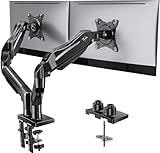
- Compatible with Wide Screens - To ensure compatibility with the dual monitor mount, your each monitor must meet three conditions at the same time: First, computer screens size range: 13 to 32 inches. Second, screen weight range: 4.4 to 19.8 lbs. Third, the back of the monitor screen must have VESA mounting holes with a pitch of 75x75mm or 100x100mm.
- Regarding the compatibility with desks - Your desk must meet three conditions at the same time: First, desk material: Only wooden desks are recommended, plastic or glass desks cannot be used. Second, desk thickness range: 0.59" - 3.54". Third, the bottom of the desk should not have any cross beams or panels, as this will interfere with installation. We recommend carefully checking that your desk and monitors meets all above conditions before purchasing.
- Dual C-Clamp Hold - Worried your dual monitors might wobble or slip? Our upgraded base uses a larger platform plus a dual C-clamp structure to lock the dual monitor arm firmly to your desk. Each arm safely keeps your screens steady while you type, click and game—no shaking, no sliding, just a clean and secure setup you can trust every day. It also provides Grommet Mounting installation choice, both options ensure stable and secure fixation for your 0.59" - 3.54" desk.
- Full-Motion Adjustment For Comfortable View - Pull the screen closer when you’re deep in a spreadsheet, push it back to watch videos, or rotate to portrait for coding — moving everything smoothly with just one hand. The monitor stand offers +85°/-50° tilt, ±90° swivel and 360° rotation. Raise your monitor up to 15.75″ to support a healthy sitting posture. Whether you’re working from home, gaming through the night, or switching between video calls and documents, getting the screens to your natural line of sight helps relieve neck, shoulder and back strain so you can stay focused longer with less fatigue.
- Keep Your Desk Organized: By lifting both screens off the desktop, this dual monitor stand opens up valuable space for your keyboard, notebook, docking station or a simple, clutter-free work area. Built-in cable management guides wires along the arms, keeping cords out of sight and out of the way. Enjoy a tidy, modern workstation that looks as good as it feels to use.
When unresolved tension fails
Indefinite withholding can turn suspense into frustration. Players need evidence that investigation changes their position, even if it does not immediately reveal the truth. New access, altered behavior, a reliable contradiction or a meaningful cost can all signal progress. If negative affect remains high while the player receives no interpretive or mechanical movement, the experience may become dysphoric rather than compelling.
Calibrate intensity instead of maximizing fear
Predictive-processing research proposes a “sweet spot” in which fear and fun coexist. The player recognizes enough safety to continue voluntarily while still expecting a meaningful disruption. The ideal level differs by person, stimulus, culture and medium; a 2019 review notes heterogeneous stimuli, methodological disparities, small samples and limited cross-cultural evidence. There is no universal fear meter.
Signals that intensity is too low
- The player can explain every cue before it matters.
- Safe rooms, checkpoints or inventory systems remove all meaningful risk.
- The same scare repeats without changing the player’s decisions.
Signals that intensity is too high
- The player cannot form a workable model of the rules.
- Setbacks erase progress without warning or recoverable choices.
- Audio, visual distortion or pursuit pressure stays extreme long enough to prevent observation.
Use quiet intervals as active prediction time rather than empty downtime. A pause lets the player inspect evidence, rehearse possibilities and notice that the rules have shifted. Accessibility options such as subtitle controls, reduced flashing, adjustable audio and alternate difficulty can preserve the psychological structure while reducing avoidable sensory overload.
Medium-specific technique: movement and uncanny enemies
In first-person PC horror, an IEEE conference study reported that uncanny-valley enemy appearances and outflanking movement behavior induced fear and tension in experimental play. An enemy that looks almost human but violates facial or bodily expectations can destabilize the player’s category judgments. An enemy that circles or approaches from outside the player’s current view turns spatial awareness into a prediction problem.
This finding is medium-specific, not a universal recipe for novels, films or every game. Apply it carefully: the movement must be readable enough for the player to infer a changing threat, while the appearance or path must resist complete classification. If the enemy simply teleports or ignores collision rules, the player may blame the system instead of feeling psychological disturbance.
A practical design workflow
- Define the emotional loss. Write one sentence describing what the player fears losing: a person, identity, memory, moral certainty or control.
- Choose the central question. Frame it as “Is…?”, “Who…?”, “How…?”, “When…?” or “Will…?” and connect it directly to the emotional loss.
- Establish a baseline. Teach the player how a familiar room, interface, companion or sound normally behaves.
- Introduce an ambiguous deviation. Change one element while leaving at least two plausible explanations.
- Let the player test a prediction. Provide an action—revisiting a room, comparing records, following a sound or trusting a character—that produces evidence.
- Contradict the working model. Confirm one part of the player’s theory while violating another part.
- Rotate uncertainty types. Move from what to how, when or whether so the player cannot rely on one solution pattern.
- Escalate consequences, not only volume. Make an interpretation affect access, relationships, resources or identity.
- Deliver a partial resolution. Close a major prediction, then introduce the next decision or uncertainty.
- Test the fear-and-fun range. Observe where players stop exploring, stop believing the rules or stop caring about the outcome, and adjust timing, clarity or consequence.
How to evaluate two psychological-horror games
Use the same questions for both works instead of judging them by the number of scares. The following axes describe how each game manages prediction and emotional proximity.
| Comparison axis | Questions to ask |
|---|---|
| Threat legibility | Is the danger clearly identified, partially inferred or radically ambiguous? |
| Uncertainty type | Does the game withhold what, how, when, whether—or rotate among them? |
| Psychological proximity | Is fear tied to bodily danger, identity, memory, morality, social betrayal or loss of agency? |
| Prediction rhythm | How often does the game confirm, revise or violate the player’s expectations? |
| Resolution pattern | Does it resolve the threat, reframe it, leave it open or convert it into a new uncertainty? |
| Intensity control | Does the game maintain a tolerable fear-and-fun range, or does distress overstay its useful duration? |
Why psychological horror can feel scarier than gore
Gore shows an outcome; psychological horror makes the player anticipate an outcome and question its meaning. A graphic image may be shocking once, but an uncertain rule can occupy attention across an entire level. The player imagines possibilities, searches for confirming evidence and rehearses decisions before anything visibly happens.
Do these 3 things before closing this tab:
1Repair Windows errors before they cause bigger problems2Scan for outdated or missing drivers - takes under a minute3Clear out junk files and repair common Windows errorsThat process also personalizes the fear. The game supplies signals, but the player’s own predictions fill the gaps. When the player cannot determine whether a perception is trustworthy, whether a companion is safe or whether a choice has already caused harm, the threat continues outside the moment of spectacle. Gore can be part of that system, but it is the emotional stakes and unstable prediction that make the horror psychologically disturbing.
Quick Recap
Product prices and availability are accurate as of the date/time indicated and are subject to change. Any price and availability information displayed on Amazon at the time of purchase will apply.

