There is no well-supported, universally accepted answer to “What was the first 60fps game?” A 60Hz display, 60 gameplay updates per second and 60 distinct rendered frames per second are different things—and early games often generated their images in ways that do not map neatly to modern frame-rate terminology. Pong is a plausible early commercial example of 60Hz-style arcade motion, but the evidence does not establish it as the first game to produce 60 unique frames per second.
Why “60fps” is hard to apply to early games
In modern game discussions, 60fps usually means that a game produces 60 distinct frames each second. That definition is not interchangeable with a display’s refresh rate or a game’s update rate:
- Display refresh rate: how often a display’s scan or refresh cycle repeats. A 60Hz display can repeat that cycle about 60 times per second, but this alone does not prove the game supplies a different image on every refresh.
- Gameplay update rate: how often the game’s state changes. The update cadence can differ from the display cadence.
- Rendered frame rate: the number of distinct frames produced each second in the modern sense. For early systems that drew directly through display circuitry—or used vector or oscilloscope displays—a completed software-rendered frame may not be a meaningful unit of comparison.
So a historical claim that a game “ran at 60” needs to specify what was measured. A 60Hz-style display signal is not, on its own, proof of 60 unique gameplay images per second.
Which early games are part of the conversation?
The answer changes with the scope of “game.” These milestones establish when notable early games existed or appeared; their dates do not establish a 60fps cadence.
Recommended Free Tools
#1 Best Overall

- 【INTEGRATED SPEAKERS】Whether you're at work or in the midst of an intense gaming session, our built-in speakers provide rich and seamless audio, all while keeping your desk clutter-free.
- 【EASY ON THE EYES】 Protect your eyes and enhance your comfort with Blue-Light Shift technology. This feature reduces harmful blue light emissions from your screen, helping to alleviate eye strain during long hours of use and promoting healthier viewing habits.
- 【WIDEN YOUR PERSPECTIVE】Our sleek minimal bezel design ensures undivided attention. The nearly bezel-free display seamlessly connects in a dual monitor arrangement, delivering an unobstructed view that lets you focus on more at once, completely distraction-free.
| Game or system | Historical milestone | What the milestone does—and does not—show |
|---|---|---|
| Tennis for Two | 1958 | APS News’ 2008 historical account discusses it as an early video-game milestone. Its oscilloscope display does not establish modern 60fps. |
| Spacewar! | 1961 | The Computer History Museum dates Steve Russell’s first version to 1961 and describes it as one of the earliest video games for a digital computer. That is chronological evidence, not a frame-rate measurement. |
| Brown Box prototype | 1967–68 | The Smithsonian describes Ralph Baer and colleagues’ prototype as a multiplayer, multiprogram video-game system. It provides home-game development context, not evidence of a 60fps first. |
| Galaxy Game | September 1971 | Guinness World Records identifies it as the first coin-operated arcade videogame, unveiled at Stanford. This is an arcade-history distinction, not a frame-rate certification. |
| Computer Space | Two months after Galaxy Game in 1971 | Guinness calls it the first commercially available coin-operated game. “First commercially available” is distinct from Galaxy Game’s earlier coin-operated debut—and neither claim determines frame rate. |
| Pong | 1972 | Often cited as an early commercial arcade example associated with 60Hz-style motion. The sources available here do not establish it as the first title to produce 60 distinct frames per second. |
Was Pong the first 60fps game?
Pong is a reasonable answer if the question is using “60fps” loosely to mean an early commercial arcade game associated with 60Hz-style motion. It is not a substantiated answer if the claim is that Pong was definitively the first game to generate 60 distinct frames per second. The evidence does not verify that per-game cadence, and the meaning of a “frame” is not consistent across early display technologies.
It is also important not to conflate Pong with separate historical firsts. Galaxy Game is recorded as the first coin-operated arcade videogame, while Computer Space is identified as the first commercially available coin-op. Neither milestone establishes that either game was the first 60fps title.
Rank #2

- QHD Resolution (2560 x 1440) has 1.7 times the pixel density of Full HD for incredibly detailed pinsharp images
- HDR10 provides brighter highlights and nuanced shadow for added depth - making every scene feel more vivid and realistic
- The 180Hz refresh rate minimizes lag for gameplay with ultra-smooth action. Plus, the 1ms response time helps capture your moves in real-time, allowing you to react fast for gaming precision
- AMD FreeSync reduces choppiness, screen lag and image tearing, ensuring that your fast-paced, complex in-game action is stable with minimal stutter
- Ergonomic stand allows for tilt, pivot and height adjustments to maximize gaming comfort
What can be stated with confidence?
- There is no demonstrated universal first under the modern meaning of 60 unique rendered frames per second.
- Early milestones such as Tennis for Two, Spacewar!, Galaxy Game and Computer Space establish historical context, not an FPS record.
- Pong can be described cautiously as an early commercial example associated with 60Hz-style arcade motion, but not as a proven first 60fps game.
For a technically meaningful “first,” a claim would need to define the display technology and whether “60” refers to display refresh, gameplay updates or distinct images, then provide evidence of that game’s actual cadence. The historical records cited here establish dates and categories, not that performance measurement.
Quick Recap
Best Value

- 1800R curve monitor the curved display delivers a revolutionary visual experience with a leading 1800R screen curvature as the images appear to wrap around you for an in depth, immersive experience
- Hdmi, VGA & PC audio in ports
- High refresh rate 75Hz.Brightness (cd/m²):250 cd/m2
- Vesa wall mount ready; Lamp Life: 30,000+ Hours
- Windows 10 Sceptre Monitors are fully compatible with Windows 10, the most recent operating System available on PCs.Brightness: 220 cd/M2
Rank #4

- 27” 240Hz 1500R Curved FHD 1080P Gaming Monitor for Game Play.
- Prioritizes Gaming Performance: Up to 240Hz high refresh rate, more immersive 1500R Curvature, FreeSync, MPRT 1ms Response Time, Black Level adjustment(shadow booster), Game Modes Preset, Crosshair.
- Cinematic Color Accuracy: 130% sRGB & DCI-P3 95% color gamut, 4000:1 contrast ratio, 300nits brightness, HDR, Anti-flicker; Anti-Glare.
- Plug & Play Design: HDMI & DP1.4 & Audio Jack(No built-in speakers), durable metal stand, tilt -5°~15, VESA 100*100mm compatible.
- Warranty: Money-back and free replacement within 30 days, 1-year quality warranty and lifetime technical support. Pls contact SANSUI service support first if any product problem.
Rank #3
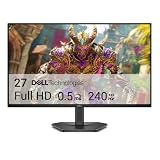
- Smooth motion: 240Hz refresh rate and fast 0.5ms response time provide crisp visuals and fluid movement with less input lag.
- Seamless gaming: FreeSync Premium and HDMI VRR eliminate tearing for smooth, responsive PC and console gameplay.
- Fast IPS: Faster 0.5ms response with excellent color accuracy across wide IPS viewing angles.
- Rich color: 99% sRGB color coverage delivers vivid, detailed imagery with strong accuracy.
- Eye comfort: TÜV Rheinland 3‑star certified display lowers blue light while preserving color quality.
Sources
- APS News: Tennis for Two historical account
- Computer History Museum: Spacewar!
- Smithsonian National Museum of American History: Brown Box prototype
- Guinness World Records: first coin-operated arcade videogame
Product prices and availability are accurate as of the date/time indicated and are subject to change. Any price and availability information displayed on Amazon at the time of purchase will apply.